
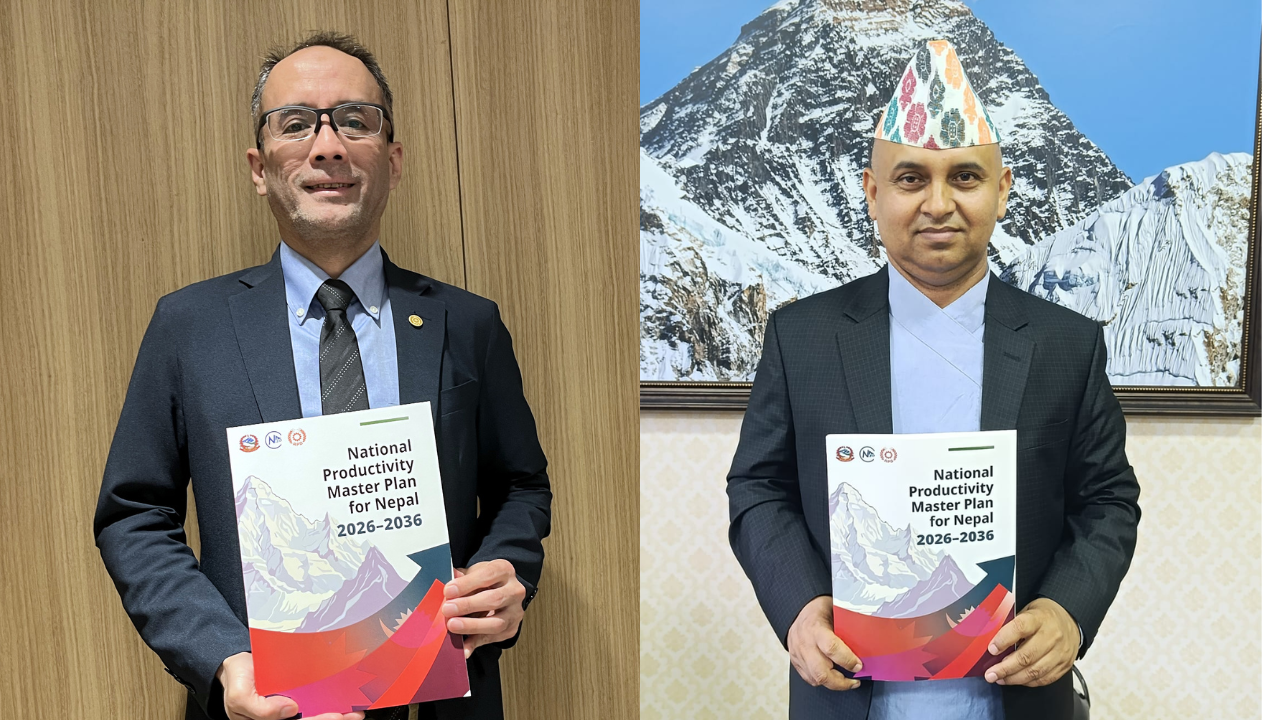
APO Secretary-General Dr. Indra Pradana Singawinata (left) and APO Director for Nepal Krishna Bahadur Raut, Secretary of the Ministry of Industry, Commerce and Supplies, pose with the National Productivity Master Plan for Nepal 2026-2036 following its completion.
TOKYO, July 15, 2026 (GLOBE NEWSWIRE) -- On 14 July 2026, the Asian Productivity Organization (APO) formally handed over the National Productivity Master Plan for Nepal 2026-2036 to the Government of Nepal during an online ceremony jointly organized with the National Productivity and Economic Development Centre (NPEDC) and the Ministry of Industry, Commerce, and Supplies. The handover marks a significant milestone in Nepal's efforts to place productivity at the heart of national development and strengthen its long-term competitiveness as it transitions from least developed country status.
The 10-year master plan provides Nepal's first comprehensive roadmap for systematically raising productivity across the economy through coordinated reforms, strategic investments, and stronger institutional collaboration. Aligned with Nepal's Sixteenth Plan and Smooth Transition Strategy, it translates national policy priorities into an implementation-oriented agenda supported by clear institutional responsibilities, implementation sequencing, monitoring and evaluation, and a national productivity scorecard.
Covering 2026-36, the master plan identifies the structural constraints limiting productivity growth, including infrastructure bottlenecks, logistical inefficiencies, skill mismatches, limited innovation, financing constraints, policy uncertainty, and uneven technology adoption. It proposes integrated solutions under four strategic goals: improving the business-enabling environment, accelerating innovation-led modernization, building competitiveness and economic complexity, and increasing productivity through climate resilience and inclusion.
"Nepal has an opportunity to demonstrate that productivity is not merely a technocratic exercise but a national pathway to stronger competitiveness, greater economic resilience, and shared prosperity. By translating this master plan into concrete action, Nepal can build a more productive, innovative, and inclusive future for generations to come," said APO Secretary-General Dr. Indra Pradana Singawinata, emphasizing that productivity is fundamental to achieving sustainable economic transformation.
In his remarks, the APO Director for Nepal and Secretary of the Ministry of Industry, Commerce and Supplies, Krishna Bahadur Raut, reaffirmed the Government of Nepal's strong commitment to implement the master plan: "The Government of Nepal views this document not merely as a report to be archived but as an agenda for national economic reform. We are fully committed to institutionalizing these recommendations given here. The Ministry, alongside the NPEDC, will spearhead the coordination, cross-governmental collaboration, and monitoring mechanisms required to bring these strategic thrusts to life."
Unlike many strategic documents, the master plan provides a practical implementation pathway that sequences reforms from establishing institutional and policy foundations to scaling successful initiatives and ultimately mainstreaming productivity-enhancing measures through federal, provincial, and local government systems. The framework also establishes mechanisms for monitoring progress, strengthening accountability, and supporting evidence-based policy adjustments throughout implementation.
The APO developed the master plan in close collaboration with the Government of Nepal, with technical support from DevTech Systems Inc. through analytical research, international benchmarking, and stakeholder consultations. The APO remains committed to supporting Nepal during implementation by sharing international experience, strengthening institutional capacity, and promoting continuous learning in productivity policy and practice.
The handover of the master plan marks the beginning of Nepal's long-term productivity transformation. Through sustained implementation, strong institutional coordination, and continued public-private collaboration, the master plan is expected to strengthen competitiveness, improve enterprise performance, generate higher-quality employment, and enhance the well-being of the Nepalese people over the coming decade.
About the APO
The APO is a regional intergovernmental organization dedicated to improving productivity in the Asia-Pacific region through mutual cooperation. Established in 1961, the APO supports its member economies through policy advisory services, capacity building, and knowledge sharing to promote sustainable socioeconomic development.
Contact: pr@apo-tokyo.org
Website: https://www.apo-tokyo.org
A photo accompanying this announcement is available at https://www.globenewswire.com/NewsRoom/AttachmentNg/4a8a1317-bb87-44ff-a4a7-8957ccc88352

