


Vancouver, British Columbia--(Newsfile Corp. - October 22, 2026) - TinOne Resources Inc. (TSXV: TORC) (FSE: 57Z0) ("TinOne" or the "Company") is pleased to announce plans for upcoming work programs at its 100%-owned Aberfoyle, Royal George and Great Pyramid projects, located in Tasmania, Australia.
Planned Program Highlights:
Vacuum or sonic drilling and metallurgical test work will evaluate tungsten and tin grades and recovery potential across legacy tailings at the Aberfoyle Project.
RC Drilling will target high-grade mineralization in the upper levels of the historic Aberfoyle Mine at Rossarden, in addition to testing for additional mineralization peripheral to the main veins within the known, 60 metre wide, mineralized envelope.
Shallow RC drilling planned at the Royal George prospect (part of the Aberfoyle Project) will target the historic mine to assess the grade, continuity and extent of tin and tungsten mineralization, with the potential to identify additional mineralized zones.
Diamond drilling at the Great Pyramid deposit will target near-surface tin mineralization across the deposit, with core samples supporting metallurgical test work to evaluate tin recovery potential.
Fully approved and ready to commence: All proposed RC and diamond drilling work programs have received regulatory approval, and drill rigs are secured with drilling set to commence in November. Legacy tailings work programs have been submitted and approval by the regulator is anticipated by year end.
"Tin and Tungsten are increasingly recognized as critical, high-value commodities, and TinOne is one of the few companies with exposure to these strategically important metals in an established mining jurisdiction," commented Rob Curtis, CEO and Director. "Our drilling program is designed to unlock value across TinOne's highly prospective Tasmanian portfolio by building on the historical exploration success at Great Pyramid and testing potential to recover tin and tungsten from Aberfoyle's legacy tailing, as well as confirm and expand the extent of the mineralized footprint at Royal George. We are aiming to identify multiple pathways to value creation across these assets and with drilling set to commence in November, we look forward to delivering results that will help define the scale and potential of these projects."
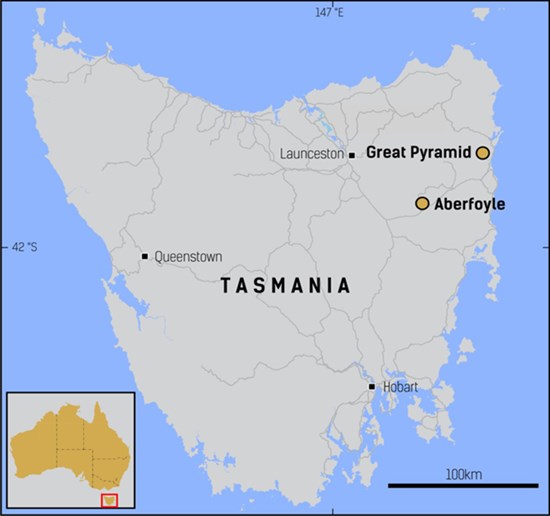
Figure 1: Location of the Company's projects in the mining friendly jurisdiction of Tasmania
To view an enhanced version of this graphic, please visit:
https://images.newsfilecorp.com/files/10969/320311_d097232b549e5b46_001full.jpg
Aberfoyle Tailings Project
Significant volumes of both coarse and fine tailings material rejected during ore beneficiation at both the historic Storeys Creek tungsten-tin mine and the Aberfoyle tin-tungsten mine are present on the Aberfoyle project (EL27/2004). Proposals to retreat the tailings, which contain both tin and tungsten, were investigated in the late 1970s and again in the 1980s, however the depressed tin and tungsten prices at the time, combined with the closure of both mines, prevented retreatment. Current strong pricing for tin and tungsten provides a clear incentive to further assess the retreatment potential. The company proposes a program of vacuum or sonic drill sampling of the tailings dumps and dams and carrying out further metallurgical test work. A summary of the material available is included below.
Aberfoyle material
Fine tailings
Located in 5 slime dams capped with clay material
Historical estimate of 198,000 dry tonnes at 0.39% tin (Sn) and 0.35% tungstate (WO3)1
Classified as Indicated Ore Reserve1
Metallurgical test work indicated recoveries of 40%1
The historical estimate was reported in 1985 by the then tenement holder of Exploration Licence 59/1983, Wheal Lutwyche Pty Ltd, in their annual report1. The estimate was based on the following work:
In 1977 the operator of the Aberfoyle Tin Mine carried out a program of sampling using 6.4cm diameter screw auger holes on a 20 x 20 metre grid across all dams2. Volume measurements were made by assigning triangular prisms to each set of three auger holes. The depths of the three holes at the corner of each prism were averaged and the volume calculated by the conventional formula. Bulked samples were sent to Aberfoyle Limited's Luina Tin Mine for sizing, analysis for tin, moisture content assessment and bulk density assessment.
A second program was recommended and carried out in April 1978, Aberfoyle Limited mine staff2. In this program, two intersecting lines of auger holes spaced 20 metres apart were drilled into three of the dams and one single line of holes were drilled across the two remaining dams.
In 1985, Wheal Lutwyche Pty Ltd reported drilling an additional 30 infill holes into the fine tailings dams and estimated an Indicated Ore Reserve of 198,000 tonnes at 0.39% tin and 0.35% tungstate, using a combination of their data and the earlier Aberfoyle Limited data1.
This historical estimate was made under the JORC Guidelines (1972-1989) before the formal JORC Code was made mandatory in Australia. The equivalent CIM terminology is Probable Mineral Reserve. There are no extant details of the methodology used to make the historical estimate.
The issuer proposes to carry out an initial program of vacuum or sonic drilling across all tailings dams on a 20 x 20 metre grid to collect samples for metallurgical test work and to enable a resource estimate under NI43-101. The issuer is confident that sufficient work has been carried out by the operator of the Aberfoyle Tin Mine and the subsequent tenement holder to warrant disclosure, with the following caveats:
A qualified person has not done sufficient work to classify the historical estimate as current mineral resources or mineral reserves.
The issuer is not treating the historical estimate as current mineral resources or mineral reserves.
1 Stacpoole, H.J. and Summons, T.G. 1985. EL59/83 Annual Report for the year ending 5th June 1985. Wheal Lutwyche Pty Ltd.
2 Palmer, K.G. 1978. Aberfoyle-Storeys Creek Tailings dam resource assessment. Aberfoyle Tin Limited
3Wellington H.K., 1983. Tin and tungsten distribution in coarse tailings from the Aberfoyle Mine at Rossarden and a recovery test incorporating grinding of a selected range of the tailings.
Coarse jig tailings
Located close to the Aberfoyle mine mill site
570,000 tonnes at a combined grade of 0.135%1
Classified as Indicated Ore Reserve in 19851
Metallurgical test work indicated recoveries of 40%1
In 1985, Wheal Lutwyche Pty Ltd reported drilling two auger holes into the coarse jig tailings pile at Aberfoyle Tin Mine and estimated an Indicated Ore Reserve of 570,000 tonnes at a combined grade of 0.135% tin and tungstate, using a combination of data from this drilling and an earlier program of ten drill holes3. The drilling method of the earlier program is not reported.
This historical estimate was made under the JORC Guidelines (1972-1989) before the formal JORC Code was made mandatory in Australia. The equivalent CIM terminology is Probable Mineral Reserve. There are no extant details of the methodology used to make the historical estimate.
The issuer proposes to carry out an initial program of vacuum or sonic drilling across all tailings dams on a 20 x 20 metre grid to collect samples for metallurgical test work and to enable a resource estimate under NI43-101. The issuer is confident that sufficient work has been carried out by the operator of the Aberfoyle Tin Mine and the subsequent tenement holder to warrant disclosure, with the following caveats:
A qualified person has not done sufficient work to classify the historical estimate as current mineral resources or mineral reserves and the company is not treating the historical estimates as current mineral resources or mineral reserves.
The issuer is not treating the historical estimate as current mineral resources or mineral reserves.
1 Stacpoole, H.J. and Summons, T.G. 1985. EL59/83 Annual Report for the year ending 5th June 1985. Wheal Lutwyche Pty Ltd.
2 Palmer, K.G. 1978. Aberfoyle-Storeys Creek Tailings dam resource assessment. Aberfoyle Tin Limited
3Wellington H.K., 1983. Tin and tungsten distribution in coarse tailings from the Aberfoyle Mine at Rossarden and a recovery test incorporating grinding of a selected range of the tailings.
Storeys Creek material
Fine tailings
An assessment of the Eastern Hill Dam in 1978 estimated that it contained about 12,000 dry tonnes grading at 0.07% Sn and 1.00% WO32
Fine tailings originally contained within a precipitate dam. Following a flood in 1986, a partial wall collapse allowed tailings material to flow into Storeys Creek. The Australian Government financed a program to relocate the remainder of the tailings as well as recovering as much as possible from Storeys Creek to the Eastern Hill Dam. Contractors removed and relocated 66,000 m3 of material to the Eastern Hill Dam4. At a bulk density of 1.5, this may represent about 99,000 additional dry tonnes.
No overall estimate of grade has been made
In 1977 the operator of the Aberfoyle Tin Mine carried out a program of sampling using 6.4cm diameter screw auger holes on a 20 x 20 metre grid the Eastern Hill tailings dam2. Volume measurements were made by assigning triangular prisms to each set of three auger holes. The depths of the three holes at the corner of each prism were averaged and the volume calculated by the conventional formula. Bulked samples were sent to Aberfoyle Limited's Luina Tin Mine for sizing, analysis for tin, moisture content assessment and bulk density assessment.
A second program was recommended and carried out in April 1978, Aberfoyle Limited mine staff2. In this program, two intersecting lines of auger holes spaced 20 metres apart were drilled into the dam.
Aberfoyle used the term indicated quality assessment in reference to both tin and tungstate grades within the dam. This historical estimate was made under the JORC Guidelines (1972-1989) before the formal JORC Code was made mandatory in Australia. The equivalent CIM terminology is Indicated Mineral Resource. The methodology used to make the historical estimate was essentially dam volume multiplied by bulk density to estimate tonnes with grade estimated using weighted averages.
The bulk of the fine tailings were relocated from an original storage dam, the Precipitate Dam, to the Eastern Hill tailings dam site in 2000 as part of a rehabilitation program funded by the Federal government4. Tailings were relocated by trucks under a supervised contract. The issuer is confident that the volume of fine tailings material moved is a reliable estimate.
An estimate of bulk density for fine tailings of 1.5 was used as a minimum value to calculate potential tonnes relocated. The estimate was supplied by the issuer's resource consultants Mining Associates (Brisbane, Australia).
No grade has been estimated for the relocated material.
The issuer proposes to carry out an initial program of vacuum or sonic drilling across the tailings repository on a 20 x 20 metre grid to collect samples for metallurgical test work and to enable a resource estimate under NI43-101. The issuer is confident that sufficient work has been carried out by the operator the Aberfoyle Tin Mine on the original Eastern Hill tailings dam to warrant disclosure, with the following caveats:
A qualified person has not done sufficient work to classify the historical estimate as current mineral resources or mineral reserves and the company is not treating the historical estimates as current mineral resources or mineral reserves.
The issuer is not treating the historical estimate as current mineral resources or mineral reserves.
2 Palmer, K.G. 1978. Aberfoyle-Storeys Creek Tailings dam resource assessment. Aberfoyle Tin Limited
4 Miedecke, J. 2000. Storeys Creek - Precipitate dam relocation construction report June 2000. Miedecke and Partners. (MRT-REHAB2000-04)
5Miedecke, J. 2003. Storeys Creek - Jig tailings relocation report June 2003. Miedecke and Partners. (MRT-REHAB2003-04)
Coarse jig tailings
A total of 73,000 m3 were relocated from the slope above Storeys Creek to the Eastern Hill tailings dam7
No overall estimate of grade has been made
Coarse jig tailings at Storeys Creek were originally disposed off on the banks of Storeys Creek.
In 2000 as part of a rehabilitation program funded by the Federal government, 2000 m3 of coarse jig tailings were relocated to the Eastern Hill tailings dam along with the fine tailings referred to in previous section4. In 2003 another 66,000 m3 of coarse jig tailings were relocated and place above the fine tailings at Eastern Hill5. Tailings were relocated by trucks under a supervised contract. The issuer is confident that the volume of coarse jig tailings material moved is a reliable estimate.
An estimate of bulk density for coarse jig tailings of 1.5 was used as a minimum value to calculate potential tonnes relocated. The estimate was supplied by the issuer's resource consultants Mining Associates (Brisbane, Australia).
No grade has been estimated for the relocated material.
The issuer proposes to carry out an initial program of vacuum or sonic drilling of the coarse jig tailings on a 20 x 20 metre grid to collect samples for metallurgical test work and to enable a resource estimate under NI43-101.
A qualified person has not done sufficient work to classify the historical estimate as current mineral resources or mineral reserves and the company is not treating the historical estimates as current mineral resources or mineral reserves.
The issuer is not treating the historical estimate as current mineral resources or mineral reserves.
4 Miedecke, J. 2000. Storeys Creek - Precipitate dam relocation construction report June 2000. Miedecke and Partners. (MRT-REHAB2000-04)
5Miedecke, J. 2003. Storeys Creek - Jig tailings relocation report June 2003. Miedecke and Partners. (MRT-REHAB2003-04)
Aberfoyle Open Cut
The Company plans to drill nine RC holes into the upper levels of the old Aberfoyle Tin Mine (Figure 2) at Rossarden (EL27/2004). The upper levels of the Aberfoyle Mine have previously been proposed for exploitation by open pit mining (Figure 3). It was originally proposed and investigated by the Aberfoyle company in the late 1970s to early 1980s.
The project is underpinned by the existence of a 60 metre wide zone of mineralization with only the major veins having been mined historically. The main vein swarm is about 550 metres long and 45 metres wide. The resource grade is not well constrained, being comprised mainly of high-grade unmined pillars, and lower grade material comprised of narrow veins and stringers. A desk-top scoping study was commissioned by Wheal Lutwyche (exploration licence holder) in 1989 and included underground mapping of adits and three diamond drill holes6, 7 . This concluded that most likely development option would be down to the 4 Level, 110 metre deep, with a stripping ratio of approximately 2.6. This would comprise an exploration target of between 5.1 to 5.5 million tonnes with a grade range of 0.20% to 0.24% combined tin and tungsten1,2. The target is based on previous work carried out by Aberfoyle Limited at the then operating mine. In 2007-2009, Minemakers drilled 22 RC holes into the upper levels of the mine, confirming the broad zone of mineralization8.
The issuer plans to carry out a new program of infill RC drilling in 2026 to further define the mineralization.
In relation to the exploration target, the potential quantity and grade is conceptual in nature, there has been insufficient exploration to define a mineral resource, and it is uncertain if a mineral resource will be delineated.
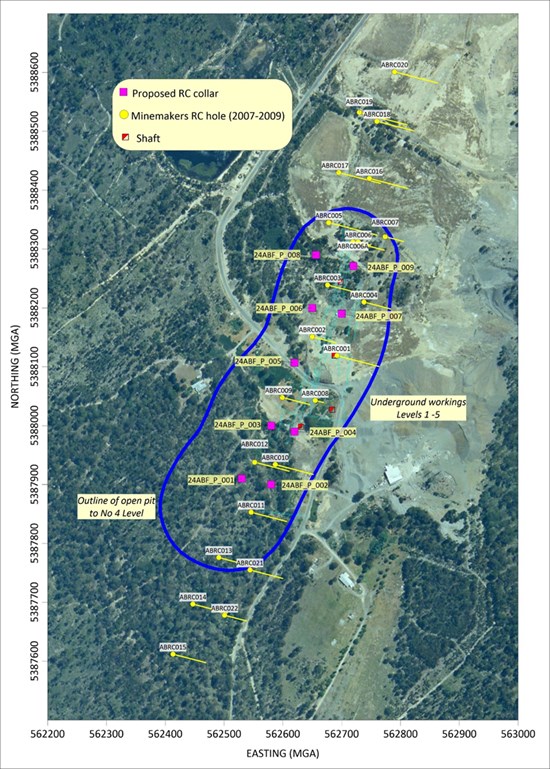
Figure 2: Location plan of proposed drilling, historic Aberfoyle Mine, Rossarden.
To view an enhanced version of this graphic, please visit:
https://images.newsfilecorp.com/files/10969/320311_d097232b549e5b46_002full.jpg
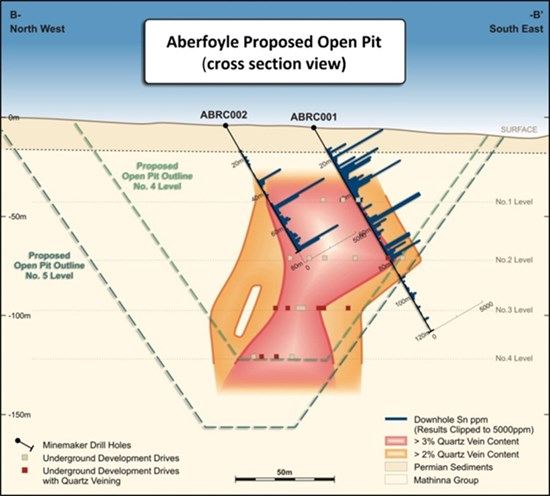
Figure 3: Cross section view of proposed Aberfoyle Open Cut. Pit outline and development from Roberts and Teh (1989), drilling data from Fulton et al (2008)3.
To view an enhanced version of this graphic, please visit:
https://images.newsfilecorp.com/files/10969/320311_d097232b549e5b46_003full.jpg
6 Summons, T. 1983. Proposed Aberfoyle open pit and quartz grades in the Aberfoyle deposit ML27M/77 Rossarden district north-east Tasmania. Wheal Lutwyche Pty Ltd. MRT open file report 83_2066.
7 Roberts, C. and Teh, M. 1989. An investigation of the potential of the Rossarden tin mine, north-eastern Tasmania, June-July 1989. Juka Mine Management Pty Ltd. MRT open file report 89_3055.
8Fulton, R., Drummond, A and Hepburn-Brown, D. 2008. Exploration Licence EL27/2004 Rossarden-Royal George Annual Report to October 2008. Minemakers Limited.
Royal George Open Cut
The Company plans to drill 4 reverse circulation drill holes into the upper levels of the old Royal George Tin Mine at Royal George (EL27/2004; Figure 4). Historic drilling has been all diamond-cored, with a range from EX to HQ size. Early programs experienced drilling difficulties with core loss common. No RC holes have ever been drilled. Drilling will focus on verifying historical assay and drill data.
The last drilling program was completed in 1989 by Spectrum Resources and comprised four cored holes utilising HQ triple tube with 100% recoveries through the mineralised zones. Assay results, tabulated below, confirm previous channel sampling and metallurgical test work indicating the potential for silver and zinc credits.
| Hole | ETT* (m) | Sn | Cu | Pb | Zn | As | S | Ag | Sb | Bi | Cd | U |
| % | ppm | |||||||||||
| S1 | 2.0 | 0.47 | 0.09 | 0.09 | 0.31 | 0.19 | 2.5 | 23 | 14 | 36 | 72 | 41 |
| S2 | 10.0 | 0.46 | 0.07 | 0.03 | 0.42 | 0.24 | 2.6 | 19 | 15 | 40 | 71 | 26 |
| S3 | 7.1 | 0.59 | 0.11 | 0.03 | 0.37 | 0.50 | 3.7 | 27 | 19 | 69 | 46 | 65 |
| S4 | 7.1 | 0.12 | <0.01 | <0.01 | 0.10 | <0.01 | 0.4 | <12 | <10 | <5 | 16 | 28 |
| ETT - Estimated true thickness | ||||||||||||
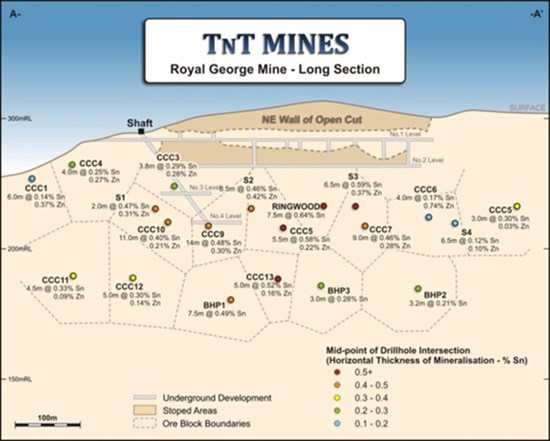
Figure 4: Long section of Royal George Mine with mineralized blocks and historic drill intercepts. CCC# holes drilled EX-size; BHP# holes drilled A-size; S# holes drilled HQ3 size 9, 10
To view an enhanced version of this graphic, please visit:
https://images.newsfilecorp.com/files/10969/320311_d097232b549e5b46_004full.jpg
9Fulton, R. 2023. EL27/2004 Rossarden - Royal George Annual Report to 26 November 2023. TinOne Resources Australia Pty Ltd.
10Newnham, L.G. 1990. EL5/88 Royal George Area. Report for period ending 30 March, 1990. Spectrum Resources Australia Pty Ltd.
Great Pyramid
A 200 metre diamond drill program is planned at the Great Pyramid Project (RL2/2009; Figure 5), comprising a total of four holes generating samples designed for metallurgical test work. The most recent metallurgical test work at Great Pyramid was carried out in the early 1980s.
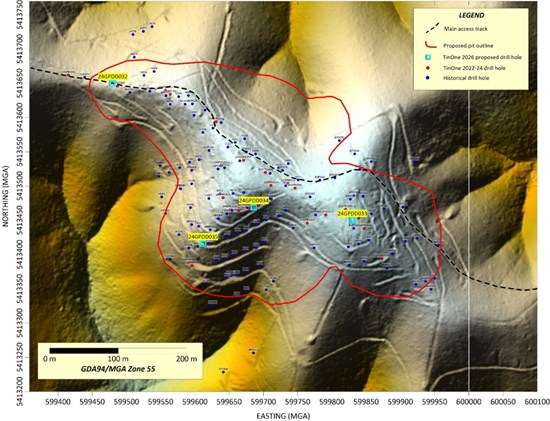
Figure 5: 3D model generated from Lidar showing existing drill holes and proposed metallurgical test work drill hole locations. Pre-existing tracks are clearly visible. The thick black line is the main Pyramid Hill track, and the red line shows the surface extent of the current resource estimate
To view an enhanced version of this graphic, please visit:
https://images.newsfilecorp.com/files/10969/320311_d097232b549e5b46_005full.jpg
About the Aberfoyle Project
The Aberfoyle project area straddles the boundary between the Silurian to Devonian Mathinna Supergroup sedimentary rocks and the Devonian Ben Lomond Granite. The historic Aberfoyle (tin) and Storeys Creek (tin-tungsten) mines as well as other vein systems are hosted in the sedimentary rocks and occur as strike extensive systems of sheeted and stockwork veining. Elevated lithium has not previously been reported from the project area.
Historic records and drilling indicate the mineralized vein system at Aberfoyle is up to 60 metres wide, 800 metres in length and extends approximately 400 metres in the down dip direction. The Lutwyche prospect occurs approximately 1 kilometre northeast of Aberfoyle and is comprised of two sets of mineralized veins which can be traced along strike for approximately 750 metres.
An additional sediment-hosted vein system, the Kookaburra, is located 200 metres southwest of the main Lutwyche vein system and is known to be approximately 40 metres wide with an along-strike extent of at least several hundred metres.
Mineralization at Storeys Creek is hosted within a 30 to 50 metre wide, north-northwest striking sheeted vein array which dips to the southwest. The system can be traced along strike for 300 metres and extends 400 metres in the down dip direction. The Ben Lomond Granite crops out approximately 1km west of the mine and has been identified at depth at 180 metres below the surface.
Additional poorly known sediment-hosted vein systems occur at Brocks, Eastern Hill and elsewhere in the tenement.
Granite-hosted occurrences are developed throughout the exposed areas of granitoid outcrop and consist of vein, disseminated and breccia style occurrences with associated greisen style alteration. These have given rise to historic small scale hard rock and more extensive alluvial production in the Gipps Creek, Rex Hill, Ben Lomond, Royal George and other areas.
The Company interprets that both sediment- and granite-hosted systems have developed in structural corridors of multi-kilometre extent and that historic exploration has not systematically explored these corridors. TinOne believes systematic exploration of these prospective corridors will result in the definition of high-quality drill targets.
About the Royal George Project
At Royal George, tin mineralisation has been introduced into the granitic rocks over a strike length of 250m. The deposit is formed by a steeply dipping zone of lodes striking at 310° to 320° and dipping 75° to 82° to the southwest. The lodes are variably spaced, and the group narrows to the north. They are variously described as joints or fracture planes with some showing good slickensides. The zone of mineralisation plunges shallowly to the north. Pneumatolytic fluids have travelled up the lodes altering the granite to greisen and introducing tin and base metal sulphides into the wall rock. This mineralisation penetrates the walls of the lodes to varying extents, typically up to 1.5m wide, and the mineralised group of lodes may be up to 20m wide but not continuously mineralised over this width. Between 5-20% disseminated pyrite, sphalerite, arsenopyrite and chalcopyrite are present in the strongly mineralised greisen bands. Sulphides average 3% within the host granite for 30m each side of the main zone of mineralisation. The cassiterite is described as ne grained and rarely visible but coarser cassiterite is reported in the higher-grade zones below the old stoping.
The deposit was mined between 1911 and 1922 and produced approximately 1,100 tonnes of tin metal from around 170,000 tonnes or ore grading at 0.65% tin11.
In 2014 a JORC Inferred Resource was estimated11:
802,233t @ 0.33% Sn for 2,650 contained tonnes of tin metal (0.2% Sn cut-off)
600,767t @ 0.36% Sn for 2,160 contained tonnes of tin metal (0.25% Sn cut-off)
11 Algar, V. 2014. Royal George tin mineral resource report for TNT Mines Limited.
About the Great Pyramid Project
The Great Pyramid deposit is located around a topographical feature known as Pyramid Hill and is hosted by Silurian to Devonian Mathinna Supergroup sandstones. The mineralization is formed by closely spaced sheeted northeast trending, cassiterite (SnO2) bearing veins associated with silicification and sericite-pyrite alteration. The deposit style and regional comparisons suggest that a tin-fertile granite exists at depth below the deposit, however this has not been encountered in drilling, and the deposit is open at depth. Geological interpretation indicates that certain sedimentary units within the folded Mathinna Supergroup sediments are more favourable hosts and diamond drilling being undertaken by the Company during the current campaign, combined with numerical modelling, will assist in developing a deeper understanding of controls on grade for follow-up drilling.
In 2023, a mineral resource estimate (MRE; Table 1) was prepared in accordance with Canadian Institute of Mining, Metallurgy and Petroleum Definition Standards for Mineral Resources and Mineral Reserves adopted May 19, 2014, and in accordance with National Instrument 43-101 Standards of Disclosure for Mineral Projects.
Table 1. Great Pyramid tin deposit inferred Mineral Resource1,2,3,4,5
| Cut Off (Sn %) | Tonnes (Mt) | Grade (Sn %) | Metal (Sn kt) | Classification |
| > 0.10 | 8.39 | 0.17 | 14.40 | Inferred |
| ||||
About TinOne
TinOne is a TSX Venture Exchange listed Canadian public company with a high-quality portfolio of tin, tin/tungsten and lithium projects in Tasmania, Australia. The Company controls some of the most important tin districts in Tasmania, including Aberfoyle and Great Pyramid and is focussed on advancing its highly prospective portfolio.
Qualified Person
The Company's disclosure of technical or scientific information in this press release has been reviewed and approved by Russell Fulton, VP Exploration for TinOne. Mr. Fulton is a Qualified Person as defined under the terms of National Instrument 43-101.
Contact Information: For more information and to sign-up to the mailing list, please contact:
Rob Curtis, CEO
Email: rob@tinone.ca
Neither TSX Venture Exchange nor its Regulation Services Provider (as that term is defined in policies of the TSX Venture Exchange) accepts responsibility for the adequacy or accuracy of this release.
SPECIAL NOTE REGARDING FORWARD-LOOKING STATEMENTS
This news release includes certain "Forward-Looking Statements" within the meaning of the United States Private Securities Litigation Reform Act of 1995 and "forward-looking information" under applicable Canadian securities laws. When used in this news release, the words "anticipate", "believe", "estimate", "expect", "target", "plan", "forecast", "may", "would", "could", "schedule" and similar words or expressions, identify forward-looking statements or information. These forward-looking statements or information relate to, among other things: the development of the Company's projects; future mineral exploration, development and production; and the release of exploration results.
Forward-looking statements and forward-looking information relating to any future mineral production, liquidity, enhanced value and capital markets profile of TinOne, future growth potential for TinOne and its business, and future exploration plans are based on management's reasonable assumptions, estimates, expectations, analyses and opinions, which are based on management's experience and perception of trends, current conditions and expected developments, and other factors that management believes are relevant and reasonable in the circumstances, but which may prove to be incorrect. Assumptions have been made regarding, among other things, the price of gold and other metals; no escalation in the severity of the COVID-19 pandemic; costs of exploration and development; the estimated costs of development of exploration projects; TinOne's ability to operate in a safe and effective manner and its ability to obtain financing on reasonable terms.
These statements reflect TinOne's respective current views with respect to future events and are necessarily based upon several other assumptions and estimates that, while considered reasonable by management, are inherently subject to significant business, economic, competitive, political and social uncertainties and contingencies. Many factors, both known and unknown, could cause actual results, performance or achievements to be materially different from the results, performance or achievements that are or may be expressed or implied by such forward-looking statements or forward-looking information and TinOne has made assumptions and estimates based on or related to many of these factors. Such factors include, without limitation: the Company's dependence on early stage mineral projects; metal price volatility; risks associated with the conduct of the Company's mining activities in Australia; regulatory, consent or permitting delays; risks relating to reliance on the Company's management team and outside contractors; risks regarding mineral resources and reserves; the Company's inability to obtain insurance to cover all risks, on a commercially reasonable basis or at all; currency fluctuations; risks regarding the failure to generate sufficient cash flow from operations; risks relating to project financing and equity issuances; risks and unknowns inherent in all mining projects, including the inaccuracy of reserves and resources, metallurgical recoveries and capital and operating costs of such projects; contests over title to properties, particularly title to undeveloped properties; laws and regulations governing the environment, health and safety; the ability of the communities in which the Company operates to manage and cope with the implications of COVID-19; the economic and financial implications of COVID-19 to the Company; operating or technical difficulties in connection with mining or development activities; employee relations, labour unrest or unavailability; the Company's interactions with surrounding communities and artisanal miners; the Company's ability to successfully integrate acquired assets; the speculative nature of exploration and development, including the risks of diminishing quantities or grades of reserves; stock market volatility; conflicts of interest among certain directors and officers; lack of liquidity for shareholders of the Company; litigation risk; and the factors identified under the caption "Risk Factors" in TinOne's management discussion and analysis. Readers are cautioned against attributing undue certainty to forward-looking statements or forward-looking information. Although TinOne has attempted to identify important factors that could cause actual results to differ materially, there may be other factors that cause results not to be anticipated, estimated or intended. TinOne does not intend, and does not assume any obligation, to update these forward-looking statements or forward-looking information to reflect changes in assumptions or changes in circumstances or any other events affecting such statements or information, other than as required by applicable law.

To view the source version of this press release, please visit https://www.newsfilecorp.com/release/320311

