
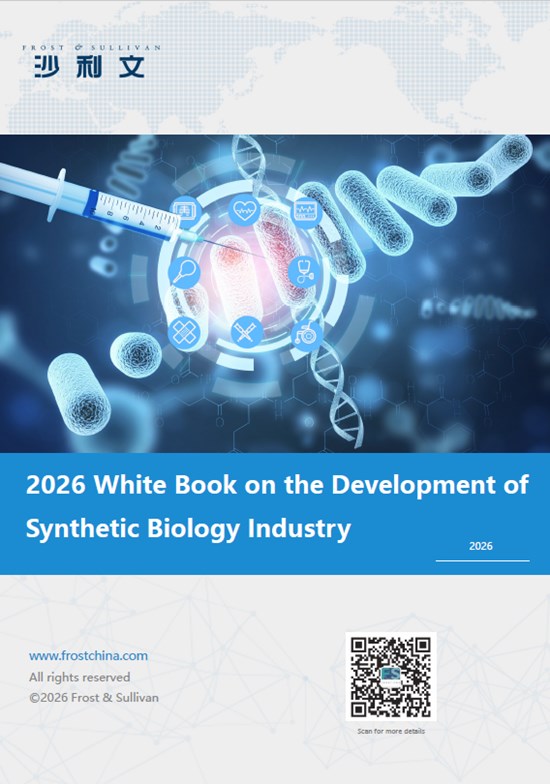
Shanghai, China--(Newsfile Corp. - October 28, 2026) - Frost & Sullivan has conducted in-depth research on the synthetic biology industry and published the "2026 White Book on the Development of Synthetic Biology Industry". The 2026 white book aims to provide a comprehensive analysis of current technological advances, policies and regulations, and market potential, as well as the challenges and future trends in the industry. The white book begins with an overview of synthetic biology. (To read the 2026 White Book on the Development of Synthetic Biology Industry, visit: https://hub.frost.com/current-status-and-trends-of-synthetic-biology-industry/.)
The authoritative definition of synthetic biology (synthetic biology, also known as Engineering Biology) is grounded in biological science and in the convergence of chemistry, physics, and information science with engineering principles. It designs and modifies natural organisms or synthesizes new ones-both "creating things to gain knowledge," thereby revealing the laws of life, and "creating things for use," thereby transforming engineering applications. At its core is convergence-it unites science's "capacity to discover," engineering's "capacity to build," and disruptive technology's "capacity to invent." In 2010, the J. Craig Venter Institute chemically synthesized a ~1 million base-pair Mycoplasma genome and transplanted it into a recipient cell, creating a self-replicating "synthetic life" (dubbed Synthia) and proving for the first time that DNA synthesis and reconstruction can reach the megabase scale (Gibson et al., Science 2010)-marking humanity's true acquisition of the ability to "write life." In 2020, AlphaFold2 cracked the 50-year-old "protein folding problem"; in 2024, AlphaFold3 could predict protein interactions with other molecules. That same year, the Nobel Prize in Chemistry was awarded jointly to David Baker (computational de novo protein design) and Demis Hassabis and John Jumper (AlphaFold), establishing AI-driven protein design as a core engine of modern science. AI has cut protein screening and optimization from months to hours, enabling humans to design from scratch functional enzymes that do not exist in nature.
With the deep integration of AI and biofoundries, synthetic biology is transitioning from experience-driven to data-driven R&D. Continuous iteration of the Design-Build-Test-Learn cycle will enhance its quantitative prediction and directed design capabilities. As underlying technologies such as enzymatic DNA synthesis mature, the industrial boundaries of biomanufacturing are steadily expanding from healthcare to energy & chemicals, food & agriculture, and environmental governance. The global rise of synthetic biology offers countries an opportunity to position themselves in an emerging field.
These expanding industrial boundaries are reflected in a growing range of application scenarios. Synthetic biology is driving biomedicine toward a new stage of precision treatment, platform-based R&D, and scaled manufacturing. In advanced materials, synthetic biology centered on engineered strains and biomanufacturing is driving the field toward greener, higher-performance, more sustainable, and large-scale development. In biomass, engineered enzymes and microorganisms improve the conversion efficiency of non-grain feedstocks and reduce the costs of traditional biofuels; in addition, C1 gas fermentation and CO2 bioconversion are breaking dependence on sugar feedstocks, expanding low-carbon fuel production pathways. In agriculture, synthetic biology delivers dual value: engineered cell factories replacing traditional farming and chemical synthesis empower the low-carbon transition of agricultural and plant protection products, while gene editing and metabolic regulation break the capacity bottlenecks of traditional production models. In consumer goods, cell factories replace traditional animal/plant extraction or chemical synthesis to enable green, sustainable production of high-value active ingredients, while genetic modification and metabolic regulation cut production costs and break the capacity limits of conventional methods. Synthetic biology applications in environmental protection now span environmental monitoring, biodegradation, and biosorption, and are evolving from single-point function validation toward integrated "monitoring-treatment-resource recovery".
Differences in technological maturity, industry chain completeness, and scale-up capacity place countries and regions at different development stages in synthetic biology, and these regional differences are directly reflected in their policy layouts. Moving from "lab-driven" to "industry-driven", synthetic biology industrialization still faces structural challenges; breaking the industrialization bottleneck requires a systemic support system coordinating "technology-platform-standards-regulation-scenarios".
Looking ahead, the synthetic biology industry is set to evolve along the following trends. Through multidisciplinary convergence and technological innovation, synthetic biology is accelerating from technology exploration toward industrialization. As industry regulation matures and business models expand, the synthetic biology market will keep growing, entering a critical industry-driven transition period. AI is deeply integrating with automated biofoundries, shifting synthetic biology R&D from experience-based trial and error to a data-driven " Design-Build-Test-Learn " closed loop. Bio-based materials are expanding from small-scale demonstration projects into packaging, textile fibers, personal care and other consumer goods, approaching the economic tipping point for petroleum substitution. With living medicines & gene-editing therapies advancing fast, medical applications of synthetic biology are transitioning from clinical validation to product launch. As funding becomes more rational, capital focus is shifting from generic platforms and distant potential toward defined products, industrialization progress, stable revenue and verifiable paths to profitability.
The 2026 White Book on the Development of Synthetic Biology Industry highlights the following:
- Chapter 1: Overview of Synthetic Biology
- Chapter 2: Application Fields and Technology Progress of Synthetic Biology
- Chapter 3: Policy Environment and Capital Trends of Synthetic Biology
- Chapter 4: Global Synthetic Biology Market Competitive Landscape & Key Company Strategy
- Chapter 5: Challenges & Future Trends of the Synthetic Biology Industry
- Chapter 6: Company Profiles in Synthetic Biology Industry
Key Topics Covered:
- Synthetic Biology Industry Chain Analysis
- Overview of the Synthetic Biology Industry Chain
- Synthetic Biology Industry Chain: Upstream Tool Layer
- Synthetic Biology Industry Chain: Midstream Platform Layer
- Synthetic Biology Industry Chain: Downstream Application Layer
- Application Fields and Technology Progress of Synthetic Biology
- Analysis of Technology Advances in Synthetic Biology: Biomedicine
- Analysis of Technology Advances in Synthetic Biology: Advanced Materials
- Analysis of Technology Advances in Synthetic Biology: Energy
- Analysis of Technology Advances in Synthetic Biology: Agriculture
- Analysis of Technology Advances in Synthetic Biology: Consumer Goods
- Analysis of Technology Advances in Synthetic Biology: Environmental Protection
- Global Synthetic Biology Policy Environment
- Analysis of the US Synthetic Biology Policy Environment
- Analysis of the EU Synthetic Biology Policy Environment
- Analysis of China's Synthetic Biology Policy Environment
- Analysis of Middle East's Synthetic Biology Policy Environment
- Synthetic Biology Investment & Financing Events
- Development Stages and Characteristics of Synthetic Biology Markets by Region
- US Synthetic Biology Market Development Stage and Characteristics
- European Synthetic Biology Market Development Stage and Characteristics
- China Synthetic Biology Market Development Stage and Characteristics
- Middle East Synthetic Biology Market Development Stage and Characteristics
- Benchmark Company Profile
About Frost & Sullivan
Frost & Sullivan (the Growth Partnership Company) has supported global enterprises for more than 65 years on growth-strategy formulation. It serves Global 1,000 corporations, emerging enterprises and public-sector clients, delivering market research, industry blue-book publication, benchmark analysis and strategic consulting services across healthcare, advanced-technology, new-energy and other vertical sectors.
Contacting Us
Company: Frost & Sullivan
Website: www.frostchina.com
Email: PR@frostchina.com
To view the source version of this press release, please visit https://www.newsfilecorp.com/release/321401
