


Vancouver, British Columbia--(Newsfile Corp. - November 12, 2026) - Golden Sky Minerals Corp. (TSXV: AUEN) ("Golden Sky" or the "Company") is pleased to provide an update on the geological interpretation of its recent ~23 line-kilometre induced polarization ("IP") survey at the Gnome target on its 100%-owned Rayfield-Gjoll Project in southern British Columbia. Integration of historical drillhole observations with three-dimensional ("3D") inverted resistivity and chargeability data has identified a compelling porphyry-style exploration target, with the interpreted system core remaining largely untested by historical drilling (Figures 1-5).
The integrated interpretation highlights a north-northwest to south-southeast-trending resistivity anomaly that is partially overlapped by a larger northwest-southeast-trending chargeability anomaly. The contrasting orientations suggest that the resistive feature may represent a more coherent intrusive or hydrothermal core. The chargeability response may be influenced by structural controls associated with sulfide mineralization along northwest- and northeast-trending faults or fracture zones, providing conduits for hydrothermal fluids driven by magmatic activity. The relative influence of these structural features at depth remains to be established through additional drilling.
Integrated Geophysical and Geological Interpretation
The 3D-inverted IP data provide an improved framework for evaluating historical drilling at Gnome and for identifying areas for follow-up exploration. Historical drillholes QN95-1 and QN95-2 are characterized predominantly by skarn and hornfelsed mafic volcanic rocks and are interpreted to have intersected the upper portion of a potential porphyry system at depth.
Drillhole QN95-1, which terminated at 174 metres depth, intersected strongly foliated volcanic rocks containing quartz-calcite veinlets with chlorite and epidote selvages, consistent with alteration observed in other historic drill holes such as QN-95-2. Pyrite occurs as disseminations and within veins and fractures, locally attaining approximately 5% of the rock mass, while localized sericite and clay alteration are also present. Chalcopyrite occurs as fine disseminations along fractures and within rare sulfide-bearing veinlets. The hole also intersected several diorite dikes, a foliated gabbro unit, and a single intercept of crowded feldspar porphyry, providing evidence of intrusive activity within the volcanic sequence. Despite these observations, QN95-1 tested only the upper margin of the large chargeability anomaly and was terminated within the margins of the resistivity anomaly. Consequently, the interpreted core area of the geophysical target was not adequately tested.
Drillhole DH72455 provides additional geological information to constrain the interpretation of the geophysical anomalies. The hole encountered quartz-calcite veins with chlorite-sericite-clay selvages, as well as variable pyrite and trace chalcopyrite. The final 68 metres of the hole, terminated at 392 metres, averaged approximately 0.10% copper. Quartz stockwork veining also occurs within the last 68 m, locally attaining up to 33 veinlets per metre. These observations demonstrate a well-developed vein and hydrothermal alteration system, although further drilling is required to define the size of the system.
The quartz-calcite veins and associated alteration selvages are interpreted to represent a potentially late-stage hydrothermal overprint associated with cooling of the system. Distribution of these may reflect a transition between higher-temperature alteration closer to the systems core and surrounding lower-temperature propylitic and phyllic alteration. The geological and geophysical relationships are consistent with a zoned hydrothermal system, although the location and extent of any higher-temperature mineralized core have yet to be confirmed.
Evidence of intrusive activity in DH72455 is comparatively limited; however, narrow aplite dikes were observed in close spatial association with copper mineralization. Late-stage aplite dikes have also been documented at the New Afton deposit, located 60 km to the southeast, where they have been interpreted in the context of prolonged magmatic evolution. This comparison provides a geological framework for further investigation at Gnome but does not, in itself, directly establish a deposit analogy.
Resistive Core Represents a Priority for Follow-Up Drilling
The Company interprets the northwest-southeast-trending resistivity anomaly as a potential expression of the core of the hydrothermal system. Increasing copper grades in historical drilling are spatially associated with the margins of this resistive feature and with drillhole intersections within the chargeability anomaly, providing an important relationship for consideration when refining drill targets.
The more extensive chargeability anomaly may reflect disseminated sulfides concentrated along structural corridors, potentially including northwest- and northeast-trending structures. Further drilling will be required to determine the sources of the resistivity and chargeability responses, to establish the significance of the interpreted structural controls, and to evaluate whether the resistive core represents a more strongly mineralized porphyry-style system.
The Company considers the combination of intrusive indicators, hydrothermal veining, sulfide mineralization and coincident but variably oriented geophysical anomalies to provide an encouraging exploration framework. Historical drilling has not adequately tested the interpreted core of the system, leaving a substantial opportunity to refine and evaluate the target through systematic follow-up exploration.
Golden Sky will use the integrated geological and geophysical interpretations to guide the prioritization of drill targets at Gnome as the Company advances exploration across the Rayfield-Gjoll Project.
John Newell, President and CEO of Golden Sky Minerals, comments: "The new survey gives us a much clearer picture of where historical drilling occurs in relation to the geological and geophysical features at Gnome. What encourages us is that the interpreted system core remains largely untested, providing a compelling opportunity within this underexplored geological setting. As we plan for 2027 with our partner, Boliden AB, these results are helping us focus Golden Sky's inaugural drill program at Rayfield-Gjoll on targets supported by the work completed to date. There is more to learn before we know what Gnome holds, but we are encouraged by the evidence coming together and are excited to take the next step."
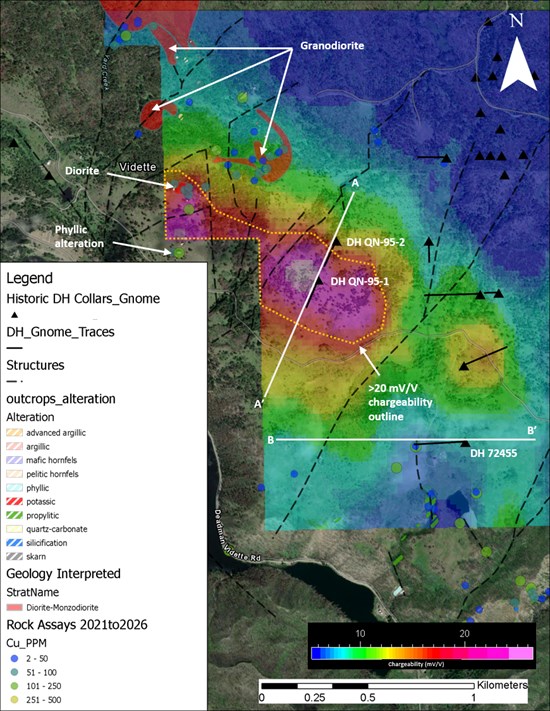
Figure 1: Results of 2026 IP survey over the Gnome target. Northwest-trending chargeability anomaly (80m depth slice) is largely untested by historic drilling and coincides with phyllic altered volcanic rocks at surface.
To view an enhanced version of this graphic, please visit:
https://images.newsfilecorp.com/files/11793/323828_a00273c3b4fb8bf8_004full.jpg
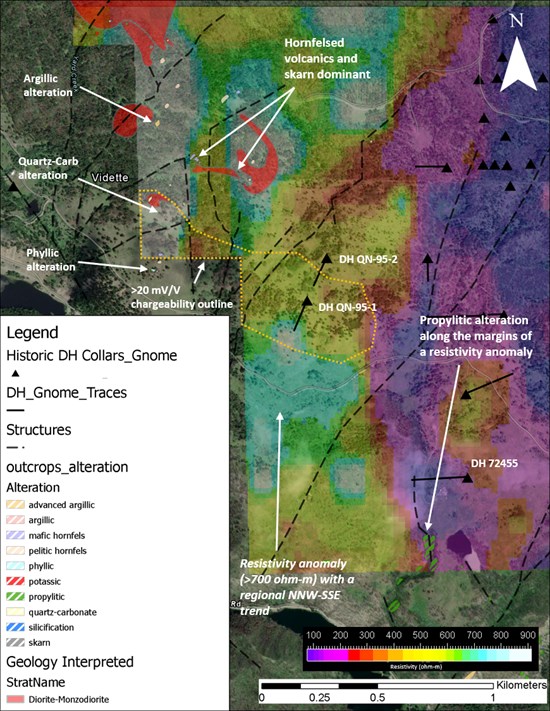
Figure 2: Results of 2026 IP survey over the Gnome target. North-northwest-trending resistivity anomaly (80m depth slice) is largely untested by historic drilling and coincides with hornfelsed volcanic rocks with locally abundant quartz-calcite veining.
To view an enhanced version of this graphic, please visit:
https://images.newsfilecorp.com/files/11793/323828_a00273c3b4fb8bf8_005full.jpg
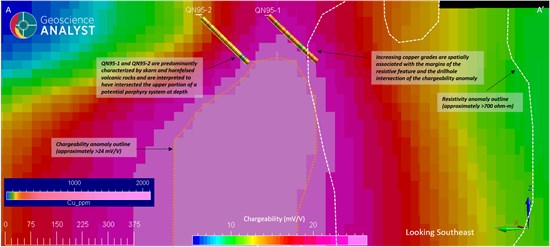
Figure 3: Cross-section A-A' looking southeast. Increasing copper grades with depth in historical drillholes appear to correlate with the margins of a chargeability anomaly that partially overlaps the resistivity feature. Future drilling will prioritize testing the lateral and depth extents of the coincident resistivity and chargeability anomalies, particularly along their interpreted margins.
To view an enhanced version of this graphic, please visit:
https://images.newsfilecorp.com/files/11793/323828_a00273c3b4fb8bf8_006full.jpg
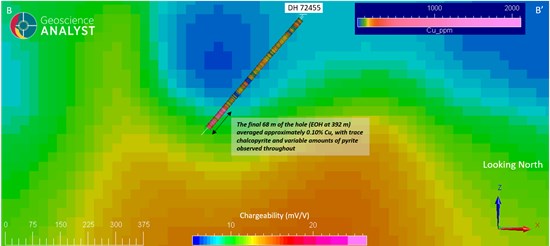
Figure 4: Cross-section B-B' looking north. Historic drillhole 72455 intersected 0.10% Cu over the last 68 m along the margins of a chargeability anomaly increasing in intensity with depth. It is interpreted that the chargeability anomaly is plunging to the southeast.
To view an enhanced version of this graphic, please visit:
https://images.newsfilecorp.com/files/11793/323828_a00273c3b4fb8bf8_007full.jpg
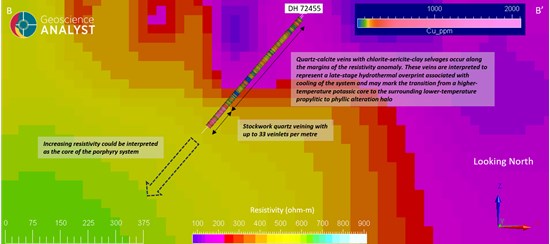
Figure 5: Cross-section B-B' looking north. The copper grade is increasing towards a zone of higher resistivity, interpreted as the potential core of a porphyry system.
To view an enhanced version of this graphic, please visit:
https://images.newsfilecorp.com/files/11793/323828_a00273c3b4fb8bf8_008full.jpg
About Golden Sky Minerals Corp.
Golden Sky Minerals Corp. is a project generator-style junior explorer focused on the acquisition, systematic exploration and strategic advancement of a diversified portfolio of 100%-owned mineral properties in highly prospective, mining-friendly jurisdictions. The Company's strategy emphasizes securing major partners on select high-potential assets to fund exploration and minimize shareholder dilution, while advancing our broader portfolio in parallel.
Golden Sky's portfolio includes the flagship Rayfield-Gjoll Copper-Gold Project in British Columbia (subject to a C$20 million earn-in and joint venture agreement with Boliden), the Hotspot and Lucky Strike gold projects in Yukon's White Gold District, and the Auden Gold Project in Ontario's Timmins camp. The Company's core assets are 100%-owned, with no underlying royalties, except for a 2% NSR applicable to a portion of Rayfield-Gjoll, which is fully purchasable.
More information can be found at the Company's website at www.goldenskyminerals.com
About Boliden
Boliden contributes to a sustainable future by extracting, producing and recycling metals that are essential to improve society for generations to come. With care for people and the environment, combined with experience gathered over a century and cutting-edge technology, Boliden's 8,000 employees have achieved leading productivity and one of the lowest carbon footprints in the industry.
www.boliden.com
ON BEHALF OF THE BOARD
John Newell, President, Chief Executive Officer and Director
Carl Schulze, P. Geo., Consulting Geologist with Aurora Geosciences Ltd, is a qualified person as defined by National Instrument 43-101 for Golden Sky's British Columbia exploration projects, and has reviewed and approved the technical information in this release.
For new information from the Company's programs, please visit Golden Sky's website at www.GoldenSkyMinerals.com or contact John Newell by telephone (604) 568-8807 or by email at info@goldenskyminerals.com or john.newell@goldenskyminerals.com.
Neither the TSX Venture Exchange nor its Regulation Services Provider (as that term is defined in the policies of the TSX Venture Exchange) accepts responsibility for the adequacy or accuracy of this release.
Forward-Looking Statements
Statements contained in this news release that are not historical facts are "forward-looking information" or "forward-looking statements" (collectively, "Forward-Looking Information") within the meaning of applicable Canadian securities legislation. In certain cases, Forward-Looking Information can be identified by the use of words and phrases such as "anticipates", "intends", "expects", "understanding", "has agreed to" or variations of such words and phrases or statements that certain actions, events or results "would", "occur" or "be achieved". Although Golden Sky has attempted to identify important factors and risks that could affect Golden Sky and may cause actual actions, events or results to differ materially from those described in Forward-Looking Information, there may be other factors and risks that cause actions, events or results not to be as anticipated, estimated or intended, including, without limitation: inherent risks involved in the exploration and development of mineral properties; the uncertainties involved in interpreting drill results and other exploration data; the potential for delays in exploration or development activities; the geology, grade and continuity of mineral deposits; the possibility that future exploration, development or mining results will not be consistent with Golden Sky's expectations; accidents, equipment breakdowns, title and permitting matters; labour disputes or other unanticipated difficulties with or interruptions in operations; fluctuating metal prices; unanticipated costs and expenses; uncertainties relating to the availability and costs of financing needed in the future, including to fund any exploration programs on its projects; that Golden Sky may not be able to confirm historical exploration results and other risks set forth in Golden Sky's public filings at www.sedarplus.ca. In making the forward-looking statements in this news release, Golden Sky has applied several material assumptions, including the assumption that general business and economic conditions will not change in a materially adverse manner. There can be no assurance that Forward-Looking Information will prove to be accurate, as actual results and future events could differ materially from those anticipated in such statements. Accordingly, readers should not place undue reliance on Forward-Looking Information. Except as required by law, Golden Sky does not assume any obligation to release publicly any revisions to Forward-Looking Information contained in this news release to reflect events or circumstances after the date hereof or to reflect the occurrence of unanticipated events.

To view the source version of this press release, please visit https://www.newsfilecorp.com/release/323828