
VANCOUVER, BC / ACCESS Newswire / July 21, 2026 / HM Exploration Corp. ("HM Exploration", "HM" or the "Company") (CSE:HM)(FSE:X5H)(OTCQB:HMEXF) is pleased to announce assay results from the first seven (7) of twelve (12) drill holes from the Company's Phase One drilling program (the "Program") at its Lewis Pilley's Project (the "Project") in Newfoundland, Canada.
Highlights:
First assays confirm significant polymetallic mineralization in both the upper and lower sulphide lenses, supporting the Company's geological model (Figure 4). Both mineralized horizons remain open along strike and down dip (Figure 1).
PI-26-007*
23.0m of 1.21 % Cu, 1.67 % Zn, 10.67 g/t Ag, 0.25 g/t Au (7.00 - 30.00m)
Including 2.03 % Cu, 0.62 % Pb, 2.36 % Zn, 16.35 g/t Ag, and 0.38 g/t Au over 8.18m (16.00 - 24.18m)
2.45 % Cu, 1.70 % Zn, 92.20 g/t Ag, 5.89 g/t Au over 0.66m (155.31 - 155.97m)
0.80 % Cu, 0.52 % Zn, 3.67 g/t Ag, 0.21 g/t Au over 3.45m (175.85 - 179.30m)
PI-26-001*
4.47m of 1.49 % Cu, 1.04 % Pb, 5.05 % Zn, 19.54 g/t Ag, 0.28 g/t Au (12.09 - 16.56m)
Including 4.58 % Cu, 1.60 % Zn, 28.10 g/t Ag, and 0.56 g/t Auover 0.60m (12.70 - 13.30m)
0.50 % Cu, 1.20 % Zn, 5.77 g/t Ag, 0.15 g/t Au over 6.45m (50.30 - 56.75m)
Including 1.38 % Cu, 2.38 % Zn, 13.90 g/t Ag, and 0.35 g/t Au over 0.87m (54.07 - 54.94m)
* All reported intervals represent drilled lengths. True widths of the mineralized intersections are currently unknown.
Downhole EM, ground EM, optical and acoustic televiewer surveys will be executed imminently to help systematically plan for Phase Two drilling, testing the further extensions of the mineralized system.
Assays for holes PI-26-008 through PI-26-012 remain pending (see Press Releases dated June 29 & July 7, 2026, for information on what was observed in these drill holes).
"The intense mineralization we have visually observed in the first seven holes has now been confirmed by laboratory analysis, including high-grade intervals grading up to 2.45% Cu, 5.89 g/t Au and 92.2 g/t Ag in the lower lens and very extensive intervals in the upper lens," said Nick Rodway, CEO of HM Exploration. "These assay results confirm that the Lewis Pilley's Project hosts a polymetallic VMS system with excellent potential for expansion. With assays pending from holes eight to twelve, we are planning our EM survey in order to systematically design our Phase Two drilling program set to commence this fall."
The 2026 Phase One drilling Program was focused on evaluating the continuity of the mineralized system below known surface showings and along strike of the Clifford Jones (Bull Road) Zone (the "Zone") to improve the Company's understanding of the geological controls on mineralization. Assays have confirmed that the upper targeted copper-bearing debris flow contains significant mineralization over an interpreted strike length of approximately 60 m, from a total drill-tested length of approximately 135 m, within zones of massive to semi-massive sulphide through holes 1 and 2 as well as holes 5, 6, and 7 (Figure 1). Assay values from hole 7 also confirm that the lower mineralized sulphide lens contains significant mineralization within predominantly massive to semi-massive, and minor disseminated, sulphide mineralization (Figures 2 & 3). The assay results validate the Company's geological interpretation that multiple stacked sulphide lenses are present within the Project's Volcanogenic Massive Sulphide ("VMS") system. Both the upper and lower mineralized zones are open along strike and down-dip.
The mineralization from the upper zone is characterized by semi-massive to massive fragments of sulphide that have been fractured, transported, and chaotically mixed with varying types of volcanic rock. The fragments range from sun-rounded to angular, possibly indicating multiple transport events and reworking of these fragments through moderate to distal transport from the original deposition site. The source of the material is interpreted to be very nearby and may be supported by a stockwork vein system representing the feeder zone of the mineralization.
The mineralization from the lower zone is characterized by more massive and coherent fragments of sulphide with less rounding and fracturing than observed in the upper zone. The more 'intact' nature of these fragments provides evidence that the new lower mineralized sulphide lens may represent debris deposited closer to the original hydrothermal vent system (Figure 4).
Significant assay results from the first seven (7) drill holes of the Phase One drilling Program can be found below in Table 1.
Table 1: Significant assays from Phase One drilling Program at the Clifford Jones (Bull Road) Zone. (NSV=No Significant Values)
Clifford Jones (Bull Road) Zone - Significant Assays* | ||||||||
Hole ID | From (m) | To (m) | Length (m) | Cu % | Pb % | Zn % | Ag g/t | Au g/t |
PI-26-001 | 12.09 | 16.56 | 4.47 | 1.49 | 1.04 | 5.05 | 19.54 | 0.28 |
Incl. | 12.70 | 13.30 | 0.60 | 4.58 | 0.19 | 1.60 | 28.10 | 0.56 |
Incl. | 14.20 | 14.92 | 0.72 | 1.96 | 3.14 | 18.40 | 44.60 | 0.30 |
And | 50.30 | 56.75 | 6.45 | 0.50 | 0.29 | 1.20 | 5.77 | 0.15 |
Incl. | 54.07 | 54.94 | 0.87 | 1.38 | 0.44 | 2.38 | 13.90 | 0.35 |
PI-26-002 | 11.10 | 16.20 | 5.10 | 0.42 | 0.08 | 0.59 | 4.61 | 0.19 |
Incl. | 14.00 | 15.00 | 1.00 | 0.89 | 0.09 | 0.91 | 6.70 | 0.26 |
PI-26-003 |
|
|
| NSV | ||||
PI-26-004 | 16.48 | 16.78 | 0.30 | 0.22 | 0.04 | 0.03 | 2.20 | 0.12 |
PI-26-005 | 14.00 | 18.00 | 4.00 | 0.59 | 0.20 | 0.66 | 11.34 | 0.18 |
Incl. | 16.33 | 17.26 | 0.93 | 1.85 | 0.37 | 1.21 | 36.70 | 0.47 |
And | 28.00 | 45.97 | 17.97 | 0.34 | 0.13 | 0.69 | 4.59 | 0.12 |
Incl. | 35.30 | 43.49 | 8.19 | 0.49 | 0.20 | 1.05 | 6.84 | 0.18 |
And | 257.44 | 257.74 | 0.30 | 0.04 | 0.04 | 0.14 | 3.90 | 0.52 |
PI-26-006 | 11.43 | 13.14 | 1.71 | 0.57 | 0.37 | 1.21 | 8.56 | 0.19 |
And | 24.98 | 27.16 | 2.18 | 0.18 | 0.06 | 0.22 | 2.66 | 0.08 |
PI-26-007 | 7.00 | 30.00 | 23.00 | 1.21 | 0.38 | 1.67 | 10.67 | 0.25 |
Incl. | 16.00 | 24.18 | 8.18 | 2.03 | 0.62 | 2.36 | 16.35 | 0.38 |
And | 155.31 | 155.97 | 0.66 | 2.45 | 0.01 | 1.70 | 92.20 | 5.89 |
And | 175.85 | 179.30 | 3.45 | 0.80 | 0.05 | 0.52 | 3.67 | 0.21 |
Incl. | 178.00 | 179.00 | 1.00 | 1.08 | 0.09 | 0.97 | 4.70 | 0.29 |
* All reported intervals represent drilled lengths. True widths of the mineralized intersections are currently unknown.
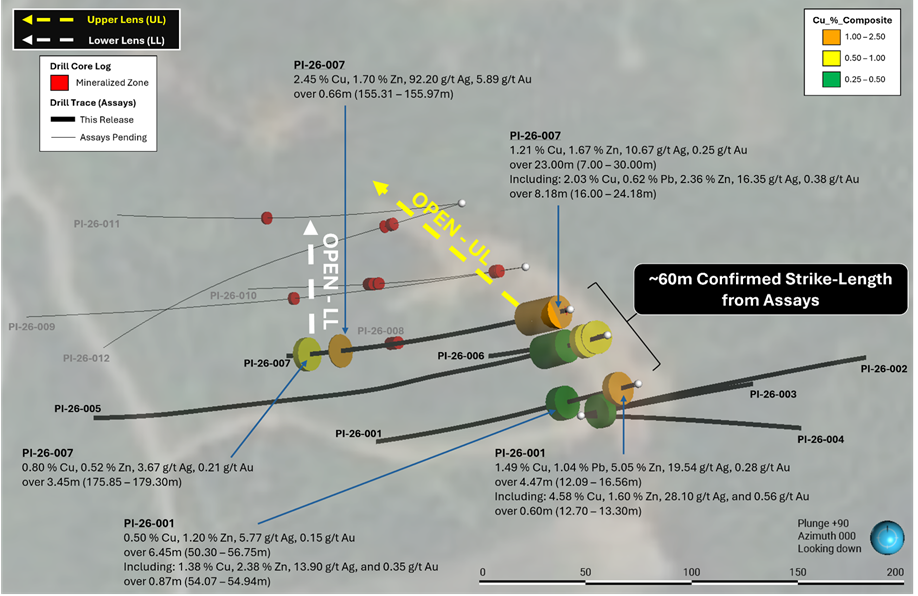
Figure 1: Plan map of 2026 diamond drilling at the Clifford Jones (Bull Road) Zone. Currently the upper lens (UL) and lower lens (LL) mineralization remains open along strike and at depth. The upper lens mineralization has been confirmed over a strike length of approximately 60 m, from a total drill-tested length of approximately 135 m, within zones of massive to semi-massive sulphide through holes 1 and 2 as well as holes 5, 6, and 7. Small red discs represent visually logged mineralized zones (assays pending). "Including" assay values not represented by colour-scale on figure.
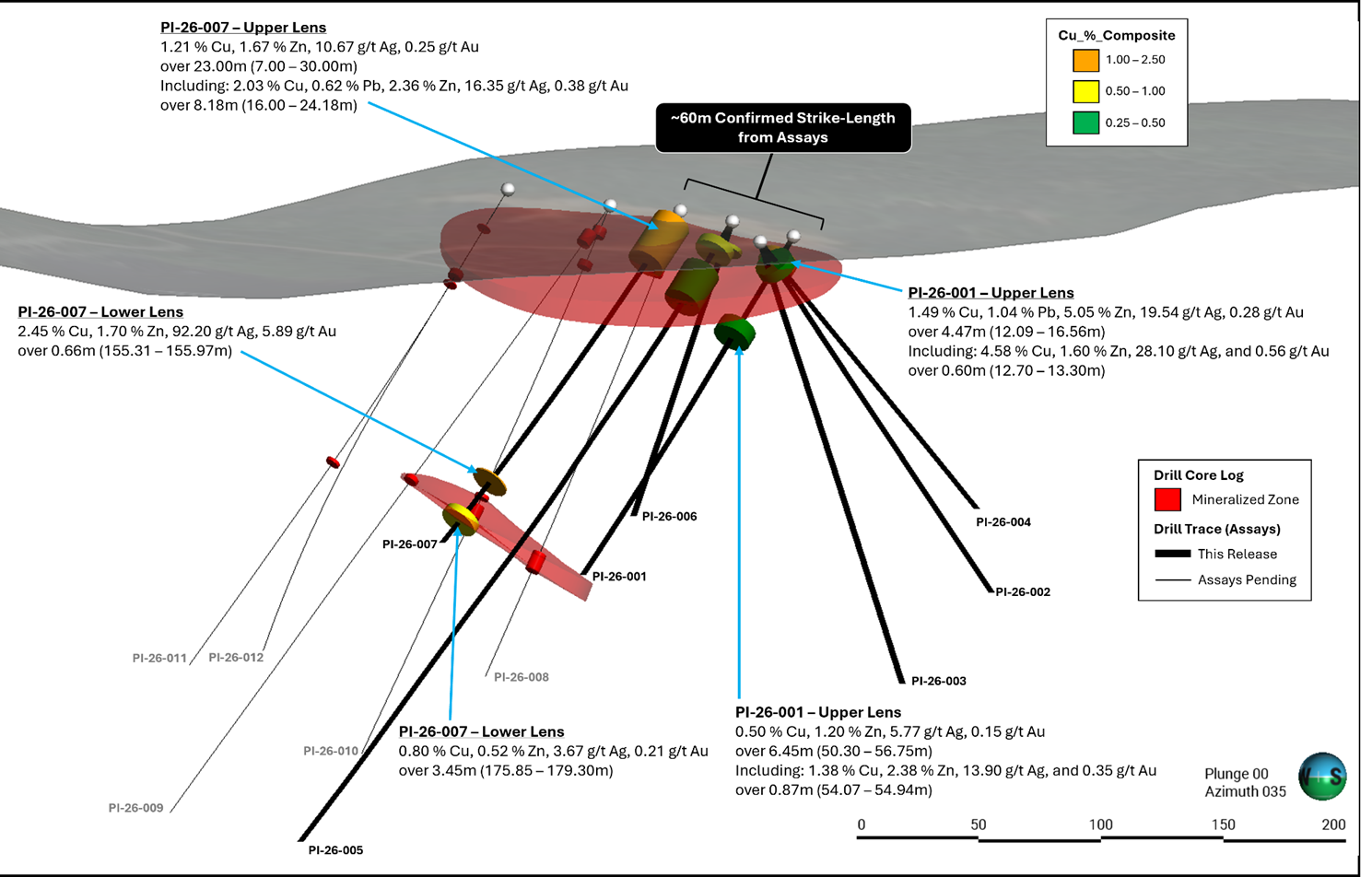
Figure 2: Oblique view of the 2026 Phase One drilling completed at the Clifford Jones (Bull Road) Zone. Small red discs represent visually logged mineralized zones (assays pending). "Including" assay values not represented by colour-scale on figure.
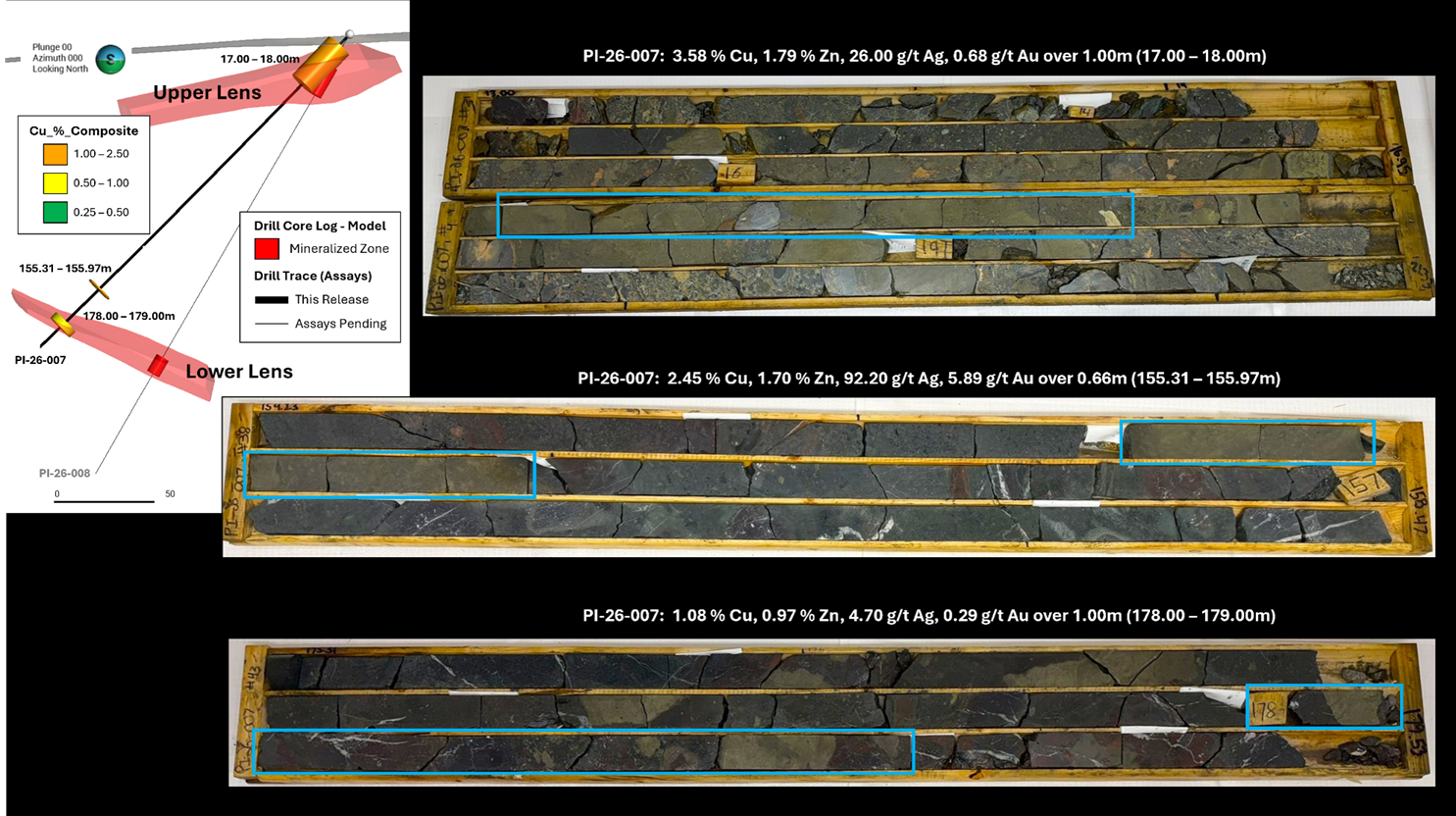
Figure 3: Cross-section of drill hole PI-26-007 (looking north) showing select significant mineralized intercepts with corresponding drill-core photos. In drill section, small red discs represent visually logged mineralized zones (assays pending).
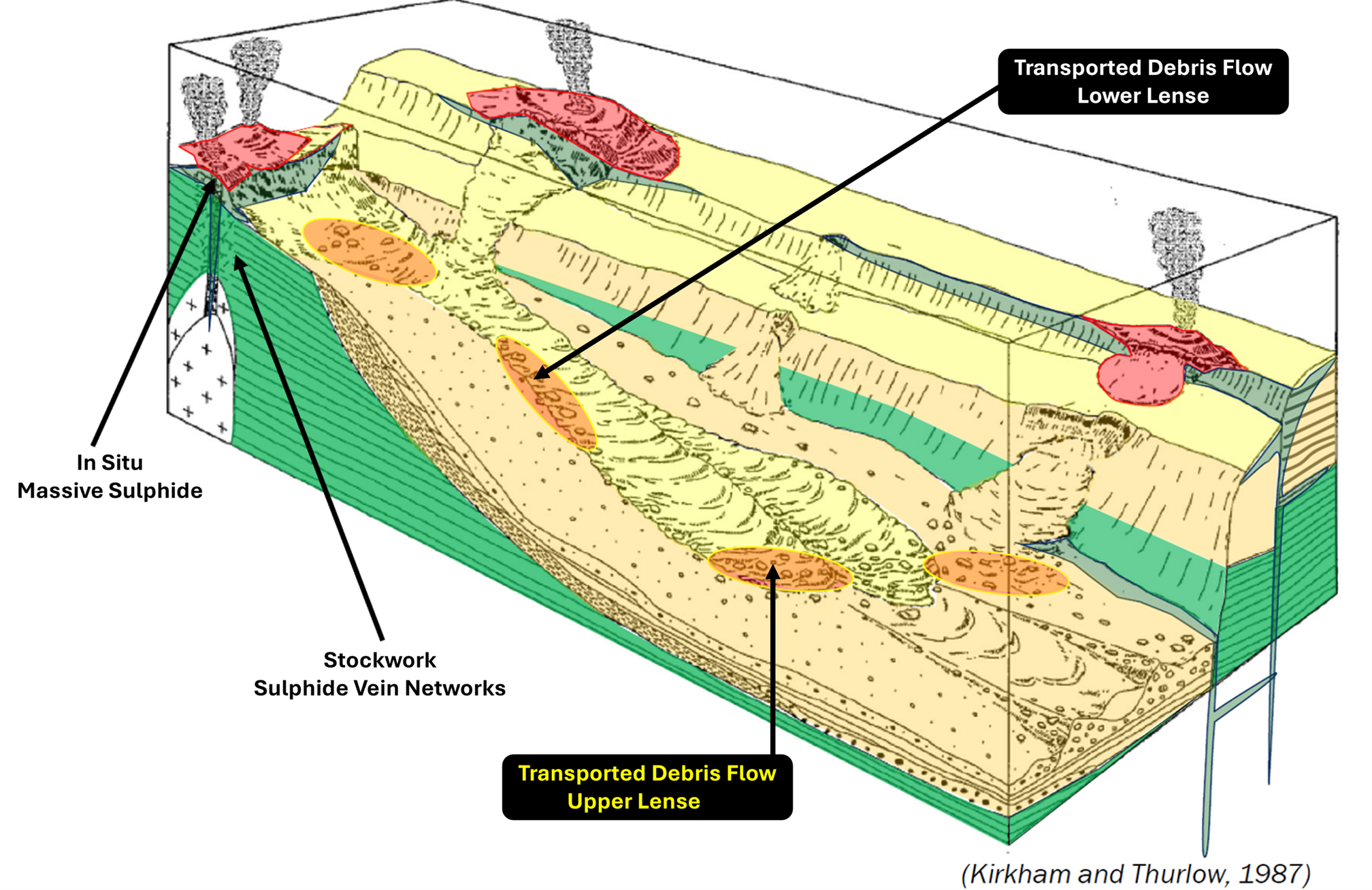
Figure 4: Conceptual model of VMS mineralization and the locations of where various types of mineralization may be located within the system. Mineralization intersected at the Clifford Jones (Bull Road) Zone appears to be transported from source; however, the angularity of the massive-sulphide clasts may indicate limited transport distance from the source vent (Modified after Kirkham and Thurlow, 1987).
Table 2: 2026 drill collar data; Coordinates reported in NAD83 - Zone 21N.
Hole ID | East | North | Azi | Dip | Depth (m) | Assay Status |
PI-26-001 | 593296 | 5485437 | 255 | -45 | 187.00 | This Release |
PI-26-002 | 593269 | 5485422 | 75 | -45 | 199.00 | This Release |
PI-26-003 | 593269 | 5485422 | 75 | -65 | 199.00 | This Release |
PI-26-004 | 593269 | 5485422 | 90 | -45 | 151.00 | This Release |
PI-26-005 | 593281 | 5485460 | 255 | -45 | 352.00 | This Release |
PI-26-006 | 593281 | 5485460 | 255 | -65 | 133.00 | This Release |
PI-26-007 | 593264 | 5485472 | 255 | -45 | 191.27 | This Release |
PI-26-008 | 593264 | 5485472 | 255 | -60 | 220.00 | Pending |
PI-26-009 | 593243 | 5485492 | 260 | -45 | 341.60 | Pending |
PI-26-010 | 593243 | 5485492 | 260 | -60 | 259.00 | Pending |
PI-26-011 | 593213 | 5485522 | 260 | -50 | 253.00 | Pending |
PI-26-012 | 593213 | 5485522 | 235 | -45 | 262.00 | Pending |
Geology & Mineralization
The Project is located within the Notre Dame Subzone of the Dunnage Tectonostratigraphic Zone. Of note, most of the Project is underlain by Ordovician submarine volcanic rocks of the Roberts Arm Group which is regionally identified as part of a mature arc sequence referred to as the Buchans-Roberts Arm Belt that also hosts the historic Buchans mine (after Dunning et al., 1987). Mineralization occurs as lower grade (Spencer's Dock); medium grade (Old Mines); and high grade (3B-Zone/Clifford Jones) deposits that are of both sub-seafloor replacement and exhalative varieties. The deposits are often flanked by extensive chlorite, sericite, silica, K-feldspar and epidote alteration often observed in bimodal-felsic VMS systems. The Spencer's Dock area displays sericite/silica alteration that generally increases in intensity near mineralized zones, while the 3B/Old Mine areas display sericite/silica alteration that is abundant but less widespread and is more intense when proximal to mineralized zones (after Kerr, 1996).
VMS deposits are a globally significant source of copper, zinc, lead, silver, and gold. The Project's geology shares key characteristics with known VMS districts in Newfoundland, including the past producing Buchans, Ming and Rambler Mines, supporting the exploration potential of the Project.
About Lewis Pilley's Project
The Project is road accessible and situated approximately twenty-five (25) km east of the town of Springdale, approximately fifty-five (55) km southeast of Firefly Metals' Green Bay Project and approximately one hundred fifty (150) km from the Pine Cove Mill and Port by way of major roads (Figure 5).
The Project has a long history of mining and exploration dating back to the late 1800s when the Pilley's Island Pyrite Company Ltd. produced approximately 450,000 tonnes of massive pyritic ore from the Pilley's Island Mine-Old Mines (after Kerr, 1996).
The Project hosts a cluster of VMS systems and prospects with demonstrated high-grade Zn-Pb-Cu-Ag+/-Au intersections. Mineralization is typical bimodal-felsic VMS, with both massive sulphide and sulphide-clast breccias (Thurlow, 1996). The geological setting is directly analogous to the Buchans camp (Thurlow, 1996), and the presence of sulphide-clast breccias is a strong vector toward proximal massive sulphide lenses.
Most of the historic showings that fall within the extents of the Project have not seen systematic exploration. Many of the historic drill holes were shallow and drilled in a vertical orientation limiting the geological knowledge of the extents of the underlying lithology and mineralization. Work is being planned to validate historic assay results as well as collect new data from the 3B-Zone, Clifford Jones (Bull Road) Extension, Bouzanne Shaft, Henderson, Mansfield and Pilley's Cove Showings.
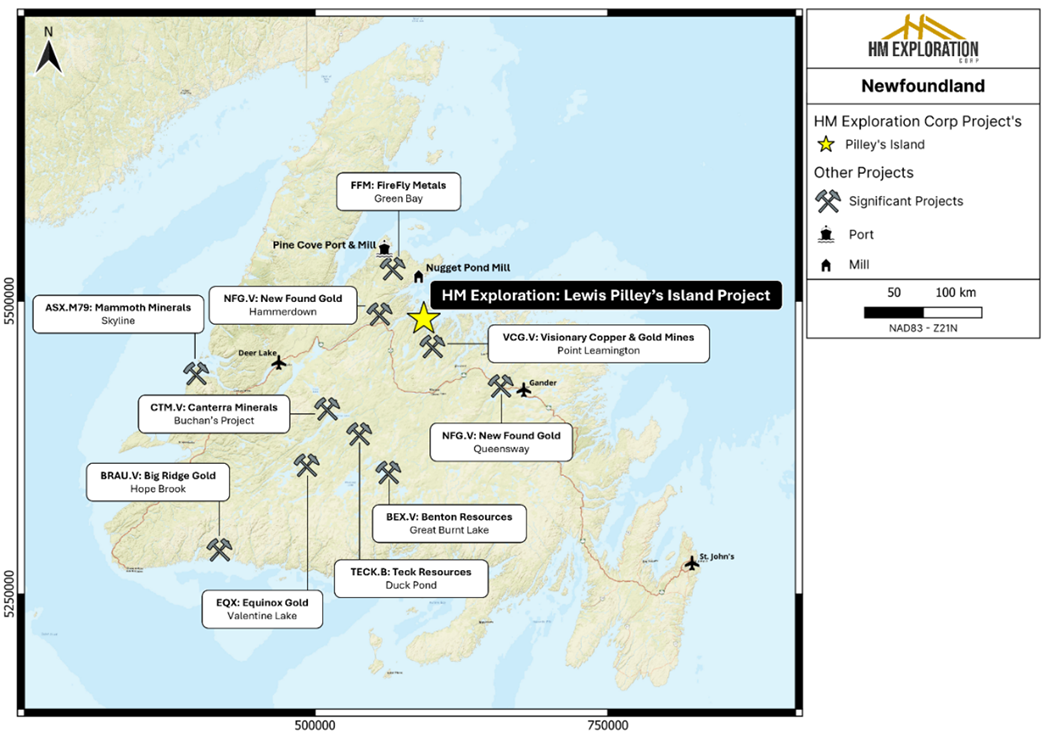
Figure 5: Regional map of Newfoundland displaying the location of the Project as well as other significant mineral exploration and mining projects in Newfoundland - Canada.
Sampling, Preparation & QA/QC
Drill collar locations were determined from hand-held GPS (NAD83-Zone 21N) and the drill rig was aligned using a Reflex TN-14 Gyrocompass alignment tool. All samples are given a unique sample ID and number and shipped directly to Eastern Analytical Ltd. (403 Little Bay Road, Springdale, NL), a commercial laboratory that is ISO/IEC 17025 accredited and completely independent of the Company. Analytical methods include ICP-OES (34 element) with four-acid digestion, Au Fire Assay (30g) with AA finish, and Ore Grade Assay (multi-acid digestion) with AA finish. The Company inserts standard, blank, and duplicate samples as part of its standard QA/QC procedures.
National Instrument 43-101 Disclosure
Nicholas Rodway, P. Geo, (Licence# 46541) (Permit to Practice# 1000359) is CEO and Director of the Company, and a qualified person as defined by National Instrument 43-101- Standards of Disclosure for Mineral Projects. Mr. Rodway has supervised the preparation of, and verified and approved the technical content in this news release. Verification included review of drill logs, sample tags, chain of custody procedures and analytical protocols. No limitations were noted during the verification process.
References
Dunning, G.R., Kean, B.F., Thurlow, J.G and Swinden, H.S. (1987): Geochronology of the Buchans, Roberts Arm and Victoria Lake Groups and Mansfield Cove Complex, Newfoundland. Canadian Journal of Earth Sciences, Volume 24, pages 1175-1184.
Kerr, A. (1996) New perspectives on the stratigraphy, volcanology, and structure of the island-arc volcanic rocks in the Ordovician Roberts Arm Group, Notre Dame Bay. In Current Research, Newfoundland Department of Natural Resources, Geological Survey, Report 96-1, pages 283-310.
Thurlow, J.G (1996): Geology of a newly discovered cluster of blind massive sulphide deposits, Pilley's Island, central Newfoundland. In Current Research, Newfoundland Department of Natural Resources, Geological Survey, Report 96-1, pages 181- 189.
About HM Exploration Corp.
The Company is currently advancing its Lewis Pilley's Project located in Newfoundland. The Project encompasses a land area of ~60.25 km² and hosts a cluster of volcanogenic massive sulphide (VMS) systems and the historic Pilley's Island Mine (~450,000 tonnes of ore produced in the late 1800s). Historic drilling at the 3B-Zone returned significant intersections, including 16.77m of 1.84% Cu and 3.05m of 5.03% Zn with 1.02 g/t Au (Au Pell, 1989). The geological setting is directly analogous to the prolific Buchans camp, with multiple underexplored showings and strong potential for new discoveries.
In addition, the Company holds 100% interest in the Devil's Den Project, an exploration-stage project consisting of two contiguous mineral licences encompassing ~3,200 hectares located west of Port Alberni, Vancouver Island, British Columbia. Exploration work completed in 2022 established four geochemical grids to identify possible buried mineralization, uncovering multiple high-grade occurrences including copper values up to 4.68% at surface (Devil's Den NI 43-101, Nov 2022). Phase One exploration completed in 2025 included high-resolution UAV magnetic surveying and a lithogeochemical program, which identified new structural targets and zones of elevated copper, zinc, and nickel geochemistry. The project hosts multiple historical adits with high-grade surface occurrences that remain undrilled. HM believes a lack of adequate modern exploration has left significant discovery potential.
HM Exploration is committed to applying modern exploration techniques across its projects to unlock value in historically underexplored Canadian mining districts.
On Behalf of the Board of Directors
HM EXPLORATION CORP.
"Nicholas Rodway"
President & CEO
Tel: 604.681.1568
info@hmexploration.com
Forward Looking Statements
This news release includes certain "Forward-Looking Statements" within the meaning of the United States Private Securities Litigation Reform Act of 1995 and "forward-looking information" under applicable Canadian securities laws. When used in this news release, the words "anticipate", "believe", "estimate", "expect", "target", "plan", "forecast", "may", "would", "could", "schedule" and similar words or expressions, identify forward-looking statements or information.
Forward-looking statements and forward-looking information relating to any future mineral production, liquidity, enhanced value and capital markets profile of HM, future growth potential for HM and its business, and future exploration plans are based on management's reasonable assumptions, estimates, expectations, analyses and opinions, which are based on management's experience and perception of trends, current conditions and expected developments, and other factors that management believes are relevant and reasonable in the circumstances, but which may prove to be incorrect. Assumptions have been made regarding, among other things, the price of copper, gold and other metals; costs of exploration and development; the estimated costs of development of exploration projects; HM's ability to operate in a safe and effective manner and its ability to obtain financing on reasonable terms.
This news release contains "forward-looking information" within the meaning of the Canadian securities laws. Statements, other than statements of historical fact, may constitute forward looking information and include, without limitation, statements with respect to the Project and its mineralization potential, the presence of VMS systems within the Project and the likelihood of a future discovery; the Company's objectives, goals, or future plans with respect to the Project; the expected benefits of completing the Program; the current and future results of the Program; and further exploration work on the Project or other projects in the future. With respect to the forward-looking information contained in this news release, the Company has made numerous assumptions regarding, among other things, the geological, metallurgical, engineering, financial and economic advice that the Company has received is reliable and are based upon practices and methodologies which are consistent with industry standards. While the Company considers these assumptions to be reasonable, these assumptions are inherently subject to significant uncertainties and contingencies. Additionally, there are known and unknown risk factors which could cause the Company's actual results, performance or achievements to be materially different from any future results, performance or achievements expressed or implied by the forward-looking information contained herein. Known risk factors include, among others: fluctuations in commodity prices and currency exchange rates; uncertainties relating to interpretation of drill results and the geology, continuity and grade of copper, gold and other metals; uncertainty of estimates of capital and operating costs, recovery rates, production estimates and estimated economic return; the need for cooperation of government agencies in the exploration and development of properties and the issuance of required permits; the need to obtain additional financing to develop properties and uncertainty as to the availability and terms of future financing; the possibility of delay in exploration or development programs or in construction projects and uncertainty of meeting anticipated program milestones; uncertainty as to timely availability of permits and other governmental approvals; increased costs and restrictions on operations due to compliance with environmental and other requirements; increased costs affecting the metals industry and increased competition in the metals industry for properties, qualified personnel, and management. All forward-looking information herein is qualified in its entirety by this cautionary statement, and the Company disclaims any obligation to revise or update any such forward-looking information or to publicly announce the result of any revisions to any of the forward-looking information contained herein to reflect future results, events or developments, except as required by law.
The Canadian Securities Exchange (CSE) does not accept responsibility for the adequacy or accuracy of this release.
SOURCE: HM Exploration
View the original press release on ACCESS Newswire:
https://www.accessnewswire.com/newsroom/en/metals-and-mining/hm-exploration-confirms-significant-mineralization-at-lewis-pilleys-project-inter-1193249
