
London, United Kingdom--(Newsfile Corp. - August 13, 2026) - CS Global Partners launches the 2026 USA Spotlight, a country-focused edition of the World Citizenship Report (WCR). The Spotlight examines the citizenship preferences of US nationals. It arrives with a striking finding that "Americans accounted for nearly a third of citizenship applications processed globally in the first quarter of 2026."
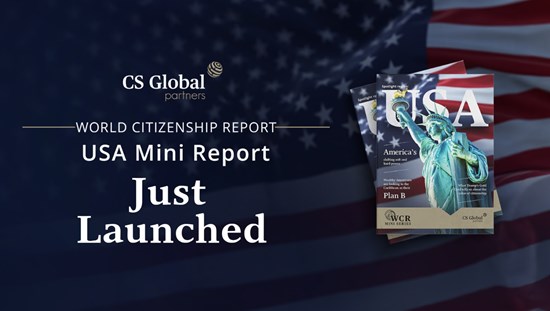
To view an enhanced version of this graphic, please visit:
https://images.newsfilecorp.com/files/10545/309468_b55a6478940a989c_001full.jpg
In the Caribbean, US nationals made up around half of all applicants in early 2026 and this growth has come even as programmes introduced higher investment thresholds, mandatory interviews, biometric requirements and enhanced due diligence.
Combining the WCR's global citizenship rankings with new survey data and market analysis, the US Spotlight explores why Americans are increasingly treating additional citizenship as long-term planning rather than a reaction to any single political or economic event.
"Second citizenship was once regarded as optional. Today, it is becoming part of the wealth planning mix, alongside investment diversification, tax structuring and long-term family security," said Micha-Rose Emmett, CEO of CS Global Partners.
"The WCR data reflects this shift and reinforces what we are seeing commercially, as US families increasingly look beyond the United States to broaden their options and build resilience."
The findings also land against a backdrop of shifting perceptions of American influence. The report notes that the United States recorded the steepest decline among 193 countries in a leading global soft power index published in January 2026, falling 4.6 points to 74.9 and narrowing its lead over China to 1.5 points.
Americans are planning, not simply leaving
While the rankings compare jurisdictions across the five WCR motivators, the survey data reveals how Americans view their own citizenship and confidence is far from absolute. Only around one-third of respondents said they were very confident their existing citizenship would provide the same security and opportunity over the next decade. Asked where their government was falling short, 45.4% pointed to a competitive economy, notable given that Economic Opportunity remains one of the United States' strongest positions in the World Citizenship Index.
"These are planners, not evacuees," Emmett said. "The decisions are driven by business and professional opportunity, investment diversification and long-term family security."
The Gold Card: a test of what money can buy
The Spotlight also examines America's own attempt at a high-value immigration pathway, the Trump administration's Gold Card, launched by executive order in September 2025 and opened to applications that December. It requires a US$1 million contribution to the federal government plus a non-refundable US$15,000 processing fee, and offers a route to lawful permanent residency rather than direct citizenship.
Initially promoted with projections of tens of thousands of participants and over US$100 billion in revenue, early uptake was far smaller. Testimony by Commerce Secretary Howard Lutnick in April 2026 indicated only one approval at that point, while a Department of Homeland Security court filing disclosed 338 requests and 165 paid fees by spring 2026.
The report argues these early figures offer a useful contrast with continued interest in established citizenship programmes, where applicants weigh legal certainty, programme longevity, due diligence and whole-family planning not just the price tag.
Demand grew as programmes raised standards
One of the report's more notable findings is timing: American demand rose precisely as Caribbean programmes strengthened integrity measures through 2025 and 2026, including mandatory interviews, biometrics, enhanced due diligence and a higher regional minimum investment threshold of US$200,000, depending on programme and route. Applicants increasingly prioritised programme longevity, legal frameworks and institutional stability over the lowest-cost option exemplified by St. Kitts and Nevis' programme, the longest-running of its kind since 1984.
An emerging trend and a new series
The wider trend remains early-stage: around 80% of respondents worldwide hold only one citizenship, 15% hold two, and 5% hold three or more. For Americans, the shift identified by the first Spotlight is less about abandoning one country than expanding the options available to individuals and families.
In the WCR's Spotlight series, the USA report sets the trajectory for what comes next. As the series expands to other major economies, the WCR will examine whether the American experience is an isolated development or part of a broader transformation in how citizens value holding more than one citizenship.
Access the report here.
Contact:
Pr@csglobalpartners.com

To view the source version of this press release, please visit https://www.newsfilecorp.com/release/309468
Source: CS Global Partners
