Vancouver, British Columbia--(Newsfile Corp. - August 20, 2026) - Standard Uranium Ltd. (TSXV: STND) (OTCQB: STTDF) (FSE: 9SU0) ("Standard Uranium" or the "Company") is pleased to provide additional highlights and interpretations of geological and geochemical assay results from its winter 2026 drill program at the Corvo Uranium Project ("Corvo", or the "Project") located near Wollaston Lake in northeastern Saskatchewan (Figure 1). The 2026 drilling results highlight the prospectivity of the Project for significant basement-hosted uranium mineralization.
Sean Hillacre, President & VP Exploration of Standard Uranium, stated, "Digging deeper into the results of our first drill program at Corvo truly emphasizes the widespread prospectivity of the Project. We have created models of uranium-enriched rock packages, structures, and associated hydrothermal alteration which really add scale and context to the fertile system we are just beginning to test at Corvo. We have run statistics and calculations on our assay results, which highlight exceptional anomalies in specific elements and isotope ratios that have been shown to be favourable for basement-hosted uranium systems. These results underpin the discovery potential on the Project and why we are so excited to continue aggressively exploring Corvo with our partners at Aventis."
Highlights
Uranium-Fertile System: Analytical results from the Company's first-ever drill campaign confirmed anomalous* uranium in all nine completed drill holes. Results returned a total of fifty-five (55) metres of weakly anomalous uranium (>10 ppm U, partial), including twenty-three (23) metres of moderately anomalous uranium (>50 ppm U, partial), and including thirteen (13) metres of highly anomalous uranium (>100 ppm U, partial; Figure 2)1.
Elevated Pathfinder Elements: Moderately to highly anomalous quantities of uranium pathfinder elements including V, Co, Cu, and Ni are consistently associated with elevated uranium across all drill holes.
Key Geochemistry Fingerprints: Geochemical ratios including U:Th and lead (Pb) isotope ratios have been calculated, and relationships suggest that the source material was distinctly rich in 238U (and by association 235U) relative to thorium, consistent with the geochemistry of known Athabasca uranium deposits. Extremely anomalous 206Pb/204Pb ratios >1,000 are highlighted across multiple uranium-bearing intervals.
Structural Continuity & Alteration: Geological and geochemical modeling of the 2026 drilling results have defined a series of stacked graphitic faults and high-strain zones associated with hydrothermal alteration and key geochemical signatures favourable for uranium mineralization across all three tested target areas.
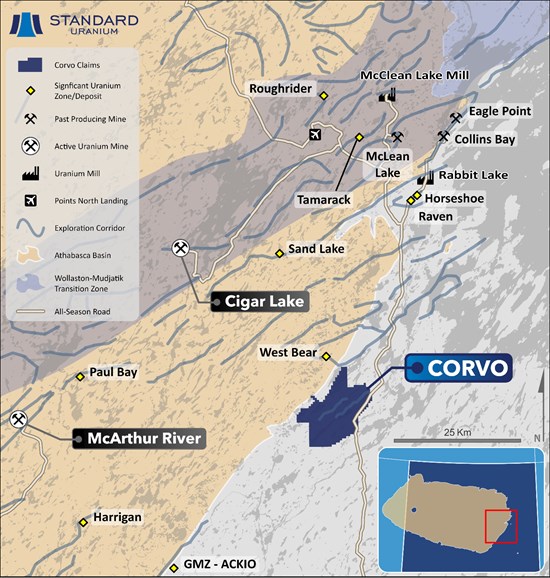
Figure 1. Regional overview of the Corvo Project in the eastern Athabasca Basin region.
To view an enhanced version of this graphic, please visit:
https://images.newsfilecorp.com/files/10633/310573_d9086260d49bd99f_001full.jpg
The Project is currently under a three-year earn-in option agreement (the "Option Agreement") with Aventis Energy Inc. ("Aventis") (CSE: AVE). A total of 2,457 metres were completed across ten reconnaissance drill holes at the Manhattan, Brooklyn, and Tribeca target areas (Figure 2). One drill hole was abandoned due to ground conditions. The winter 2026 drill program was funded by Aventis and operated by Standard Uranium.
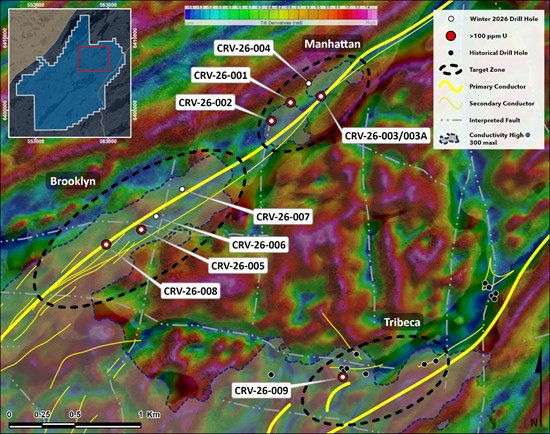
Figure 2. Corvo project overview highlighting drill holes with intervals of highly anomalous uranium >100 ppm U across high-priority target areas drilled during the winter 2026 program.
To view an enhanced version of this graphic, please visit:
https://images.newsfilecorp.com/files/10633/310573_d9086260d49bd99f_002full.jpg
Corvo 2026 Drill Program Results
The winter 2026 drill program was highly successful in uncovering a uranium-fertile system at Corvo along multi-kilometre long structural trends. The drill results highlight tens of metres of anomalous* uranium and other pathfinder elements indicative of a basement-hosted uranium system across multiple target areas.
Key context and takeaways of the 2026 drilling results:
Partial-digestion results & U:Th Ratios: Partial-digestions uranium assays inherently emphasize hydrothermal uranium input while reducing the contribution from resistant accessory minerals. During early-stage targeting, interpreting partial digestion assays and U:Th ratios can be used as an exploration vector and improve discrimination between fertile lithologies and genuinely mineralized systems - In general, the higher the ratio, the better for hydrothermal U systems. The Corvo uranium results returned U:Th ratios averaging 1.5 to 5, and locally as high as 12 to 21.
Pb Isotope Ratios: Lead isotope ratios are often used to assist in identifying anomalous rock samples related to the radioactive decay of uranium and can outline trends or a "footprint" corresponding to the location of uranium mineralization. 206Pb and 207Pb are products of the radioactive decay of 238U and 235U, respectively, and 208Pb is a product of the radioactive decay of 232Th. 204Pb is non-radiogenic and acts as a measure of background lead content. Calculating the 206Pb/204Pb ratio is a key indicator to the influence of uranium decay in mineralized systems, with values >100 being considered highly anomalous. The 206Pb/204Pb ratio results from 405 Corvo samples averages 147, with 27 samples >400 and a maximum of 5,100.
Scale of Structure & Alteration: Inaugural drilling intersected key characteristics of a multi-kilometre uranium-bearing mineralized system across the Manhattan, Brooklyn, and Tribeca target areas. Drilling confirmed the presence of significant fault systems linked to uranium enrichment and prospective hydrothermal alteration in the basement rock (Figures 3-5).
Overall, the 2026 drill program results have confirmed that Corvo boasts key geological and geochemical hallmarks of a fertile uranium system, and the results have increased the Company's confidence in the prospectivity of the Project.
Targets were selected and prioritized through an iterative approach working in collaboration with Convolutions Geoscience Corporation, targeting compelling geophysical signatures and favorable geological/structural settings. Prospecting and mapping across the Project in 2025 outlined multiple mineralized outcrops and boulders, including the Manhattan showing which returned results up to 8.10% U3O8 at surface2. These surface showings paired with the results of the Company's first drill campaign on the Project build a compelling basis for continued exploration.
*In crystalline basement rocks, the Company considers concentrations of uranium >10 ppm U to be "weakly anomalous", concentrations >50 ppm U to be "moderately anomalous" and concentrations >100 ppm U to be "highly anomalous". Intervals represent drilled core lengths; True thicknesses of mineralized zones cannot be determined with certainty at this stage of exploration.
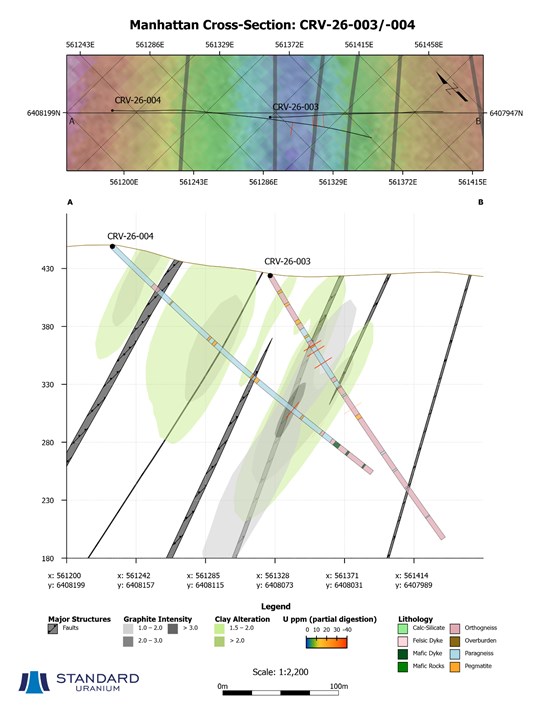
Figure 3. Schematic cross-section of drill holes CRV-26-003 and CRV-26-004 highlighting anomalous uranium intersections >20 U ppm and associated structure, graphite, and hydrothermal clay alteration. Total Field magnetics are shown in the background of the plan view insert.
To view an enhanced version of this graphic, please visit:
https://images.newsfilecorp.com/files/10633/310573_d9086260d49bd99f_003full.jpg
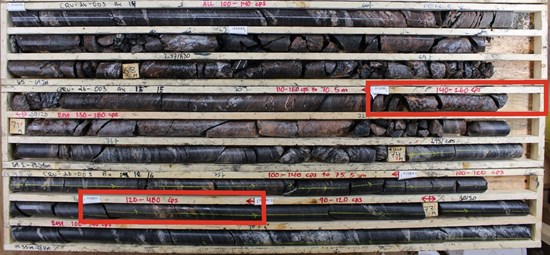
Figure 4. Drill core photos from CRV-26-003 highlighting anomalous uranium associated with hydrothermal alteration and structure. Geochemical assay of a fractured and hematized zone returned 64.4 ppm partial uranium over 0.5 m from 70.5 to 71.0 m. From 76.0 to 76.5 m, semi-pelitic gneiss with local pegmatite intrusion returned 76.2 ppm partial uranium (0.008 wt.% U308) over 0.5 m.
To view an enhanced version of this graphic, please visit:
https://images.newsfilecorp.com/files/10633/310573_d9086260d49bd99f_004full.jpg
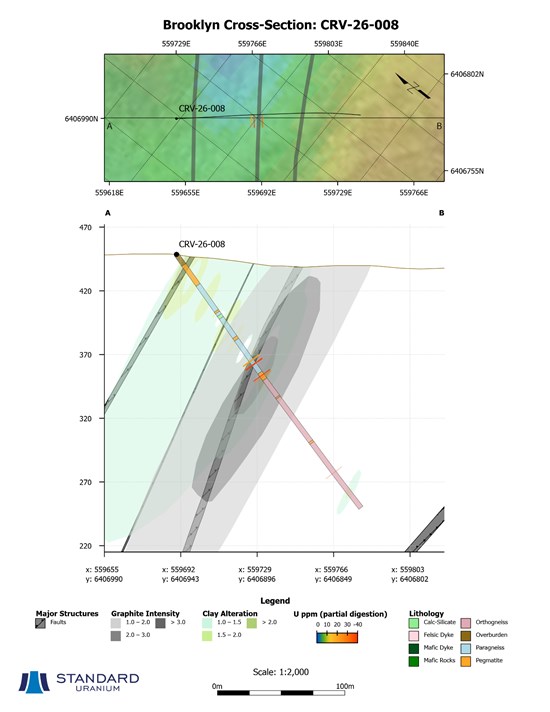
Figure 5. Schematic cross-section of drill hole CRV-26-008 highlighting anomalous uranium intersections >20 U ppm and associated structure, graphite, and hydrothermal clay alteration. Total Field magnetics are shown in the background of the plan view insert.
To view an enhanced version of this graphic, please visit:
https://images.newsfilecorp.com/files/10633/310573_d9086260d49bd99f_005full.jpg
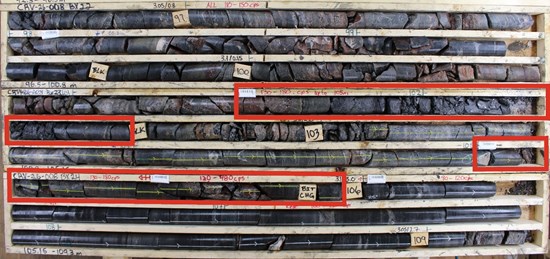
Figure 6. Drill core photos from CRV-26-008 highlighting anomalous uranium associated with hydrothermal alteration and structure. Graphitic brittle reactivated fault zone within pelitic gneiss characterized by strong to locally intense graphitic gouge hosts 21.2 ppm partial uranium over 1.0 m from 101.5 to 102.5 m. Below, geochemical assays returned 0.003 wt.% U3O8 (36.1 ppm, partial) over 0.5 m from 105.0 to 105.5 m and 0.024 wt.% U3O8 (201.0 ppm, partial) over 0.5 m from 105.5 to 106.0 m associated with hematized pelitic gneiss.
To view an enhanced version of this graphic, please visit:
https://images.newsfilecorp.com/files/10633/310573_d9086260d49bd99f_006full.jpg
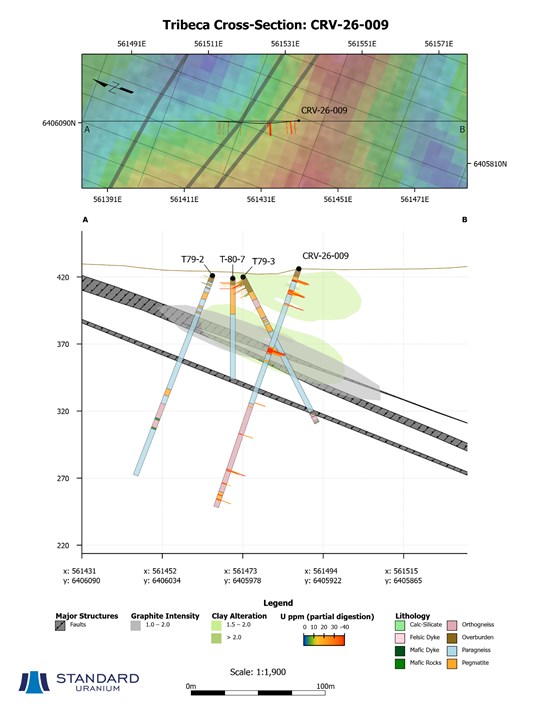
Figure 7. Schematic cross-section of drill hole CRV-26-009 highlighting anomalous uranium intersections >20 U ppm (centre of trace) and U3O8 values ranging from 0.002 wt.% to 0.04 wt.% (right of trace), and associated structure, graphite, and hydrothermal clay alteration. Historical holes T79-2, T79-3, and T-80-7 are projected to section highlighting U3O8 values ranging from 0.002 wt.% to 0.116 wt.% (left of trace). Total Field magnetics are shown in the background of the plan view insert.
To view an enhanced version of this graphic, please visit:
https://images.newsfilecorp.com/files/10633/310573_d9086260d49bd99f_007full.jpg
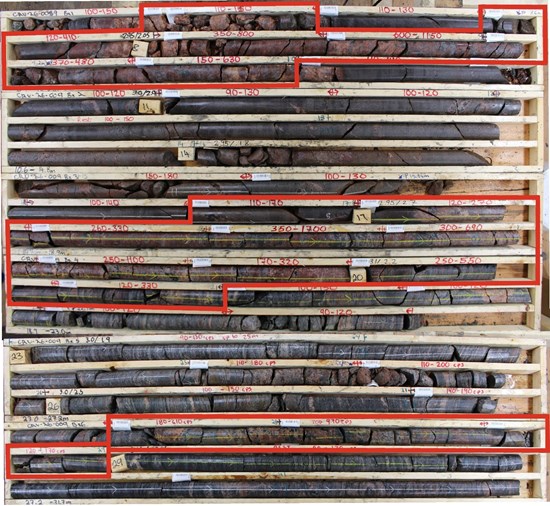
Figure 8. Drill core photos from CRV-29-009 highlighting anomalous uranium values associated with hydrothermal alteration and structure. Assays returned uranium values of 0.0005 wt.% to 0.018 wt.% U3O8 (10.1 to 192.0 U ppm, partial) over 3.0 m between 6.5 to 10.0 m; values ranging from 0.0005 up to 0.019 wt.% U3O8 (11.1 up to 171.0 U ppm, partial) over 4.5 m from 16.5 to 21.0 m; and values of 0.001 wt.% up to 0.035 wt.% U3O8 (27.0 ppm and 300 U ppm, partial) over 1.5 m from 27.5 to 29.0 m.
To view an enhanced version of this graphic, please visit:
https://images.newsfilecorp.com/files/10633/310573_d9086260d49bd99f_008full.jpg
Next Steps & Follow Up
The Company is currently planning additional surface exploration and geophysical work to be completed in the coming months. A second phase drilling program is being planned for 2027 to follow-up along strike of mineralized drill holes and continue testing of priority drill targets across the Project.
The Company believes the Project is highly prospective for the discovery of shallow, high-grade** basement-hosted uranium mineralization akin to the Rabbit Lake deposit. Located just outside the current margin of the Athabasca Basin, Corvo boasts more than 29 km of structural corridors with multiple untested drill targets with minimal cover of glacial till.
This first pass drill program marks the first drilling on the Project in more than 40 years, and the results confirm uranium fertility across multiple target areas. Standard and Aventis will incorporate the results of the 2026 program into the exploration strategy at Corvo for follow-up exploration programs targeting basement hosted uranium mineralization.
Qualified Person Statement
The scientific and technical information contained in this news release has been reviewed and approved by Sean Hillacre, P.Geo., President and VP Exploration of the Company and a "qualified person" as defined in NI 43-101 - Standards of Disclosure for Mineral Projects.
Samples collected for analysis were sent to SRC Geoanalytical Laboratories in Saskatoon, Saskatchewan for preparation, processing, and ICP-MS multi-element analysis using total and partial digestion and boron by fusion. Basement samples were tested with ICP-MS2 uranium multi-element exploration package plus boron. All sandstone samples, and basement samples marked as radioactive upon arrival to the lab were also analyzed using the U3O8 assay (reported in wt.%). Basement rock split interval samples range from 0.1 to 1.0 m. SRC is an ISO/IEC 17025/2005 and Standards Council of Canada certified analytical laboratory. Blanks, standard reference materials, and repeats were inserted into the sample stream at regular intervals in accordance with Standard Uranium's quality assurance/quality control ("QA/QC") protocols. All samples passed internal QA/QC protocols and the results presented in this release are deemed complete, reliable, and repeatable.
Samples containing clay alteration were sent to Rekasa Rocks Inc. in Saskatoon, Saskatchewan to be analyzed by Short Wavelength Infrared Reflectance ("SWIR") via a Portable Infrared Mineral Analyzer ("PIMA") to verify clay species.
REE oxide conversion factors3 were verified using the following formulas:
Convert REE (Rare Earth Element) ppm to REO (Rare Earth Oxide): REO % = (ppm / Atomic Weight of REE) * (Molecular Weight of REO / 10,000). Element-to-oxide conversion factor: Molecular weight of the oxide / atomic weight of the element. For oxides with more than one metal cation, account for the number of cations in the formula. See Appendix A and Table 2 for individual REE assay results.
Historical data disclosed in this news release relating to sampling results from previous operators are historical in nature. Neither the Company nor a qualified person has yet verified this data and therefore investors should not place undue reliance on such data. The Company's future exploration work may include verification of the data. The Company considers historical results to be relevant as an exploration guide and to assess the mineralization as well as economic potential of exploration projects. Any historical grab samples disclosed are selected samples and may not represent true underlying mineralization.
Natural gamma radiation from rocks reported in this news release was measured in counts per second ("cps") using a handheld RS-125 super-spectrometer and RS-120 super-scintillometer. Readers are cautioned that scintillometer readings are not uniformly or directly related to uranium grades of the rock sample measured and should be treated only as a preliminary indication of the presence of radioactive minerals. Because the orientation of mineralization is unknown, true widths are unknown and reported intervals represent core lengths. The RS-125 and RS-120 units supplied by Radiation Solutions Inc. ("RSI") have been calibrated on specially designed Test Pads by RSI. Standard Uranium maintains an internal QA/QC procedure for calibration and calculation of drift in radioactivity readings through three test pads containing known concentrations of radioactive minerals. Internal test pad radioactivity readings are known and regularly compared to readings measured by the handheld scintillometers for QA/QC purposes.
References
1 News Release: Standard Uranium Confirms Uranium Enrichment in all Winter 2026 Drill Holes at the Corvo Uranium Project, https://www.standarduranium.ca/news-releases/standard-uranium-confirms-uranium-enrichment-in-all-winter-2026-drill-holes-at-the-corvo-uranium-project
2 News Release: Standard Uranium Confirms High-Grade Uranium Mineralization up to 8.10% U3O8 at Surface on the Corvo Project, https://standarduranium.ca/news-releases/standard-uranium-confirms-high-grade-uranium-mineralization-at-surface-on-the-corvo-project/
3 https://www.jcu.edu.au/advanced-analytical-centre/resources/element-to-stoichiometric-oxide-conversion-factors
**The Company considers uranium mineralization with concentrations greater than 1.0 wt.% U3O8 to be "high-grade".
About Standard Uranium (TSXV: STND)
We find the fuel to power a clean energy future
Standard Uranium is a uranium exploration company and emerging project generator poised for discovery in one of the world's premier uranium districts. The Company holds interest in over 233,366 acres (94,440 hectares) in the Athabasca Basin in Saskatchewan, Canada. Since its establishment, Standard Uranium has focused on the identification, acquisition, and exploration of Athabasca-style uranium targets with a view to discovery and future development.
Standard Uranium's Davidson River Project, in the southwest part of the Athabasca Basin, Saskatchewan, consists of ten mineral claims over 30,737 hectares. Davidson River is highly prospective for basement-hosted uranium deposits due to its location along trend from recent high-grade uranium discoveries. However, owing to the large project size with multiple targets, it remains broadly under-tested by drilling. Recent intersections of wide, structurally deformed and strongly altered shear zones provide significant confidence in the exploration model and future success is expected.
Standard Uranium's eastern Athabasca projects comprise over 44,099 hectares of prospective land holdings. The eastern basin projects are highly prospective for unconformity related and/or basement hosted uranium deposits based on historical uranium occurrences, recently identified geophysical anomalies, and location along trend from several high-grade uranium discoveries.
Standard Uranium's Sun Dog project, in the northwest part of the Athabasca Basin, Saskatchewan, consists of nine mineral claims over 19,603 hectares. The Sun Dog project is highly prospective for basement and unconformity hosted uranium deposits yet remains largely untested by sufficient drilling despite its location proximal to uranium discoveries in the area.
For further information contact:
Jon Bey, Chief Executive Officer, and Chairman
Suite 3123, 595 Burrard Street
Vancouver, British Columbia, V7X 1J1
Tel: 1 (306) 850-6699
E-mail: info@standarduranium.ca
Cautionary Statement Regarding Forward-Looking Statements
This news release contains "forward-looking statements" or "forward-looking information" (collectively, "forward-looking statements") within the meaning of applicable securities legislation. All statements, other than statements of historical fact, are forward-looking statements and are based on expectations, estimates and projections as of the date of this news release. Forward-looking statements include, but are not limited to, statements regarding: the timing and content of upcoming work programs; timing of results of assays; geological interpretations including the Company's beliefs with respect to the Project and similarities to nearby deposits; timing of the Company's exploration programs; and estimates of market conditions.
Forward-looking statements are subject to a variety of known and unknown risks, uncertainties and other factors that could cause actual events or results to differ from those expressed or implied by forward-looking statements contained herein. There can be no assurance that such statements will prove to be accurate, as actual results and future events could differ materially from those anticipated in such statements. Certain important factors that could cause actual results, performance or achievements to differ materially from those in the forward-looking statements are highlighted in the "Risks and Uncertainties" in the Company's management discussion and analysis for the fiscal year ended April 30, 2025.
Forward-looking statements are based upon a number of estimates and assumptions that, while considered reasonable by the Company at this time, are inherently subject to significant business, economic and competitive uncertainties and contingencies that may cause the Company's actual financial results, performance, or achievements to be materially different from those expressed or implied herein. Some of the material factors or assumptions used to develop forward-looking statements include, without limitation: that the transaction with Aventis will proceed as planned; the future price of uranium; anticipated costs and the Company's ability to raise additional capital if and when necessary; volatility in the market price of the Company's securities; future sales of the Company's securities; the Company's ability to carry on exploration and development activities; the success of exploration, development and operations activities; the timing and results of drilling programs; the discovery of mineral resources on the Company's mineral properties; the costs of operating and exploration expenditures; the presence of laws and regulations that may impose restrictions on mining; employee relations; relationships with and claims by local communities and indigenous populations; availability of increasing costs associated with mining inputs and labour; the speculative nature of mineral exploration and development (including the risks of obtaining necessary licenses, permits and approvals from government authorities); uncertainties related to title to mineral properties; assessments by taxation authorities; fluctuations in general macroeconomic conditions.
The forward-looking statements contained in this news release are expressly qualified by this cautionary statement. Any forward-looking statements and the assumptions made with respect thereto are made as of the date of this news release and, accordingly, are subject to change after such date. The Company disclaims any obligation to update any forward-looking statements, whether as a result of new information, future events or otherwise, except as may be required by applicable securities laws. There can be no assurance that forward-looking statements will prove to be accurate, as actual results and future events could differ materially from those anticipated in such statements. Accordingly, readers should not place undue reliance on forward-looking statements.
Neither the TSX-V nor its Regulation Services Provider (as that term is defined in the policies of the TSX-V) accepts responsibility for the adequacy or accuracy of this release.
Appendix A - REE Assay Results
Table 2. Winter 2026 Corvo individual REE assay results from drill hole CRV-26-009. Intervals represent drilled core lengths; True thicknesses cannot be determined with certainty at this stage of exploration.
| DDH | Target Area | From (m) | To (m) | Width (m) | Ce (ppm) | Dy (ppm) | Eu (ppm) | Gd (ppm) | Ho (ppm) | La (ppm) | Lu (ppm) | Nd (ppm) | Pr (ppm) | Sm (ppm) | Tb (ppm) | Tm (ppm) | Y (ppm) | Yb (ppm) |
| CRV-26-009 | Tribeca | 7.5 | 8.0 | 0.5 | 494 | 9.97 | 4.57 | 0.98 | 17.5 | 1.91 | 230 | 0.57 | 205 | 61.5 | 31.3 | 2.24 | 0.58 | 48.2 |
| 8.0 | 8.5 | 0.5 | 733 | 20.2 | 8.34 | 1.11 | 42 | 3.98 | 351 | 0.81 | 306 | 88 | 52.3 | 3.54 | 1.28 | 110 | ||
| 8.5 | 9.0 | 0.5 | 1,230 | 31.8 | 12.7 | 0.93 | 59.8 | 6.03 | 531 | 1.34 | 491 | 146 | 84.1 | 5.51 | 2.01 | 163 | ||
| 9.5 | 10.0 | 0.5 | 968 | 16.7 | 7.25 | 0.8 | 27.3 | 3.19 | 442 | 1.16 | 363 | 110 | 53.3 | 4.07 | 0.89 | 68.4 | ||
| 159.0 | 159.5 | 0.5 | 1,120 | 18 | 7.24 | 0.78 | 31.1 | 3.26 | 485 | 0.97 | 388 | 126 | 58.6 | 3.38 | 1.22 | 87.1 | ||
| 169.5 | 170.0 | 0.5 | 544 | 12.2 | 6.11 | 1.58 | 15 | 2.28 | 276 | 0.67 | 190 | 56.9 | 29.4 | 2.5 | 1.06 | 60.9 |

To view the source version of this press release, please visit https://www.newsfilecorp.com/release/310573
Source: Standard Uranium Ltd.