NEW YORK CITY, NY / ACCESS Newswire / September 1, 2026 / Sustainability consulting and research firm Governance & Accountability Institute (G&A) and nonprofit advocacy organization Ceres released joint research examining the first voluntary corporate reports on climate risk submitted under California's Climate-Related Financial Risk Act (SB 261). This research on new rules from California - one of the world's largest economies - comes as state-level climate disclosure takes on a larger role in the absence of U.S. federal mandates.
The research analyzes 154 voluntary disclosures under SB 261 as of early May 2026. Entities operating in California submitted these reports voluntarily amid legal challenges to the law. "Companies' decision to report before it is mandatory to do so offers a signal of continued momentum toward more comprehensive climate-risk disclosure," said Annie Roberts, SVP, Climate Consulting, G&A Institute.
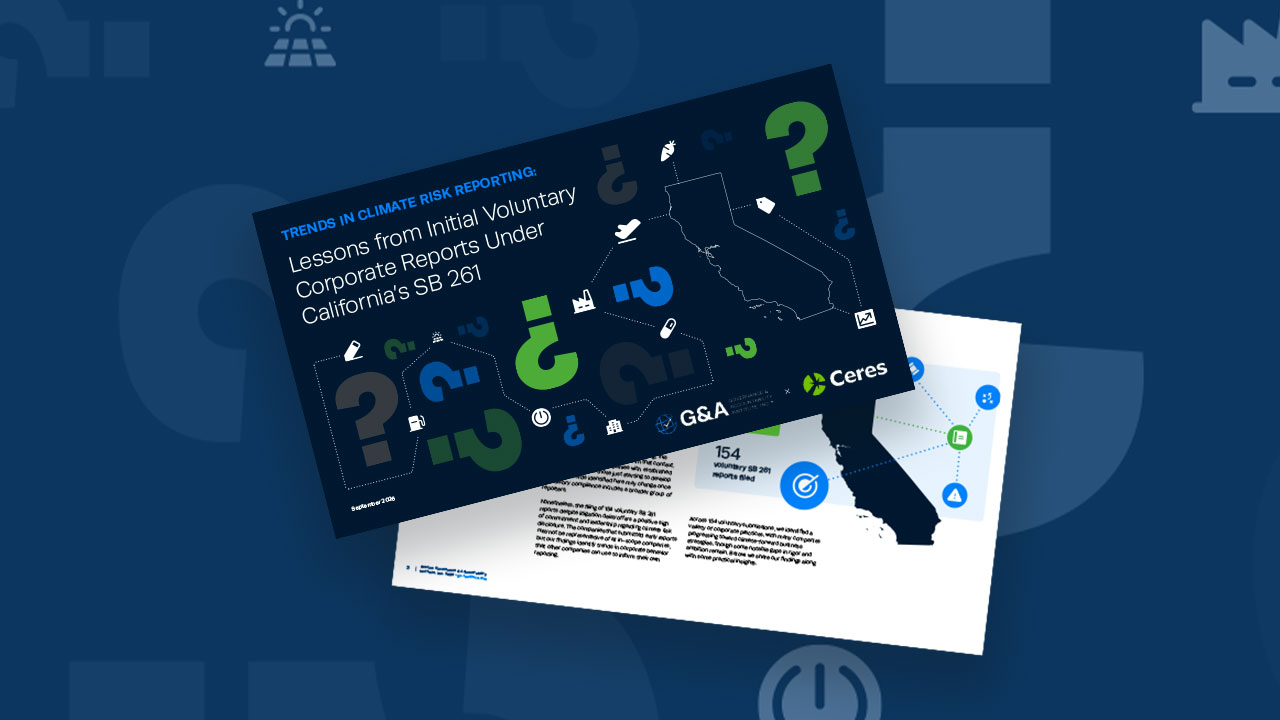
The paper, "Trends in Climate Risk Reporting: Lessons From Initial Voluntary Corporate Reports under California's SB 261," documents a wide range of approaches to identifying, assessing, and managing climate risk.
Key Findings from SB 261 Voluntary Reports
The findings establish an initial baseline for understanding how corporate climate risk reporting is developing ahead of mandatory compliance. As a resource for companies preparing for SB 261 reporting cycles, the results show that disclosure quality can vary dramatically. The authors identified gaps in the rigor and ambition of climate risk management; for example, nearly all early reporters identify physical and transition risks, but only 12% mention a formal transition plan and 12% quantify the financial impacts of climate-related risks. This result shows how companies technically can meet the minimum disclosure requirement while producing disclosures that fall short of what investors actually need.
"The first SB 261 reports make clear that the market has moved beyond the question of whether companies will disclose climate risk," said Steven Rothstein, Chief Program Officer at Ceres. "The most important question for investors is how useful those disclosures are-and whether they connect climate risks to financial impacts, business strategy, and concrete transition plans."
In another finding, 92% of early reporters disclosed board-level oversight of climate-related issues, though governance structure alone did not guarantee substantive climate action or disclosure quality.
"CARB's minimum requirements are an important starting point, but the strongest disclosures demonstrate that companies can-and increasingly need to-go further," said Roberts. "For investors, decision-useful disclosure means understanding not only what climate risks a company faces, but how those risks could affect its financial performance and how management plans to respond."
Where companies demonstrate more leadership is in their preparation of GHG emissions inventories, in many cases including Scope 3 emissions. While companies are not required to disclose emissions under SB 261, some of the same companies will be subject to SB 253, which requires Scopes 1-2 reporting beginning in November 2026 and Scope 3 reporting in 2027.
Wider Benefits of SB 261 Research
In conducting this research, G&A translated the CARB disclosure checklist into outputs related to the structure of TCFD and IFRS S2 and created measurable indicators for each one. They developed an AI analysis tool to extract specific data points from each individual report submitted to CARB's public docket and manually reviewed data points against the individual report. Together, G&A and Ceres drew on their knowledge of corporate and investor perspectives to provide context and interpret the results. Ultimately, the research yielded a set of indicators that can be used to assess future SB 261 submissions.
In addition, the paper presents case studies of leading disclosure practices, providing practical examples for organizations seeking to strengthen their disclosures.
Looking Forward
Climate disclosure practices can scale quickly once reporting frameworks become embedded in regulatory and voluntary expectations. G&A's long-range research on trends in corporate sustainability disclosure shows just how quickly: in G&A's flagship Sustainability Reporting in Focus research, among Russell 1000 companies, TCFD alignment rose from just 4% in 2019 to 60% in 2023. As California's climate-related disclosure requirements become more established, we would expect a similar trajectory - perhaps even faster, given their mandatory nature.
The report is available through G&A's research hub and Ceres' reports page.
About G&A Institute, Inc.
Founded in 2006, Governance & Accountability Institute (G&A) is a New York-based sustainability consulting and research firm with deep advisory experience supporting corporate leaders and investors in integrating sustainability into governance, risk, enterprise performance, and evolving regulatory and stakeholder expectations.
Backed by rigorous disclosure research and one of the industry's most comprehensive benchmarking databases, we deliver insight that strengthens transparency, enhances competitiveness, and drives measurable return on investment.
G&A has published numerous research papers, issue briefs, and quick reference guides covering global sustainability reporting regulations and frameworks, including the CSRD, ISSB standards, and other emerging mandates.
For more information, visit G&A Institute.
Media Contact:
Louis D. Coppola, CEO & Co-Founder
Governance & Accountability Institute, Inc.
Tel 646.430.8230 ext 14
Email lcoppola@ga-institute.com
About Ceres
Ceres is a nonprofit advocacy organization working to accelerate the transition to a cleaner, more just, and resilient economy. With data-driven research and expert analysis, we inspire investors and companies to act on the world's sustainability challenges and advocate for market and policy solutions. Together, our efforts transform industries, unlock new business opportunities, and foster innovation and job growth - proving that sustainability is the bottom line.
For more information, visit ceres.org.
Media Contact:
Diane May, Senior Communications Manager
Accelerator for Sustainable Capital Markets, Ceres
Tel 617.247.0700
Email: dmay@ceres.org
Find more stories and multimedia from Governance & Accountability Institute at 3blmedia.com.
Contact Info:
Spokesperson: Governance & Accountability Institute
Website: https://www.3blmedia.com/profiles/governance-accountability-institute-inc
Email: info@3blmedia.com
SOURCE: Governance & Accountability Institute
View the original press release on ACCESS Newswire:
https://www.accessnewswire.com/newsroom/en/business-and-professional-services/ganda-and-ceres-research-finds-lessons-in-initial-voluntary-repo-1215152