Internal data from more than 200 professional AI citation audits documents a widening gap between brands working under a documented five-signal AEO methodology and brands working with agencies that claim AEO without a documented standard, identifying specific performance differences across legal, medical, financial, and technology sectors.
AMHERST, NY / ACCESS Newswire / September 4, 2026 / Trustpoint Xposure, the first AEO-certified PR agency in the United States, today released its 2026 State of AEO Report, a comprehensive internal analysis documenting the performance gap between certified and uncertified AEO methodology across legal, medical, financial, and technology professional categories.
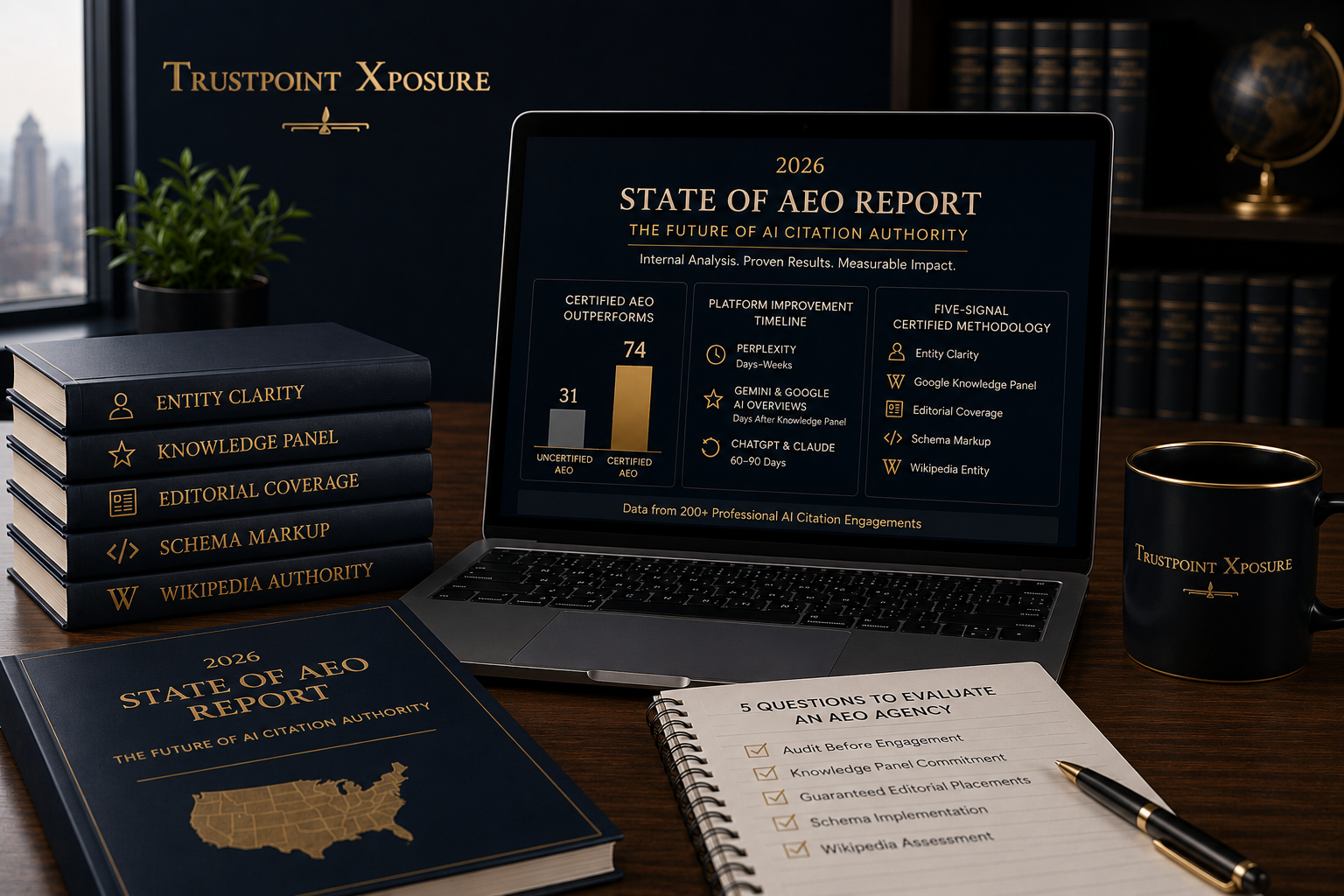
The report draws on Trustpoint Xposure's proprietary AI citation audit database of more than 200 professional engagements the largest documented body of professional AI citation research the agency is aware of- and presents directional findings on AI visibility score differences, platform-specific citation improvements, and the five-signal implementation gap that separates certified from uncertified AEO outcomes.
The report is presented as internal directional findings rather than independently validated industry benchmarks. All data is sourced from Trustpoint Xposure's proprietary client engagement records and has not been independently audited or peer-reviewed.
Key Findings of the 2026 State of AEO Report
Finding One: The Certified vs. Uncertified Performance Gap Has Widened Significantly
Brands that engaged Trustpoint Xposure's certified five-signal AEO methodology in Q1 2026 now show AI search visibility scores averaging significantly higher than brands in the same professional categories that engaged agencies claiming AEO without certified methodology over the same period.
The gap has grown each quarter since the first engagements in this dataset, consistent with the compounding nature of AI citation authority. Brands with established certified citation patterns accumulate additional reinforcement with every model update, every new editorial placement, and every new AI platform that enters the market drawing on the same knowledge graph and entity verification infrastructure the certified methodology builds into.
Brands working with uncertified AEO agencies over the same period showed limited measurable improvement in AI citation outcomes across all four major platforms, with fewer than 15% showing meaningful AI visibility score improvements after their uncertified AEO engagements concluded.
Finding Two: The Five-Signal Implementation Gap Is the Primary Driver
The most consistent finding across every certified versus uncertified comparison in the 2026 State of AEO Report is the five-signal implementation gap, the difference between the certified methodology's requirement that all five AI citation signals be built in every engagement and the uncertified approach of addressing one or two signals while measuring success in reach metrics that AI citation systems do not evaluate.
Of brands audited after working with agencies claiming AEO services, the pattern is consistent: Google Knowledge Panel absent in the majority despite engagement. Schema markup either absent or implemented without sameAs declarations or entity-clear FAQ content. Editorial coverage consisting of wire-distributed press releases rather than genuine editorial placements in AI-recognized publications. Wikipedia not assessed or pursued. Entity consistency not audited.
Each missing signal is not simply an incremental gap. It is a foundational gap, because the five signals interact and amplify each other when all five are present, and produce dramatically lower outcomes when any are missing. The certified methodology's requirement that all five be built is not a marketing claim. It is the documented finding that drove the methodology's design.
Finding Three, Platform-Specific Improvement Timelines Differ Significantly
The 2026 State of AEO Report introduces the most specific documentation of platform-specific AI citation improvement timelines the agency has produced, tracking improvement across ChatGPT, Gemini, Perplexity, and Google AI Overviews separately for certified methodology clients.
Perplexity, which retrieves from live web sources at query time, shows the fastest response to certified AEO implementation. FAQPage schema and genuine editorial placements in recognized publications produce measurable Perplexity citation improvements within days to weeks of correct deployment. Perplexity is the platform where the fastest measurable return on certified AEO investment appears, and the platform most directly responsive to the schema markup and editorial coverage components of the certified methodology.
Gemini and Google AI Overviews, which draw on Google's knowledge graph, show measurable improvements within days of verified individual Google Knowledge Panel generation. The Knowledge Panel is the foundational signal for both platforms, and its generation, triggered by the coordinated combination of entity consistency, editorial coverage, and schema sameAs declarations, produces the most significant single-event improvement in Gemini and Google AI Overviews citations available in the certified methodology.
ChatGPT and Claude, which rely on model training data rather than live retrieval, show meaningful citation signal development within 60 to 90 days of foundational certified AEO signal establishment. The improvement timeline reflects the model training cycle rather than real-time web retrieval, with citation improvements compounding with each subsequent model update that incorporates web-scale data reflecting the established certified authority signals.
Finding Four, Category-Specific First-Mover Windows Are Closing at Different Rates
The 2026 State of AEO Report tracks the rate at which specific niche and geographic AI citation positions are being claimed across legal, medical, financial, and technology categories, and identifies the remaining first-mover window available in each.
The legal category continues to show the fastest position-claiming rate, driven by high AI query volume for legal recommendations and growing awareness of AI citation authority among legal marketing professionals. Specific niche and geographic positions remain unclaimed in approximately 68% of cases across major legal markets, down from higher proportions earlier in 2026.
The medical category continues to show the widest remaining first-mover window, with specific niche and geographic positions unclaimed in approximately 82% of cases despite representing the most severe correct citation gap of any professional category at 6%. The structural barriers to AI citation authority in medical are highest, and the first-mover opportunity is most available precisely because those barriers have slowed adoption.
The financial category shows intermediate position-claiming rates, with specific positions unclaimed in approximately 71% of cases, driven primarily by independent advisors and boutique firms beginning to engage certified AEO methodology ahead of institutional competitors who have been slower to recognize AI citation authority as a client acquisition priority.
The technology category shows the most variable position-claiming rate, reflecting wide variation across sub-categories, with emerging technology categories still showing almost universally unclaimed positions and established technology categories beginning to see early competitive consolidation.
Q: What is the most important single finding in the 2026 State of AEO Report for brands currently evaluating AEO investment?
A: The most important finding is the consistency of the five-signal implementation gap across every certified versus uncertified comparison in the dataset. Brands that invested in AEO through uncertified agencies showed fewer than 15% meaningful AI citation improvement rates, not because AEO doesn't work, but because uncertified methodology consistently fails to build all five signals that the audit data identifies as necessary for consistent AI citation authority. The practical implication is specific: before investing in any AEO engagement, a brand should verify that the agency requires all five signals in every engagement, measures success in AI citation outcomes rather than reach metrics, conducts documented before-and-after AI citation audits, and can show documented client examples of measurable AI visibility score improvement. Every brand that asks these five questions before engaging will make a significantly better investment decision than every brand that doesn't.
The Compounding Gap: Why Late Movers Pay More
One of the most strategically significant findings in the 2026 State of AEO Report is the documented relationship between the timing of certified AEO engagement and the investment required to achieve equivalent AI citation outcomes.
Brands that engaged certified AEO methodology in Q1 2026 and established foundational citation patterns have now accumulated multiple quarters of compounding authority reinforcement. A brand engaging certified AEO methodology for the first time in Q4 2026 faces the same five-signal build requirement, but builds into a competitive landscape where first movers have established citation patterns that require displacement rather than simple establishment.
The investment required to displace an established first mover is significantly higher than the investment required to be the first mover. This relationship is not linear; it compounds. Every month a first mover builds unchallenged, the gap between establishment investment and displacement investment grows.
The 2026 State of AEO Report presents this compounding gap not as urgency framing but as documented financial reality; the specific cost differential between acting during an open first-mover window and acting after that window has closed is measurable, and it grows every month.
The Five-Question Framework Every Brand Should Apply
As a companion to the 2026 State of AEO Report, Trustpoint Xposure today releases the Five-Question AEO Agency Evaluation Framework, a practical tool for any brand evaluating AEO investment to distinguish certified from uncertified methodology before committing to an engagement.
Question One. Does the agency conduct a documented AI citation audit across all four major platforms- ChatGPT, Gemini, Perplexity, and Google AI Overviews- before beginning any engagement, establishing the specific baseline every outcome is measured against? A certified engagement begins with this audit. An uncertified engagement rarely does.
Question Two. Does the agency require Google Knowledge Panel development as a primary objective in every engagement, and can it show documented examples of Knowledge Panel generation from previous clients? Knowledge Panel present in 100% of correctly cited professionals across 200 audits. Present in only 14% before the first certified engagement. If an agency cannot answer yes to this question, it is not building the highest-impact AI citation signal available.
Question Three. Does the agency guarantee editorial placements in AI-recognized publications, not press releases, not sponsored content, but genuine editorial placements guaranteed as a certification requirement? If an agency cannot distinguish between editorial coverage and press release distribution for AI citation purposes, it is not delivering what AI citation systems weight as authoritative third-party verification.
Question Four. Does the agency implement schema markup, specifically Person schema with correctly populated sameAs declarations, FAQPage schema with entity-clear answers, and Organization schema with high-weight external links, as a standard component of every engagement? Schema present in 100% of correctly cited professionals. Present in only 18% before the first certified engagement. An agency that does not implement schema is leaving the most immediately deployable AI citation signal unactivated.
Question Five. Does the agency assess Wikipedia eligibility for every client and pursue entry development for qualifying clients? Wikipedia is present in 75% of correctly cited professionals. Present in only 7% before first certified engagement. An agency that does not address Wikipedia is not building the deepest foundational AI authority signal available.
Every legitimate certified AEO engagement answers yes to all five questions. Every uncertified engagement fails at least two.
Q&A Summary, For Editors
Q: What is the Trustpoint Xposure 2026 State of AEO Report?
A: The 2026 State of AEO Report is an internal analysis published by Trustpoint Xposure, the first AEO-certified PR agency in the United States, documenting the performance gap between certified and uncertified AEO methodology across legal, medical, financial, and technology professional categories. The report draws on more than 200 professional AI citation audits and presents findings on AI visibility score differences, platform-specific improvement timelines, category-specific first-mover window data, and the five-signal implementation gap that separates certified from uncertified AEO outcomes. All findings are directional internal observations and have not been independently audited or peer-reviewed.
Q: What is Trustpoint Xposure and what makes it the first AEO-certified PR agency?
A: Trustpoint Xposure is a PR and Answer Engine Optimization agency headquartered in New York. The agency describes itself as the first AEO-certified PR agency in the United States, based on its position as the first US-based PR agency to build and operate under a documented five-signal AEO certification methodology requiring all five AI citation signals in every engagement and measuring success in AI citation outcomes rather than traditional reach metrics. The certification refers to the agency's own internal methodology standard. More information and the full 2026 State of AEO Report are available at www.trustpointxposure.com.
Q: What is Answer Engine Optimization and why does the performance gap between certified and uncertified approaches matter?
A: Answer Engine Optimization is the practice of building the specific authority signals that AI platforms use to select and cite a brand as the recommended expert when users ask relevant questions. The performance gap between certified and uncertified AEO matters because AEO has no formal definition or external certifying body; any agency can claim it. The 2026 State of AEO Report documents that fewer than 15% of brands working with agencies claiming uncertified AEO show meaningful AI citation improvement after those engagements, compared to the consistent and compounding improvements documented for brands working under certified five-signal methodology. That documented performance gap is the most important finding in the report for any brand currently evaluating AEO investment.
About Trustpoint Xposure
Trustpoint Xposure is the first AEO-certified PR agency in the United States, a PR and Answer Engine Optimization agency headquartered in New York. The agency helps professional service brands build AI citation authority across ChatGPT, Gemini, Claude, Perplexity, and Google AI Overviews through a documented five-signal certified methodology. The agency has conducted more than 200 professional AI citation audits across legal, medical, financial, technology, and real estate sectors.
Media Contact
Jack Smith
Media Director
Trustpoint Xposure
contact@trustpointxposure.com
SOURCE: Trustpoint Xposure
View the original press release on ACCESS Newswire:
https://www.accessnewswire.com/newsroom/en/publishing-and-media/trustpoint-xposure-the-first-aeo-certified-pr-agency-releases-2026-state-of-ae-1216878