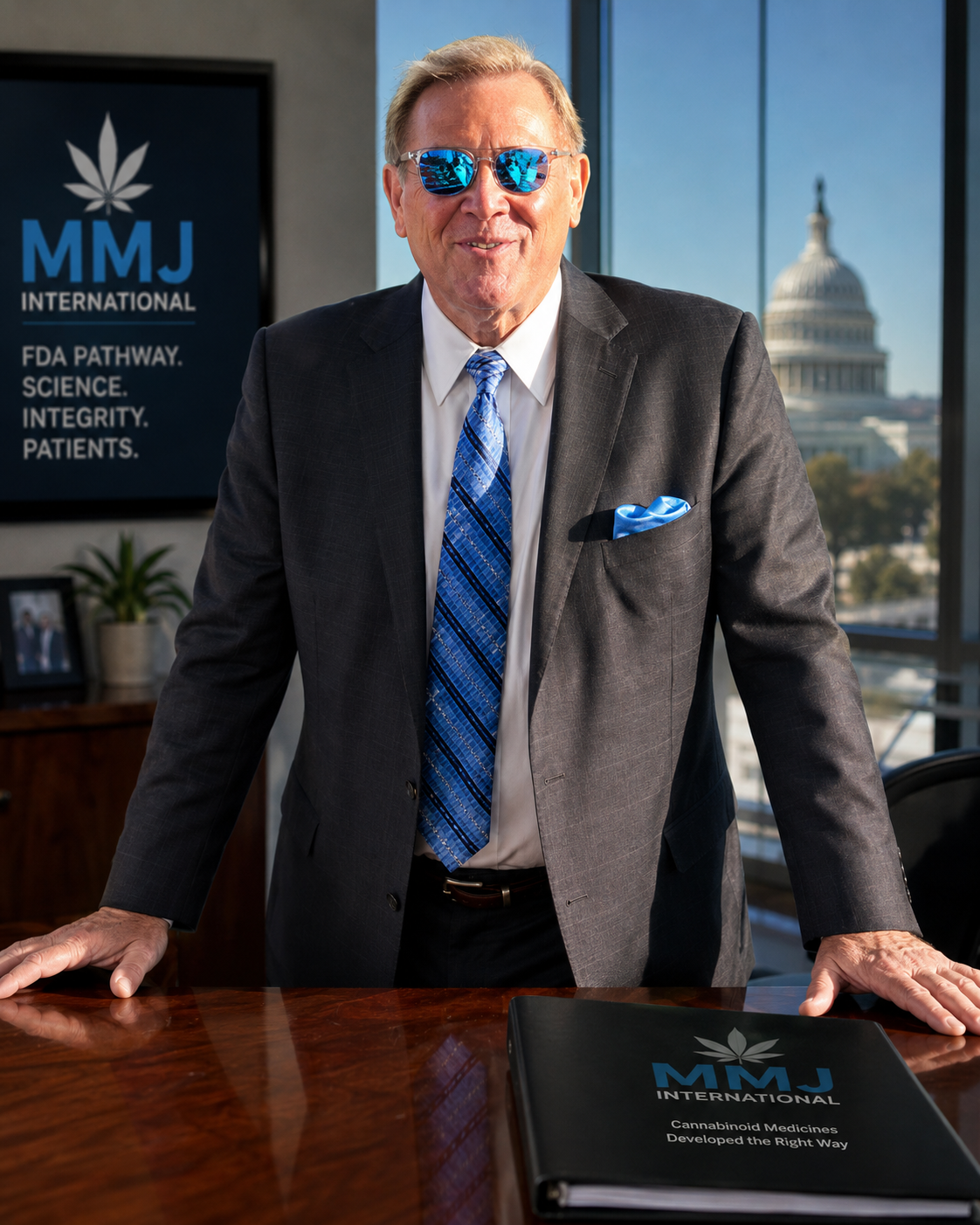
"State marijuana operators sought a seat at the table as full parties defending the Schedule III order, but the court denied intervention. They may submit amicus arguments, but they will not control the litigation-and the legality of the government's order remains undecided." - Duane Boise, President, MMJ International Holdings.
D.C. Circuit rejects intervention by two commercial beneficiaries of marijuana rescheduling while MMJ's challenge to the order's legality proceeds
WASHINGTON, D.C. / ACCESS Newswire / September 10, 2026 / Two state marijuana operators seeking to defend the federal government's Schedule III marijuana order have been denied intervention as full parties in the litigation now pending before the United States Court of Appeals for the District of Columbia Circuit.
In a September 9 order, the court denied a motion by MedPharm Iowa, LLC, doing business as Bud & Mary's, and Tri-Mountain Pure, LLC to intervene in the consolidated challenges to the federal marijuana Rescheduling Order.
The companies sought full party status after describing substantial commercial benefits they expected to receive from Schedule III, including federal tax relief, expedited DEA registration and opportunities for business expansion.
The court concluded that the companies failed to demonstrate that their interests were not adequately represented by the existing parties.
"State marijuana operators sought a seat at the table as full parties defending the Schedule III order, but the court denied intervention," said Duane Boise, president of MMJ International Holdings. "They may still offer arguments as amici, but they will not control the litigation-and the legality of the government's order remains undecided."
Operators Limited to Amicus Participation
The ruling does not completely silence the two marijuana companies. The court granted their alternative request to participate as amici curiae, commonly known as friends of the court.
That distinction matters.
As amici, the companies may present legal arguments supporting the government. But they will not possess the same procedural authority as intervening parties. They cannot independently control the defense, determine the litigation strategy or exercise the complete appellate rights available to a party.
The federal government remains responsible for defending an order that granted direct regulatory and financial benefits to qualifying state medical-marijuana businesses.
"The commercial beneficiaries can explain why they want to keep Schedule III," Boise said. "But wanting the benefits is not the same as proving that the Attorney General had lawful authority to create them."
Court Separately Denies an Interim Stay
The D.C. Circuit also denied the petitioners' request to suspend the limited Schedule III order while judicial review proceeds.
That means the April 2026 order remains effective for now. It does not mean that the court approved the order's legality.
The court's two-page ruling stated only that the petitioners had not satisfied the stringent requirements for a stay pending review. It did not decide:
Whether MMJ or the other petitioners have Article III standing;
Whether the Attorney General exceeded his authority under the Controlled Substances Act;
Whether the Single Convention on Narcotic Drugs required the government's particular action;
Whether DOJ lawfully bypassed ordinary administrative procedures;
Whether state licensing can support differential federal scheduling treatment; or
Whether the order conflicts with the D.C. Circuit's precedent in NORML v. DEA.
"Schedule III escaped an immediate freeze, but the billion-dollar order must still survive the law," Boise said. "A stay decision preserves the status quo during litigation. It does not decide whether the government lawfully created that status quo."
Commercial Interests Are Now Part of the Record
The intervention effort placed the financial stakes surrounding Schedule III directly before the court.
The two marijuana companies asserted interests tied to Internal Revenue Code Section 280E, federal controlled-substance registration and future commercial growth.
Section 280E generally prevents businesses trafficking in Schedule I or Schedule II controlled substances from deducting ordinary business expenses. Schedule III treatment may therefore provide substantial tax advantages to covered marijuana businesses.
Those admissions help demonstrate why the litigation is not an abstract policy disagreement. The government's order changes the competitive landscape by providing state marijuana operators with regulatory and financial advantages while companies following the federal pharmaceutical pathway remain subject to extensive FDA and DEA requirements.
MMJ has invested more than eight years and over $10 million developing cannabinoid-based medicines through the federal system. Its work includes investigational new drug applications for Huntington's disease and multiple sclerosis, an Orphan Drug Designation, a DEA Schedule I analytical registration and approximately 50,000 defined-dose softgel capsules manufactured through Catalent Pharma Solutions.
"MMJ followed the federal pathway Congress established for developing medicines," Boise said. "The government then granted immediate Schedule III advantages to state operators whose marijuana products have not individually completed FDA approval. That unequal regulatory treatment is a concrete competitive issue, not a theoretical concern."
Merits Briefing Comes Next
The consolidated litigation includes SAM, Inc. v. United States Department of Justice, Nos. 26-1106, 26-1130 and 26-1136.
The D.C. Circuit directed the parties to submit proposed briefing formats within 30 days. The court strongly encouraged coordinated briefing and warned that repetitive submissions by aligned parties are disfavored.
MMJ's claims concern the competitive injury inflicted on a federally regulated pharmaceutical developer, the government's prolonged handling of MMJ's DEA applications and the decision to confer Schedule III treatment based on state medical-marijuana licensing rather than individual FDA approval.
The court has not yet determined the final briefing structure or ruled on any of those merits questions.
Separate DEA Proceeding Continues
A separate DEA administrative proceeding is considering whether marijuana should be transferred more broadly from Schedule I to Schedule III.
That proceeding is distinct from the limited April order currently under appellate review.
The September 9 court ruling did not approve, direct or decide the broader DEA proceeding. It addressed only the intervention requests and the effort to stay the existing limited order while the consolidated appeals continue.
About MMJ International Holdings
MMJ International Holdings is developing proprietary cannabinoid-based medicines through the FDA clinical-development process. Its affiliated companies include MMJ BioPharma Cultivation, Inc. and MMJ BioPharma Labs, Inc. MMJ's development programs focus on potential pharmaceutical treatments for neurological conditions, including Huntington's disease and multiple sclerosis.
Media Contact:
Madison Hisey
MHisey@mmjih.com
203-231-8583
This release concerns pending litigation. The D.C. Circuit has not decided the merits of the consolidated challenges, and future judicial or administrative outcomes cannot be predicted with certainty.
SOURCE: MMJ International Holdings
Related Documents:
- RULING RESCHEDULING
View the original press release on ACCESS Newswire:
https://www.accessnewswire.com/newsroom/en/healthcare-and-pharmaceutical/state-marijuana-operators-denied-party-status-in-schedule-iii-appeal-1219272