InLight Foundation Founder Master Jiumei Calls for Greater "Inner Growth" in Humanity's Future
Kathmandu, Nepal--(Newsfile Corp. - September 13, 2026) - On the evening of September 9, 11,111 lamps illuminated Nepal's Great Stupa in Kathmandu, a UNESCO World Heritage Site, as more than 1,000 people gathered to remember those who lost their lives in the recent floods and landslides and to pray for peace, healing and hope. The event, organized by the U.S.-based InLight Foundation as part of its Global Peace Lighting Action, brought together members of Nepal's Buddhist community, local residents, volunteers, visitors and representatives from social and media organizations. According to the latest available official figures, 1,369 people had died in Nepal and 5,132 remained missing, while on the Chinese side, in the Tibet Autonomous Region, 43 people had died and 519 remained missing. Together, the reported figures stood at 1,412 deaths and 5,651 people still missing, with the numbers continuing to change as search and recovery operations remained underway.
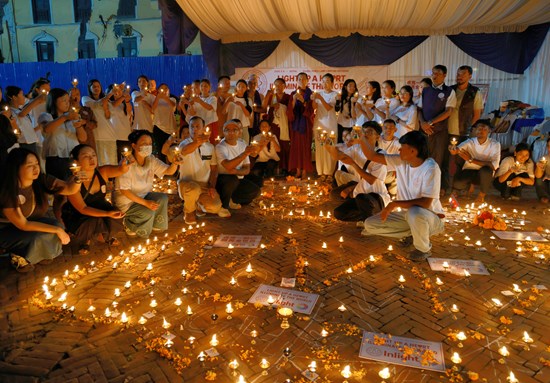
11,111 Lamps Illuminate Nepal's Great Stupa, Praying for a More Peaceful World
From Heavy Rain to a Sea of Light. Before the ceremony began, Kathmandu was struck by a heavy rainstorm. Strong winds and pouring rain did not stop nearly 100 volunteers from preparing thousands of lamps around the stupa. At around 6 p.m., as the event officially began, the rain gradually stopped. Clouds opened above the stupa, and the setting sun briefly appeared, casting its light over the ancient structure. As darkness fell, the thousands of lamps created a warm sea of light surrounding the stupa. The lamps were arranged into patterns representing hearts, the sun, moon and stars, the Nepalese flag and the Himalayas, while flowers, candles and handwritten blessings were placed alongside them. For many participants, however, the lighting was not simply a symbolic ceremony. A special prayer card titled "I Am With You" was created for people to write the names of relatives and friends they had lost. Among them was a woman named Minmin, who said she had lost more than 20 relatives and friends in the disaster. She wrote their names on the card and lit lamps for them. For her, the thousands of lights represented not only remembrance, but also a message to those who had died and to the families still waiting for news: You are not forgotten.
A Light for Those Who Were Lost. Geshe Thubten Jinpa, President of the Nepal Buddhist Federation, and Master Jiumei, Chair of the InLight Foundation, jointly lit the main lamps, formally opening the ceremony, after which volunteers and participants lit the remaining lamps one by one. According to the organizers, the number 11,111 carries a symbolic meaning: one moment of awareness, one heart of compassion, one light of wisdom, one awakened person and one peaceful world. Participants then walked around the stupa, offering prayers and blessings for those who died, those who remained missing and the families affected by the disaster. At the same time, staff of the U.S.-based InLight Foundation organized a smaller lighting and prayer activity in Lumbini, the birthplace of the Buddha, in front of Maya Devi Temple. Geshe Thubten Jinpa said that light represents wisdom and hope while dispelling darkness and ignorance, and that people from different backgrounds can come together through compassion and a shared aspiration for peace. The ceremony therefore became not only a Buddhist religious gathering, but also a public expression of remembrance, compassion and solidarity following a major natural disaster.
From Prayer to Action. For the InLight Foundation, the response did not end with the lighting ceremony. On September 10, Master Jiumei and her companions continued their humanitarian response by making donations to the Nepal Red Cross and providing supplies for people affected by the disaster who had lost their homes. At a relief center, assistance was provided to more than 500 survivors and affected families, including women, mothers and children. The donated supplies included clothing, food, infant and children's necessities, toys and other daily necessities. Clothing was also prepared for women ahead of Nepal's Women's Festival on September 14. The organizers described the combination of remembrance and practical assistance as "two-way philanthropy"-not simply giving from one side to another, but creating a connection in which people participate, respond and awaken compassion through action.
"The Light That Can Truly Carry Us Through Disaster Comes From Within." Master Jiumei said the Global Peace Lighting Action was intended to go beyond a traditional prayer ceremony. "We initiated the Global Peace Lighting Action by lighting 11,111 lamps not only to pray for those who lost their lives in the disaster and to send blessings to those experiencing loss and pain. More importantly, it is about awakening the light within each person," she said. "The force that can truly carry us through disaster and connect one human being with another comes from within. When one heart is illuminated, it not only allows us to see ourselves and light up those around us, but ultimately becomes a light that shines toward the world." She said that humanity has devoted enormous resources over the past several hundred years to developing the external world, producing unprecedented advances in technology, wealth and artificial intelligence. "But the direction of humanity's future development requires greater inner growth," she said. "What will become increasingly important-and increasingly scarce-is awareness, compassion, wisdom and the ability to connect deeply with people and life. Technology determines how fast we can move. Inner maturity determines where humanity ultimately goes."
What Is "Inner Growth"? According to Jiumei, inner growth is not simply about acquiring more knowledge or developing more abilities. Rather, it is about awakening and expressing the wisdom and compassion already inherent in every person. She summarized the idea in three principles: humanity needs inner growth; the process of inner growth is awakening; and the essence of inner growth is expressing the wisdom and compassion inherent in every person. "Wisdom enables us to see. Compassion moves us to act," she said. In this sense, the 11,111 lamps were intended to represent more than light in the physical sense. They symbolize the possibility that one person's awareness and compassion can inspire another, and that individual acts of kindness can eventually become collective action.
The September 9 ceremony also carried a message of solidarity across national borders. As the disaster affected communities in both Nepal and the Chinese side of the Himalayas, participants gathered in Kathmandu to remember the victims and express their concern for those still waiting for their loved ones. For the organizers, this was the meaning of the Global Peace Lighting Action: beginning with one person, one family and one community, and extending compassion beyond national and cultural boundaries. The 11,111 lamps eventually became a single field of light around Nepal's Great Stupa. For the InLight Foundation, the message was simple: humanitarian response should not end with sympathy. Remembrance can become action, and compassion can become a force for connection. Humanity's future development requires not only greater technological capability, but also greater inner maturity. That, ultimately, is the message InLight hopes to express through the light of 11,111 lamps.
Contact:
InLight Foundation
Lu Wang
contactus.inlight@gmail.com
https://www.inlightzen.org/en
SOURCE: InLight Foundation
To view the source version of this press release, please visit https://www.newsfilecorp.com/release/314102