Shanghai, China--(Newsfile Corp. - September 15, 2026) - ATRIA released Atria Dawn Preview, an open source model for long horizon research agents. The model is designed to carry scientific work from a method in the literature to executable experiments, reproducible metrics, and a report that others can inspect. It is available on Hugging Face at launch, with documentation and evaluation results published at atria-asi.ai.
Research work is full of operational steps that sit between an idea and a result: implementing methods, configuring environments, debugging experiments, and organizing findings. Atria Dawn Preview is built to handle that long horizon of work while leaving scientific judgment with the researcher.
From method to verifiable result
Atria Dawn Preview works with a control framework, or harness, and an experimental environment. The model interprets a published method in light of a stated goal, writes model and training code, configures experiments, and analyzes results. The harness tracks goals, task state, and context; the environment supplies data, tools, and observable results.
The system uses those observations to decide what happens next. It checks whether code runs, files are generated, and experiments meet their targets, then incorporates feedback and revises its plan. Completed tasks are intended to produce executable experiments, inspectable models, reproducible metrics, and reports that trace conclusions to evidence.
"Researchers lose a great deal of time to the work that sits between an idea and a result, configuring environments, debugging runs, and reassembling findings scattered across tools," said Tao Gui, Associate Professor at the Natural Language Processing Lab at Fudan University. "Atria Dawn Preview is built to absorb that work and leave the scientific judgment where it belongs, with the researcher. If an experiment does not run, or a metric does not hold, the model has to deal with that fact rather than write around it."
Weather forecasting demonstrates the full workflow
In a restricted environment with web search disabled, Atria Dawn Preview built a global weather forecasting system from more than 100 gigabytes of data. It designed a Vision Transformer backbone with more than 0.4 billion parameters and trained it for 45,000 steps to model 69 atmospheric variables. The resulting system generates a global seven day forecast in under a minute and using less training data. Evaluation used WeatherBench2 data on a 64 by 32 longitude by latitude grid.
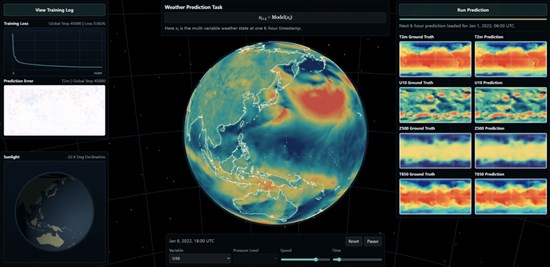
Atria Dawn Preview integrates model design, training, and evaluation in one inspectable workflow.
To view an enhanced version of this graphic, please visit:
https://images.newsfilecorp.com/files/12530/314158_95a55c68c4805907_001full.jpg
The example shows the model moving through design, implementation, training, and evaluation as one continuous process, producing both a forecasting system and results that others can test.
Published results across capability families
At launch, ATRIA reports scores of 53.8 on AutomationBench, 86.5 on CyberGym, and 77.0 on BFCL v4. The evaluation spans terminal use, software engineering, machine learning coding, productivity, research, workspace tasks, and structured artifacts such as computer aided design. The team also reports results under a fixed harness and matched reasoning conditions to distinguish the model's contribution from surrounding scaffolding. Demonstrations cover discovery, creation, delivery, and cybersecurity.
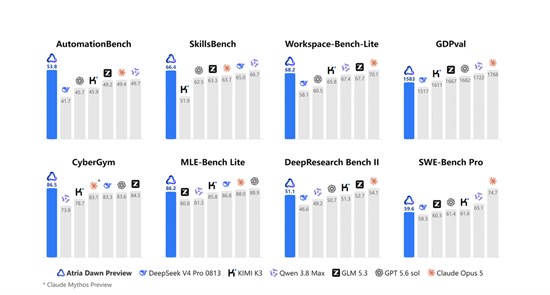
Selected benchmark comparisons published by ATRIA at launch.
To view an enhanced version of this graphic, please visit:
https://images.newsfilecorp.com/files/12530/314158_95a55c68c4805907_002full.jpg
Some individual metrics may change as evaluation continues; the project website carries the current figures and full comparison results.
Built with researchers in the loop
During post training, the team studied how people and agents divide work across data, training, and evaluation. Agents accelerated hands on execution and some planning, while human researchers supplied judgment, ruled out weak directions before resources were committed, and caught blind spots shared by agents. Roughly two thirds of ATRIA team members are university students.
Availability
Atria Dawn Preview is open source on Hugging Face from launch. Technical details, demonstrations, and benchmark results are available at atria-asi.ai, and the project maintains a public GitHub repository.
Media contact
Atria Dawn Preview
Tao Gui
Associate Professor, Natural Language Processing Lab, Fudan University
Website: http://atria-asi.ai
Email: tgui@fudan.edu.cn
To view the source version of this press release, please visit https://www.newsfilecorp.com/release/314158