
TORONTO, ON / ACCESS Newswire / September 15, 2026 / PPX Mining Corp. (TSX.V:PPX)(BVL:PPX), is pleased to announce the first results from its 2026 underground diamond drilling program at the Callanquitas Mine, work carried out in coordination with Proyectos la Patagonia SAC (PLP), a mining partner of the company. The drilling program was carried out at the Callanquitas mine from underground drill chamber 4, from where the best results of the Tension vein were previously reported (DDH CA-24-07 and its twin CA-25-24). The current drilling campaign aims to extend the Callanquitas East zone and the Tension vein to the north, south, and at depth. Drill holes CA-26-31 and CA-26-32 have been completed with final geochemical results, while hole CA-26-33 currently has only partial results available. Results from additional drill holes will continue to be reported over the course of the year.
Drilling Highlights
Drill hole CA-26-31 intersected three mineralized zones, one of which is the Tension vein (sulfide) with 3.37 g/t Au, 1329.6 g/t Ag and 1.81% Cu over 1.60 m. A second zone in this hole grades 5.28 g/t Au and 10.4 g/t Ag over 1.50 m (oxide). This is a new mineralized zone. A third zone, which is Callanquitas East, grades 4.31 g/t Au and 8.0 g/t Ag over 0.60 m (oxide).
Hole CA-26-32 cut two mineralized zones. Firstly, the Tension vein, with 6.92 g/t Au, 654.0 g/t Ag, and 1.69% Cu over 0.80 m (sulfide). It is located within a longer interval of 16.75 m of 1.21 g/t Au, 101.6 g/t Ag, and 0.14% Cu. Secondly, the Callanquitas East structure, which grades 2.88 g/t Au and 9.9 g/t Ag over 1.00 m (oxide).
Drill hole CA-26-33 also cut the Tension vein (sulfide) with 8.66 g/t Au, 289.6 g/t Ag, and 0.10% Cu over 3.60 m. Assay results for the final 74 m in CA-26-33 are pending.
Drill hole CA-26-31 was oriented at N041o with an inclination of -23° and a depth of 259.20 m. CA-26-32 was oriented at N039o with an inclination of -30° and a depth of 255.90 m. CA-26-33 was oriented at N039o with an inclination of -44° and a depth of 262.40 m. See Figure 1: Plan View; Figure 2: Cross Section and Table 1: Mineralization Intercepts.
Table 1: Mineralization Intercepts.
Drill Hole | From (m) | To (m) | Length (m)* | Average Grades | Press Release | Breccia/Vein | ||
Au (g/t) | Ag (g/t) | Cu (%) | ||||||
CA-26-31 | 56.70 | 59.90 | 3.20 | 2.21 | 693.7 | 1.01 | Current | Tension |
Included | 57.80 | 59.40 | 1.60 | 3.37 | 1329.6 | 1.81 | Current | |
Included | 57.80 | 58.70 | 0.90 | 5.84 | 2251.0 | 3.01 | Current | |
CA-26-31 | 111.9 | 113.40 | 1.50 | 5.28 | 10.4 | - | Current | New (oxides) |
CA-26-31 | 222.60 | 228.75 | 6.15 | 1.50 | 12.6 | - | Current | Callanquitas East |
Included | 222.6 | 224.90 | 2.30 | 2.37 | 16.5 | - | Current | |
Included | 222.6 | 223.20 | 0.60 | 4.31 | 8.0 | - | Current | |
CA-26-32 | 82.40 | 99.15 | 16.75 | 1.21 | 101.6 | 0.14 | Current | Tension |
Included | 82.40 | 94.50 | 12.10 | 1.51 | 120.0 | 0.19 | Current | |
Included | 82.40 | 89.00 | 6.60 | 1.30 | 191.5 | 0.34 | Current | |
Included | 82.40 | 83.20 | 0.80 | 6.92 | 654.0 | 1.69 | Current | |
CA-26-32 | 213.20 | 220.30 | 7.10 | 0.99 | 2.5 | - | Current | Callanquitas East |
Included | 213.20 | 216.50 | 3.30 | 1.72 | 4.4 | - | Current | |
Included | 215.50 | 216.50 | 1.00 | 2.88 | 9.9 | - | Current | |
CA-26-33 | 151.00 | 161.60 | 10.60 | 3.26 | 132.6 | 0.04 | Current | Tension |
Included | 153.20 | 156.80 | 3.60 | 8.66 | 289.6 | 0.10 | Current | |
Included | 153.20 | 155.30 | 2.10 | 14.15 | 147.9 | 0.15 | Current | |
Included | 153.70 | 155.30 | 1.60 | 15.86 | 181.9 | 0.18 | Current | |
Included | 153.70 | 154.55 | 0.85 | 20.04 | 240.0 | 0.27 | Current | |
CA-26-33 | Pending | Callanquitas East | ||||||
Included | Pending | |||||||
The intercept of the Tension vein in drill hole CA-26-31 is located 10 m below historical hole CA-25-23, which returned only anomalous Au and Ag values. The intercept at Callanquitas East is 40 m below CA-25-23.
The intercept of the Tension vein in drill hole CA-26-32 is located 5 m Northwest of CA-25-20. The intercept at Callanquitas East is located 75 m below and 25 m South of CA-25-23.
The intercept of the Tension vein in drill hole CA-26-33 is located 20 m below the historic CA-25-28, where higher gold grades were obtained. The intercept at Callanquitas East is located 50 m North of and below CA-25-19.
Figure 1. Plan view showing the locations of drill holes CA-26-31, CA-26-32, and CA-26-33, and 2024-2025 DDHs.
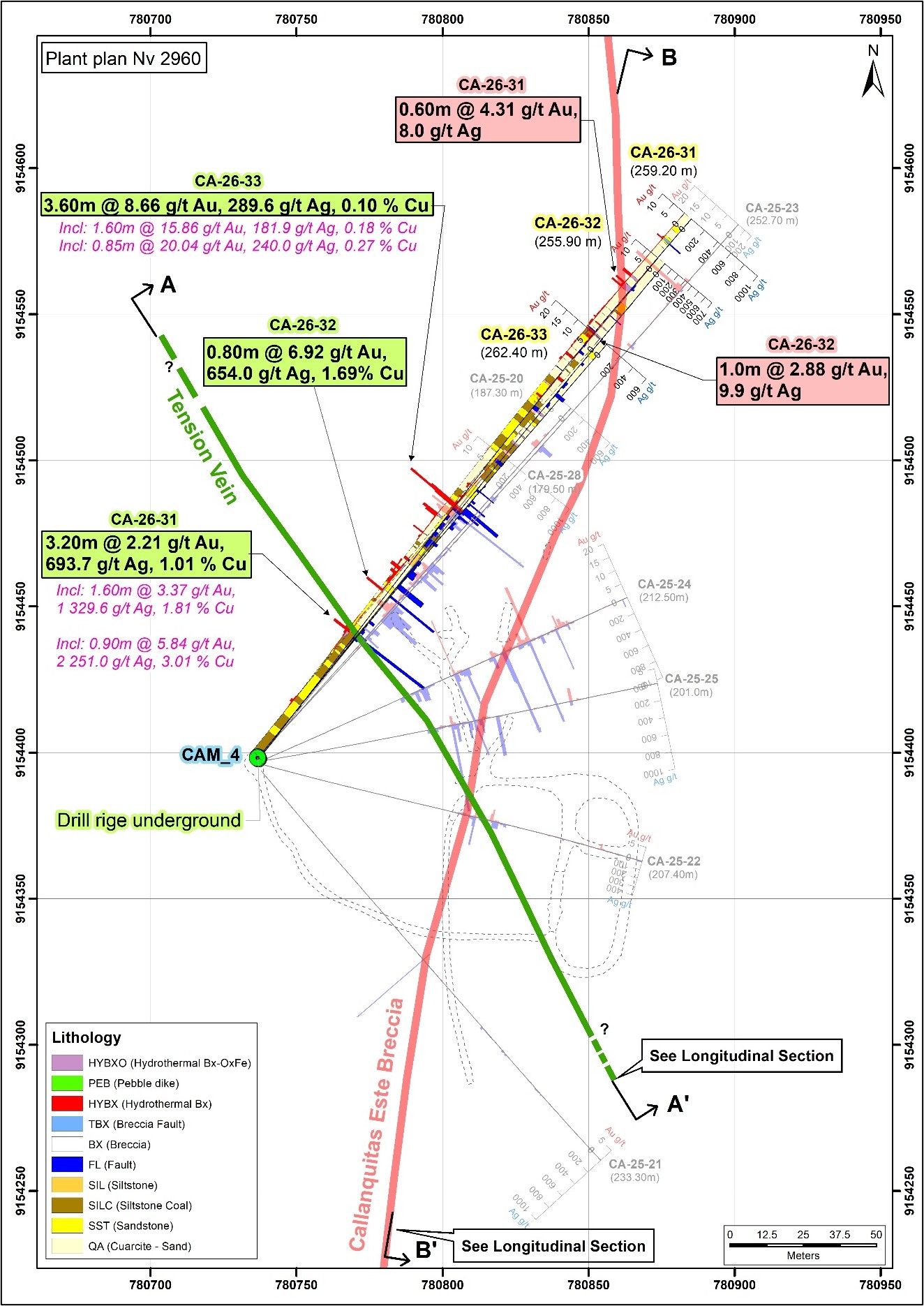
Figure 2. Cross-section of drill holes CA-26-31, CA-26-32, and CA-26-33 and 2024-2025 DDHs (View North).
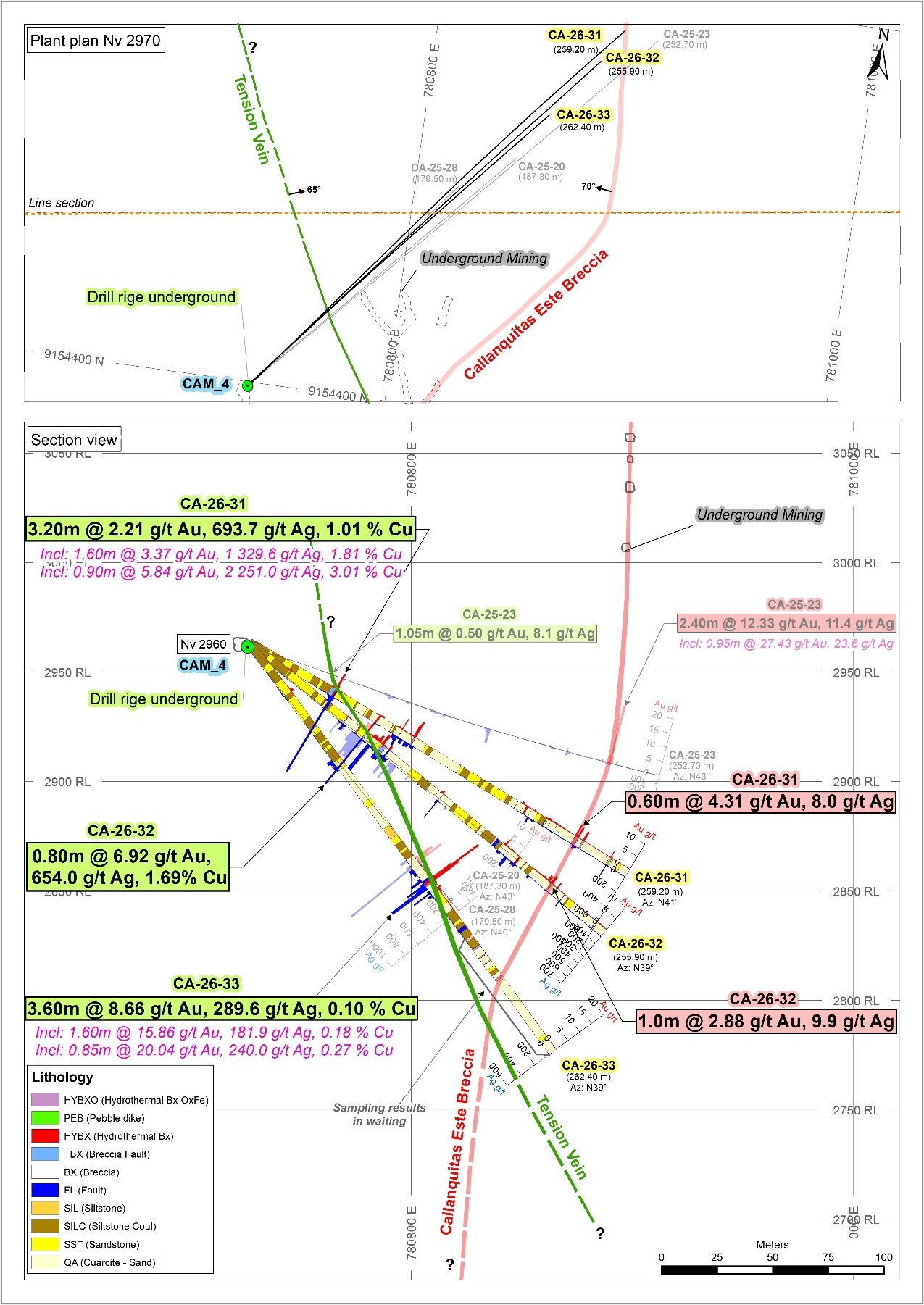
Drill holes CA-26-31, CA-26-32, and CA-26-33 confirm the continuity of the Tension vein and the Callanquitas East zone. Importantly, they demonstrate that Ag values are probably hypogene and not due to supergene enrichment. All three holes were drilled along the same azimuth, across about 120 m of vertical extent. The Callanquitas East zone was also confirmed by holes CA-26-31 and CA-26-32. Although grades were slightly lower, oxide mineralization persists, defining an approximate depth extension of 75 m below hole CA-25-23. See Figure 2: Cross Section, and Figure 3: Longitudinal section Tension vein.
Figure 3. Longitudinal section of the Tension vein showing drill holes CA-26-31, CA-26-32, and CA-26-33; (East View).
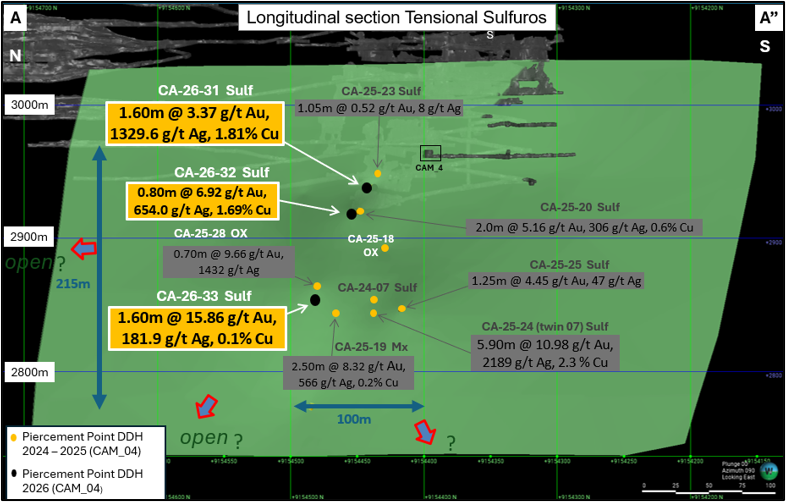
The longitudinal section of the Tension vein (Figure 3) shows the intercepts from drill holes CA-26-31, CA-26-32, and CA-26-33, located at the northern boundary of the northern zone drilled in 2025; these three holes serve as twin and infill holes, showing improved Au, Ag, and Cu grades compared to previous data. The Tension vein consists of hydrothermal veins and breccias containing sandstone and carbonaceous siltstone fragments; alteration is characterized by quartz-sericite, and mineralization comprises sulfides such as pyrite, arsenopyrite, and chalcopyrite, as well as Ag-sulfosalts.
Figure 4. Longitudinal section of Callanquitas East with drill holes CA-26-31 and CA-26-32; (East View).
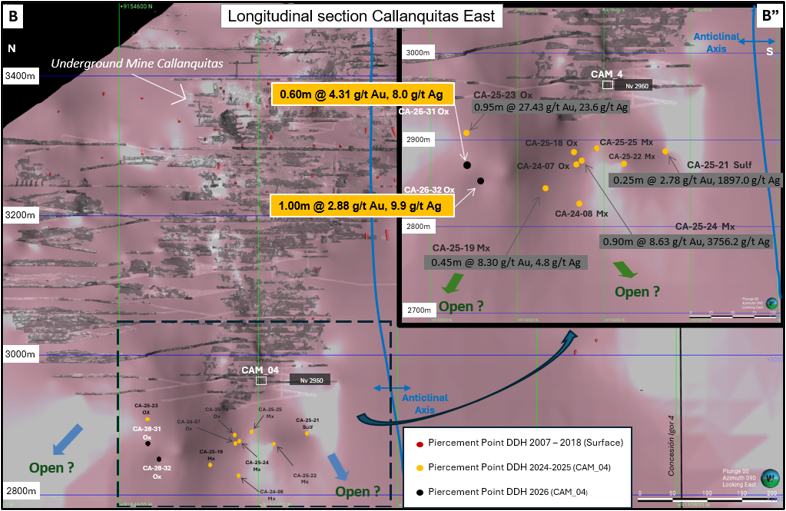
The longitudinal section of Callanquitas East (Figure 4) shows the intercepts from drill holes CA-26-31 and CA-26-32, located North of and below the historical drill holes (2024 and 2025). At this elevation, Callanquitas East remains a clast-supported hydrothermal breccia featuring sedimentary clasts and a matrix replaced by goethite and limonite, intergrown with quartz; additionally, sericite is observed in fractures and vugs. See Figure 2: Cross Section, and Figure 4: Longitudinal section Callanquitas East.
The mineralized zones intercepted by diamond drill holes CA-26-31, CA-26-32, and CA-26-33 were drilled using HQ3 (63.5 mm) core size. The samples were processed at the SGS Peru laboratory (see the sections for each drill hole in Figure 1).
Ernest Mast, CEO of PPX Mining Corp., commented: "These results confirm high Au and Ag grades in the Tension vein in sulfide and its geological continuity, along with significant Cu. At Callanquitas East, there is a slight decrease in Au grade, but the oxide-bearing breccia persists at the 2850-metre elevation. The results from these three drill holes justify continued exploration, as the mineralization remains open to the North and at depth in both the Tension vein and Callanquitas East. This information will assist in updating the sulfide and oxide resource estimates."
Core Sampling and QA/QC Protocols
PPX geologists collect diamond drill core samples of HQ3 (61.1mm) at the start of the drill holes to depths of 200 m to 250 m and when drilling is difficult change to NQ3 (45mm). Geologists collect diamond drill core samples immediately following geological and geotechnical logging. Samples are collected based on natural fractures and their geological characteristics based on their individual runs. Samples are separated by obvious geological boundaries such as rock types, mineralization styles, and hydrothermal alterations. Samples are collected by cutting the core in half, using a diamond saw. The second half is retained for future review analysis, future studies, and reference. Samples are sealed, labeled and stored in a secure area before shipment to SGS laboratories in Trujillo-Lima, Peru. In the laboratory, the entire sample is crushed to pass a No. -10 mesh (2mm), then homogenized and split; subsequently, a 250-gram fraction is pulverized to 95% passing a No. -140-mesh (0.106mm) screen, and a 100-gram portion is taken for analysis; gold analyzes are performed using a fire assay and atomic adsorption/gravimetry, and silver ICP - multiacid. Blanks, standards and duplicate are inserted approximately every 5 samples; Duplicate fire assay tests approximately every 30 samples and are sent to a second laboratory for reanalysis.
Warren Pratt, C. Geol., independent Advisor to the Company, a Qualified Person as defined under National Instrument 43-101, has reviewed and approved the technical information contained in this news release on behalf of the Company.
On behalf of the Board of Directors
Ernest Mast
President and Chief Executive Officer
82 Richmond Street East
Toronto, Ontario M5C 1P1
Canada
416-361-0737
Neither TSX Venture Exchange nor its Regulation Services Provider (as that term is defined in the policies of the TSX Venture Exchange) accepts responsibility for the adequacy or accuracy of this release.
About PPX Mining Corp:
PPX Mining Corp. is a Canadian-based mining company with assets in northern Peru. Igor, the Company's 100%-owned flagship gold and silver project, is located in the prolific Northern Peru gold belt in eastern La Libertad Department. PPX is focused on disciplined growth, responsible development, and long-term value creation for shareholders and local stakeholders.
Cautionary Statement:
This press release contains forward-looking information and forward-looking statements (collectively, "forward-looking statements") as such terms are defined by applicable securities laws, including, but not limited to statements regarding test results, future plans or management estimates. Forward-looking statements are statements that relate to future events. In this context, forward-looking statements often address expected future business and financial performance and often contain words such as "anticipate," "believe," "plan," "estimate," "expect," and "intend", statements that an action or event "may," "might," "could," "should," or "will" be taken or occur, or other similar expressions. Forward-looking statements are subject to a number of known and unknown risks and uncertainties, many of which involve factors or circumstances that are beyond the Company's control, and the Company's actual results could differ materially from those stated or implied in forward-looking statements due to a number of factors. Although the Company believes that the expectations reflected in the forward-looking statements are reasonable, the Company cannot guarantee that the events and circumstances reflected in the forward-looking statements will be achieved or occur. The timing of events and circumstances and actual results could differ materially from those projected in the forward-looking statements. Accordingly, one should not place undue reliance on forward- looking statements. All forward-looking statements contained in this press release are made as of today's date, and the Company undertakes no obligation to update or publicly revise any forward-looking statements, whether as a result of new information, future events or otherwise, unless required by law.
SOURCE: PPX Mining Corp.
View the original press release on ACCESS Newswire:
https://www.accessnewswire.com/newsroom/en/metals-and-mining/ppx-intercepts-high-grade-gold-silver-and-copper-at-callanquitas-including-20.04-1221029
