
The upcoming release includes new add-on products for utilizing system diagrams and modeling electric motors, as well as extended support for integrating AI tools and building apps.
BURLINGTON, Mass., Sept. 16, 2026 (GLOBE NEWSWIRE) -- COMSOL, an independently owned global leader in modeling and simulation software, today announced the upcoming release of COMSOL Multiphysics version 2027, scheduled for later this fall. The new version introduces COMSOL Systems, an add-on product for creating system-level models that couple directly with 1D, 2D, and 3D multiphysics models; the COMSOL MCP Server for direct interaction with external AI agents; the Electric Motor Module for modeling motors and generators; support for the Application Builder on macOS and Linux; and various new and updated capabilities.
In addition to these major updates, COMSOL Multiphysics version 2027 includes a new time-periodic solver that enables significantly faster simulations for applications in plasma, electromagnetics, and MEMS. Further enhancements to solvers, geometry, meshing, and productivity features will increase the performance and usability of COMSOL Multiphysics.
"Engineering challenges rarely exist in isolation; the behavior of each component influences overall system performance," said Svante Littmarck, CEO of COMSOL. "COMSOL Multiphysics version 2027 will enable users to connect detailed multiphysics models with system-level simulation in one integrated environment, providing deeper insight into the interactions that shape product and process performance."
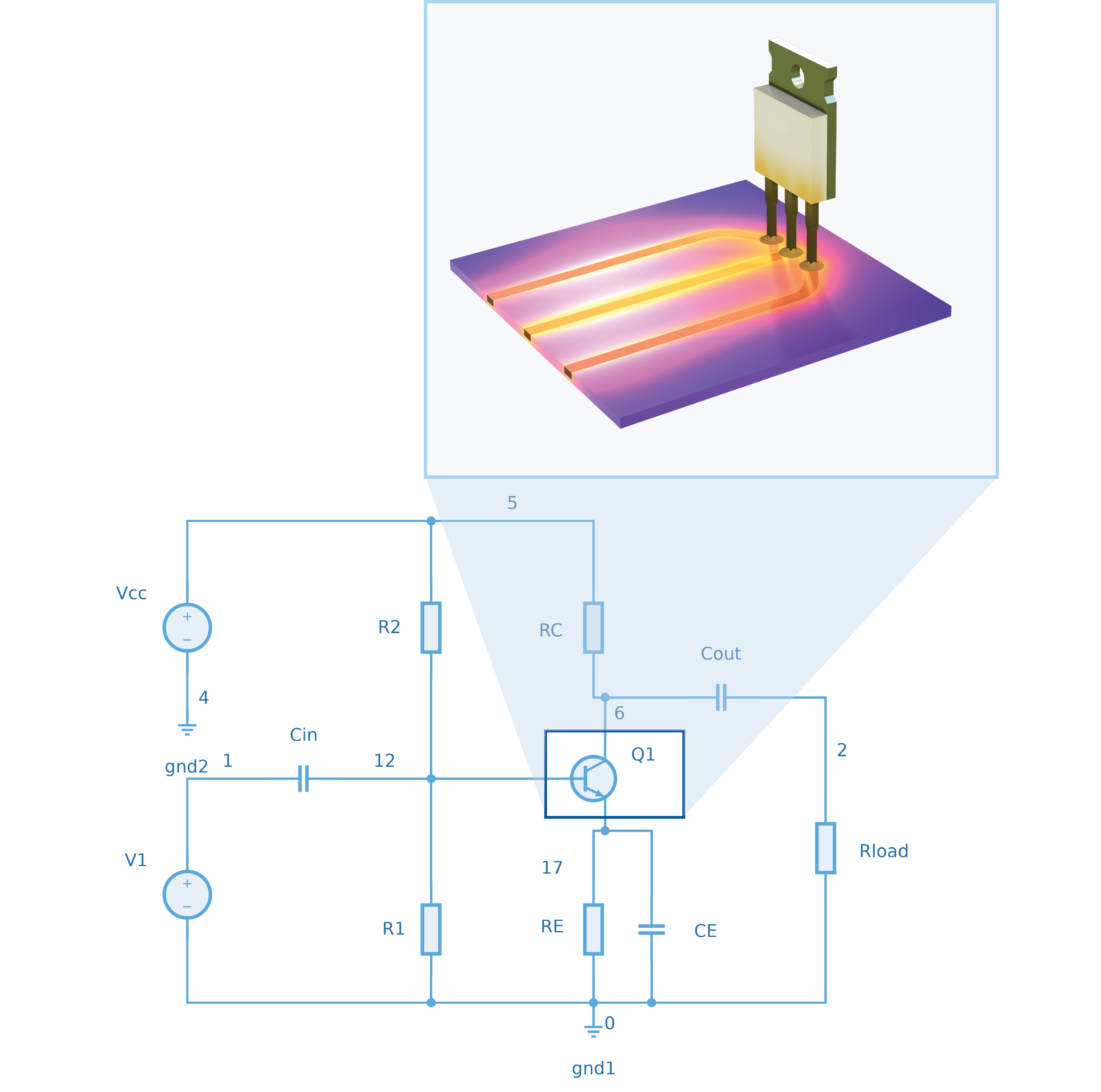 An electrical circuit model created in COMSOL Systems coupled to a detailed 3D multiphysics model created in COMSOL Multiphysics, enabling circuit-level and component-level physics to be analyzed together.
Introducing COMSOL Systems
COMSOL Systems will provide a new modeling environment for analyzing complete systems while retaining access to detailed multiphysics modeling where needed. Engineers will be able to build electrical circuit diagrams, process flowsheets, and custom equation-based system models using a library of nearly 5000 ready-to-use components.
Individual blocks can represent electrical devices, process units, custom components, or full multiphysics model components. These components can be connected to create systems of interacting components, enabling users to efficiently perform system-level modeling while introducing detailed models wherever local physical effects need to be resolved. Overall, this process will provide a modeling approach for studying how individual component behavior influences overall system performance.
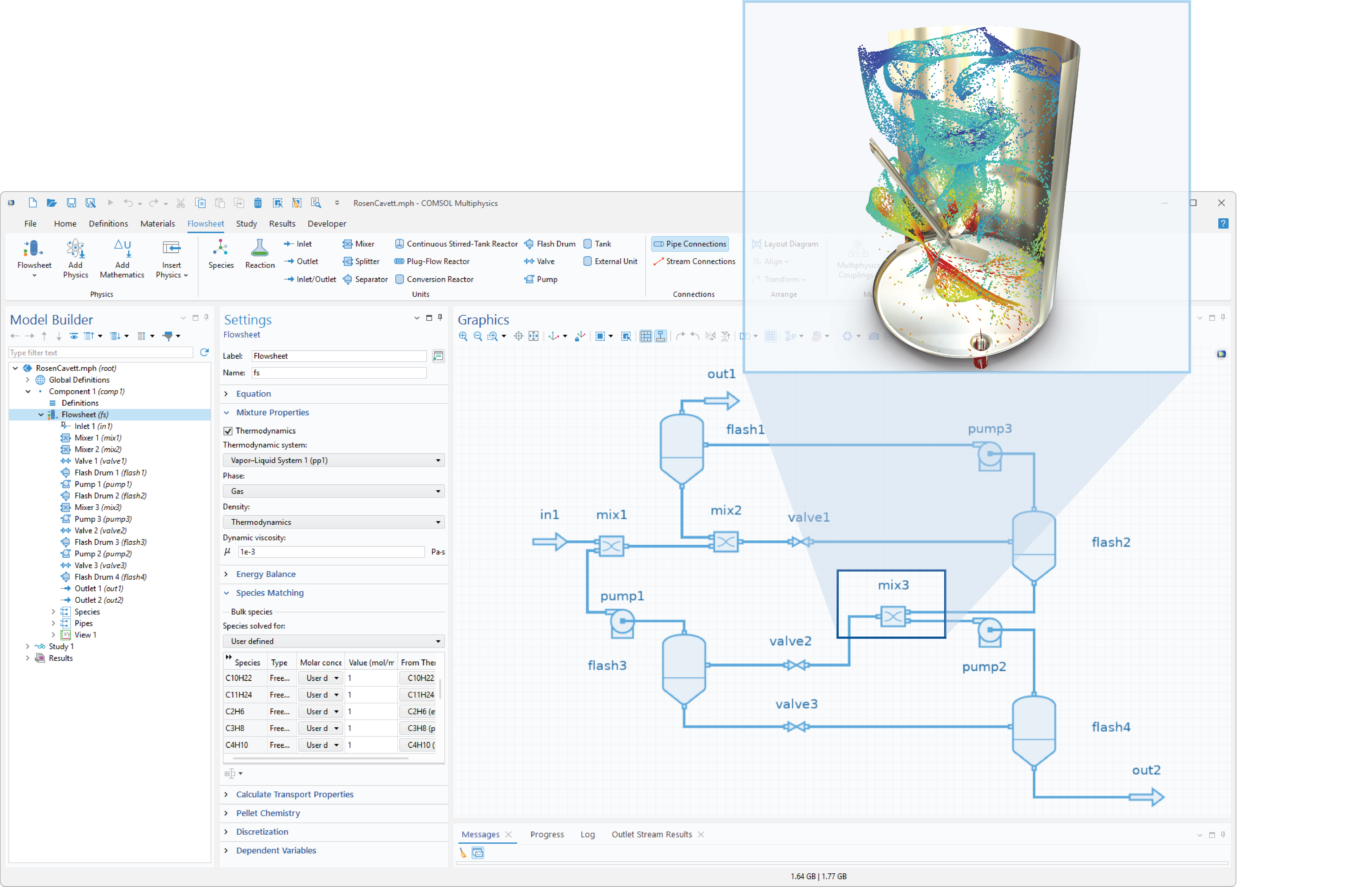
The Model Builder with the Flowsheet interface highlighted, the corresponding Settings window, and a flowsheet in the Graphics window coupled to a detailed 3D multiphysics model of a continuous mixer, providing a direct link between system-level process behavior and the detailed physics of an individual process unit.
Advancing AI-Assisted Simulation with Agentic Workflows
The previous version of COMSOL Multiphysics provided generative AI assistance through an optional Chatbot window, which can be used for obtaining modeling and programming guidance. Version 2027 takes the next step in AI-tool integration with the new COMSOL MCP Server, which uses the Model Context Protocol (MCP) to provide a standardized way for AI agents to interact directly with COMSOL Multiphysics. With this server, an agent will be able to easily perform modeling and simulation tasks through the COMSOL API used for all physics functionality and all stages of the modeling workflow.
An agent can build and/or modify a model, run simulations, inspect results, and use those results to decide what to do next. Throughout the process, the user can review and refine the work in the COMSOL Desktop environment.
"This support will open the door to more ambitious engineering workflows, connecting modeling, simulation, optimization, validation, and reporting in an iterative, goal-driven process," said Mikael Sterner, director of development at COMSOL. "Engineers can focus more on the questions they want to answer, with agents helping to carry out the simulation work."
New Electric Motor Module
The new Electric Motor Module provides a streamlined environment for modeling electric motors and generators in COMSOL Multiphysics. Dedicated functionality makes it easier to evaluate performance, operating ranges, losses, material effects, excitation circuits, and faults in both 2D and 3D, as well as to optimize machine designs for improved performance, efficiency, and material utilization.
The module provides enhanced capabilities for coupling electric machine models with heat transfer, structural mechanics, acoustics, fluid flow, and electrical circuits. This specialized multiphysics functionality makes it possible to more efficiently and accurately look beyond electromagnetics alone and understand how different physical effects influence overall performance.
Increased Access to the Application Builder
The Application Builder will now also be available on macOS and Linux with version 2027, enabling more users to build customized simulation tools.
First introduced in 2014, the Application Builder enables simulation experts to turn detailed multiphysics models into easy-to-use simulation apps with interfaces tailored to a specific task or audience. By asking for the relevant inputs, outputs, and settings only, these apps make it possible for colleagues or customers with little or no simulation experience to run analyses and make physics-informed decisions in the office, in the field, or on the factory floor, extending the value of simulation throughout R&D. Simulation apps can also serve as customized interfaces for digital twin solutions.
News Across the Product Suite
Additional updates in version 2027 include:
- Expanded defeaturing capabilities for ECAD and planar geometry models
- New interior grid meshing and enhanced swept meshing
- Fluid-structure interaction with high Mach number flow
- Edge- and point-to-surface mechanical contact
- New acoustic material library with biomedical and porous material properties
- Faster pseudo-4D battery simulations and new poroelasticity coupling for lithium-ion batteries
COMSOL Multiphysics version 2027 will be discussed in more detail at the COMSOL Conference, which is being hosted this fall in the UK, U.S., Japan, China, and India.
About COMSOL
COMSOL (https://www.comsol.com/) is a global provider of simulation software for product design and research to technical enterprises, research labs, and universities. Its COMSOL Multiphysics product is an integrated software environment for creating physics-based models and simulation apps. A particular strength is its ability to account for coupled or multiphysics phenomena. Add-on products expand the simulation platform for electromagnetics, structural, acoustics, fluid flow, heat transfer, and chemical applications. Interfacing tools enable the integration of COMSOL Multiphysics simulations with all major technical computing and CAD tools on the CAE market. Simulation experts rely on COMSOL Compiler and COMSOL Server to distribute apps to their design teams, manufacturing departments, test laboratories, and customers throughout the world. Founded in 1986, COMSOL has 16 offices worldwide and extends its reach with a network of distributors.
COMSOL, COMSOL Multiphysics, COMSOL Systems, COMSOL Compiler, and COMSOL Server are either registered trademarks or trademarks of COMSOL AB. Linux is a registered trademark of Linus Torvalds in the U.S. and other countries. macOS is a trademark of Apple Inc., registered in the U.S. and other countries.
Contact:
Mike Nourie
(781)273-3322
michael.nourie@comsol.com
Photos accompanying this announcement are available at
https://www.globenewswire.com/NewsRoom/AttachmentNg/fbb60f32-83e1-49df-810c-d0325644c58b
https://www.globenewswire.com/NewsRoom/AttachmentNg/20c0760a-61cb-44fa-a075-c706c881f0f3

