
InHand Networks shares five questions covering carrier support, network integration, failover, backup power and remote management
CHANTILLY, VA / ACCESS Newswire / September 16, 2026 / A strong speed test does not show what happens when a site's primary connection drops or the router needs attention after hours. InHand Networks today shared five questions for organizations evaluating 5G connectivity at small offices, retail locations, branch sites and project sites.
Speed is only one part of the decision," said an InHand Networks spokesperson. "A business also needs the right carrier support, a clear recovery plan and enough visibility to diagnose a problem."
Five questions to ask before choosing a 5G cellular router
1. Does it support the selected carrier at the intended site?
Certification is a starting point. Local coverage, congestion and building conditions still affect performance, so businesses should test service where the router will be installed.
2. Can it connect to the existing network?
A consumer hotspot may be enough for personal devices. A business site may also need Ethernet, IP passthrough, VPN support and traffic policies.
3. What happens when a connection fails?
Buyers should check how the router detects a problem, when it switches links and how active applications recover. A backup link does not guarantee that every session will continue without interruption.
4. What remains powered during an outage?
A router battery can keep the router running. Switches, payment terminals, cameras and computers need their own power plan.
5. Can the router be monitored without a site visit?
Alerts, logs, remote configuration and diagnostics can help an IT team investigate first. Buyers should also confirm which management services and support terms are included.
Where the CR602 fits
The InHand Networks CR602 combines 5G connectivity based on 3GPP Release 16, Wi-Fi 7 and two 2.5GbE WAN/LAN ports. It supports two Nano-SIM cards and a built-in, pre-provisioned eSIM, with configurable SIM priority and link detection.
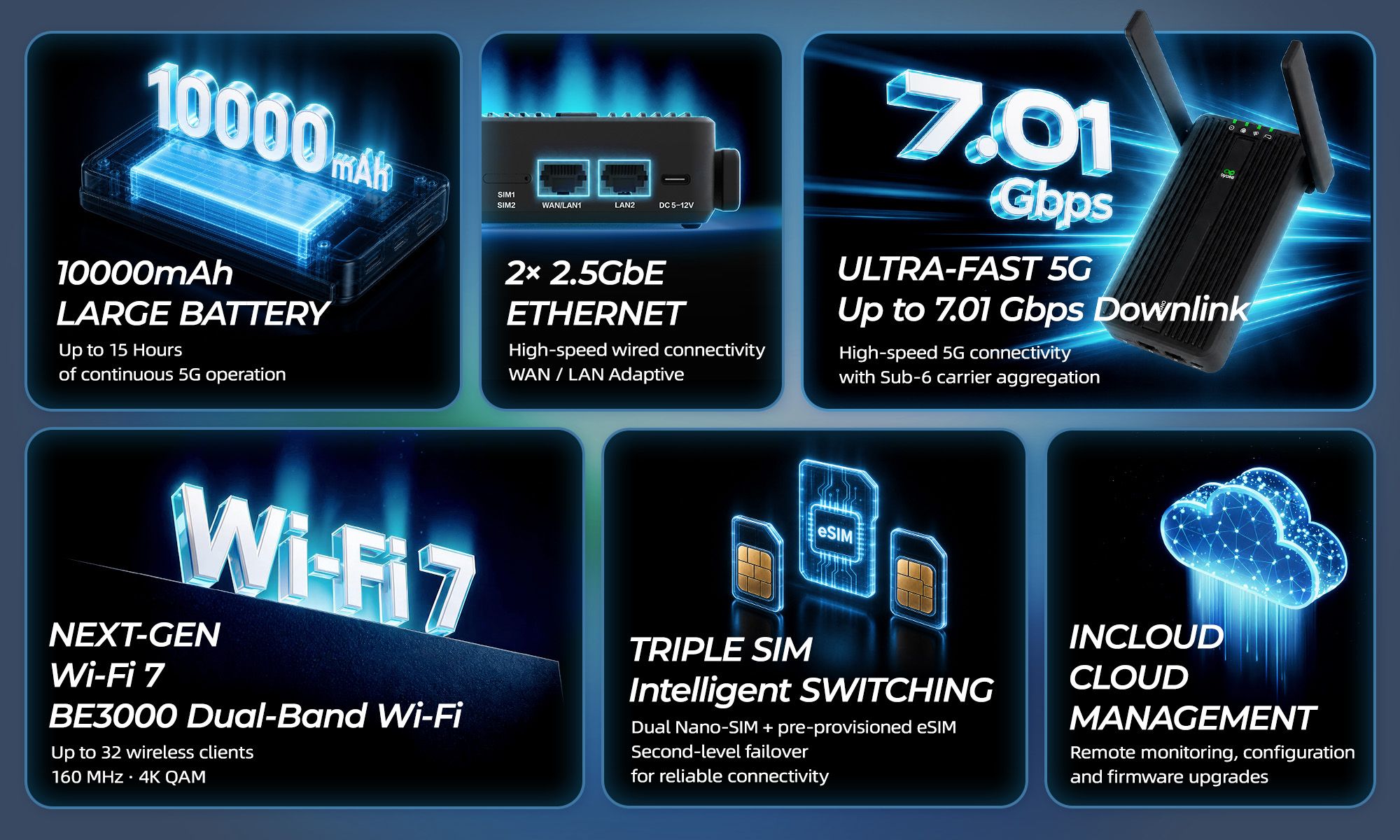
Beyond Wi-Fi access, CR602 can connect to switches, access points and other network equipment through its 2.5GbE ports. IP passthrough, VLAN support, policy routing and traffic controls allow it to work as part of a larger site network instead of operating only as a standalone Wi-Fi connection.
CR602 is certified for Verizon, AT&T, T-Mobile and FirstNet in North America. Its 10,000mAh battery is rated for up to 15 hours of operation in 5G mode. Actual runtime varies with signal conditions, traffic, configuration, temperature and battery condition. The battery powers the router, not connected equipment.
The router supports up to 32 Wi-Fi clients. InCloud Manager provides centralized monitoring, remote configuration, firmware management and diagnostics.
Learn more about the CR602 5G Cellular Router:
https://www.inhand.com/en/products/cellular-routers/cr602
About InHand Networks
InHand Networks provides IoT and networking solutions for business networking, industrial IoT, smart commerce, digital energy and mobility. Its products and cloud services help organizations connect and manage operations across distributed sites. Learn more at https://www.inhand.com.
Media contact
Eleanor Chen
Marketing & Communications
marketing@inhand.com
SOURCE: InHand Networks
View the original press release on ACCESS Newswire:
https://www.accessnewswire.com/newsroom/en/computers-technology-and-internet/beyond-the-hotspot-choosing-a-5g-cellular-router-for-business-1221509
