
CALGARY, Alberta, Sept. 17, 2026 (GLOBE NEWSWIRE) -- Condor Energies Inc. ("Condor" or the "Company") (TSX: CDR), a Canadian based, internationally focused energy transition company with active Central Asian operations is pleased to provide an operational update on its Uzbekistan project.
The Kumli-48 horizontal well ("K-48") was recently drilled to a total depth of 3,233 meters and includes an 863-meter open-hole lateral section into a lower carbonate reservoir interval that was identified by the previously drilled K-42 vertical well. K-48 initially flowed at a peak rate of 19.5 MMscf/d (or 3,250 boe/d) but was rate restricted to manage the high gas stream velocities. K-48 was tested on a 1" choke for four hours at an average rate of 18.1 MMscf/d (or 3,017 boe/d) with a flowing tubing pressure of 1,005 psi. Formation water production was negligible and the preliminary condensate-gas ratio from the flow test is 7.6 barrels per MMscf. The well is currently being tied in and will begin producing to gas sales shortly.
The Kumli 50 horizontal well ("K-50") which drilled the same lower carbonate reservoir has reached a total depth of 3,375 meters and is currently being completed prior to testing. The drilling rig from K-50 has commenced drilling the K-51 horizontal well which targets the same prolific lower carbonate reservoir as the K-48 and K-50 wells and the drilling rig from K-48 has moved to the adjacent Andakli field to begin drilling the A-22 horizontal well which targets a regionally extensive stratigraphic carbonate play.
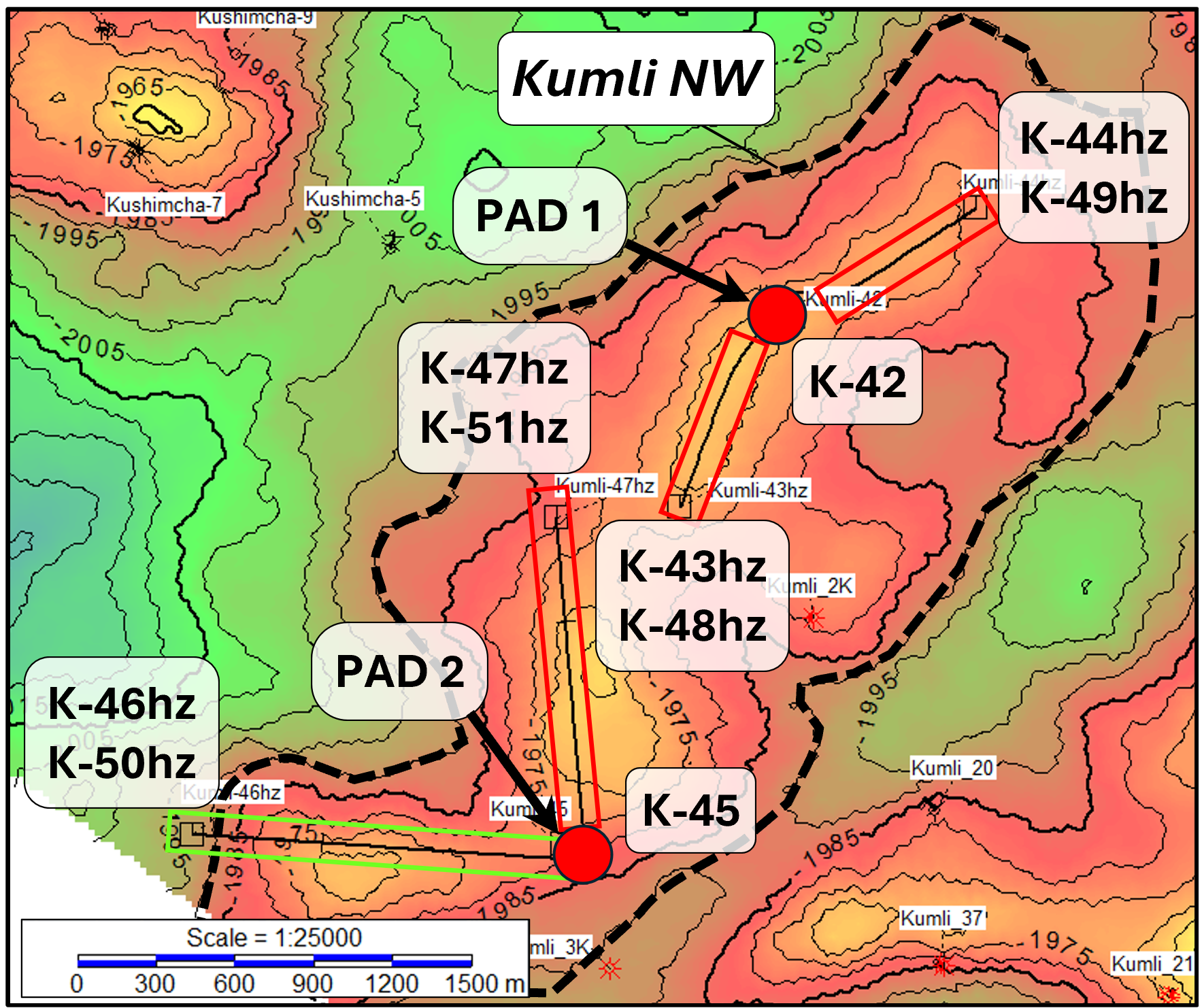
Figure 1: Kumli NW field Pads and development wells
Don Streu, Condor's President and CEO commented: "The very strong flow results from K-48 and its predecessors demonstrate the transformative impact horizontal wells can deliver and validates the significant value realized by successfully applying proven reservoir characterization and modern drilling technologies.
The Company has now drilled eight wells on the Kumli Northwest structure in 2026 that have added significant production volumes, while the drillable prospect inventory has grown to 58 and continues to expand our multi-year drilling program. Relocating one of the rigs to the Andakli field in the northern part of the concession becomes part of Condor's next growth engine to further enhance long-term value in Uzbekistan. Andakli is a large area of established gas charge where the team has recently tested and flowed gas outside of existing mapped structural closure boundaries. Given that we have already proven the commerciality of horizontal developments at Kumli, this opens significant prospective drilling acreage at Andakli while the second rig continues to monetize the Kumli field".
ABOUT CONDOR ENERGIES INC
Condor Energies Inc is a TSX-listed energy transition company that is uniquely positioned on the doorstep of European and Asian markets with three distinct first-mover energy security initiatives: increasing natural gas and condensate production from its existing fields in Uzbekistan; an ongoing project to construct and operate Central Asia's first LNG 'lower carbon fuel' diesel substitution facility in Kazakhstan; and a separate initiative to develop and produce critical minerals from brines in Kazakhstan. Condor has already built a strong foundation for reserves, production and cashflow growth while also striving to minimize its environmental footprint.
The Company recognizes 100% of the production volumes, sales volumes, sales revenues, royalties and expenses related to the production enhancement contract project in Uzbekistan ("PEC Project") and then allocates 49% of the comprehensive income (loss) attributable to the non-controlling interest holder. This is consistent with the accounting and disclosure in the Company's financial statements. Accordingly, the production volumes disclosed in this news release related to the PEC Project are 100% of the amounts attributable to the PEC Project, of which 51% are attributable to the Company.
FORWARD-LOOKING STATEMENTS
Certain statements in this news release constitute forward-looking information under applicable securities legislation. Such statements are generally identifiable by the terminology used, such as "is", "expect", "plan", "estimate", "may", "will", "could", "ongoing", "predict", "future", "continue", "upcoming", "possible", "continue", "extend", "advance", "on track", "underway", "leading" or other similar wording. Forward-looking information in this news release includes, but is not limited to: the timing and ability to drill, complete, test, tie in and produce new wells; the timing and ability to restrict gas flows and manage high gas stream volumes; the timing and ability to target the same lower carbonate reservoir as K-48 and K-50; the timing and ability to target the regionally extensive stratigraphic carbonate play; the timing and ability of the horizontal wells to deliver transformative impact and significant value; the timing and ability to successfully apply proven reservoir characterization and modern drilling technologies; the timing and ability of the drilling inventory locations to be drilled and become producing wells; the timing and ability to expand the multi-year drilling program; the timing and ability for Andakli to become part of the next growth engine to enhance long-term value; the timing and ability to test and flow gas outside of existing mapped structural closure boundaries; the timing and ability to deliver on the Company's broader initiatives to increase natural gas and condensate production in Uzbekistan, construct and operate an LNG facility in Kazakhstan, and to develop and produce critical minerals from brines in Kazakhstan.
By its very nature, such forward-looking information requires Condor to make assumptions that may not materialize or that may not be accurate including, but not limited to, the assumptions that: the Company will be able to fund its initiatives through a combination of cash on hand, increased cashflows, debt or equity financing, asset sales, or other financing arrangements; the financing available to the Company will be on terms acceptable to the Company, the Company will be able to manage liquidity and capital expenditures through budgeting and authorizations for expenditures; the Company will be able to manage health, safety, and operational risks through existing precautions and guidelines; the Company will be able to adapt to changing trade policies, tariffs, and restrictions; the Company will be able to obtain various approvals to conduct its planned exploration and development activities; the Company will be able to access natural gas pipelines as planned, the Company will be able to access sales markets as planned, the Company will have accurately estimated the anticipated capital expenditures and anticipated potential budgeting shortfalls; and the Company will be able to manage the impact of geopolitical instability and sanctions. Forward-looking information is subject to both known and unknown risks and uncertainties and other factors, which may cause actual results, levels of activity and achievements to differ materially from those expressed or implied by such information. Such risks and uncertainties include, but are not limited to: regulatory changes including changes to environmental regulations; the timing of regulatory and government approvals and the possibility that such approvals may be delayed or withheld; the risk that results of exploration and development drilling and related activities differ from what was initially anticipated; the risk that historical production and testing rates may not be indicative of future production rates, capabilities or ultimate recovery; the risk that the historical composition and quality of oil and gas does not accurately predict its future composition and quality; the risks associated with general economic, market and business conditions; risks relating to the uncertainty related to marketing and transportation; the risk of competitive action by other companies; risks associated with market fluctuations, particularly with respect to oil and natural gas prices; the effects of weather and climate conditions; fluctuation in interest rates and foreign currency exchange rates; the ability of suppliers to meet commitments; unanticipated actions by governmental authorities, including increases in taxes, tariffs, levies and fees; decisions or approvals of administrative tribunals and the possibility that government policies or laws may change or the possibility; risks associated with oil and gas operations, both domestic and international and other factors, many of which are beyond the control of Condor.
These risk factors are discussed in greater detail in filings made by Condor with Canadian securities regulatory authorities including the Company's most recent Annual Information Form, which may be accessed through at www.sedarplus.ca.
Readers are cautioned that the foregoing list of important factors affecting forward-looking information is not exhaustive. The forward-looking information contained in this news release are made as of the date of this news release and, except as required by applicable law, Condor does not undertake any obligation to update publicly or to revise any of the included forward-looking information, whether as a result of new information, future events or otherwise. The forward-looking information contained in this news release is expressly qualified by this cautionary statement.
BARRELS OF OIL EQUIVALENT
References herein to barrels of oil equivalent ("boe") are derived by converting gas to oil in the ratio of six thousand standard cubic feet ("Mcf") of gas to one barrel of oil based on an energy conversion method primarily applicable at the burner tip and does not represent a value equivalency at the wellhead. Given the value ratio based on the current price of crude oil as compared to natural gas is significantly different from the energy equivalency of 6 Mcf to 1 barrel, utilizing a conversion ratio at 6 Mcf to 1 barrel may be misleading as an indication of value, particularly if used in isolation.
| ABBREVIATIONS | |
| The following is a summary of abbreviations used in this news release: | |
| MMscf | million standard cubic feet |
| MMscf/d | million standard cubic feet per day |
| boe/d | barrels of oil equivalent per day |
| - | inch |
| psi | pounds per square inch |
| - | percent |
| LNG | Liquefied Natural Gas |
| TSX | Toronto Stock Exchange |
The TSX does not accept responsibility for the adequacy or accuracy of this news release.
For further information, please contact Don Streu, President and CEO or Sandy Quilty, Vice President of Finance and CFO at 403-201-9694.
A photo accompanying this announcement is available at https://www.globenewswire.com/NewsRoom/AttachmentNg/c4e382d0-b794-422c-8550-d194980e5032

