
Jayne Catherine Conway disputes research identifying the 18th-century philosopher as Margaret Haverkam
Austin, Texas--(Newsfile Corp. - September 17, 2026) - Jayne Catherine Conway, author of The Gilded Cage of Woman (July 2, 2024, Greenleaf Book Group Press), is challenging a claim made by the Royal Society that the 18th-century philosopher and scientific educator Margaret Bryan was the same woman as Margaret Haverkam, daughter of Oswald and Sarah Haverkam.
Margaret Bryan (1757-1836) was a pioneering educator who taught astronomy, mathematics, and natural philosophy to young women in England and published scientific textbooks at a time when advanced education was largely unavailable to women. Conway argues that the Royal Society's identification of Bryan as Margaret Haverkam is not supported by the historical evidence and raises a more fundamental question: How did Margaret Bryan acquire the sophisticated scientific education necessary to become the author and teacher documented in the historical record?
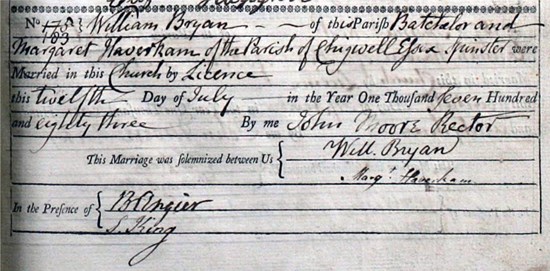
The 1783 London marriage record of Marg Haverkam and William Bryan
To view an enhanced version of this graphic, please visit:
https://images.newsfilecorp.com/files/9458/314691_b8ec36c6543cd9b4_001full.jpg
"I am categorically challenging the assertion that Margaret Bryan the philosopher was Margaret Haverkam," says Conway. "The evidence simply does not establish that these two women were the same person." One of the strongest pieces of evidence Conway cites is the 1783 London marriage record of Marg Haverkam and William Bryan. The certificate identifies the bride as "Marg," and Conway argues that the handwriting is inconsistent with the sophisticated cursive signature associated with Margaret Bryan, whose name appears in her published works and other documents. The marriage certificate also contains a small cross between "Marg" and "Haverkam." Conway believes this may be her mark indicating that Marg Haverkam was unable to sign her own name.
Additional records show that Marg Haverkam's brother, James Haverkam, married Mary Kirwan in Antigua in 1783 by his mark, which had to be proved after his death in 1819. This is conclusive evidence that he was illiterate. Conway argues in general, that the family's documented circumstances make the Royal Society's proposed educational history for Margaret Haverkam particularly difficult to reconcile with the known accomplishments of philosopher Margaret Bryan.
The Royal Society's research suggests that Bryan's advanced education in astronomy and natural philosophy most likely came from private tutors. Conway questions that conclusion. "Where are the tutors?" Conway asks. "Where is the evidence that Margaret Haverkam received this education? Her mother died when she was a small child, and her father put her and her brothers under the guardianship of their uncle when he remarried. She was then a young woman living in Bocking, England, at the end of the 18th century. The Royal Society's research does not establish how she could have acquired an advanced education in astronomy and Newtonian mechanics." Conway believes the question of Bryan's education is central to identifying her correctly. She argues that researchers have spent years attempting to connect Bryan inaccurately to a husband, while overlooking the possibility that her scientific education came through her own Bryan family.
Conway believes Margaret Bryan was her fourth great-aunt and descended from generations of London clockmakers and mathematical instrument makers. She believes Bryan received advanced mathematical instruction from her uncle Samuel Bryan, an accomplished 18th-century clockmaker. "I believe Margaret Bryan has been hiding in plain sight," says Conway. "Researchers have been looking for a husband, children, and a life that I believe she deliberately obscured. The evidence points back to the Bryan family itself."
Conway acknowledges that the Royal Society's research has uncovered some interesting probate and family records but argues that those records should not be treated as conclusive proof that Margaret Haverkam was the philosopher, Margaret Bryan.
Her challenge is particularly notable given the Royal Society's longstanding motto, Nullius in verba, meaning "take nobody's word for it."
"Nullius in verba," Conway says. "I am simply asking that the evidence be examined again from the lens as to where she could possibly have acquired her mathematical education, as a woman in Eighteenth Century England."
About Jayne Catherine Conway
Jayne Catherine Conway was born in England and immigrated to the United States with her family as a child. She holds a BS in engineering from North Carolina State University and an MBA from Harvard Business School.
After earning her MBA, she worked as a strategy consultant for Bain & Company and then held various C-suite leadership positions at Dunkin' Brands, Gulf Oil, Alex and Ani, and Planet Fitness. While at Alex and Ani, she had the privilege of partnering with First Lady Michelle Obama on the Let Girls Learn campaign. It was here that she developed her passion for raising awareness for women's lack of access to higher education and education in general. Jayne was a teaching fellow at Harvard Business School before she penned The Gilded Cage of Woman.
When Jayne and her uncle were working on their family tree together, they rediscovered the lost story of Margaret Bryan-an eighteenth-century relation and trailblazer in the education of women in the sciences, who found her path when there was no path for her.
Media Contact:
Gwen Cunningham
Greenleaf Book Group
gcunningham@greenleafbookgroup.com

To view the source version of this press release, please visit https://www.newsfilecorp.com/release/314691
