- All ten 2026 drill holes were located outside the currently defined Kate NI 43-101 resource boundary, with drill sites ranging from 67.7 metres (219 ft) to approximately 1 km from the Kate Silver Resource (KSR) outline.
- K26-08 approximately 1 km from the KSR returned:
- 13.4 metres (44 ft) averaging 267.6 g/t silver
- 7.9 metres (26 ft) grading 473.2 g/t silver and 2.92 g/t gold
- 1.5 metres (5 ft) grading 1,030 g/t silver and 1.65 g/t gold
- 1.8 metres (6 ft) grading 675 g/t silver and 10.20 g/t gold.
- The entire 184.1-metre (604 ft) assayed hole averaged 21.8 g/t silver
Vancouver, British Columbia--(Newsfile Corp. - September 22, 2026) - Viscount Mining Corp. (TSXV: VML) (OTCQX: VLMGF) ("Viscount" or the "Company") is pleased to report final assay results from its ten-hole, approximately 830-metre (2723 ft) 2026 drilling program at the Silver Cliff Project in Custer County, Colorado. All ten drill sites were outside the currently defined Kate NI 43-101 resource boundary, ranging from 67.7 metres (222 ft) to approximately 1 km from the KSR outline. Six holes specifically tested Kate resource-expansion ground 67.7 (222 ft) to 117.7 metres (383 ft) from the KSR, while four northern holes tested the broader structural trend 573.6 metres (1881 ft) to approximately 1 km from the KSR.
Using an economic 15 g/t silver cutoff, for the 2026 drill results, three holes averaged more than 20 g/t silver across their entire lengths:
K26-04 averaged 28.9 g/t silver over 56.4 metres (185 ft)
K26-08 averaged 21.8 g/t silver over 184.1 metres (604 ft)
K26-09 averaged 21.7 g/t silver over 62.3 metres (204 ft)
Project Manager/Geologist Chrissy Ricks stated, "Applying the 15 g/t silver cutoff highlights the breadth and more continuous zones of silver mineralization across the 2026 drilling. The drill program has significantly advanced the Silver Cliff story, strengthening both our open pit resource-expansion opportunity at Kate and the broader exploration potential to the north. We interpret the Kate and Passiflora mineralizing systems as potentially related components of the broader Silver Cliff hydrothermal system, while recognizing that their mineralization styles, alteration and geological characteristics are distinct. The 2026 step out results provide new information on both the potential extent of Kate-style silver mineralization and the evolution of the mineralizing system to the north. Based on the results we are currently preparing for a follow up 10-hole drill program this year."
The 2026 program was designed to test two complementary opportunities at Silver Cliff: expanding the near-surface open pit opportunity at the KSR beyond its currently modelled boundary, and testing soil-geochemical anomalies north of Kate along the broader structural trend toward the Passiflora porphyry target. The current April 2023 Kate mineral resource remains unchanged and was prepared using a 30 g/t silver cutoff. For evaluation and reporting of the 2026 drilling, Viscount is now applying a 15 g/t silver cutoff. These lower cutoff highlights broader consolidated mineralized intervals while preserving the higher-grade sub-intervals as important internal zones. The six Kate-focused holes tested ground 67.7 metres (222 ft) to 117.7 metres (386 ft) from the current KSR outline, and five returned composite intervals averaging at least 15 g/t silver. Because those intercepts lie beyond the existing resource boundary, none of that mineralization is currently included in the modelled tonnes or ounces. The four northern holes, at 573.6 metres (1881 ft) to approximately 1 km from the KSR, returned a distinctly different polymetallic signature, culminating in K26-08 with the strongest silver-gold mineralization of the program.
Highlights
High-Grade Silver-Gold Intercept
- K26-08 returned 13.4 metres (44 ft) averaging 267.6 g/t silver, including 7.9 metres (26 ft) grading 473.2 g/t silver and 2.92 g/t gold, 1.5 metres (5 ft) grading 1,030 g/t silver and 1.65 g/t gold, and a separate 1.8 metres (6 ft) grading 675 g/t silver and 10.20 g/t gold. The entire 184.1-metre (604 ft) assayed hole averaged 21.8 g/t silver.
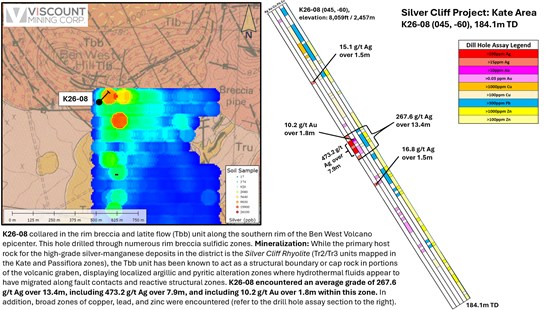
Silver Cliff Project: Kate Area Figure 1 K26-08 downhole assay section showing lithology, alteration and multi-element assay results along the hole
To view an enhanced version of this graphic, please visit:
https://images.newsfilecorp.com/files/2736/315229_92368eaad4236a45_002full.jpg
Kate Resource Expansion
The six Kate resource-expansion holes were located 67.7 metres (222 ft) to 117.7 metres (386 ft) outside the current KSR outline. Using the 15 g/t silver cutoff, five of six returned qualifying composite intervals. K26-04 returned 45.7 (149 ft) metres averaging 34.1 g/t silver and K26-09 returned 18.0 metres (59 feet) averaging 46.0 g/t silver, materially broadening the mineralized intervals being evaluated for potential future resource expansion.
K26-04 averaged 28.9 g/t silver across its entire 56.4-metre (185 ft) assayed length. K26-09 averaged 21.7 g/t silver across its entire 62.3-metre (204 ft) assayed length. K26-10 returned 12.5 metres (41 ft) averaging 15.3 g/t silver, including 4.0 metres (13 ft) averaging 54.1 g/t silver.
Northern Exploration Trend
- Northern drilling highlights broader silver mineralization under the 15 g/t cutoff. K26-07 returned 15.9 (52 ft) metres averaging 28.1 g/t silver, including 1.2 metres (3.0 ft) grading 212 g/t silver and 0.38 g/t gold. K26-08 returned 13.4 (44 ft) metres averaging 267.6 g/t silver and averaged 21.8 g/t silver across its entire 184.1-metre (604 ft) assayed length, defining a high-priority corridor for follow-up exploration toward Passiflora.
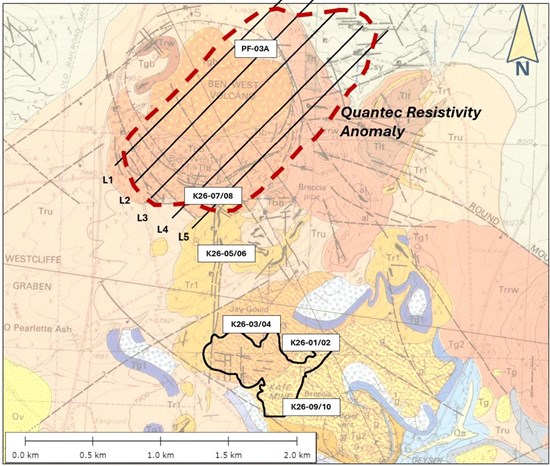
Figure 2: Silver Cliff drill-hole location and area map showing the 2026 Kate-area holes (K26-01 through K26-10), the Pasiflora target (PF-03A) and the Quantec resistivity anomaly approximately 2 km to the north.
To view an enhanced version of this graphic, please visit:
https://images.newsfilecorp.com/files/2736/315229_92368eaad4236a45_003full.jpg
Why the Step-Out Results Matter
The current April 2023 NI 43-101 Kate mineral resource contains 10.275 million ounces of silver in the measured and indicated categories at an average grade of approximately 71 g/t silver, plus 14.215 million ounces inferred at approximately 52 g/t silver. That resource remains unchanged by the 2026 drill results. With silver prices materially higher than when that resource was prepared, Viscount is using a 15 g/t silver cutoff to evaluate the 2026 drilling, highlighting broader zones of mineralization that may be considered in a future resource update. For this release grades shown are based on the Company geologist's composite calculations. All reported lengths are downhole core lengths; true widths have not been determined.
The central significance of the step-out program is that the successful Kate-focused intercepts occur beyond the existing resource envelope and therefore are not already counted in the current tonnes or ounces. The 15 g/t evaluation materially broadens several of the mineralized intervals: K26-04 returns 45.7 metres (150 ft) averaging 34.1 g/t silver; K26-09 returns 18.0 metres (59 ft) averaging 46.0 g/t silver; K26-10 returns 12.5 metres (41 ft) averaging 15.3 g/t silver; K26-01 returns 7.6 metres (25 ft) averaging 15.0 g/t silver; and K26-03 returns 6.1 metres (20 ft) averaging 15.5 g/t silver. K26-02 did not return a composite interval averaging at least 15 g/t silver. If follow-up drilling demonstrates sufficient continuity, geometry, thickness and grade, the new data could support extension of resource wireframes and the addition of mineralized tonnage and contained ounces in a future updated mineral resource estimate. The 2026 results do not themselves constitute an increase in the current mineral resource.
Kate Resource-Expansion Holes - Best Intervals
Six holes (K26-01 through K26-04, K26-09 and K26-10) were drilled as Kate resource-expansion step-outs outside the currently defined boundary of the Kate Silver Resource. For this release, Viscount is using a 15 g/t silver cutoff to define broader consolidated mineralized intervals. Five of the six holes returned qualifying composite intervals at or above this cutoff. Higher-grade internal intervals are shown separately in the table below.
| Hole | Interval (ft) | Length ft (m) | Ag (g/t) | Notes |
| K26-04 | 0-150 | 150 (45.7) | 34.1 | Entire 56.4 m hole avg. 28.9 g/t Ag; incl. 24.4 m @ 48.9 g/t Ag |
| K26-09 | 137-196 | 59 (18.0) | 46.0 | Entire 62.3 m hole avg. 21.7 g/t Ag; incl. 6.1 m @ 93.2 g/t Ag |
| K26-10 | 142-183 | 41 (12.5) | 15.3 | incl. 4.0 m @ 54.1 g/t Ag; 1.5 m @ 73.3 g/t Ag |
| K26-03 | 105-125 | 20 (6.1) | 15.5 | incl. 1.5 m @ 31.0 g/t Ag |
| K26-01 | 77-102 | 25 (7.6) | 15.0 | incl. 4.6 m @ 22.5 g/t Ag |
Note: K26-02 did not return a composite interval averaging at or above the 15 g/t silver cutoff. All reported lengths are downhole core lengths; true widths have not been determined.
North East Structural Trend Toward Passiflora - Best Hole Intervals
The final four holes of the program (K26-05 through K26-08) tested soil-geochemical anomalies north of the Kate resource along the structural trend r the Company is evaluating between Kate and Passiflora. The K26-05/K26-06 drill site is 573.6 metres (1879 ft) from the KSR outline and the K26-07/K26-08 site is approximately 1 km away. Using the 15 g/t silver cutoff highlights broader mineralized intervals in the northern drilling, including 15.9 metres (52 ft) averaging 28.1 g/t silver in K26-07 and 13.4 metres (44 ft) averaging 267.6 g/t silver in K26-08. K26-08 averaged 21.8 g/t silver across its full 184.1-metre (604 ft) assayed length. The Company considers the combination of broad silver mineralization, higher-grade silver-gold zones, changing metal assemblage and alteration to be an important exploration marker for follow-up work.
| Hole | Interval (ft) | Length ft (m) | Ag (g/t) | Au (g/t) | Pb (%) | Zn (%) |
| K26-08 | 254-298 | 44 (13.4) | 267.6 | -- | -- | -- |
| incl. | 262-288 | 26 (7.9) | 473.2 | 2.92 | 0.13 | 0.12 |
| incl. | 278-283 | 5 (1.5) | 1,030 | 1.65 | 0.27 | 0.24 |
| incl. | 262-268 | 6 (1.8) | 675 | 10.20 | 0.13 | 0.12 |
| K26-07 | 325-377 | 52 (15.9) | 28.1 | -- | -- | -- |
| incl. | 344-348 | 4 (1.2) | 212.0 | 0.38 | 0.50 | 0.50 |
| K26-05 | 65-85 | 20 (6.1) | 46.3 | -- | -- | -- |
| K26-06 | 246-256 | 10 (3.0) | 15.0 | -- | -- | -- |
Hole-by-Hole Summary
K26-01 through K26-04 - Kate Resource Expansion
K26-01 through K26-04 were drilled to test for resource expansion outside the current Kate resource boundary. Under the 15 g/t cutoff, K26-04 returned a broad 45.7 metre (150 ft) interval averaging 34.1 g/t silver and the entire 56.4-metre (185 ft) assayed hole averaged 28.9 g/t silver. Within the broader zone, K26-04 returned 24.4 metres (80 ft) averaging 48.9 g/t silver. K26-01 returned 7.6 metres (25 ft ) averaging 15.0 g/t silver, including 4.6 metres (15 ft ) averaging 22.5 g/t silver. K26-03 returned 6.1 metres ( 20 ft ) averaging 15.5 g/t silver, including 1.5 metres ( 5 ft ) at 31 g/t silver. K26-02 did not return a composite interval averaging at least 15 g/t silver. The Company considers these results to support further evaluation of Kate-style mineralization beyond the current modelled boundary. Any resource expansion remains subject to additional drilling and an updated mineral resource estimate prepared by a qualified person.
K26-09 and K26-10 - Kate Resource Expansion
K26-09 and K26-10 tested resource-expansion potential on the southeast side of the currently defined Kate resource. At the 15 g/t cutoff, K26-09 returned 18.0 metres (59 ft) averaging 46.0 g/t silver, including 6.1 metres (20 ft) averaging 93.2 g/t silver and 1.5 metres ( 5 ft ) at 182 g/t silver. The entire 62.3-metre (204 ft) assayed hole averaged 21.7 g/t silver. K26-10 returned 12.5 metres (41 ft) averaging 15.3 g/t silver, including 4.0 metres (14 ft ) averaging 54.1 g/t silver and 1.5 metres (5 ft) at 73.3 g/t silver.
K26-05 - Defender Structural Trend
K26-05 was drilled on a north-south structure south of the historic Defender Mine, a past-producing lead-silver vein mine. At the 15 g/t cutoff, the hole returned 6.1 metres (20 ft) averaging 46.3 g/t silver, including 1.5 metres (5 ft) at 164 g/t silver. A separate 6.1 metres (20 ft) interval averaged 25.5 g/t silver. Lead, zinc and cadmium were also anomalous, supporting the interpretation of a polymetallic hydrothermal system.
K26-06 - Follow-Up Structural Test
K26-06 was drilled from the same location as K26-05 as a follow-up along the same structural corridor. The hole returned a 3.0 metre (10 ft) consolidated interval averaging 15.0 g/t silver under the 15 g/t cutoff, within a broader lower-grade lead-zinc mineralized zone. The Company considers the combination of broader base-metal mineralization and silver-bearing intervals to be consistent with a zoned hydrothermal system.
K26-07 - Ben West Volcanic Rim Target
K26-07 tested the southern rim of the Ben West volcanic complex. Using the 15 g/t cutoff, the hole returned a broad 15.9 metre (52 ft) interval averaging 28.1 g/t silver, including a 1.2 metre (4 ft) interval grading 212 g/t silver, 0.38 g/t gold, 0.50% lead and 0.50% zinc. A separate 4.6 metre (15 ft) interval averaged 37.7 g/t silver. The Company considers the result important evidence of broader silver mineralization accompanying the evolving silver-gold-base-metal system north of Kate.
K26-08 - High-Grade Silver-Gold Zone
K26-08, drilled toward the Company's PF-03A porphyry discovery hole at Passiflora, returned the strongest assay results of the 2026 program. At the 15 g/t cutoff, the hole returned 13.4 metres (44 ft) averaging 267.6 g/t silver. This broader interval includes 7.9 metres (26 ft) averaging 473.2 g/t silver and 2.92 g/t gold, including 1.5 metres (5 ft) of 1,030 g/t silver and 1.65 g/t gold and, separately within the same higher-grade core, 1.8 metres (6 ft) of 675 g/t silver and 10.20 g/t gold. The entire 184.1-metres (604 ft) assayed hole averaged 21.8 g/t silver. The Company considers the broader silver envelope, high-grade silver-gold core and alteration observed in K26-08 to define a high-priority corridor for follow-up drilling toward Passiflora.
K26-08 was collared in the rim breccia and latite flow ("Tbb") unit along the southern rim of the Ben West volcanic complex, drilling through numerous rim breccia sulfidic zones. Mineralization: while the primary host rock for the high-grade silver-manganese deposits in the district is the Silver Cliff Rhyolite (Tr2/Tr3 units mapped in the Kate and Passiflora zones), the Tbb unit has been known to act as a structural boundary or cap rock in portions of the volcanic graben, displaying localized argillic alteration zone with abundant pyrite where hydrothermal fluids appear to have migrated along fault contacts and reactive structural zones.
Six thin sections examined by optical microscopy from K26-08 showed selective pervasive biotite alteration, with the deepest slide, at approximately 182.7 m, showing pervasive potassic alteration; propylitic alteration was also observed to be well developed. The Company considers this alteration style relevant to its exploration model for a porphyry-related mineralizing system at depth and to the north, but additional drilling is required to test that interpretation. Multi-Metal Geochemistry.
In addition to silver and gold, the 2026 program returned widespread manganese, zinc and lead anomalies across the 506 drill-core samples assayed. Manganese exceeded 1,000 ppm in 196 of 506 samples, including 76 samples above the laboratory's 1,000 ppm upper reporting limit for the routine analytical method. Zinc exceeded 1,000 ppm (0.1%) in 146 of 506 samples, and lead exceeded 1,000 ppm (0.1%) in 116 of 506 samples, including three samples above the laboratory's 10,000 ppm (1%) upper reporting limit. Cadmium, which commonly occurs with lead-zinc mineralization, was also anomalous, with one sample exceeding the routine method's upper reporting limit.
These anomalies are most pronounced in the four northern holes (K26-05 through K26-08) and are broadly coincident with the lead-zinc-silver mineralization described above. Because 76 manganese samples exceeded the routine method's upper reporting limit, their actual manganese grades are not yet known. Selected over-limit samples will be re-analyzed using appropriate higher-range methods as part of the Company's ongoing technical review.
Manganese - U.S. Critical Mineral Context
Manganese is included on the final 2025 U.S. Critical Minerals List. According to the U.S. Geological Survey (USGS), manganese ore containing 20% or more manganese has not been produced domestically since 1970, and the United States was 100% net-import reliant for manganese content in 2025. USGS estimated 2025 imports of approximately 350,000 metric tons of manganese ores and concentrates, 350,000 metric tons of ferromanganese and 310,000 metric tons of silicomanganese, or approximately 1.01 million metric tons combined on a gross-weight basis.
Of the 197 samples submitted for manganese analysis, 76 samples, or approximately 38%, exceeded the laboratory's upper reporting limit for the routine analytical method. The frequency of these over-limit results indicates that manganese enrichment is widespread within the sampled material and warrants higher-range re-analysis to determine actual manganese grades and better evaluate continuity.
Source for U.S. manganese market context: U.S. Geological Survey, Mineral Commodity Summaries 2026 and final 2025 List of Critical Minerals.
Next Steps
Viscount is using the 2026 assay results to refine the next phase of exploration at Silver Cliff. Planned work includes:
Evaluate the appropriate timing for an updated Kate mineral resource estimate after sufficient follow-up drilling and technical review have been completed.
Complete a new soil-geochemical survey across the resource-expansion area and adjacent ground to better define the surface expression and continuity of mineralization and to refine follow-up drill targets.
Integrate the new soil data with the 2026 drill assays, geological observations and existing geophysical information to rank priority drill targets around Kate and along the northern structural trend.
Complete higher-range re-analysis of selected samples that exceeded routine laboratory reporting limits using appropriate analytical methods for the applicable multi-element packages.
Plan an initial follow-up drill program for later in 2026. Final collar locations and priorities will be selected after the new soil survey and technical integration are complete, with the program intended to test the highest-priority resource expansion and northern trend targets.
Analytical Method and Composite Methodology
Silver and gold values reported above reflect fire-assay analysis with a gravimetric or ICP finish for samples that exceeded the upper reporting limit of the routine multi-element ICP method. For this release, silver composites are reported using a 15 g/t Ag cutoff. Broader consolidated intervals may include internal samples below 15 g/t Ag where the combined interval maintains an average grade of at least 15 g/t Ag; higher-grade internal intervals are reported separately. All reported grades and composites are based on the Company geologist's calculations and have been reviewed as part of the Company's technical disclosure process. "Including" intervals identify higher-grade sub-intervals within a broader composite and are not additional to the composite length. All reported lengths are downhole core lengths; true widths have not been determined.
Qualified Person
The scientific and technical information contained in this news release, including the use of a 15 g/t silver cutoff for the 2026 drill-result composites, has been reviewed and approved by Harald Hoegberg, C.P.G., an independent consulting geologist who is a "Qualified Person" as such term is defined under National Instrument 43-101 - Standards of Disclosure for Mineral Projects ("NI 43-101"). On-site geological logging and field supervision of the 2026 program was conducted by Christina Ricks, project geologist.
Composite intervals presented in this news release are downhole core lengths; true widths have not been determined. Readers are cautioned that mineralization intersected in drill core may not be representative of the deposit as a whole. The 15 g/t silver cutoff used to evaluate and report the 2026 drilling has not yet been incorporated into an updated Kate mineral resource estimate. The current April 2023 resource remains unchanged. The 2026 step-out results demonstrate mineralization beyond the current resource boundary but do not, by themselves, establish an increase in the Kate mineral resource. Any resource expansion will require sufficient follow-up drilling, resource modelling and preparation of an updated mineral resource estimate by a qualified person. Historic and current drill results are not necessarily indicative of mineralization that may be encountered elsewhere on the property.
About Viscount Mining Corp.
Viscount Mining Corp. (TSXV: VML) (OTCQX: VLMGF) is a mineral exploration company focused on advancing silver, gold and copper projects in the western United States. The Company's portfolio includes the Silver Cliff Project in Colorado, which hosts the NI 43-101 Kate Silver Resource and the Passiflora copper-gold porphyry target, and the 100%-controlled Cherry Creek Project in Nevada, a historic multi-metal district with more than 20 past-producing mines.
For additional information, please visit www.viscountmining.com.
On Behalf of the Board of Directors
"Jim MacKenzie"
Jim MacKenzie, President, Chief Executive Officer and Director
For further information, please contact:
Viscount Investor Relations
Email: info@viscountmining.com
Neither TSX Venture Exchange nor its Regulation Services Provider (as that term is defined in the policies of the TSX Venture Exchange) accepts responsibility for the adequacy or accuracy of this release.
Cautionary Note Regarding Forward-Looking Statements
This news release includes certain statements that may be deemed "forward-looking statements" within the meaning of applicable Canadian securities legislation. Forward-looking statements include, but are not limited to, statements with respect to Viscount Mining's operations, exploration and development plans, expansion plans, estimates, expectations, forecasts, objectives, predictions and projections of the future. Specifically, this news release contains forward looking statements with respect to the actual size of the anomaly, feasibility, grade of mineralization and the content of the mineralization. Generally, forward-looking statements can be identified by the forward-looking terminology such as "plans", "expects" or "does not expect", "is expected", "budget", "scheduled", "estimates", "projects", "intends", "anticipates", or "does not anticipate", or "believes", or variations of such words and phrases or state that certain actions, events or results "may", "can", "could", "would", "might", or "will" be taken, occur or be achieved. Forward-looking statements are subject to known and unknown risks, uncertainties and other factors that may cause the actual results, level of activity, performance or achievements of Viscount Mining to be materially different from those expressed or implied by such forward-looking statements, including but not limited to: risks related to the exploration and development and operation of Viscount Mining's projects, the actual results of current exploration, development activities, conclusions of economic evaluations, changes in project parameters as plans continue to be refined, future precious metals prices, as well as those factors discussed in the sections relating to risk factors of our business filed in Viscount Mining's required securities filings on SEDARPlus. Although Viscount Mining has attempted to identify important factors that could cause results to differ materially from those contained in forward-looking statements, there may be other factors that cause results to be materially different from those anticipated, described, estimated, assessed or intended.
There can be no assurance that any forward-looking statements will prove accurate, as actual results and future events could differ materially from those anticipated in such statements. Accordingly, readers should not place undue reliance on forward-looking statements. Viscount Mining does not undertake to update any forward-looking statements that are incorporated by reference herein, except in accordance with applicable securities laws.

To view the source version of this press release, please visit https://www.newsfilecorp.com/release/315229