
Istanbul, Turkey--(Newsfile Corp. - September 29, 2026) - International Plus, a Turkish dental group authorised by the Turkish Ministry of Health, has published the internal protocol that defines where artificial intelligence is applied in its international patient pathway and, equally, where clinical decisions remain with named specialists. The document follows a health innovation panel at Atlas University in Istanbul at which chief executive Mehmet Ali Arici set out the group's position on AI in medical tourism.
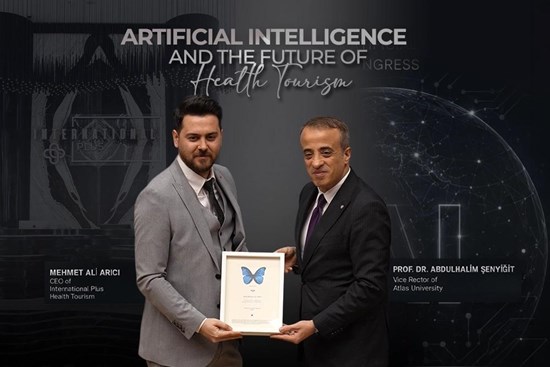
Image Description: International Plus CEO Mehmet Ali Arici presents an award with Prof. Dr. Abdulhalim Senyigit during a health tourism and artificial intelligence event.
To view an enhanced version of this graphic, please visit:
https://images.newsfilecorp.com/files/11790/315847_ffa79eca449469da_001full.jpg
Publication of the protocol addresses a gap that has followed the sector for several years. Clinics across the medical travel market describe themselves as AI enabled without stating which decisions the software actually makes. The document released this week separates the two categories explicitly, setting out where software is used for administrative and measurement work and where every clinical judgement remains with a named clinician.
What the Atlas University Panel Addressed
Mehmet Ali Arici appeared on the health innovation panel at Atlas University, one of Istanbul's private universities on a bill of speakers drawn from academic as well as clinical backgrounds. His contribution dealt with a specific problem in cross border care: an international patient commits to travel and often to a treatment plan before meeting the clinician who will carry it out.
"A patient in another country is asked to make a decision on incomplete information and that is the real problem to solve," said Mehmet Ali Arici, chief executive of International Plus. "Software can close part of that gap by making the plan legible earlier. It cannot close the part that requires a surgeon to look at a scan and take responsibility for what happens next."
That distinction became the organising principle of the protocol published afterwards.
Where AI Enters the International Patient Pathway
Under the published protocol, software is used at four points in the pathway in each case for administrative, organisational or measurement work. None of these systems is used as a medical device. No automated system in this pathway produces a diagnosis, a clinical finding, a risk score or a treatment recommendation.
Intake review. Forms and free text submitted by a patient are consolidated into a single structured record, so that something written in a message does not sit apart from something entered in a form. The software organises and routes the material. It does not interpret it. A coordinator reads the consolidated record and passes it to a clinician.
Imaging handling. Where a patient supplies existing radiographs, software standardises file format, orientation and scale so that images can be displayed consistently and measured on screen. Reading those images is carried out by a clinician. No automated marking, detection or interpretation is applied to them at any stage.
Aesthetic proportion measurement. Facial and dental proportion software measures how the smile line sits against the midline and the wider facial landmarks. These are dimensional measurements used in restorative design rather than a clinical assessment of health or disease.
Scheduling and logistics. Phase sequencing from surgery through healing to the prosthetic stage is coordinated by planning software, which matches the clinical timetable against travel dates and the availability of the in-house laboratory.
Where the Protocol Stops
The more unusual half of the document is the exclusion list. Four stages are recorded as clinician-only: diagnosis, approval of the treatment plan, surgical decision making, final prosthetic sign-off. The responsible specialist is named in the patient file at each.
Automated planning speeds up the early stages of a case considerably but the protocol does not permit it to shorten the diagnostic stage because a plan built on an unverified diagnosis simply reaches the wrong destination faster. Complex cases are instead routed to the group's multidisciplinary Diagnostic Council, where surgeons and prosthodontists review the file together with restorative specialists before a plan is issued.
The Technology in Use at the Istanbul Facility
Digital infrastructure at the Istanbul facility supports the protocol. Intraoral scanning is carried out with TRIOS 5 systems, which record oral anatomy directly and remove the dimensional distortion that physical impression materials introduce during setting and transport. Cone beam computed tomography provides the three dimensional anatomical record used for surgical planning. Photogrammetric measurement with iCam iMetric establishes the spatial relationship between implants in full arch cases, where cumulative error across several fixtures is the main threat to a passive fit.
Restorations are produced in an in-house laboratory at the same site. Because fabrication happens under the same roof as treatment, a design can be revised and remade within the patient's stay rather than across an international shipping cycle.
Why Medical Travel Is the Harder Case
Domestic patients can return for an additional appointment without much difficulty. An international patient cannot, which changes the stakes attached to getting a plan right the first time and explains why cross border providers have adopted digital planning faster than the wider profession.
Since 2014 the provider reports treating more than 200,000 patients from over 140 countries. That volume, drawn from a wide range of anatomies and treatment histories, is what gives the protocol something to govern, though the document notes that a larger record improves the quality of the information reaching a clinician without changing who is accountable for acting on it.
Patients and referring clinicians can review the group's published protocols and clinician credentials through its medical tourism resources.
Regulatory Context
Turkey's health tourism sector operates under a licensing regime administered by the Ministry of Health, which authorises facilities to treat international patients. International Plus holds that authorisation alongside USHAS health tourism authorisation plus Health Turkiye certification and it operates under ISO 9001, ISO 27001, ISO 10002 management systems. On the clinical side the practice carries ADA, AACD, ITI, EAO dental accreditations. Data protection carries particular weight where AI is involved since intake and imaging systems process personal health information belonging to residents of more than 140 countries. Information security management under ISO 27001 governs how that material is handled.
About International Plus
Founded in 2014, International Plus is a dental group based in Istanbul, authorised by the Turkish Ministry of Health and holding USHAS health tourism authorisation together with Health Turkiye certification. The group carries ADA, AACD, ITI, EAO dental accreditations and operates under ISO 9001, ISO 27001, ISO 10002 management systems. It reports treating more than 200,000 patients from over 140 countries, with patient coordination offered in more than 20 languages, an in-house digital laboratory at its Istanbul facility and case planning carried out by a multidisciplinary Diagnostic Council.
Media Contact
Company: International Plus
Location: Istanbul, Turkey
Website: internationalplus.net
Email: info@internationalplus.net
Phone: +90 850 309 44 61
WhatsApp: +90 535 963 26 30
To view the source version of this press release, please visit https://www.newsfilecorp.com/release/315847
