
As agents like Meta's Muse begin shopping for users, Snaplii Cash gives them a budget instead of a credit card
SAN FRANCISCO, CA / ACCESS Newswire / October 5, 2026 / AI agents, such as Meta's Muse, are beginning buying things for users, one question keeps coming up. Which card should you give your AI agent? Snaplii, the digital wallet and smart shopping app, is offering an answer that leaves the credit card out. Snaplii Cash can serve as a separate, pre-funded wallet that an AI agent spends from, with a limit the user sets and cashback on purchases.
The new normal of agents moving from answering questions to completing tasks is becoming even more real with Meta launching its Muse agent on Sept. 8. It has reached No. 1 on Apple's U.S. App Store on Sept. 18, according to Sensor Tower data reported by TechCrunch. On Sept. 28, TechCrunch reported that Instinct, another personal AI agent, raised a $1 billion Series C at a $10 billion valuation. Both are built to handle everyday tasks on a user's behalf, and those tasks can include making purchases.
However, comfort with handing over payment details has not kept pace. A January 2026 PYMNTS Intelligence report found that 69% of consumers are interested in delegating tasks such as subscription management, grocery shopping and meal planning to agentic AI. Separately, Visa research found that only 23% of U.S. consumers trust generative AI to handle payments on their behalf.
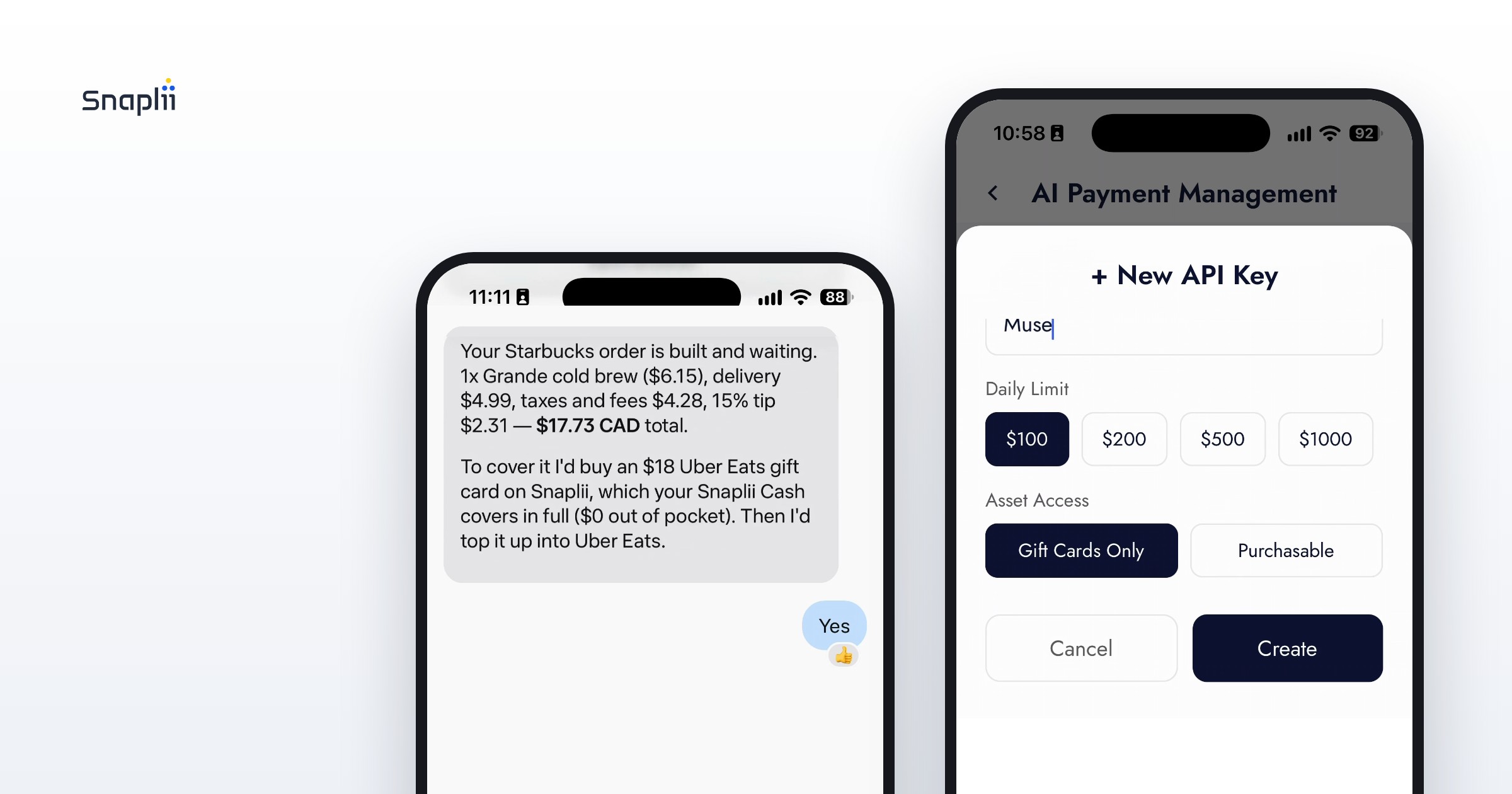
With Snaplii Cash, a user loads only the amount they are willing to let an agent spend and sets a spending limit, such as $50, in the Snaplii app. When the user asks an agent such as Muse to buy something, the payment comes from that Snaplii Cash balance, and each payment appears as paid from the user's Snaplii Cash. The user's credit card and bank account details are not shared with the agent.
Purchases an agent makes with Snaplii Cash earn cashback on the platform. Examples include 10% back at DoorDash and 3% at Uber Eats, so an $18 Uber Eats order returns $0.54, with up to 15% back at select brands across Snaplii's network of more than 500 brands.
Snaplii Cash can be used with Meta's Muse today and is built to work with other consumer agents such as Instinct, so users can keep one spending wallet as they try different agents. For developers, Snaplii also offers an MCP-compatible Agent-to-Merchant interface that issues one-time, pre-funded credentials for each transaction.
"You wouldn't hand a new assistant your credit card on day one. You'd give them a budget. That's what Snaplii Cash is for an AI agent, a budget, not a blank check," said Spencer Xu, Founder and CEO of Snaplii. "Agents are getting smarter every week. The one thing that should stay simple is how much of your money they can touch."
"Muse and Instinct have made it normal to ask an AI to go buy something for you. The next question everyone asks is which card do I give it? Our answer is none of them. Give your agent a Snaplii Cash balance. It can only spend what you put in, it never sees your card, and every purchase earns you cashback," said Xu.
Snaplii's wallet already serves more than 350,000 users and processes more than US$100 million in annual transaction volume across more than 500 brands. Snaplii is available in the United States and Canada. To learn more, visit snaplii.com.
About Snaplii
Snaplii, founded and based in Toronto, is a digital wallet and infrastructure for AI-native commerce. The platform provides cashback rewards for shoppers at 500-plus brands across North America and has more than 350,000 users spending over $100 million in annual transactions via the app.
Media Contact
marketing@snaplii.com
SOURCE: Snaplii Inc.
View the original press release on ACCESS Newswire:
https://www.accessnewswire.com/newsroom/en/computers-technology-and-internet/as-muse-tops-the-app-store-and-instinct-raises-1-billion-snaplii-1230134
