
Independent reviews highlight the memoir's extensive documentary record, while a new author interview examines whistleblowing, constitutional accountability and the decision to go public
WASHINGTON, D.C. / ACCESS Newswire / October 8, 2026 / Former CIA intelligence and operations officer Pedro Israel Orta's memoir, The Broken Whistle: A Deep State Run Amok, is drawing a growing body of independent critical attention for its extensive documentation, insider perspective and examination of whistleblowing, institutional power and government accountability.
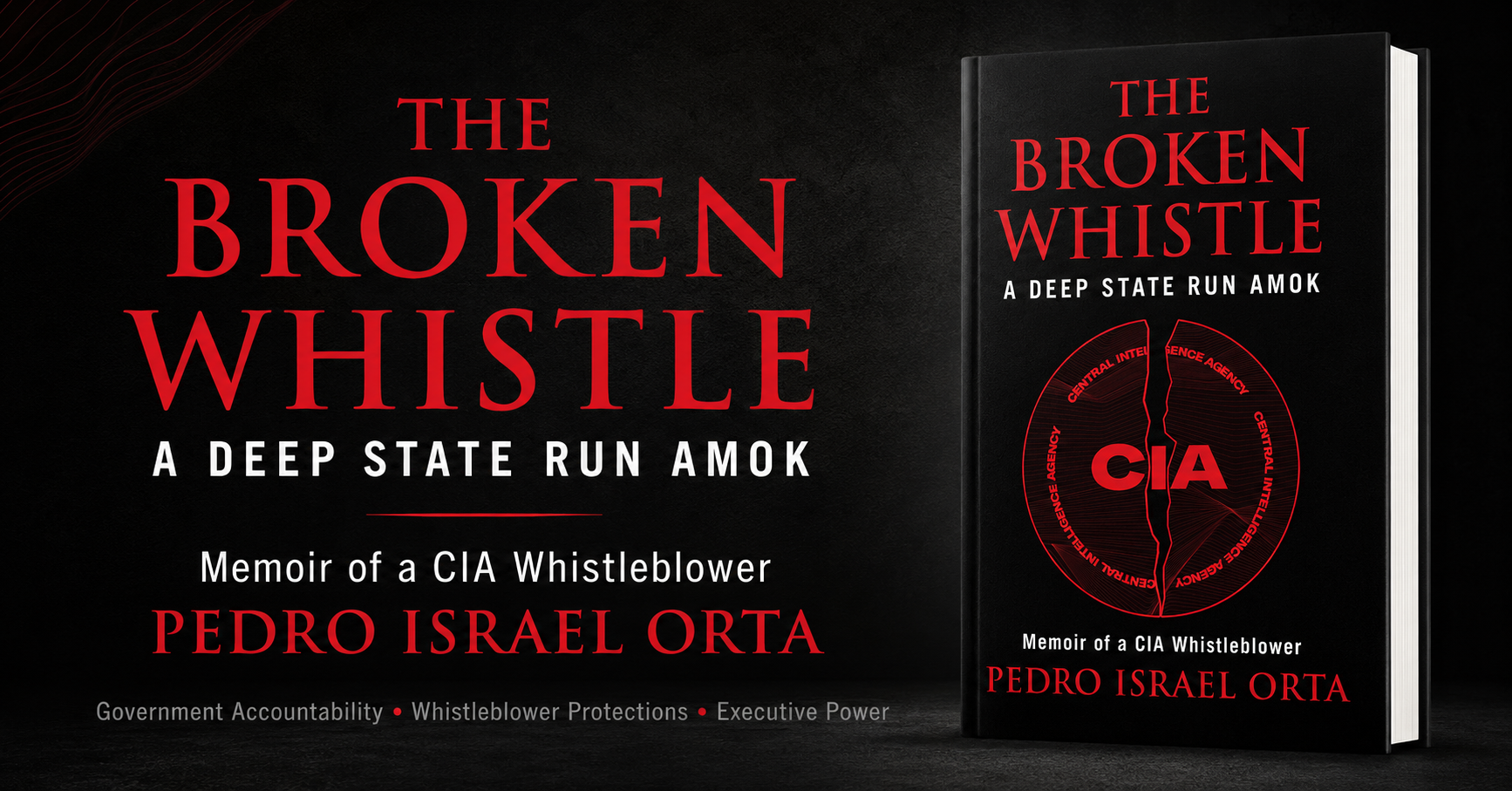
Recent assessments from The Prairies Book Review, BookView Review, IndieReader, Literary Titan, The Book Revue and other reviewers have approached the memoir from different perspectives, but repeatedly return to several themes: the volume of supporting documentation, the personal cost of dissent, the exercise of institutional power and questions about whether internal oversight mechanisms can effectively hold government organizations accountable.
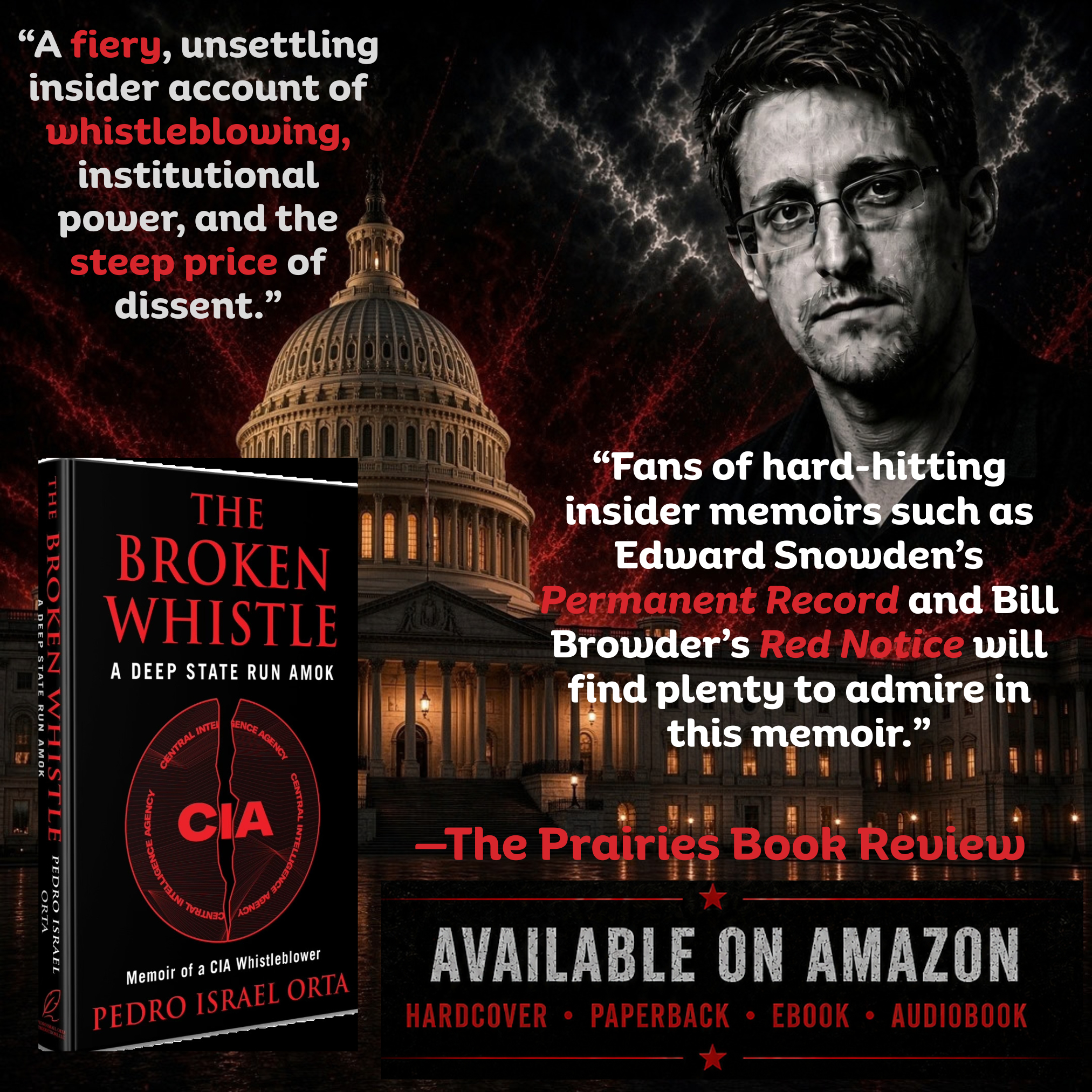
The Prairies Book Review described The Broken Whistle as a "fiery, unsettling insider account of whistleblowing, institutional power, and the steep price of dissent."
The review also placed the memoir alongside two prominent insider accounts:
"Fans of hard-hitting insider memoirs such as Edward Snowden's Permanent Record and Bill Browder's Red Notice will find plenty to admire in this memoir."
The Prairies further characterized the book as "dense with documentation but propelled by personal conviction" and "an urgent, combative account of conscience colliding with bureaucracy."
BookView Review similarly emphasized the evidentiary character of the work, calling it a "painstakingly documented account" and concluding:
"A document-rich, intensely personal reckoning with secrecy, power, and the battle to put one's story on the record."
The growing critical attention comes as Orta is also speaking more publicly about why he ultimately decided to document his 18½-year U.S. Intelligence Community career and the disputes that followed his whistleblower disclosures.
A NEW AUTHOR INTERVIEW EXAMINES WHY ORTA WENT PUBLIC
In an October 2 conversation with BookView Author Interview, Orta said he did not leave the CIA intending to attack the institution or disclose protected information. Instead, he said he spent years attempting to work through established government mechanisms for reporting alleged wrongdoing and retaliation.
According to Orta, the decision to write publicly came after he concluded that those mechanisms had failed and that the documentary record should not disappear inside government bureaucracy.
The interview places The Broken Whistle within a larger argument about oversight and constitutional government.
"Our constitutional republic is far more fragile than many people realize," Orta told BookView. "It depends on robust oversight, accountable institutions, and citizens who remain informed and engaged in government rather than assuming someone else will safeguard it for them."
For Orta, that distinction is central to understanding why he considers the book more than an autobiography.
"At its core, The Broken Whistle is not merely a memoir," he said in the interview. "It is also a documented case history of what happened to one CIA officer after he reported what he believed to be wrongdoing and subsequently alleged retaliation."
DOCUMENTATION, NOT SIMPLY RECOLLECTION
The documentary foundation repeatedly cited by reviewers was intentional.
Orta says he reconstructed events by comparing personal recollections with journals, logs, emails, correspondence, policies, complaints, timelines and other contemporaneous records accumulated over the course of his career and subsequent disputes.
"Memory alone was never enough," Orta told BookView Review. "I repeatedly checked those memories against journals, logs, emails, correspondence, documents, and my personal archives. Wherever possible, I wanted the contemporaneous record to anchor the recollection."
That approach also shapes how Orta asks readers to evaluate the book.
"I did not want The Broken Whistle to depend solely upon my recollection or interpretation of events," Orta said. "I wanted readers to examine the record-the correspondence, policies, complaints, timelines and institutional responses-and decide for themselves."
IndieReader described the result as "a courageous and very detailed account of holding onto integrity despite coming under intense pressure from the CIA."
Literary Titan awarded the memoir five stars and described it as "more than an exposé."
Reviewer Philip Zozzaro, writing for Reedsy Discovery/San Francisco Book Review, called the book "a stand-out exposure of the haphazard organization of the Central Intelligence Agency."
The Book Revue called it "essential and deeply unsettling reading" for readers seeking to understand the exercise of power inside the Intelligence Community.
LOYALTY, WHISTLEBLOWING AND INSTITUTIONAL ACCOUNTABILITY
The BookView interview also addresses one of the central tensions running through the memoir: how a career intelligence officer reconciles loyalty to an institution with the decision to challenge it.
Orta said he views the issue through the oath taken by federal employees.
"My ultimate loyalty was never to an agency or bureaucracy," he said. "It was to the United States of America and our constitutional republic."
Orta argues that reporting suspected wrongdoing is not inherently disloyal to an institution because intelligence personnel themselves operate under laws, executive orders, regulations and internal policies requiring certain concerns to be reported.
His experience on both sides of the whistleblower system shaped another central conclusion.
Asked what surprised him most after becoming a whistleblower himself, Orta answered: "The extraordinary gap between rhetoric and action."
The memoir recounts Orta's experience with internal complaints, oversight bodies and whistleblower mechanisms. Those events are presented from his perspective and supported throughout the book by the records he retained.
The broader question, he argues, is not whether institutions should have oversight systems on paper, but whether those systems function effectively when confronted with difficult cases involving powerful organizations and senior officials.
PROFESSIONALLY PRODUCED INDEPENDENT PUBLISHING
Although independently published, The Broken Whistle was developed with an experienced professional publishing team spanning editorial assessment, copyediting, proofreading and book design.
Veteran editor Steve Gansen professionally copyedited and editorially assessed the manuscript. His career spans nearly three decades and more than 100 books across memoir, military history, politics and nonfiction.
Gansen's portfolio includes Floyd L. Paseman's A Spy's Journey: A CIA Memoir, the firsthand account of a 35-year CIA career spanning eight presidential administrations. The New York Times Book Review called Paseman's memoir "a pleasure to read," while Library Journal described it as "one of the best CIA memoirs published in a long while." The memoir was also reviewed in the CIA's professional journal, Studies in Intelligence.
United Kingdom-based David Haviland, an editor, author and publishing professional with more than two decades of industry experience, provided the final proofreading. His professional background includes work as an editor, author, ghostwriter, literary agent and publisher across memoir, biography and nonfiction.
Veteran book designer David Ter-Avanesyan created the book's cover and visual identity. His more than 20 years in professional book design include work associated with Simon & Schuster, St. Martin's Press, Basic Books, McGraw-Hill and Skyhorse Publishing. After approximately 11 years at Simon & Schuster, where he advanced to senior designer, he later became a lead designer at Skyhorse Publishing.
"Independent publishing did not mean independent of professional standards," Orta said. "I deliberately sought experienced publishing professionals for the manuscript, the final proof and the book's design."
FROM MEMOIR TO LEADERSHIP CASE STUDIES
The documentary record underlying The Broken Whistle is also being adapted into visual case studies examining leadership, organizational culture, institutional learning and oversight within the CIA and broader Intelligence Community.
The studies draw upon episodes from Iraq, Afghanistan, CIA headquarters and Intelligence Community oversight organizations.
Rather than simply retelling the memoir, the project examines recurring management and leadership questions: why some high-pressure organizations function effectively under demanding conditions while others become vulnerable to dysfunction, how leadership culture shapes organizational behavior, and whether oversight mechanisms learn from institutional failures.
Orta has said some of the most important leadership lessons of his CIA career came during assignments in Baghdad.
In the BookView interview, he contrasted the intense operational environment there with later experiences elsewhere in the bureaucracy. Despite disagreements and personality conflicts, he said Baghdad functioned effectively because professional disagreements were generally not allowed to become personal vendettas.
For Orta, that comparison has become part of the larger leadership argument emerging from the book.
A MEMOIR ABOUT MORE THAN ONE WHISTLEBLOWER
The Broken Whistle: A Deep State Run Amok recounts Orta's 18½-year career in the U.S. Intelligence Community and his account of the disputes that followed his whistleblower disclosures.
Drawing upon correspondence, policies, complaints, timelines and other records, the book presents Orta's account while providing readers with extensive documentation from which to reach their own conclusions.
The memoir previously reached #1 New Release in Amazon's Civil Rights Law category and has continued accumulating independent reviews and interviews examining its whistleblower, leadership and accountability themes.
For Orta, however, the larger question extends beyond his individual case.
In his BookView interview, he said the experience ultimately forced him to distinguish between people who speak publicly about courage and accountability and those prepared to act when defending those principles carries a cost.
The question he leaves readers with is therefore not confined to intelligence agencies or government whistleblowers:
Who will speak for you when you are the one standing alone?
And behind that question lies an even more fundamental one:
Does the law matter?
ABOUT PEDRO ISRAEL ORTA
Pedro Israel Orta is a former CIA intelligence and operations officer and former inspector within the Office of the Inspector General of the Intelligence Community.
During an 18½-year U.S. Intelligence Community career, his work included assignments in Iraq, Afghanistan and other high-threat environments, as well as human intelligence operations, covert action, counterterrorism, counterintelligence, technical targeting, foreign liaison, strategic intelligence analysis and executive-level briefing.
He also served as an Intelligence Community inspector working on whistleblower matters and received eight Exceptional Performance Awards during his intelligence career.
Orta is the author of The Broken Whistle: A Deep State Run Amok and executive producer of the Deep State Gangsters documentary project, which examines intelligence, whistleblowing, institutional accountability and government power.
For media inquiry: pedro@pedroisraelorta.com
Book Website: www.brokenwhistlebook.com
LinkedIn
Instagram
Facebook
YouTube
TikTok
X
Embedded Short Reel From YouTube: https://youtube.com/shorts/7Swr-RD9TIA?si=LvbSL2sln_f_aIwf
SOURCE: Pedro Israel Orta
View the original press release on ACCESS Newswire:
https://www.accessnewswire.com/newsroom/en/business-and-professional-services/former-cia-officers-%22the-broken-whistle%22-book-draws-new-crit-1233001
