
Employee and community letters call for Bay-specific research before further cuts threaten jobs and local economies
REEDVILLE, VA / ACCESS Newswire / October 27, 2026 / A total of 1,267 menhaden industry employees and community members submitted letters during the public comment period asking the Atlantic States Marine Fisheries Commission's (ASMFC) Atlantic Menhaden Management Board to reject further cuts to the Chesapeake Bay reduction fishery cap and mandatory seasonal allocations.
The signers included 386 industry employees and 881 community members. They signed three letters representing menhaden workers, residents of Virginia's Northern Neck, and people outside the region who recognize the fishery's broader economic importance.
The three letters described a fishery whose economic reach extends well beyond the vessels and processing plant. The fishery supports workers and local businesses, contributes to the coastwide bait sector and supplies products used by other industries.
All three letters opposed the options in Draft Addendum II that would cut the Bay Cap by as much as 50%, tie it to the annual coastwide total allowable catch or divide it into seasonal quota periods.
The letters made six central points:
1. The proposal has not demonstrated the need for new restrictions
Draft Addendum II does not establish a demonstrated Bay-specific biological problem, show that the existing Bay Cap has failed, connect the reduction fishery to a Bay-specific biological problem or demonstrate that the proposed restrictions would produce a biological benefit. The addendum's own statement of the problem acknowledges that there are not enough scientific data to fully describe menhaden abundance and distribution throughout the Bay or determine the influence of fishing pressure.
2. The Bay Cap was precautionary, not a scientifically calculated biological limit
The Bay Cap began in 2006 while managers pursued research into possible localized depletion. It was later reduced from 109,020 metric tons to 87,216 metric tons in Amendment 2 and then to 51,000 metric tons in Amendment 3. Amendment 2 states that the cap was not based on a scientifically quantified harvest threshold, fishery health index or population-level study.
3. The funded Bay-specific research should be completed first
Virginia has committed $2 million over two years for research needed to inform a scientifically defensible and ecologically meaningful Chesapeake Bay harvest cap. The federal government has committed another $2.5 million, while industry-supported projects are developing a research roadmap and testing tagging technology. The letters urged the Board to allow that work to produce the needed evidence before imposing another major restriction.
4. The evidence does not establish that the reduction fishery caused the reported problems
The 2026 Chesapeake Bay osprey study reported reproductive deficits and signs of food stress in higher-salinity areas, but it does not establish that commercial menhaden harvest caused the reduced prey availability or reproductive problems. The study states that there is no fishery-independent monitoring of adult menhaden in the Bay and that the data needed to evaluate the relationship between harvest and adult menhaden abundance are not available.
The ASMFC's Maryland pound-net analysis likewise showed different catch-rate patterns in 2023 and 2024 and identified limits on what can be inferred from those data. Those results do not establish that the reduction fishery caused the changes.
5. Seasonal allocations could disrupt fishing, processing and jobs
Employees warned that seasonal allocations could leave vessels and the processing plant idle during productive summer weeks and push more work into less dependable fall conditions. The addendum's economic analysis acknowledges potential harm if seasonal restrictions limit periods of high catch efficiency or interrupt steady processing.
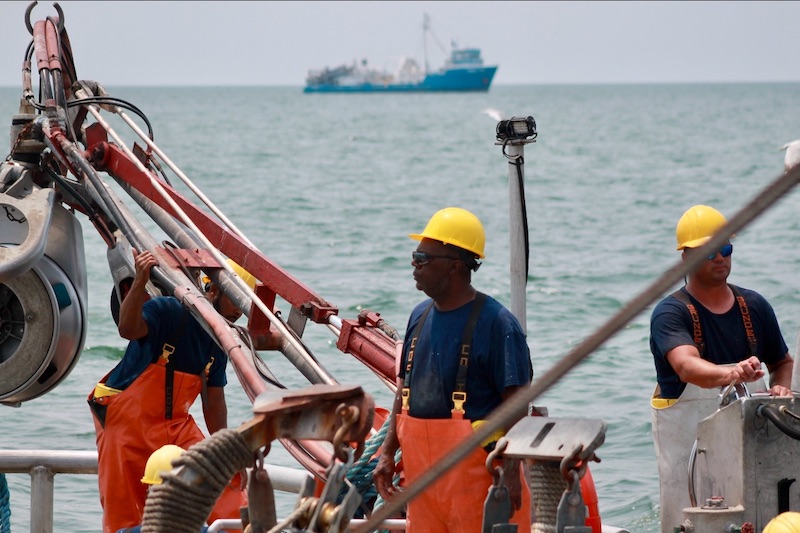
Employees also explained why access to the Bay matters. Rough offshore weather can prevent crews from seeing the schools they locate by sight or catching enough fish to keep the plant operating. Fishing in the Bay is safer, uses less diesel and gets crews home sooner.
The ASMFC's Committee on Economics and Social Sciences has also warned that the industry must maintain a minimum operating volume and that falling below it could potentially result in a complete facility shutdown. That would affect fishermen, processing and manufacturing employees, union families, suppliers, local businesses and the surrounding Northern Neck community. UFCW Local 400 describes a heavily unionized, multigenerational workforce that includes one of Northumberland County's largest minority workforces.
6. The economic consequences would extend beyond the Northern Neck
The letters from outside the region emphasized that the industry supports businesses, workers and customers across Virginia and in other states. The fishery supplies bait used by commercial and recreational fishermen, while the reduction fishery produces fish meal, fish oil and fish solubles. NOAA Fisheries says these products are used in aquaculture and that refined menhaden oil is used in nutritional supplements for people.
Together, the 1,267 signers asked the Atlantic Menhaden Management Board to reject further Bay Cap cuts and mandatory seasonal allocations. They urged the Board to complete the funded research, establish the problem and show that a proposed restriction will improve the outcome before putting additional jobs and communities at risk.
The Board is expected to consider final action on Draft Addendum II at the ASMFC Annual Meeting in November 2026.
About Ocean Harvesters
Ocean Harvesters owns and operates a fleet of more than 30 fishing vessels in the Atlantic Ocean and Gulf of America. The company's purse-seine fishing operation is exclusively engaged in the harvest of menhaden, a small, nutrient-dense fish used to produce fish meal, fish oil, and fish solubles. Both its Atlantic and Gulf Menhaden fisheries are certified sustainable by the Marine Stewardship Council. Committed to responsible fishing operations, Ocean Harvesters is proud to be heir to a fishing legacy that extends nearly 150 years.
Press Contact
Stove Boat Communications
(202) 595-1212
contact@stoveboat.com
SOURCE: Ocean Harvesters
View the original press release on ACCESS Newswire:
https://www.accessnewswire.com/newsroom/en/industrial-and-manufacturing/1-267-workers-and-community-members-urge-menhaden-board-to-reject-new-1242705
