
NORTHAMPTON, MA / ACCESS Newswire / October 30, 2026 / Originally published on 3M News Center
AI runs on more than software. Every model ultimately depends on physical infrastructure, including advanced semiconductor chips manufactured on silicon wafers to extraordinarily precise tolerances.
That is where 3M's deep materials expertise comes in, bridging AI's computing demands with the physical technologies that make it possible.
For more than 25 years, 3M has worked with leading semiconductor companies on materials and process challenges across manufacturing, from wafer polishing and protection to advanced packaging, thermal management and safe component transport.
"AI is increasing the pressure on semiconductor manufacturers to deliver more powerful, efficient and reliable chips," said Kyle Turner, vice president, 3M Semiconductor. "Our role is to work closely with customers to understand their challenges and apply 3M's technical capabilities to help solve those problems."
The physical reality behind AI
As AI workloads scale, manufacturers need chips that process and move more data while using energy more efficiently. Delivering that performance requires chips that are smaller and more complex, increasing the demands on every stage of manufacturing.
Meeting that demand does not happen through software alone. It requires highly precise manufacturing processes, where even a small variation can affect reliability, performance and yield. For manufacturers, the challenge is not only making advanced chips possible, but making them consistently, efficiently and in high volumes.
Solving for precision in wafer polishing
Every advanced chip begins on a thin, circular wafer. The wafer moves through dozens of exacting manufacturing steps before it is divided into individual chips.
One critical step is chemical mechanical planarization, or CMP, a polishing process used to create an extremely flat surface so additional layers can be built with precision. For semiconductor manufacturers, CMP performance can directly affect productivity, consistency and cost, which is why 3M works with customers on materials and process solutions designed to support wafer planarization, pad performance, durability, process control and manufacturing efficiency.
Rethinking a customer challenge
As chipmakers push for greater productivity and yield, unplanned maintenance, process variability and shorter consumable life can create costly disruptions. Manufacturers are looking for ways to improve consistency, reduce downtime and increase throughput without compromising performance. Traditional pad conditioning approaches often rely on hard, diamond-based materials, which can make those goals harder to achieve. Working closely with customers to understand those challenges, 3M explored a different approach.
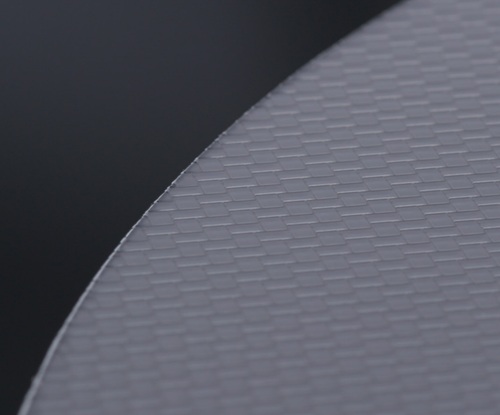
The result is the 3M Flexible Pad Conditioner (FPC), designed to prepare polishing pads used in advanced semiconductor manufacturing. Rather than using the conventional hard, diamond-based approach, 3M developed a flexible, metal- and diamond-free abrasive surface that brings together materials science capabilities from across the company.
Customer results illustrate the potential impact. One customer using 3M's FPC technology reported seven times fewer defects in its copper barrier process and 10 times fewer defects in its oxide buff process. The customer also reported longer pad and conditioner life, contributing to a lower total cost of ownership compared with its process of record.
"Our customers are under constant pressure to increase productivity and efficiency while managing increasingly complex manufacturing processes," Turner said. "By working alongside them to understand their specific challenges, we can apply 3M materials science in ways that help address real production constraints and deliver meaningful business impact."
As AI continues to reshape semiconductor performance demands, the manufacturing processes behind those chips must keep advancing as well. 3M brings broad technical know-how and capabilities from across the company to that challenge, helping support the precision and reliability required for the next generation of semiconductor technology.
FAQ
What are semiconductors?
Semiconductors are materials used to make chips, the small electronic devices that process, store and move information in products such as phones, computers, vehicles, medical devices and data centers.
Why are semiconductors important for AI?
AI requires significant computing power. The data centers that train and run AI models depend on advanced chips for processing, memory, storage and energy-efficient performance.
What does 3M do in the semiconductor industry?
For more than 25 years, 3M has worked with leading semiconductor companies on materials and process solutions that help address manufacturing challenges across key steps, including wafer polishing, process protection, thermal management, advanced packaging and safe transport of electronic components.
Why does materials science matter in chipmaking?
Advanced chips are made through highly precise manufacturing processes. Materials science can help manufacturers improve consistency, protect fragile components, manage heat and support reliable production as chips become smaller, more complex and more powerful.
How is 3M working with semiconductor customers?
3M works with customers to understand their manufacturing challenges and apply expertise across abrasives, adhesives, films, advanced materials and precision processing to develop practical solutions for complex semiconductor production needs.

Find more stories and multimedia from 3M at 3blmedia.com.
Contact Info:
Spokesperson: 3M
Website: https://www.3blmedia.com/profiles/3m
Email: info@3blmedia.com
SOURCE: 3M
View the original press release on ACCESS Newswire:
https://www.accessnewswire.com/newsroom/en/business-and-professional-services/the-materials-science-powering-semiconductor-innovation-1244223
