

NORTHAMPTON, MA / ACCESS Newswire / November 3, 2026 / Chris Kotowicz, CFA | Co-Portfolio Manager and Senior Research Analyst-US Relative Value; Senior Research Analyst-US Growth Equities
Adam Yee | Co-Portfolio Manager and Senior Quantitative Analyst-US Relative Value; Senior Quantitative Analyst-US Growth Equities
Come rain or shine, company research can help investors position portfolios with confidence.
Equity markets can be as difficult to forecast as the weather, yet investors often assume future return patterns will predictably follow recent trends. In today's turbulent market climate, we think fundamental research can help investors build conviction in long-term company forecasts that may be obscured by the AI-driven cloud cover.
In the 1960s, Edward Lorenz, a meteorologist and a pioneer of chaos theory, performed a detailed study of daily Northern Hemisphere weather patterns.1 Lorenz examined 1,000 fixed sites over five years, identifying pairs of separate atmospheric states that began with highly similar conditions, such as temperature, barometric pressures and precipitation. Then, he measured how quickly daily conditions diverged after day zero.
Weather Uncertainty Increases Exponentially
Looking at his dataset, Lorenz made a dramatic discovery-that very small forecasting errors could grow exponentially, with uncertainty doubling roughly every 2.5 days. Put simply, having detailed information about day zero conditions was irrelevant in predicting what the weather would look like at that location just two weeks later. That means the range of weather outcomes on day 15 was roughly 64 times more variable than after day one, according to our calculations (Display).
Why Weather Forecasts Are Notoriously Unreliable
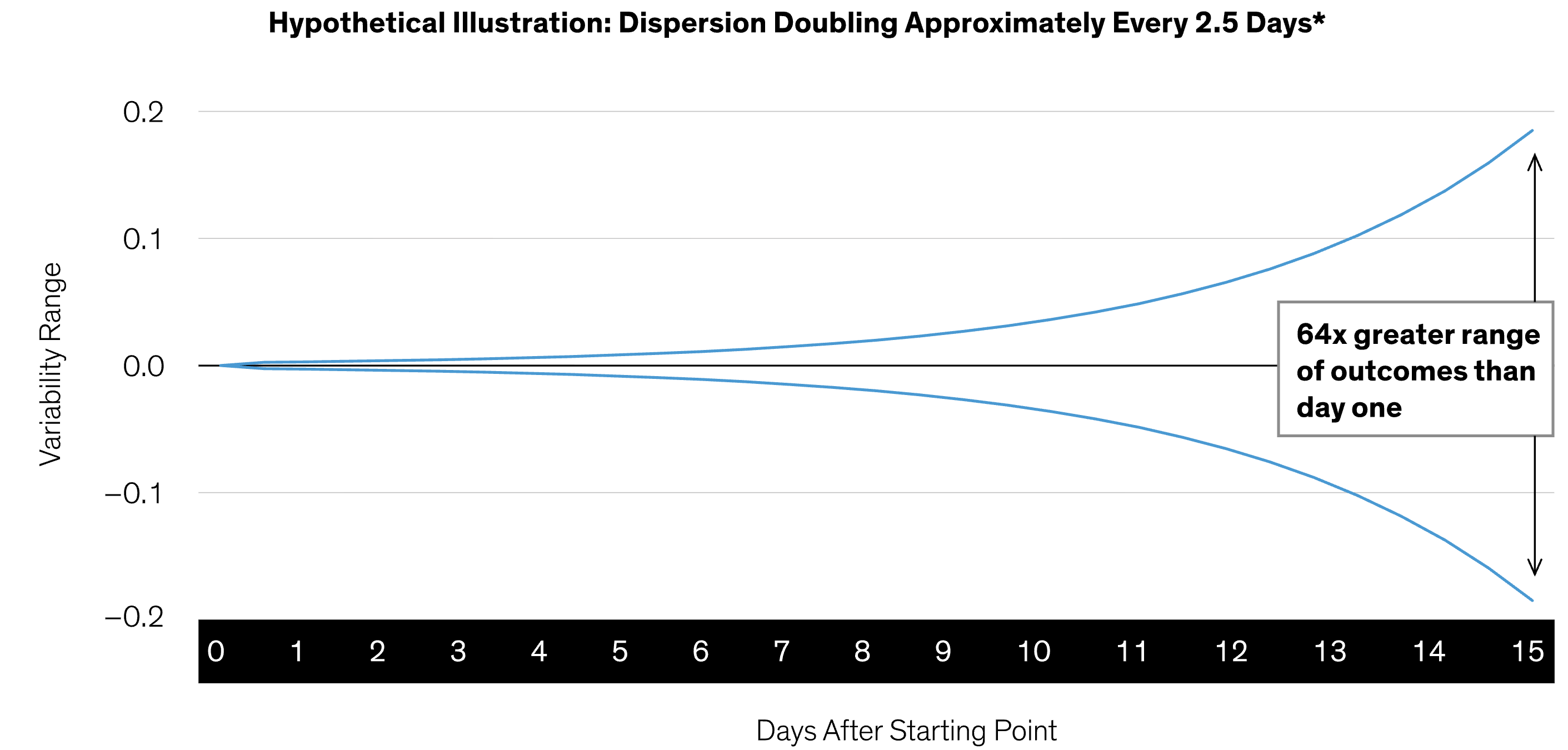
For illustrative purposes only
*Hypothetical illustration created by AB to depict the doubling dynamic described by Edward Lorenz. Does not represent Lorenz's data, methodology or findings
Source: AllianceBernstein (AB)
Technological advancements haven't helped much. Even with better measurement, satellite imagery and powerful computing, weather forecasts are still notoriously unreliable two weeks out because countless variables compound in ways that technology can't fully overcome. Fortunately, most people don't need to know what the weather will look like that far in advance.
By contrast, investing generally requires making predictions that look ahead much further than two weeks. Yet, like the weather, equity markets are complex systems with a plethora of independent variables driving performance. Here, too, technology provides faster information to more investors. These advances might give investors more confidence, but we believe they haven't really made equity markets any easier to forecast.
Strong Performance Often Fades
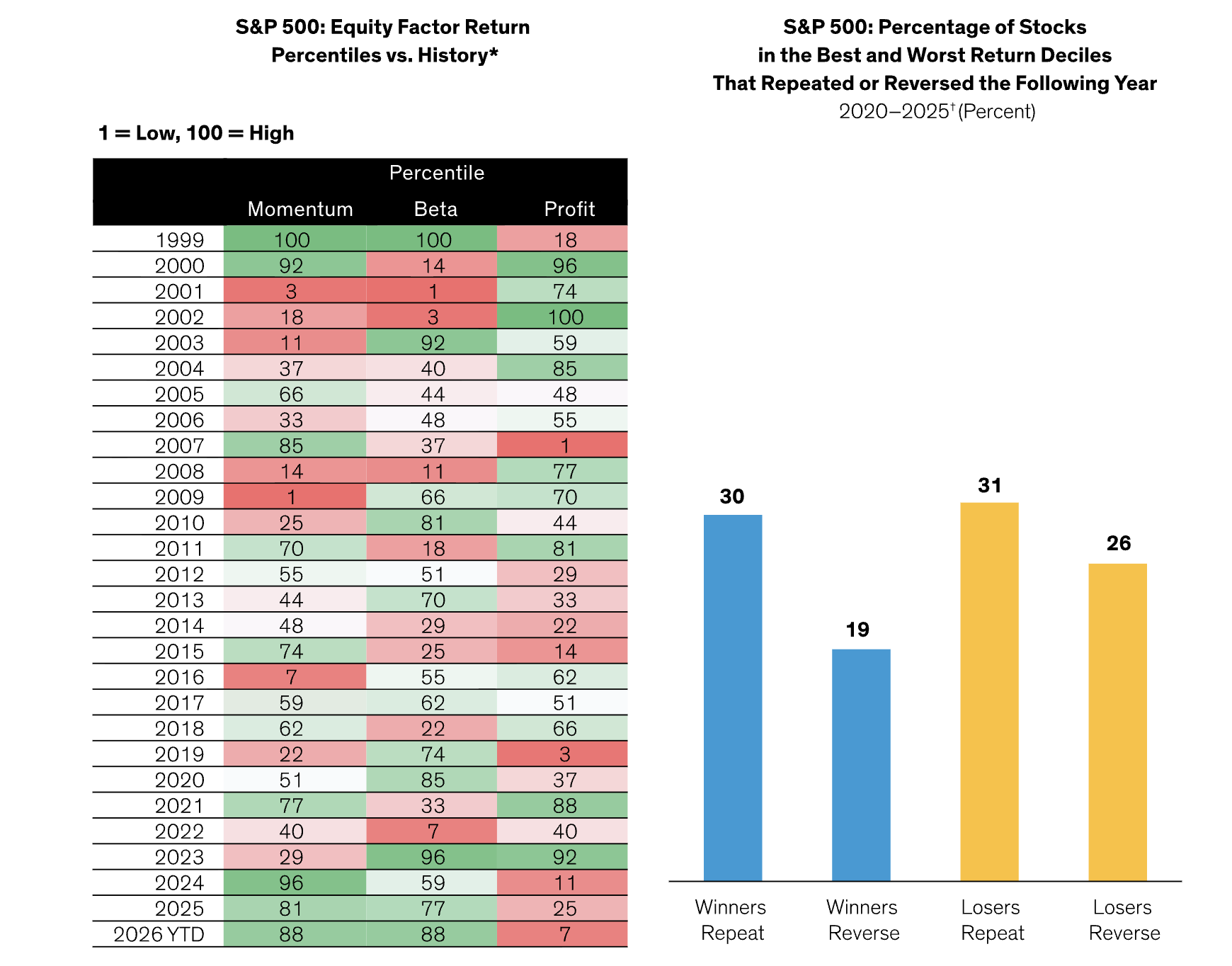
Leadership in equities is fleeting. In any given year, the strongest group of stocks is only slightly more likely to remain in the lead the next year (Display). For example, momentum stocks ranked in the top decile of their historical performance in 1999 and 2000, only to drop toward the bottom of the pack in the next three years. Our research also shows that while roughly 30% of top- and bottom-performing stocks across the market repeat their performance the following year, many others swing sharply in the opposite direction. That creates asymmetric payoffs: yesterday's losers can deliver meaningful upside if they recover, while yesterday's winners may offer lower expected returns as success becomes reflected in the price.
Long-Term Investors Should Be Wary of Chasing Short-Term Trends
Past performance does not guarantee future results.
*Based on Barra risk factors. Annual return percentile rank vs. each factor's return history from 1999 to 2026.
†Based on stocks in the S&P 500's top two and bottom two annual return deciles from the prior year. "Repeat" indicates stocks that remained in the same top or bottom two deciles in the following year; "reverse" indicates stocks that moved from the top two deciles to the bottom two deciles, or vice versa. Annual observations, 2020-2025.
Source: Barra, S&P and AB
Chasing past performance is human nature, which is why we're constantly reminded that "past performance does not guarantee future results". Yet investors often gravitate toward companies they know-typically the biggest winners making the biggest headlines. Lately, many have followed the popular AI trade, chasing growth rather than demonstrated profitability.
In recent years, that was a winning strategy. Technology stocks have posted powerful gains since 2024, dominating market performance and driving unusual leadership concentration.
However, momentum can run both hot and cold as good or bad news quickly gets priced in today. Indeed, July was very challenging for the technology sector. Stocks often rise or fall more than implied by their underlying fundamentals.
Market Rotations Are Hard to Predict
Inflection points in equity market are arguably impossible to forecast with any precision. At turning points, portfolio resilience, by definition, doesn't come from owning yesterday's winners. Instead, we believe it comes from owning an array of businesses with attractive but unrelated long-term fundamentals to support long-term profitable growth, preferably acquired at a favorable price. For investors who care about capital preservation and capital appreciation, we believe this type of diversification is the best strategy for capturing more consistent risk-adjusted return potential over time.
As we see it, that makes thoughtful, forward-looking equity research more important than ever. While the technology mega-caps include great businesses, we think investors should beware of paying too high a price for potential. Good research entails identifying situations where the market is meaningfully mispricing the quality, durability or absolute future earnings power of a business. It enables an investor to assess whether they're getting paid for risks taken, which requires understanding the nuts and bolts of a business model. Today, we believe many companies with strong profitability are priced at a discount after persistent weak performance.
Company Research Considers Many Outcomes
Market forecasts can become stale quickly because they depend on predicting collective behavior. Research, by contrast, is an ongoing discipline that seeks to understand a company's underlying economics, competitive position and strategic options. While market forecasts often imply a specific outcome, company analysis is inherently probabilistic, supporting more informed assessments about a range of long-term outcomes.
Today, many attractive businesses with strong long-term prospects have been overshadowed by a relatively narrow group of AI-related winners. The trend may persist, but history suggests that extreme concentration often gives way to opportunity in areas that have been ignored. We believe investors building for resilience should maintain meaningful exposure to healthy businesses beyond the AI boom.
High-quality fundamental research is one of the few variables over which investors can assert control. The goal isn't to predict each market rotation with precision, but to identify resilient companies that can stand the test of time-no matter which way the unpredictable market winds may blow.
1 Edward N. Lorenz, "Atmospheric Predictability as Revealed by Naturally Occurring Analogues," Journal of the Atmospheric Sciences 26, no. 4 (July 1969): 636-646.
The views expressed herein do not constitute research, investment advice or trade recommendations, do not necessarily represent the views of all AB portfolio-management teams and are subject to change over time.
Learn more about AB's approach to responsibility here.

Find more stories and multimedia from AllianceBernstein at 3blmedia.com.
Contact Info:
Spokesperson: AllianceBernstein
Website: https://www.3blmedia.com/profiles/alliancebernstein
Email: info@3blmedia.com
SOURCE: AllianceBernstein
View the original press release on ACCESS Newswire:
https://www.accessnewswire.com/newsroom/en/banking-and-financial-services/alliancebernstein-equity-markets-and-the-weather-escaping-the-foreca-1245785
