
New findings from the Action Institute for Outcomes Research track skill growth in autistic children; four years of Supervisor Book Clubs prepare new BCBAs to mentor the next generation of clinicians.
AUSTIN, TX / ACCESS Newswire / November 3, 2026 / Action Behavior Centers (ABC), a leading provider of evidence-based applied behavior analysis (ABA) therapy for children diagnosed with autism spectrum disorder (ASD), is sharing new peer-reviewed research from the Action Institute for Outcomes Research (AIoR). The findings show how autistic children build skills over the course of ABA treatment.
ABC is also highlighting its Supervisor Book Clubs, which have helped Board Certified Behavior Analysts (BCBAs) prepare to supervise fieldwork for four years.
What does new research show about skill growth outcomes in ABA treatment?
At intake and every six months, BCBAs at ABC assess each child's skills using the Vineland Adaptive Behavior Scales, Third Edition (VABS-3) and a curriculum assessment such as the Verbal Behavior Milestones Assessment and Placement Program (VB-MAPP). Those results guide what BCBAs teach next and when a child may be ready for discharge.
AIoR's first large-scale analysis of VB-MAPP change scores, published in Behavioral Interventions,¹ looked at scores for 282 children. On average, scores rose 69.6 points over about 1.5 years of treatment, with the steepest growth between the first and second assessments. VABS-3 communication, socialization, and Adaptive Behavior Composite scores correlated moderately to strongly with VB-MAPP scores, and those correlations grew stronger over time.
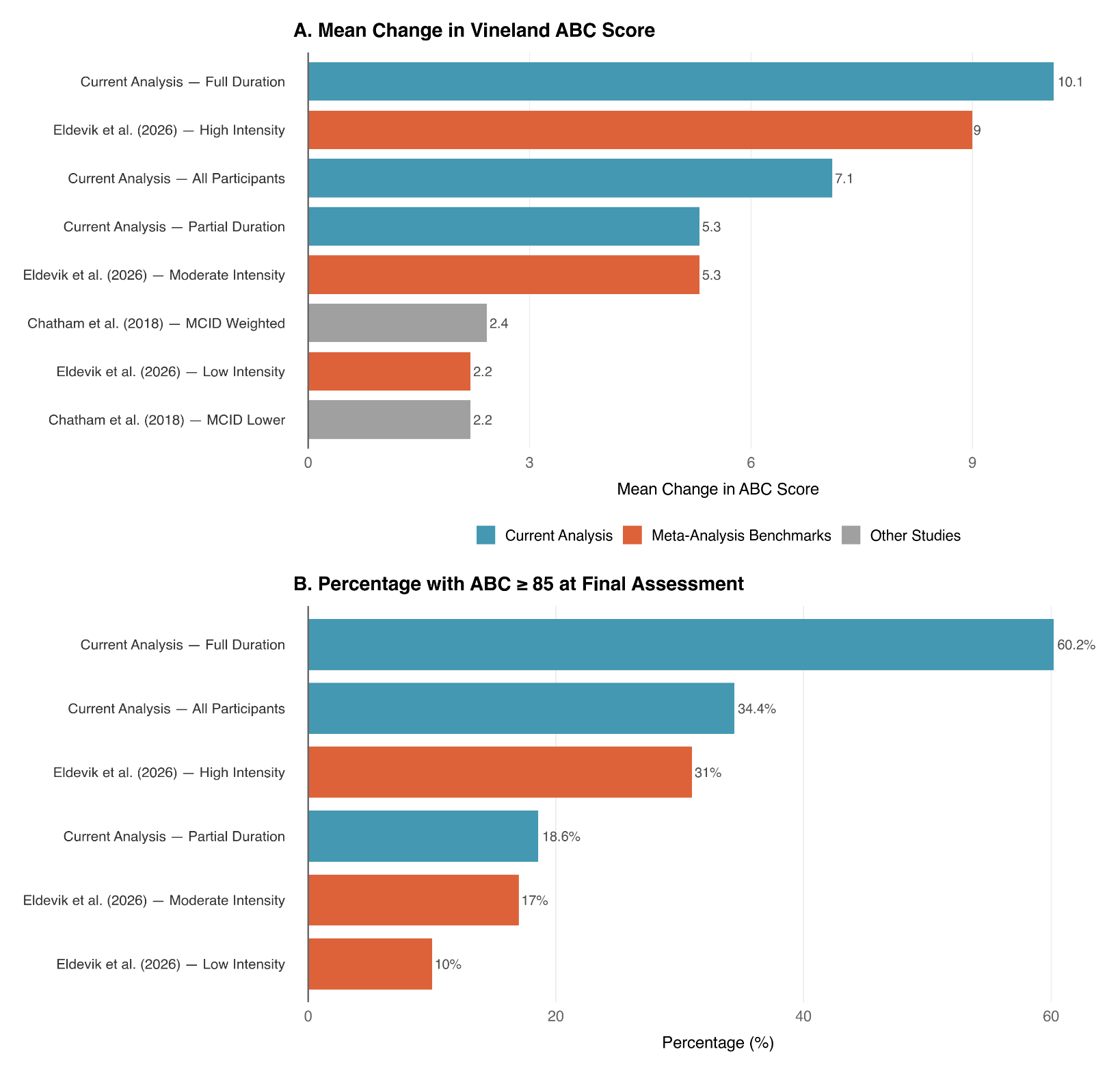
A second AIoR analysis, now under peer review, examined VABS-3 scores for more than 250 children. Among the 98 children who completed the recommended duration of Early Intensive Behavioral Intervention (EIBI), 60.2% scored 85 or higher at discharge, in the nonclinical range, with Adaptive Behavior Composite scores improving by an average of 10.07 points. Among the 161 children who received part of the recommended duration of treatment, 18.6% scored 85 or higher, with an average improvement of 5.15 points. These outcomes were comparable to recently published benchmarks² and well above the published minimum clinically important difference.³
"Regular assessment gives our BCBAs and families a clear picture of what each child is learning and what to focus on next," said Dr. Linda LeBlanc, Executive Director of AIoR. "Sharing these findings helps hold ABA treatment providers to a high standard of care and gives families information they can use when making decisions about their child's care."
How does Action Behavior Centers prepare new BCBAs to be fieldwork supervisors?
Because the ABA field is growing quickly, most people completing fieldwork for the BCBA credential are supervised by someone within a few years of certification. The Behavior Analyst Certification Board (BACB) requires BCBAs in their first year of certification to work with a more senior BCBA mentor before they can supervise fieldwork.4
At ABC, new BCBAs spend their first year after certification supervising their Registered Behavior Technicians (RBTs) and building their caseloads, without fieldwork supervision responsibilities. Near the end of that year, they can join a book club with the authors of the workbook Success in the First Year of Supervision (Sellers & LeBlanc, 2022). Monthly activities prepare them for mentorship meetings with their Clinical Director.
Clinical Directors take part in a parallel book club using a companion workbook (LeBlanc & Sellers, 2022) that guides how they mentor new supervisors. Both workbooks focus on self-assessment, self-reflection, and planning for the supervisor's and supervisee's growth. Over four years, the book clubs have helped hundreds of BCBAs prepare to build strong supervisory relationships.
The book clubs build on ABC's Everest Program, which offers unrestricted fieldwork hours, paid study time off the schedule, and mentorship from experienced clinical supervisors to RBTs pursuing the BCBA credential. More than 1,000 ABC teammates have earned the BCBA credential through Everest since the program began in 2024.
"The supervision a trainee receives shapes the care they'll provide to children and families for years to come," said Dr. Linda LeBlanc. "When new supervisors have dedicated time to reflect and plan with a mentor, they're better prepared to guide their own supervisees and trainees."
Clinicians can learn more about ABC's ABA therapy outcomes research at actionbehavior.com/resource/research.
RBTs interested in growing their ABA careers can explore the Everest Program at actionbehavior.com/career/bcba/everest. View open roles at actionbehavior.com/career/apply.
¹ LeBlanc, L. A., Kaplan, B. A., Thompson, K., Sweatman, A & Mintz, C. (2026). Changes in curriculum assessment scores associated with early intensive behavioral intervention in a routine clinical care setting, Behavioral Interventions, 41(4), e70142. https://doi.org/10.1002/bin.70142.
² Eldevik, S., Stromgren, B., Eikeseth, S., Fields, A, Goetz, C.M., & Titlestad, K.B. (2026). Clinically significant outcomes of early intensive behavioral intervention for children with autism spectrum disorders: An individual participant data meta-analysis. Autism Research, 1-32. https://doi.org/10.1002/aur.70169
³ Chatham C. H., Taylor, K. I., Charman, T., Liogier D'ardhuy, X., Eule, E., Fedele, A., Hardan, A. Y., Loth, E., Murtagh, L., del Valle Rubido, M., San Jose Caceres, A., Sevigny, J., Sikich, L., Snyder, L., Tillmann, J. E., Ventola, P. E., Walton-Bowen, K. L., Wang, P. P., Willgoss, T. & Bolognani, F. (2018). Adaptive behavior in autism: Minimal clinically important differences on the Vineland-II. Autism Research: Official Journal of the International Society for Autism Research, 11(2), 270-83. https://doi.org/10.1002/aur.1874.
4 Behavior Analyst Certification Board. Consultation and supervisor requirements
LeBlanc, L. A., & Sellers, T. P. (2022). The consulting supervisor's workbook: Supporting new supervisors. Key Press Publishing.
Sellers, T. P., & LeBlanc, L. A. (2022). The new supervisor's workbook: Success in the first year of supervision. Key Press Publishing.
About Action Behavior Centers
Action Behavior Centers (ABC) provides evidence-based applied behavior analysis (ABA) therapy for children diagnosed with autism spectrum disorder (ASD). Our services include diagnostic support, Family Guidance, school readiness programs, and Early Intensive Behavioral Intervention (EIBI) at 450+ locations across Arizona, Colorado, Illinois, Indiana, Minnesota, North Carolina, Pennsylvania, South Carolina, and Texas. Visit actionbehavior.com to find a center near you.
Media Contact:
Matt Stringer
Chief Marketing Officer
matt.stringer@actionbehavior.com
SOURCE: Action Behavior Centers
View the original press release on ACCESS Newswire:
https://www.accessnewswire.com/newsroom/en/healthcare-and-pharmaceutical/action-behavior-centers-shares-new-aba-therapy-outcomes-research-and-1246056
