
10-part series repeats false claims of overfishing, overlooks ASMFC scientific findings, existing ecosystem-based management, and the workers whose livelihoods depend on the fishery.
WASHINGTON, D.C. / ACCESS Newswire / November 3, 2026 / The Theodore Roosevelt Conservation Partnership's 10-part video series gets an important point right: Atlantic menhaden matter.
They are an important food source for striped bass, bluefish, ospreys, whales, and other wildlife. They support charter fishing, recreational fishing, and coastal tourism. They provide bait for commercial crabbers, other watermen, and anglers. They are also the foundation of a fishing and processing industry that has supported Chesapeake Bay communities for generations.
The people who work in that industry understand the value of a healthy Bay. Their families' future depends on it.
But several people featured in the series go beyond describing the importance of menhaden. They assert that the fishery is overfishing the stock, taking more fish than the Chesapeake Bay can sustain, or causing ecological and economic damage. Others make sweeping claims about menhaden research, water quality, predator diets, and the value of the fish.
The Atlantic States Marine Fisheries Commission's latest assessment found that Atlantic menhaden are not overfished and are not experiencing overfishing. The ASMFC manages the fishery using ecological reference points that account for predators' needs, with striped bass serving as the focal predator. For 2026, the commission reduced the coastwide catch limit by 20 percent. Its scientists projected a 0 percent probability of overfishing under that limit.
Here is what the speakers said-and what the evidence shows.
1. Gaelin Rosenwaks: "The biggest threat ... is obviously overfishing right now"
Rosenwaks is a marine scientist and underwater filmmaker based on Long Island.
Her statement that the biggest threat facing menhaden is "overfishing right now" conflicts directly with the ASMFC's assessment: overfishing is not occurring.
Rosenwaks also describes seeing fewer menhaden and whales near shore in recent years. Those sightings do not establish that the coastwide menhaden population is declining or that fishing caused a change in the number of whales visible from shore.
2. John Henry Wehner: The fishery is taking "more than the bay can handle"
Wehner works for Tidewater Charters on the Chesapeake Bay.
Wehner says the reduction fishery's quota is "way too high," that it is taking "more than the bay can handle," and that the fishery is "not sustainable."
The science says otherwise. Under the 2026 coastwide quota, the ASMFC projected a 0 percent probability of overfishing. The quota was established using ecological reference points that account for predators' needs. Wehner's assertion that the fishery is unsustainable is not supported by the ASMFC's coastwide stock assessment.
Wehner also says that without menhaden, striped bass "starve." Striped bass eat a variety of prey. A peer-reviewed paper summarizing Chesapeake Bay diet research reported that bay anchovy made up 22.2% of the diet by weight for striped bass 150-500 millimeters long in the Bay's main stem, compared with 8.7% for menhaden. The ASMFC also states that ending all menhaden fishing would not, by itself, rebuild striped bass to their biomass target. Sustainable striped bass fishing mortality is essential to rebuilding the stock.
Wehner refers to the harvesting operation as "Omega." Omega Protein processes the fish; Ocean Harvesters operates the Atlantic harvesting vessels.
3. Will Poston: "We really have no menhaden science specific to the Chesapeake Bay"
Poston is a forage campaign manager for the Chesapeake Bay Foundation.
His assertion that there is essentially no Chesapeake-specific menhaden science is wrong. VIMS has conducted or participated in research on Chesapeake menhaden abundance, juvenile recruitment, feeding, reproduction, and the fishery's social and economic importance. NOAA also identifies published research on juvenile menhaden abundance in the Chesapeake Bay.
More research is already underway, and substantial additional research has been funded. The industry-funded Science Center for Marine Fisheries (SCEMFIS) has brought together scientists from VIMS, the University of Maryland Center for Environmental Science, and NOAA to develop a research roadmap for a scientifically based Chesapeake Bay harvest cap. The project is laying the groundwork for additional research as Virginia has committed $2 million over two years and the federal government has provided $2.5 million for Bay-specific menhaden research, VIMS reports.
Poston says managers need a "drastic" catch reduction to leave enough menhaden for the ecosystem. The ASMFC's assessment found the stock is not overfished and overfishing is not occurring; its 2026 coastwide quota was projected to produce a 0 percent probability of overfishing.
The ASMFC already manages Atlantic menhaden coastwide using ecological reference points that account for predator needs. Striped bass is the focal predator used to set the reference points; osprey were included in the full ecosystem model that supports the management model.
The decision followed years of work involving the ASMFC, scientists, the menhaden industry, recreational fishing representatives, and conservation organizations. A 2015 ASMFC workshop brought those interests together to establish ecosystem-management objectives that guided the development of the reference points adopted five years later. The Chesapeake Bay Foundation also participated in the collaborative process.
The approach was welcomed when it was adopted in 2020. TRCP President Whit Fosburgh called it a "landmark decision," while the American Sportfishing Association praised quotas that account for predators as science-based management. Chesapeake Bay Foundation President William C. Baker called it "a historic day for fisheries management."
4. Steve Atkinson: Menhaden left in the water are worth twice as much
Atkinson represents the Virginia Saltwater Sportfishing Association.
Atkinson says economists have determined that menhaden left in the water are worth twice as much as menhaden harvested and processed. He does not identify the economists or study in the video.
The claim resembles a figure promoted in the 2012 Lenfest report Little Fish, Big Impact. Lenfest's figure was a global estimate comparing the modeled value that forage fish provide to commercial predator fisheries with the direct catch value of forage fisheries worldwide. It was not a finding that an Atlantic menhaden left in the Chesapeake Bay is worth twice as much as one harvested by the Virginia fishery. Lenfest reported that its estimates varied substantially among ecosystems.
The report's assumptions and broad recommendations have since been challenged. In peer-reviewed research, University of Washington fisheries scientist Ray Hilborn and his coauthors argued that the effects of forage fishing on predators depend on the species and ecosystem and should be evaluated case by case.
Two members of the original Lenfest task force, Timothy Essington and Éva Plagányi, also published research examining limitations in ecosystem models, including whether those models represented predators in sufficient detail to evaluate their sensitivity to changes in forage fish.
Atkinson also cites approximately 112 million pounds that may be harvested under the Chesapeake Bay reduction cap. That is a rounded conversion of the 51,000-metric-ton cap. It is a maximum limit on Bay reduction harvest, not a statement that the fishery catches that amount in the Bay every year.
5. Steve Atkinson and Remy Montcrieffe: Osprey claims
Montcrieffe is identified with the National Audubon Society in Virginia.
Atkinson says osprey in the main stem of the Chesapeake Bay are "basically failing due to a lack of menhaden." Montcrieffe describes poor osprey reproduction and malnourished chicks, while the video title asks whether the Bay's osprey population is collapsing.
The Mobjack Bay experiment involved researchers adding menhaden directly to osprey nests. The nests given extra fish were more successful than nests that did not receive the supplemental food. In other words, the experiment found that providing osprey families with additional food improved their nesting success. It did not measure the local menhaden population or demonstrate that the menhaden fishery caused the food stress.
A separate study of 571 nests found substantial differences between higher- and lower-salinity study areas. Together, these studies do not establish that restricting the menhaden fishery would solve the problems observed at particular nests. A reproductive problem in selected areas is not proof that the entire Chesapeake Bay osprey population has collapsed.
Montcrieffe's assertion that "every seabird" eats menhaden and that birds "just eat menhaden" is also far too broad. Bird diets differ by species, location, and season. Menhaden are important prey; they are not the only prey available to every seabird.
6. Paul Dixon and Nathan Richardson: Menhaden "clean" the water
Dixon operates To The Point Charters in Montauk, New York. Richardson is associated with Bailey's Bait and Tackle in Cape Charles, Virginia.
Both describe menhaden as cleaning the water. Menhaden feed by filtering plankton and other particles, but filtering food from the water is not the same as demonstrating a substantial net improvement in water quality.
A Virginia Institute of Marine Science study found that menhaden filter feeding had little net effect on overall Chesapeake Bay water quality after accounting for the nutrients they consume and release. The Bay study does not measure every Atlantic water body, but it challenges the claim that menhaden function as a large-scale Chesapeake Bay cleanup system.
7. Paul Dixon: The data showed the fishery was taking more than expected
Dixon says "the data was wrong" and that the fishery had been taking "a lot more than ... anticipated." He does not identify the data or explain which finding he means.
Dixon appears to be referring to a revision of the estimate of natural mortality-the number of menhaden that die from causes other than fishing. The ASMFC's Technical Committee considered Dr. Jerald Ault's work, along with other analyses, when it revised that estimate for the 2025 assessment. The committee also identified concerns about the methods and assumptions behind Ault's substantially lower estimate, which it did not adopt. The committee's October 2026 memorandum describes those concerns. The revision did not mean that fishermen had been catching more menhaden than they reported.
Dixon also says historical fisheries repeatedly netted menhaden "until there were no more." The video provides no evidence that the coastwide population disappeared on the occasions he describes.
8. Chris Moore and Nathan Richardson: Claims of a Bay-wide decline
Moore is the Chesapeake Bay Foundation's Virginia executive director.
Moore says people are seeing fewer schools and anticipates that a reduced menhaden population in the Bay is driving ecological and economic consequences. Richardson says there is a "very, very low amount of menhaden in the bay." Neither establishes a Bay-wide adult abundance estimate or demonstrates that the reduction fishery caused a shortage.
The ASMFC reports that coastwide menhaden bait landings averaged approximately 50,000 metric tons after the quota was introduced, compared with about 44,600 metric tons in 2005-2012. The commission also documented lower pound-net catch rates in Maryland, Virginia, and the Potomac River in 2023 and 2024. Those data do not establish that the reduction fishery caused the decline or that cutting it would restore local bait catches.
Maryland's juvenile survey provides another part of the picture: its menhaden index was strong in each year from 2023 through 2026.
9. Joanna Steidle and Gaelin Rosenwaks: Sightings are not a stock assessment
Steidle is a drone photographer and videographer based on eastern Long Island.
Steidle says she saw menhaden on 76 days in 2023 and 24 days in 2025. Rosenwaks also says she has seen fewer menhaden near shore.
Neither count is a scientific estimate of the Atlantic menhaden population. The videos do not establish that observation locations, time spent looking, weather, water conditions, or the distribution of schools were comparable from year to year. A change in what someone sees from shore or from a drone does not establish a coastwide population decline or show that fishing caused it.
10. Kate Wilke: Local availability and the size of the fishery
Wilke is a fisheries scientist with The Nature Conservancy in Virginia.
Wilke recognizes that the ASMFC uses ecological reference points to manage menhaden and says she thinks the management is good. Those reference points already account for the needs of predators, including striped bass. She also says fish need to be available where and when predators need them, and that population trends should be tracked over time.
Wilke describes menhaden as the target of one of the nation's largest fisheries. NOAA confirms that Atlantic menhaden have the largest commercial landings by weight on the Atlantic Coast. The size of a catch must be evaluated against the size and productivity of the population and the science-based limits used to manage it. The ASMFC's assessment found the stock is not overfished and overfishing is not occurring.
The people missing from the picture
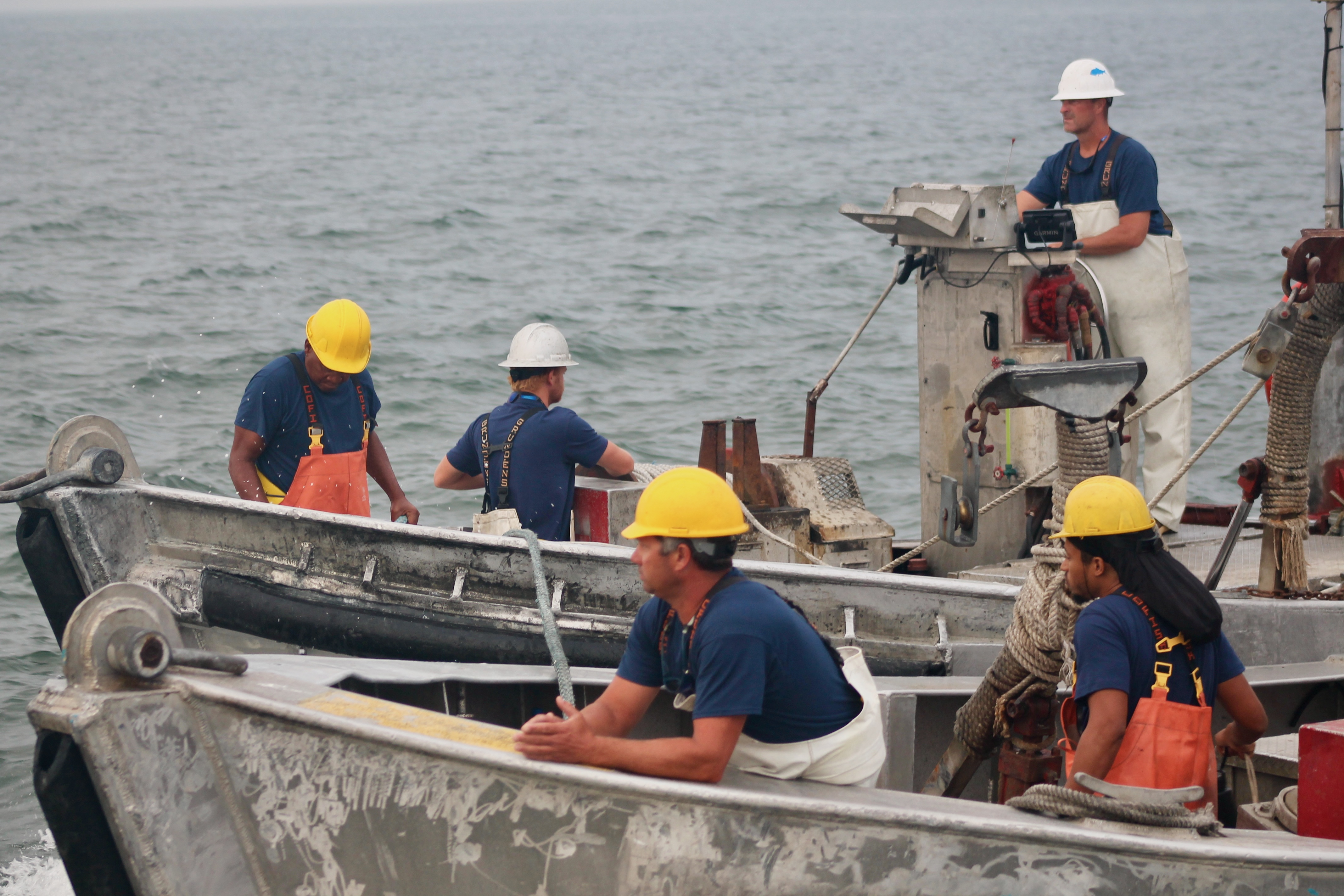
The series describes the people whose livelihoods depend on recreational fishing, bait sales, photography, and tourism. The menhaden fishermen and processing families whose livelihoods also depend on the Bay deserve the same consideration.
The menhaden fishery has supported generations of families in Virginia's Northern Neck, including a predominantly minority workforce and union fishermen whose jobs provide wages, health insurance, and retirement benefits.
The Virginia NAACP, the Southern Christian Leadership Conference, and UFCW Local 400 have warned about the consequences further restrictions could have for workers and their families. The Virginia NAACP has emphasized health insurance, retirement, family stability, and the scarcity of comparable jobs. The SCLC has raised issues of economic justice and the dignity of work.
UFCW Local 400, which represents menhaden fishermen, has urged lawmakers and the ASMFC to refrain from additional Bay restrictions until ongoing research establishes their necessity. The union says conservation and workers' rights belong together and that working people must have a voice in decisions affecting their livelihoods.
The ASMFC has already incorporated predator needs into menhaden management, and additional Bay-specific research has begun or been funded. Decisions should be based on what that work establishes, not on unsupported declarations that the fishery is overfishing the stock or has caused every change someone observes on the water.
Sources
TRCP. The Most Important Fish in the Sea. Video playlist.
Atlantic States Marine Fisheries Commission. (2025). Atlantic Menhaden Board Reduces 2026 TAC by 20% and Initiates Addendum for Chesapeake Bay Cap.
Atlantic States Marine Fisheries Commission. (2025). Atlantic Menhaden FAQs.
Atlantic States Marine Fisheries Commission. (2025). Atlantic Menhaden FAQ: 2025 Annual Meeting Outcomes, question 13, PDF p. 7.
Atlantic States Marine Fisheries Commission. (2025). Chesapeake Bay Precautionary Management Work Group Report, executive summary.
Virginia Institute of Marine Science. Atlantic Menhaden: research and funding.
Science Center for Marine Fisheries. (2026, May 4). SCEMFIS-Supported Menhaden Research Advances Work Toward a Scientifically Based Chesapeake Bay Harvest Cap.
Atlantic Menhaden Technical Committee and Stock Assessment Subcommittee. (2026, October 21). Stock projections to inform 2027-2029 TAC levels, memorandum, PDF p. 34.
Lenfest Ocean Program. (2012). The Economic Value of Forage Fish.
Hilborn, R., et al. (2017). When does fishing forage species affect their predators? Fisheries Research, 191, 211-221.
Essington, T. E., & Plagányi, É. E. (2013). Pitfalls and guidelines for recycling models for ecosystem-based fisheries management. ICES Journal of Marine Science.
Academia, M. H., & Watts, B. D. (2023). Food supplementation increases reproductive performance of ospreys in the lower Chesapeake Bay. Frontiers in Marine Science.
Watts, B. D., et al. (2026). Widespread reproductive deficits in Chesapeake Bay ospreys. Frontiers in Marine Science.
Virginia Institute of Marine Science. (2010). Menhaden appear to have little net impact on Bay water quality.
Atlantic States Marine Fisheries Commission. (2025). Atlantic Menhaden Board Materials, May 2025, non-purse-seine bait fisheries.
Maryland Department of Natural Resources. (2026, October 19). Maryland Striped Bass Reproduction Index Higher for 2026 But Below Average for Eighth Straight Year.
NOAA Fisheries. Atlantic Menhaden: species information.
UFCW Local 400. (2026, October 27). Statement on Proposed Chesapeake Bay Menhaden Cuts.
Southern Christian Leadership Conference. (2026). Letter to Governor Wes Moore concerning Atlantic menhaden.
Menhaden Fisheries Coalition. (2026, October 28). Whose Jobs Count? Recreational Fishing Groups Dismiss Menhaden Workers.
NOAA Fisheries. Factors Affecting the Abundance of Age-0 Atlantic Menhaden in Chesapeake Bay.
Menhaden Fisheries Coalition. (2026, October 19). Maryland Survey Finds Strongest Four-Year Run of Juvenile Menhaden Abundance in Over 30 Years.
Lenfest Ocean Program. (2012). Little Fish, Big Impact: A Report from the Lenfest Forage Fish Task Force.
Pagenkopp Lohan, K. M., et al. (2023). Juvenile Striped Bass consume diverse prey in Chesapeake Bay tributaries. Marine and Coastal Fisheries, PDF p. 2.
Theodore Roosevelt Conservation Partnership. (2020, August 5). Anglers Praise Decision to Strengthen Striped Bass Populations.
National Fisherman. (2020). Atlantic States commission to consider menhaden's ecological role. Reports Chesapeake Bay Foundation statement.
Howell, D., et al. (2021). Combining Ecosystem and Single-Species Modeling to Provide Ecosystem-Based Fisheries Management Advice Within Current Management Systems. Frontiers in Marine Science.
Menhaden Fisheries Coalition. (2025, October 27). Menhaden Fisheries Coalition Refutes False Claims by Chesapeake Bay Foundation's Chris Moore.
About the American Small Pelagics Network
The American Small Pelagics Network represents fishermen, processors, suppliers, and coastal communities connected to fisheries such as menhaden, mackerel, herring, squid, and butterfish. ASPN advocates for sustainable fisheries management that supports critical fish species, while maintaining economic opportunities for fishermen and fishing communities.
PRESS CONTACT
Stove Boat Communications
202-595-1212
contact@smallpelagics.com
SOURCE: American Small Pelagics Network
View the original press release on ACCESS Newswire:
https://www.accessnewswire.com/newsroom/en/industrial-and-manufacturing/ten-trcp-videos-one-incomplete-picture-of-the-menhaden-fishery-1246072
