
TALLINN, EE / ACCESS Newswire / November 4, 2026 / Any broker trading platform can look excellent in a demo; the real test is a volatile Monday, a server restart or a retried request, so brokers should judge forex brokerage software by evidence of how it behaves under stress, not by how it looks.
In short:
- A demo shows the happy path. Production exposes quiet calculation errors, load limits and weak recovery.
- Ask for evidence: published test results, a load test at your scale, a tested backup restore and direct access to the engineers who maintain the platform.
- A self-hosted trading platform gives a broker control over data, latency and audit, while White Label SaaS is the faster managed route.
Why a Good Demo Proves Very Little About a Trading Platform
A demo shows a few accounts, calm markets and a happy path. Production brings thousands of accounts, bursts of quotes, clients who retry a request when a connection drops, managers acting on groups of orders, and servers that restart at the worst moment.
Some newer, low-cost platforms are polished on the surface and untested underneath. They look right, and they may even be right most of the time. A broker finds out which on the busiest day of the quarter, with client money and trust on the line.
This article covers what breaks first, how to test for it before you sign, and what a platform that has been through years of production looks like.
What Breaks First in Brokerage Software: 6 Production Risks
- Quiet wrong numbers. The worst bugs do not look like errors. A position can be marked closed and its profit realised, yet still be counted in margin. Every screen looks plausible, but the account state is wrong. As ScaleTrade's CTO notes in a public testing overview, margin decides whether the next order opens and equity drives stop-out, so small calculation errors become client disputes.
- Failure under load. Demos run with a few dozen accounts. Real life brings thousands of accounts, bursts of quotes and mass margin recalculation. A platform that has never been load-tested at your expected scale is a guess.
- Weak recovery. A correct result before a restart says nothing about the result after it. A backup only matters if a restore produces a coherent trading state, and that has to be tested, not assumed.
- Security and data exposure. Brokers hold exactly what criminals want: passports, bank details and transaction history. In 2021, researchers found a forex broker's unprotected server exposing almost 20 TB and more than 16 billion records. That was a configuration failure, but it shows how one weak component can expose a whole client base. Cracked or unverified builds make it worse: nobody can say what else is in the code, and there is no vendor patch channel.
- Unclear licensing and dependency. Unlicensed software is copyright infringement, and owners enforce their licences. Even legitimate arrangements carry risk: reseller and sub-licence terms are set by someone else and can be revised or withdrawn. If your platform rights are unclear, your business can stop on someone else's decision.
- Nobody to call. When something breaks at 3 a.m., you need people who know the code. A support desk that only forwards tickets cannot fix a live trading problem.
Regulators are paying attention too. In the EU, the Digital Operational Resilience Act (DORA), applicable since January 2025, requires financial firms to manage the risks of ICT third-party providers, including data location, recovery and exit plans.
Why Software That Looks Right Is Not the Same as Software That Is Right
Software can be made to look right in several ways: by copying how an established product behaves from the outside, by generating code with AI tools, or by assembling ready-made components. In a demo, the result can be indistinguishable from a mature system.
The difference appears in cases that nobody can copy by observation: partial closes, rollover and swaps, multi-currency accounts, a take-profit hit while a modification is in flight, recovery after a restart, and what happens when the same request arrives twice. Engineers who designed the system, and who test it against independent financial models, have a real advantage here.
AI tools are excellent assistants, and they are also very good at producing software that looks right. The risk begins when nobody on the team can explain why it is right. Accountability still has to sit with engineers.
10-Point Checklist for Choosing a Broker Trading Platform Provider
Use these questions with any vendor. A confident vendor will answer them in writing.
Ask | A good answer looks like |
Who built it, and who maintains it? | A named engineering team, a track record, and references you can call |
Can I see test evidence? | Published regression results tied to build numbers, including failed runs |
What happens after a crash? | Documented backup, restore and failover, with a restore that was tested, not assumed |
Was it load-tested at my scale? | Results for your account, position and quote-rate targets, not a brochure figure |
How is the financial logic verified? | Margin, equity, swaps and commissions checked against independent calculations |
Where does client data live, and who can access it? | Your own servers or a clearly defined environment, with access logs and no hidden third parties |
What are my licence terms? | A written licence, a known build source and a signed update path |
How do I integrate, and how do I leave? | Documented REST, FIX and server APIs, data export and broker platform migration tooling |
How is it secured? | Firewall, staff two-factor login, a patch cadence and security testing |
Who answers at 3 a.m.? | Direct access to engineers and defined response times |
5 Demo Tests to Run Before You Sign With a Trading Platform Provider
A checklist tells you what to ask. These five tests show you what the platform does. Ask the vendor to run them in front of you, on hardware as close to yours as possible.
- Close half a position. Check that balance, margin, equity and trade history all agree afterwards.
- Send the same request twice. A retried order or close must not create a duplicate financial effect.
- Restart the server mid-session. Accounts, open positions and history must come back unchanged.
- Replay a quote burst. Use your expected tick rate and number of open positions, and watch how long opening and closing a trade takes.
- Restore a backup onto a clean server. Reconcile balances and positions against the original.
A vendor that cannot or will not run these has told you something important.
Self-Hosted vs White Label Trading Platform: How Control Changes the Risk
A self-hosted trading platform runs on infrastructure you control, either your own servers or your own cloud account. That removes several of the risks above at the root. The same reasoning applies if you are planning to launch a crypto broker or add crypto to a forex offer.
- Your data stays with you. Client records, trade history and logs live in your environment, which matters for data-residency rules in the EU, UK, UAE and elsewhere.
- Audit access is direct. Logs, execution records and configuration history are available to you without going through a vendor.
- Latency is your decision. You can place servers close to your liquidity provider. ScaleTrade quotes about 20 ms end-to-end and under 1 ms engine-side when co-located; real figures depend on your network and hardware.
- Cost follows a licence, not your volume. ScaleTrade's self-hosted model is licence-based rather than usage-based, which makes growth easier to budget.
- No shared tenant. There is no common vendor environment that another customer's incident can affect.
There is a trade-off. You take on more operational responsibility, so choose a vendor with a documented installation and a real backup design. ScaleTrade deploys a main server with a hot-standby backup, and offers a managed White Label SaaS on the same engine for brokers who prefer to start without servers and move to self-hosted later.
The two deployment models side by side:
Self-hosted | White Label SaaS | |
Where it runs | Your servers | Provider-managed infrastructure |
Client data | Stays in your environment | Hosted by the provider |
Typical launch | About one week | One to two weeks |
Latency | You choose server location, including co-location | Managed by the provider |
Best for | Regulated firms, data-residency needs, scaling brokers | Startups, regional operators, market tests |
ST Trader: built, tested and supported by engineers
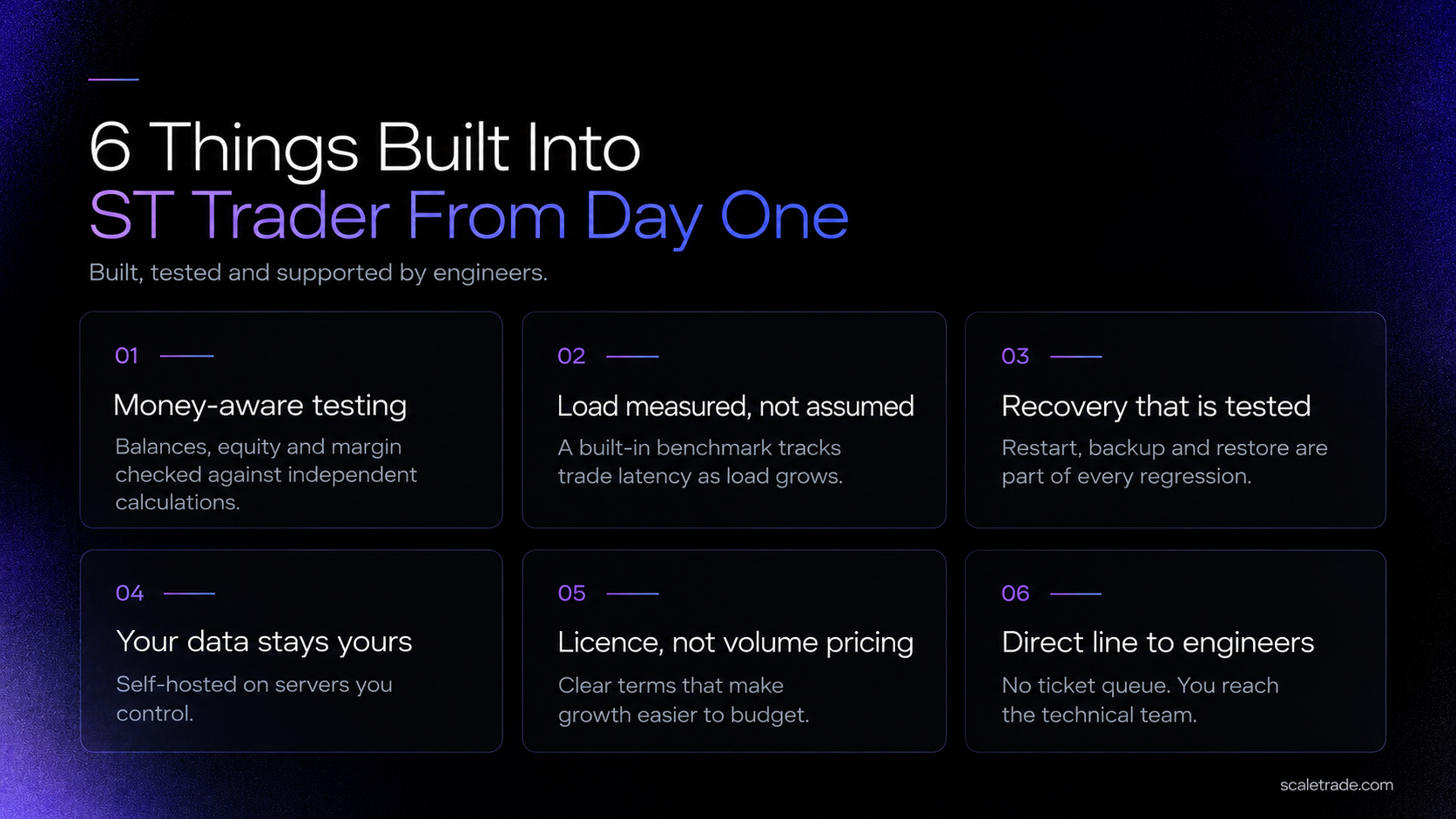
ST Trader, the forex and multi-asset brokerage platform from ScaleTrade, is the example we know best. Everything below comes from ScaleTrade's public pages.
- New company, long experience. ScaleTrade entered the market in 2021. Its platform is built by engineers and developers with more than a decade of brokerage-technology experience (company statement).
- Every defect becomes a permanent test. The release discipline described by ScaleTrade's CTO is to test the exact candidate build, run the established regressions, and, when a defect exposes a missing case, add a reproducer so later releases exercise it. This is how a platform builds a memory.
- Tests that model money, not just responses. The regression suite checks balances, equity and margin against independent calculations and covers commissions, swaps, hedge margin, stop-out, multi-currency portfolios, bulk operations, client isolation, and restart, backup and recovery. The copy-trading scenario alone has 193 independent cases, and a block of 13 trade-mutation sections covers concurrent duplicates, imports and exports.
- Evidence you can inspect. ScaleTrade publishes the results of its regression tests, so brokers and their technical teams can see what was tested and what the outcome was.
- Load measurement built in. A load-benchmark tool measures how trade latency changes as accounts, positions and quote rates rise. Its published input limits are targets for testing, not a capacity guarantee, so ask any vendor for results at your own scale.
- No ticket queue. When something goes wrong, you reach a member of the technical team directly. The problem is either fixed or the situation is explained, depending on what happened, without waiting days for a reply.
- A complete stack. Trading engine, CRM and back office, KYC, cashier, copy trading, prop trading, branded web, desktop, iOS and Android terminals, and documented REST, WebSocket, server and FIX interfaces.
- Two ways to run it. Self-hosted on your servers, or managed White Label SaaS on the same engine, typically live in one to two weeks. A dedicated broker platform migration tool supports moves from MT4, MT5, cTrader and Match-Trader, with parallel operation possible.
Frequently Asked Questions About Broker Trading Platforms
Is it legal to run a cracked trading platform? No. Unlicensed software infringes copyright, leaves you without security updates, and exposes client data and your regulatory standing.
What is a self-hosted trading platform? Brokerage software installed on infrastructure you own or control, so the trading engine, client data and logs stay in your environment instead of a vendor's shared cloud.
Self-hosted or white label: which is better for a new broker? White Label SaaS is faster and needs no infrastructure team. Self-hosted gives control over data, latency and audit. With ScaleTrade both run on the same engine, so you can start managed and move later.
How do I check if a trading platform is reliable? Ask for published test results tied to build numbers, a load test at your scale, a tested backup restore, and direct access to the engineers who maintain it.
Can I switch platforms without closing client positions? With a structured migration process, yes. ScaleTrade carries open positions over at the market price at the moment of transfer and can run both platforms in parallel for a phased handover.
What is a white label trading platform? A white label trading platform is licensed brokerage software delivered under the broker's own brand, while the provider hosts and operates the infrastructure.
How long does it take to launch a brokerage trading platform? With ScaleTrade, a White Label SaaS environment is typically live in one to two weeks and a self-hosted deployment in about a week from agreement. Timelines vary with scope and data volume.
About ScaleTrade
ScaleTrade develops ST Trader, a self-hosted and White Label brokerage platform with a trading engine, CRM and BackOffice, branded web, desktop and mobile terminals, copy trading and prop trading modules. The company reports more than 10 million traders and more than 100 million trades processed on its platform.
Contact:
ScaleTrade
sales@scaletrade.com
SOURCE: ScaleTrade
View the original press release on ACCESS Newswire:
https://www.accessnewswire.com/newsroom/en/blockchain-and-cryptocurrency/demo-proof-or-production-proof-how-to-choose-a-broker-trading-platfor-1240556
