
"MMJ Calls on DEA and the Courts to Explain How State Marijuana - Hemp Products Can Enter the US supply chain or even Schedule III Without Demonstrating the Chemical Consistency Required by Federal Regulation", asked Duane Boise CEO MMJ International Holdings.
WASHINGTON, D.C. / ACCESS Newswire / June 25, 2026 / If Schedule III Requires "Defined Chemical Composition," Which State Marijuana Operators Actually Meet the DOJ's Own 2020 Standard?
As the Drug Enforcement Administration prepares for its June 29 administrative hearing on marijuana rescheduling, MMJ International Holdings, Inc. (MMJIH) is calling attention to a critical federal requirement that has received virtually no public discussion: the Department of Justice's own 2020 Final Rule governing marijuana cultivation.
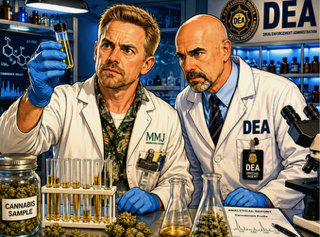
In December 2020, DOJ and DEA fundamentally expanded the federal marijuana cultivation program. In doing so, the agency established an objective standard for federally authorized marijuana manufacturers. Under 21 C.F.R. § 1318.05(b)(2), applicants must demonstrate their ability to:
"consistently produce and supply cannabis of a high quality and defined chemical composition."
That language was not aspirational. It became federal law.
Today, MMJ asks a simple question:
If marijuana products are being moved into Schedule III, where is the evidence that the products entering that schedule satisfy the very chemical-consistency standard DEA itself requires?
"The federal government already answered what pharmaceutical-quality cannabis should look like," said Duane Boise, CEO of MMJ International Holdings. "DEA required cannabis to have a defined chemical composition, consistent manufacturing, and reproducible quality. Those are precisely the characteristics physicians, patients, and FDA regulators expect from prescription medicines."
Unlike conventional FDA-approved drugs, many state marijuana programs permit cultivation practices involving hundreds or thousands of unique cultivars, varying cannabinoid and terpene profiles, changing genetics, and production methods that differ from operator to operator and even harvest to harvest. Products are generally regulated under state cannabis programs rather than FDA new drug approval standards, including the chemistry, manufacturing, and controls (CMC) framework used for prescription pharmaceuticals.
MMJ contends that these differences raise an important regulatory question:
How can products qualify for treatment under Schedule III if they have not demonstrated the "defined chemical composition" and manufacturing consistency DEA itself identified as essential for federally authorized marijuana production?
"This is not an attack on the cannabis industry," Boise said. "It is a question about equal application of federal law. DEA required our company to satisfy rigorous federal standards while developing FDA-regulated medicines. Those same standards should be addressed whenever products are granted the legal and commercial benefits associated with Schedule III."
For more than eight years, MMJ has pursued cannabinoid medicines through the FDA's Investigational New Drug process, investing more than $10 million in pharmaceutical manufacturing, analytical testing, stability studies, quality systems, and regulatory compliance designed to produce chemically characterized, reproducible drug products.
The company argues that the June 29 hearing should not simply consider whether marijuana should move from Schedule I to Schedule III. It should also address whether products expected to benefit from that change satisfy the federal quality standards already codified by DOJ and DEA.
"This hearing should answer one fundamental question," Boise added. "Does DEA intend to enforce its own regulations equally, or will the federal standards requiring high quality and defined chemical composition apply only to companies that followed the law?"
MMJ has raised these issues in its pending consolidated petitions before the U.S. Court of Appeals for the District of Columbia Circuit (Nos. 26-1106, 26-1130, and 26-1136), where the company argues that uniform application of federal law is essential to protecting patients, preserving scientific integrity, and maintaining public confidence in the nation's controlled-substance regulatory system.
About MMJ International Holdings
MMJ International Holdings, Inc. is a pharmaceutical company developing cannabinoid-based prescription medicines for Huntington's disease and multiple sclerosis through FDA-regulated clinical development. The company holds two active FDA Investigational New Drug (IND) applications, FDA Orphan Drug Designation, and a DEA Schedule I Analytical Laboratory Registration, and has pursued federal regulatory compliance for more than eight years.
Media Contact
Madison Hisey
MHisey@mmjih.com
203-231-8583
SOURCE: MMJ International Holdings
View the original press release on ACCESS Newswire:
https://www.accessnewswire.com/newsroom/en/healthcare-and-pharmaceutical/state-marijuana-products-can-not-enter-schedule-iii-without-demonstra-1182313
