
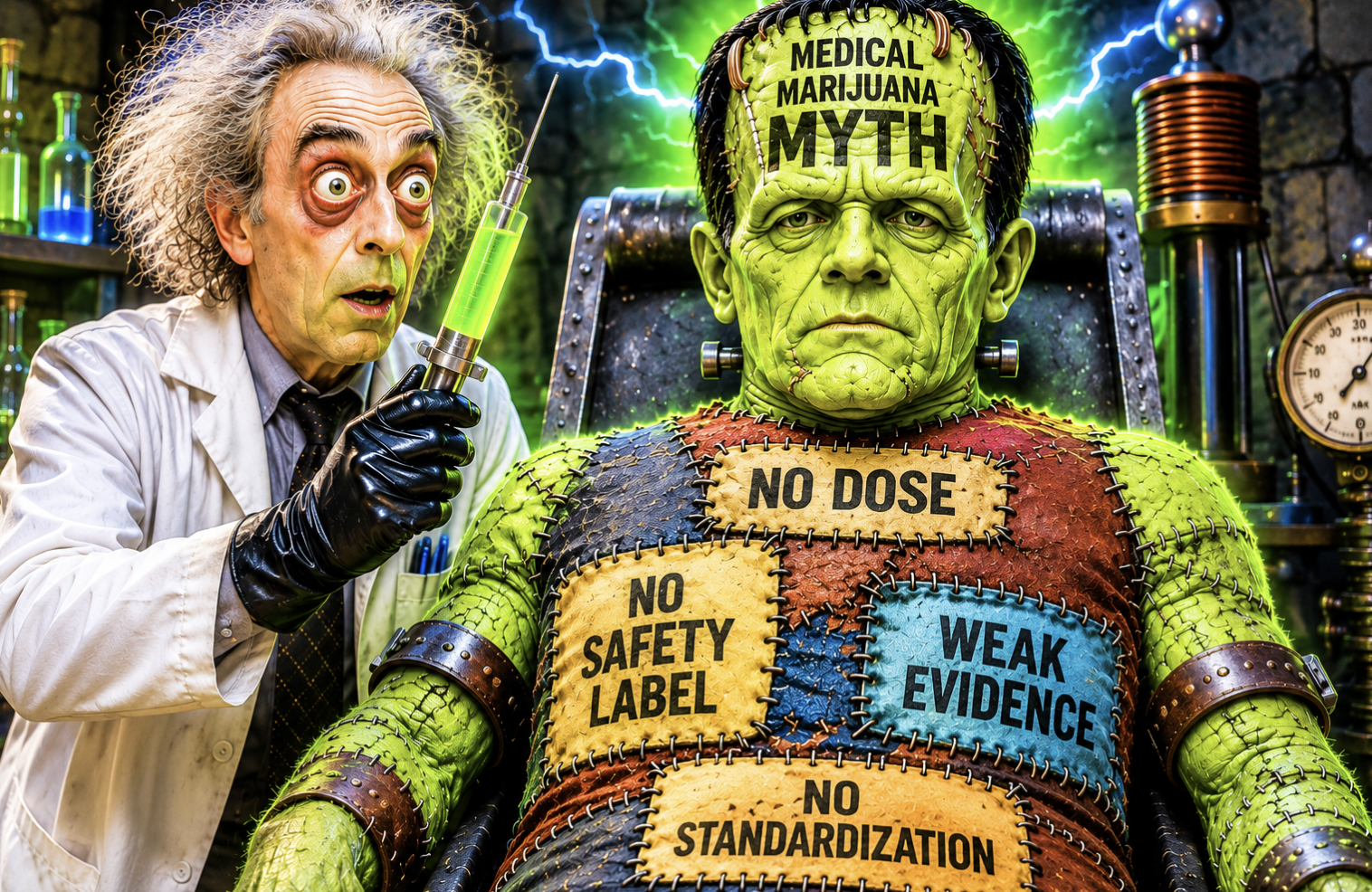
"Dr. Kenneth Finn, former President of the American Board of Pain Medicine, testified that today's state 'medical marijuana' system is a 'ruse'-one where the clinical evidence is lacking and standards are missing, as he reminisced of the old pill mills" stated Duane Boise CEO MMJ International Holdings.
WASHINGTON, D.C. / ACCESS Newswire / July 9, 2026 / Day seven of the Drug Enforcement Administration's marijuana rescheduling hearing produced some of the most pointed testimony yet against the government's effort to move marijuana to Schedule III - and it came from a board certified pain physician the court accepted as an expert.
Kenneth Finn, M.D. - board certified in Physical Medicine & Rehabilitation, Pain Management, and Pain Medicine, and a former President of the American Board of Pain Medicine - testified that state "medical" marijuana does not operate under the standards required of modern medicine, and that the scientific evidence used to justify rescheduling does not support the claims made for it.
"MMJ has spent years following the FDA's botanical drug development pathway because patients deserve medicines supported by reproducible science, controlled manufacturing, and clinical evidence," said Duane Boise, President and CEO of MMJ International Holdings. "Day seven showed, in a physician's own words, exactly what state marijuana programs are missing - and why those standards cannot be waved away with a recommendation slip."
"Recommendation," Not Prescription
Dr. Finn drew a hard line between prescribing an FDA approved medicine and issuing a state marijuana "recommendation." A prescription, he testified, carries a drug name, a defined dose in milligrams, directions for use, and quantity limits. State marijuana recommendations, he testified, come with no dosing guidelines, no safety studies, and no established base of clinical knowledge in his field about how the products should be used.
"A Ruse": His Own Records Don't Exist
In one of the hearing's most striking moments, Dr. Finn described becoming a registered Colorado medical-marijuana patient himself. He testified that he cannot identify the physician who recommended him, and that when he requested the medical records the state requires to be kept, he was told they do not exist. He characterized the arrangement as "somewhat of a ruse," in which recommending physicians do not maintain the bona fide doctor patient relationship or records that state law requires.
No Label, Real Risk
Dr. Finn contrasted FDA approved cannabinoid medicine with dispensary product. FDA approved drugs carry prescribing information, contraindications, drug-interaction warnings, and monitoring guidance; dispensary marijuana, he testified, carries no comparable federally reviewed safety label. He noted that CBD alone has hundreds of documented drug interactions, and that the FDA-approved CBD drug Epidiolex warns on its label of liver injury, suicidal ideation, and sedation - information a dispensary product does not provide. He described a patient on anticoagulant therapy who suffered serious, potentially life-threatening complications after using CBD products - the kind of adverse event, he testified, that standardized safety studies and labeling exist to prevent.
The Evidence for Pain "Does Not Support" the Claims
On marijuana's most cited use - chronic pain - Dr. Finn testified that the published evidence does not support broad efficacy claims. Reviewing the analyses relied upon in the rescheduling process, he testified that of 27 randomized controlled trials, 18 showed no benefit and one showed worsening - roughly two-thirds showing no benefit - and that many of those trials were small, short, and used cannabis far less potent than what dispensaries actually sell. He testified that chronic pain comprises many distinct conditions requiring different treatments, and that no single product should be treated as a universal remedy.
A Fringe of the Profession - "Reminiscent of the Pill Mills"
Dr. Finn testified that state marijuana recommendations are written by a tiny, concentrated group of physicians. Citing his exhibits, he testified that in Colorado - where he practiced for three decades - fewer than 2 percent of licensed physicians are certified to recommend marijuana, and just three doctors wrote more than one-quarter of all recommendations in 2022. In Oregon, he testified, nine doctors approved more than half of all patients in the state program; in Florida, 88 percent of all certifications were issued by 21 percent of qualified physicians; and in New York, only about 3.4 percent of physicians participate at all.
Dr. Finn testified that this concentration is "somewhat reminiscent of the pill mills of yesteryear," drawing a direct comparison to the prescribing patterns of the opioid epidemic - and testified from personal experience that he stopped writing recommendations after his own patients returned with adverse events.
The Issue to MMJ - and to the Court
MMJ International Holdings continues to pursue FDA regulated cannabinoid medicines for Huntington's disease and multiple sclerosis through active Investigational New Drug programs, while awaiting action on its DEA bulk manufacturer registration - pending since December 2018. MMJ argues that Congress established a science-based pathway for medicines containing controlled substances, and that rescheduling must not erase the distinction between FDA-approved pharmaceuticals and products that have never undergone the same review.
"Medicine is built on evidence, reproducibility, quality control, and patient safety," Boise said. "A board-certified pain specialist just testified, under oath, that the state 'medical' system delivers none of them - no dose, no label, no records, and no reliable evidence of benefit. That is the difference between what MMJ has spent eight years building and what the rescheduling order rewards. It matters to regulators, to physicians, to patients - and to the courts now reviewing this process."
As the hearing moves toward its scheduled conclusion, MMJ maintains that the record is narrowing to a single question: whether marijuana sold under state regulatory systems meets the scientific and medical standards required for a finding of "currently accepted medical use" under federal law. On the evidence of day seven, MMJ believes the answer is evident.
About MMJ International Holdings
MMJ International Holdings, Inc. is a pharmaceutical development company focused on cannabinoid-based medicines for Huntington's disease and Multiple Sclerosis. MMJ maintains FDA Investigational New Drug applications, FDA Orphan Drug Designation, a DEA Schedule I analytical laboratory registration, and ongoing cannabinoid pharmaceutical development programs pursuing the federal FDA botanical drug pathway.
Editor's Note: This article summarizes testimony from the Day 7 hearing based on an attendees notes. Final quotations and specific wording should be verified against the certified transcript when it becomes available.
CONTACT:
Madison Hisey
MHisey@mmjih.com
203-231-8583
SOURCE: MMJ International Holdings
View the original press release on ACCESS Newswire:
https://www.accessnewswire.com/newsroom/en/healthcare-and-pharmaceutical/day-7-alj-hearing-prominent-pain-physician-calls-state-medical-mariju-1189060
