
0.77% CuEq* over 317m starting at surface;
0.48% CuEq* over 419 m starting at 460 m, including:
0.98% CuEq* over 31 m at 604 m in diorite porphyry intrusion and skarn, and;
33.4% CuEq* on 1.48% WO3, 0.32% Cu & 427 g/t Ag in a two metre interval in garnet marble skarn at 535m, above the diorite porphyry;
0.35% CuEq* over 7 m incl. mineralized granite porphyry at 858 m at bottom of hole.
VANCOUVER, British Columbia, Aug. 26, 2026 (GLOBE NEWSWIRE) -- VR Resources Limited ("VR" or the "Company", TSX.V: VRR, FSE: 5VR0; OTCQB: VRRCF) is pleased to announce geochemical results from drill hole NB26-003 completed through continuous veining with sulfide to 881m depth (2,892 ft) in the western part of its New Boston moly-copper-tungsten-silver-zinc porphyry-skarn mineral system located just off Highway 95 in west-central Nevada.
From Dr. Michael Gunning, Chief Executive Officer of the Company, "The new data from NB26-003 show us nearly continuous mineralization in moly, copper, tungsten, silver and zinc in complex and intense polyphase veining that is continuous across 2,892 ft of drill core, and starts with 3.95% CuEq* at surface (see Photo 1).
Moly-tungsten mineralization with copper characterizes the upper 317 m mineral interval at 0.77% CuEq*, and copper-moly mineralization characterizes the 419 m interval at 0.48% CuEq* below, which is centered on a mineralized diorite porphyry intrusion at 0.98% CuEq* that is a new and important discovery for the New Boston porphyry-skarn system overall.
New Boston is a polymetallic mineral system. Tungsten mineralization starts at surface and is present to 550 m depth, with sample values up to 2.3%. There is moly across 2,892 ft of drill core, with sample values up to 1.0%. Copper mineralization is nearly continuous and strengthens down-hole, with sample values up to 0.73% Silver is present across the 2.1 km strike of sheeted veins on surface at New Boston (see Figure 1), and there is low grade silver throughout NB26-003, with values up to 830 g/t over 1m in high grade skarn zones.
Alteration, veining and mineralization effects all rock types in the drill hole, from top to bottom, and the system is open at depth. NB26-003 was ended at 881 m because the hole was unstable; there is copper and moly mineralization at the bottom of the hole in a strengthening potassic alteration facies (Photo 14).
Drill hole NB26-003 demonstrates a kilometer-scale vertical dimension to the polymetallic mineral system at New Boston, to match the 2.1 km strike of mineralized sheeted veins exposed on surface.
Drill hole NB26-003 is literally a handful of kilometers away from state highway, grid power and rail infrastructure (see panoramic field photo in Figure 1).
Permitted drill sites are shown in Figure 2. They are amongst a network of historic drill roads and trails visible in Figure 1, and will facilitate cost-effective follow-up drilling planned for the NB26-003 discovery.
There is current exploration on tungsten systems of similar geologic age and setting nearby to the southeast at Pilot Mountain, and in southwest Idaho in the Thompson creek camp. New Boston stands out for its polymetallic composition, with critical metals in moly, copper, silver and zinc in addition to tungsten, all on the Strategic Metals list in Washington where the political focus is on domestic critical-metal supply and resilience. We look forward to providing further details as we advance on the results achieved in this drill hole."
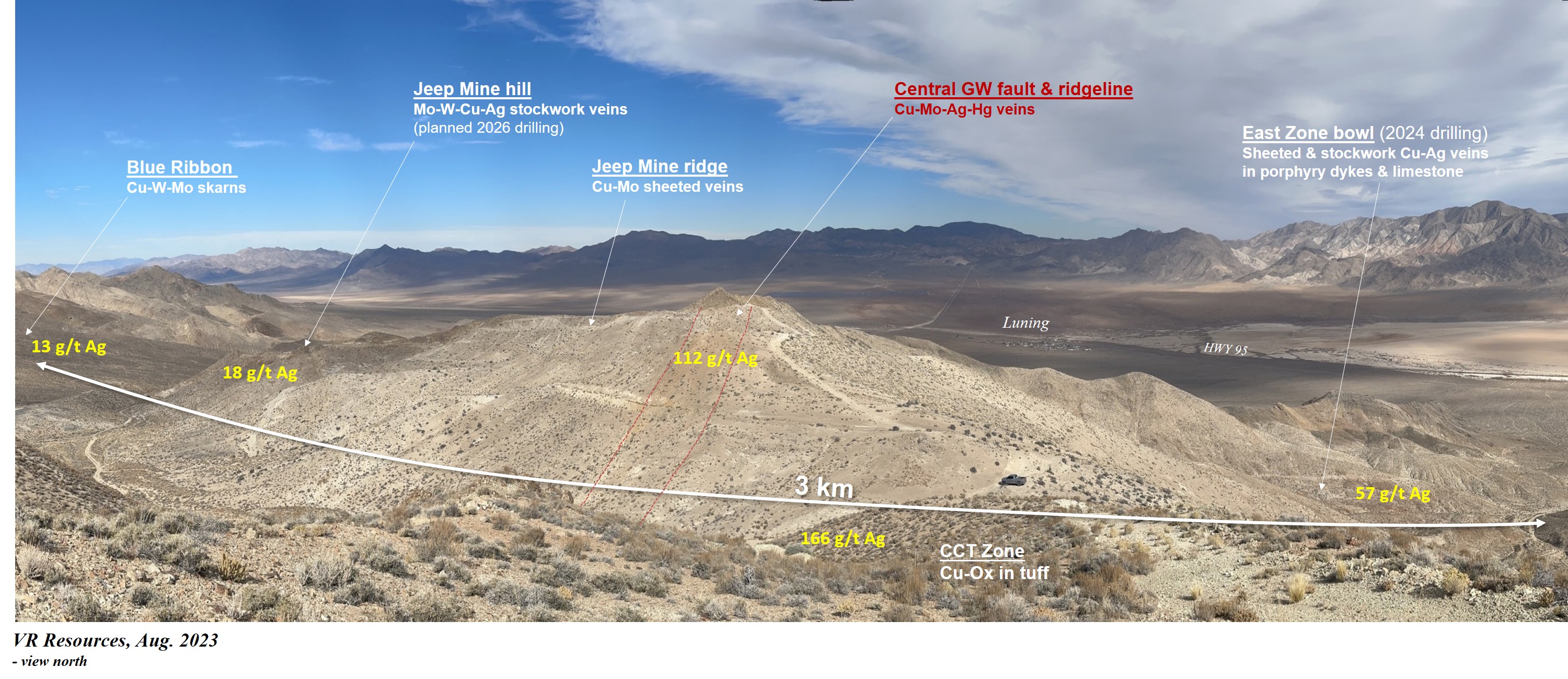
Figure 1 New Boston has scale. Sheeted dykes and sheeted and stockwork veins with tungsten, moly, copper and silver are exposed on surface over an east-west strike length of more than 3km. Yellow text highlights, for example, silver content in surface grab samples of veins by VR. Conductivity anomalies at East Zone were drilled by VR in 2024. Co-spatial conductivity - IP chargeability anomalies at Jeep Mine shown in Figures 2 & 3 were the target for NB26-003 completed in June, 2026. Local infrastructure is strong at New Boston.
Table 1. Summary of mineral intervals, drill hole NB26-003-
