Anzeige
Mehr »
Mittwoch, 23.09.2026 - Börsentäglich über 12.000 News
Brandneue News liefert jetzt Teil 2 dieser Kupfer-Story
Anzeige

Indizes

Kurs

%
News
24 h / 7 T
Aufrufe
7 Tage

Aktien

Kurs

%
News
24 h / 7 T
Aufrufe
7 Tage

Xetra-Orderbuch

Fonds

Kurs

%

Devisen

Kurs

%

Rohstoffe

Kurs

%

Themen

Kurs

%

Erweiterte Suche
GW

WKN: A411MG | ISIN: IE000T78CHJ8 | Ticker-Symbol: 8GW0
Frankfurt
23.09.26 | 08:02
0,041 Euro
+1,23 % +0,001
Branche
Rohstoffe
Aktienmarkt
Sonstige
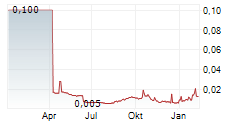
1-Jahres-Chart
GREAT WESTERN MINING CORPORATION PLC Chart 1 Jahr
5-Tage-Chart
GREAT WESTERN MINING CORPORATION PLC 5-Tage-Chart
RealtimeGeldBriefZeit
0,0410,04511:36
ACCESS Newswire
290 Leser
Artikel bewerten:
(1)

Great Western Mining Corporation plc Announces Completion of Drilling: Defender Tungsten Project

GREAT WESTERN MINING CORPORATION PLC
("Great Western", "GWM" or the "Company")

Completion of RC Drilling at Defender Tungsten Project, Nevada, USA

Shortwave Ultraviolet confirms that multiple holes intersected scheelite bearing skarn across wide intervals

DUBLIN, IRELAND / ACCESS Newswire / September 23, 2026 / Great Western Mining Corporation PLC (AIM:GWMO)(Euronext Growth:8GW)(OTCQB:GWMOF), a strategic minerals exploration and development company, is pleased to announce the completion of its reverse circulation ("RC") drilling campaign at the Defender Tungsten Project in Mineral County, Nevada, USA.

OVERVIEW

  • Programme comprised approximately 8,500 ft (2,590 m) of drilling across 23 holes to depths ranging between 200 ft (61 m) and 600 ft (183 m), targeting skarn hosted tungsten mineralisation.
  • Primary objective of the drilling was to link historic workings between the Defender and Pine Crow mines, across an approximate strike length of around 1 km.
  • Geological field logging and shortwave ultraviolet ("SWUV") inspection confirm that multiple drillholes intersected scheelite bearing skarn across several wide intervals.
  • These subsurface intercepts support the positive results from recent surface channel sampling reported in the RNS of 7 July 2026, reinforcing a consistent picture of tungsten mineralisation extending from surface to depth.
  • Samples have been dispatched to an accredited laboratory for assay, and the results will be used to inform a maiden Mineral Resource Estimate ("MRE").

Great Western CEO, Ed Loye, commented: "Completing our first drilling campaign at the Defender Tungsten Project marks a major step forward for GWM. Intersecting broad zones of scheelite bearing skarn across several targets is highly encouraging and validates our geological model for the district. The presence of scheelite over broad intervals is very encouraging ahead of assay results. Importantly, the subsurface skarn zones we have now drill-tested complement the positive results from our recent surface channel sampling, giving us a coherent picture of mineralisation from surface to depth."

DETAILS

Geological Observations and Highlights

Geological field logging and SWUV inspection of drill cuttings across the programme identified multiple zones of scheelite-bearing skarn at three principal target areas (see Figure 1):

  • Defender Hill: Drilling intersected 100 ft (31 m) of continuous skarn from 50 ft (15 m) to 150 ft (46 m) depth, with visible scheelite identified throughout the interval.
  • Dough God Mine: Approximately 125 ft (38 m) of continuous skarn was intersected from surface to 125 ft (38 m) depth, with abundant visible scheelite observed across the full interval (Figure 1).
  • Pine Crow Mine: A 30 ft (9 m) interval of continuous skarn was intersected from 115 ft (35 m) to 145 ft (44 m) depth, exhibiting intense scheelite UV fluorescence over narrower intervals compared to the targets further east.

These subsurface intercepts appear consistent with the positive results from recent surface channel sampling reported in the Company's RNS of 7 July 2026, reinforcing a coherent picture of tungsten mineralisation extending from surface to depth across the project area.

It is anticipated that the results from the recently completed RC drilling campaign will be used to inform a maiden MRE to be undertaken by Addison Mining Services, in order to test the geological model that supports the potential for an emerging near-surface, metallurgically amenable tungsten system (as reported in the Company's RNS of 16 September 2026).

Work Completed

The programme comprised 23 reverse circulation drillholes for a total of ~8,500 ft (2,590 m). Holes were drilled to depths of between 300 ft (91 m) and 600 ft (183 m) using standard RC hammer drilling procedures, with downhole survey completed as standard.

All samples have been dispatched to American Assay in Reno, Nevada, for analysis. Results are expected in Q4 2026 and will be reported in due course.

Geology and Geological Interpretation

The Defender Tungsten Project comprises scheelite-bearing garnet skarns developed along the contact between Cretaceous granitic intrusions and limestones of the Jurassic Dunlap Formation. The drilling programme was designed to test the continuity of skarn-hosted tungsten mineralisation between the historic Defender Mine and Pine Crow Mine workings, across an approximate strike length of 1 km, and to confirm widths of mineralisation at depth.

Field logging of drill cuttings confirms the presence of skarn development across all three principal target areas, with intercept widths and geological character broadly consistent with the Company's pre-drill geological model for the district.

Mineralisation

Tungsten mineralisation at the project occurs primarily as scheelite within garnet skarn units. SWUV inspection of drill cuttings confirmed the presence of scheelite across multiple broad intercepts, with the strongest fluorescence responses observed at the Defender Hill and Dough God Mine targets. Assay results, once received, will provide quantitative grade data to complement the visual and geological observations reported herein.
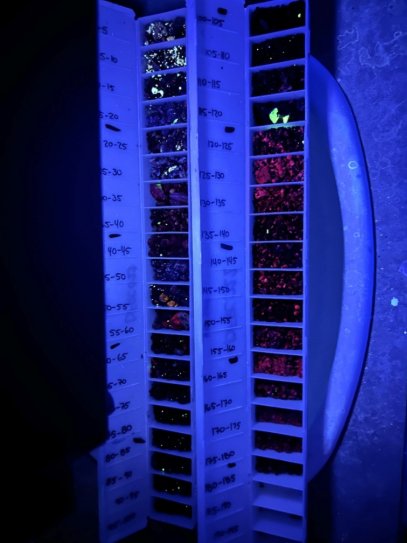
Figure 1: RC chip tray under SW UV Dough God Mine Hole DFRC022 skarn interval from surface to 125 ft with scheelite showings (white dots). Each tray compartment represents a 5ft (1.5m) interval.

Competent Person's Statement and Technical Sign off

The technical information in this release which relates to GWMO's Defender Tungsten Project is based upon and fairly represents information and data presented and reviewed by Mr. Lewis Harvey, MSc., Principal Geologist for Addison Mining Services, who is a Member of the Australian Institute of Geoscientists.

The technical information has also been reviewed by Mr. James Hogg MSc, MAIG, Principal Geologist for Addison Mining Services (AMS).

Mr Harvey and Mr Hogg have sufficient experience relevant to the style of mineralisation, the type of deposit under consideration and the activity undertaken to qualify as Competent Persons as defined in the JORC Code 2012 edition of the Australasian Code for Reporting of Exploration Results, Mineral Resources and Ore Reserves, and Qualified Persons under the AIM rules.

Mr. Harvey and Mr. Hogg (who were both involved in supervising the drilling project) have reviewed and verified the technical information that forms the basis of and has been used in the preparation of this announcement, including all sampling and analytical data, and analytical techniques where applicable. Mr. Hogg and Mr. Harvey consent to the inclusion in this announcement of the matters based on the information, in the form and context in which it appears.

Forward-Looking Statement

This announcement contains forward-looking statements which involve a number of risks and uncertainties. These forward-looking statements are expressed in good faith and believed to have a reasonable basis. These statements reflect current expectations, intentions or strategies regarding the future and assumptions based on currently available information. Should one or more of the risks or uncertainties materialise, or should underlying assumptions prove incorrect, actual results may vary from the expectations, intentions and strategies described in this announcement. No obligation is assumed to update forward-looking statements if these beliefs, opinions and estimates should change or to reflect other future developments.

Glossary of Technical Terms:

"%"percent
"AIM"Alternative Investment Market: London Stock Exchange designed for smaller, growing companies.
"CEO"Chief Executive Officer
"GWMO"Great Western, GWM or the Company
"CP"Competent Person
"CRM"Certified reference material or standard
"DTM"Digital Terrain Model. Computerised topographic model
"ft"Feet. Unit of measurement.
"inc"including
"m"Metre. Unit of measurement.
"MAIG"Member of the Australian Institute of Geoscientists
"MRE"Mineral Resource Estimate
"Ag"Silver
"AMS"Addison Mining Services
"Au"Gold
"Cu"Copper
"JORC (2012)"2012 edition of the JORC code
"JORC"Australasian Code for Reporting of Exploration Results, Mineral Resources and Ore Reserves, as published by the Joint Ore Reserves Committee of The Australasian Institute of Mining and Metallurgy, Australian Institute of Geoscientists and Minerals Council of Australia
"km"Kilometre
"LSE"London Stock Exchange.
"m"metre
"RC"Reverse Circulation. Method of drilling
"RNS"Regulatory News Statement.
"SWUV"Shortwave ultraviolet
"W"Tungsten
"QA/QC"Quality Assurance/Quality Control,

Appendix 1: Table 1 (JORC 2012)

Section 1 Sampling Techniques and Data

(Criteria in this section apply to all succeeding sections)

CriteriaJORC Code explanationAMS Commentary
Sampling techniques
  • Nature and quality of sampling (e.g. cut channels, random chips, or specific specialised industry standard measurement tools appropriate to the minerals under investigation, such as down hole gamma sondes, or handheld XRF instruments, etc). These examples should not be taken as limiting the broad meaning of sampling.
  • Samples were generated using standard RC drilling procedures.
  • The sampling methods are sufficient for the current stage of exploration.
  • No handheld XRF or downhole instruments were used.
  • Include reference to measures taken to ensure sample representivity and the appropriate calibration of any measurement tools or systems used
  • Sampling was supervised by a GWM or AMS geologists throughout.
  • Samples are considered representative of the deposit and are sufficient for the current stage of exploration.
  • The deposit is dipping approximately 50 degrees and holes are inclined to intercept mineralisation as close to perpendicular as possible.
  • No additional measurement tools were used.
  • Aspects of the determination of mineralisation that are Material to the Public Report.
  • Samples were analysed at American Assay Laboratories, Nevada.
  • AAL is an accredited laboratory.
  • Standard four acid digest and multi-element ICP analysis.
  • In cases where 'industry standard' work has been done this would be relatively simple (e.g. 'reverse circulation drilling was used to obtain 1 m samples from which 3 kg was pulverised to produce a 30 g charge for fire assay'). In other cases more explanation may be required, such as where there is coarse gold that has inherent sampling problems. Unusual commodities or mineralisation types (e.g. submarine nodules) may warrant disclosure of detailed information.
  • Samples were generated using standard RC drilling procedures.
  • Samples were split and sampling was constrained by similar geological characteristics where possible.
  • Sample lengths are around 5 ft or 1.5 m.
  • Sample weights were around 3-5 kg.
  • Samples are dried, crushed and pulverised to produce a 50 g pulp for four acid digest and multi-element ICP analysis.
Drilling techniques
  • Drill type (e.g. core, reverse circulation, open-hole hammer, rotary air blast, auger, Bangka, sonic, etc) and details (e.g. core diameter, triple or standard tube, depth of diamond tails, face-sampling bit or other type, whether core is oriented and if so, by what method, etc).
  • Samples were generated using standard RC drilling.
Drill sample recovery
  • Method of recording and assessing core and chip sample recoveries and results assessed.
  • Samples were weighed to assess approximate recovery by the drillers.
  • Depth confirmed and compared to and from, from drillers' measurements and RC chip trays and sample bags.
  • Recovery data has not been assessed to date.
  • Visual inspection of samples from site visit shows recovery to be reasonable.
  • Measures taken to maximise sample recovery and ensure representative nature of the samples.
  • Measures taken to improve recovery include the use of added thickeners and polymers.
  • Whether a relationship exists between sample recovery and grade and whether sample bias may have occurred due to preferential loss/gain of fine/coarse material.
  • No recovery data is available for comparison and scattergram analysis at this time.
  • Further work is required to check against potential biases.
Logging
  • Whether core and chip samples have been geologically and geotechnically logged to a level of detail to support appropriate Mineral Resource estimation, mining studies and metallurgical studies.
  • Chips were geologically logged in its entirety, covering lithology, grain size, and colour amongst others.
  • Recovery was noted; no detailed geotechnical logging is available for RC.
  • Geological logging is sufficient to support any future estimation studies.
  • Whether logging is qualitative or quantitative in nature. Core (or costean, channel, etc) photography.
  • Geological logging is qualitative.
  • Photography was completed on all the chip trays boxes.
  • The total length and percentage of the relevant intersections logged.
  • All intersections were geologically logged and photographed.
Sub-sampling techniques and sample preparation
  • If core, whether cut or sawn and whether quarter, half or all core taken.
  • The hole is selectively sampled.
  • Samples are produced from the cyclone and splitter
  • If non-core, whether riffled, tube sampled, rotary split, etc and whether sampled wet or dry.
  • Samples are RC chips.
  • Samples are produced from wet ground and sun dried.
  • For all sample types, the nature, quality and appropriateness of the sample preparation technique.
  • Sample collection procedures, sample size, preparation and analysis are considered appropriate for the mineralogy, deposit type and the stage of the exploration.
  • Samples are of sufficient quality for the exploration stage of the project.
  • Quality control procedures adopted for all sub-sampling stages to maximise representivity of samples.
  • Samples were visually checked by the GWM / AMS geologist to ensure samples were representative.
  • Samples have been reviewed by AMS and the CP on the site visit to check for representativity.
  • Measures taken to ensure that the sampling is representative of the in situ material collected, including for instance results for field duplicate/second-half sampling.
  • Field duplicates are generated using reference samples from the primary sample and submitted to the laboratory to monitor for repeatability.
  • Whether sample sizes are appropriate to the grain size of the material being sampled.
  • Preliminary review from the CP site visit suggests that the sample sizes are appropriate to the grain size.
  • No detailed work has been completed in this area.
Quality of assay data and laboratory tests
  • The nature, quality and appropriateness of the assaying and laboratory procedures used and whether the technique is considered partial or total.
  • Samples were analysed at American Assay Laboratories, Nevada.
  • AAL is an accredited laboratory.
  • Standard four acid digest and multi-element ICP analysis.
  • Sample analytical techniques are considered in line with industry standards for this style of mineralisation.
  • Given the expected grades, lithology and deposit type, the laboratory procedures are considered appropriate for this level of work.
  • For geophysical tools, spectrometers, handheld XRF instruments, etc, the parameters used in determining the analysis including instrument make and model, reading times, calibrations factors applied and their derivation, etc.
  • No geophysical tools, spectrometers or handheld XRF instruments were used in the exploration work.
  • Nature of quality control procedures adopted (e.g. standards, blanks, duplicates, external laboratory checks) and whether acceptable levels of accuracy (i.e. lack of bias) and precision have been established.
  • GWM routinely insert, CRMS, blanks and duplicates into the sample stream.
  • QC inserted at a rate of approximately 1:10.
  • The quality and nature of assay data and laboratory tests are acceptable for the exploration work for this deposit.
  • Analysis is pending and no exploration results are being reported herein.
  • The nature and quantity of QC data for the sampling, procedures employed, level of accuracy and precision are considered adequate for the number of primary samples and level of exploration.
Verification of sampling and assaying
  • The verification of significant intersections by either independent or alternative company personnel.
  • The results were independently verified and reviewed by Mr. J. Hogg, MSc. MAIG and Mr. L Harvey, MSc. MAIG Principal Geologists for Addison Mining Services (AMS).
  • Mr. Hogg and Mr. Harvey have sufficient experience relevant to the style of mineralisation, the type of deposit under consideration and the activity undertaken to qualify as a Competent Person as defined in the JORC Code 2012 edition of the Australasian Code for Reporting of Exploration Results, Mineral Resources and Ore Reserves.
  • Mr. Hogg and Mr. Harvey have reviewed and verified the technical information that forms the basis of and has been used in the preparation of this announcement, including all sampling and analytical data, and analytical techniques where applicable.
  • Mr. Hogg and Mr. Harvey consent to the inclusion in this announcement of the matters based on the information, in the form and context in which it appears.
  • Mr. Hogg and Mr. Harvey have both completed site visits and have supervised the drilling practices.
  • The use of twinned holes.
  • No twin holes have been completed at this time, due to the stage of the project.
  • Documentation of primary data, data entry procedures, data verification, data storage (physical and electronic) protocols.
  • Database validation and verification is pending delivery of final database.
  • Discuss any adjustments to assay data.
  • N/A
Location of data points
  • Accuracy and quality of surveys used to locate drill holes (collar and down-hole surveys), trenches, mine workings and other locations used in Mineral Resource estimation.
  • Drillholes will be surveyed using a DGPS.
  • Accuracy is sufficient for the stage of exploration.
  • Specification of the grid system used.
  • Data was captured and located using NAD83 / UTM zone 11N, EPSG: 26911.
  • Elevations are reported in metres above sea level.
  • Quality and adequacy of topographic control.
  • An accurate topographic DTM was provided to AMS.
  • The DTM is adequate for the stage of project.
Data spacing and distribution
  • Data spacing for reporting of Exploration Results.
  • Sample spacing between holes varies from 50 to 80 metres.
  • Data spacing is sufficient for the stage of exploration.
  • Whether the data spacing and distribution is sufficient to establish the degree of geological and grade continuity appropriate for the Mineral Resource and Ore Reserve estimation procedure(s) and classifications applied.
  • The data spacing and distribution are likely sufficient to establish the degree of geological and grade continuity appropriate for future Mineral Resource Estimations.
  • No exploration results are being reported herein.
  • No MRE is being reported herein.
  • Whether sample compositing has been applied.
  • N/A.
Orientation of data in relation to geological structure
  • Whether the orientation of sampling achieves unbiased sampling of possible structures and the extent to which this is known, considering the deposit type.
  • No bias is currently perceived. Further work required.
  • If the relationship between the drilling orientation and the orientation of key mineralised structures is considered to have introduced a sampling bias, this should be assessed and reported if material.
  • The deposit is dipping approximately 50 degrees and holes are inclined to intercept mineralisation as close to perpendicular as possible.
  • There is no relationship bias perceived at this time between drilling orientation and the orientation of mineralised structures.
  • Further work required to prove any relationship.
Sample security
  • The measures taken to ensure sample security.
  • Samples were transported from the site to the laboratory or GWM warehouse in secure polyweave bags by GWM staff.
  • AAL have a pickup service from the GWM warehouse.
  • GWM and AAL are responsible for the chain of custody.
  • The samples arrived in good condition at AAL.
  • AMS reviewed sample security and no issues were observed.
Audits or reviews
  • The results of any audits or reviews of sampling techniques and data.
  • Desk study review and audit by Principal Consultants M James Hogg and Mr Lewis Harvey determined sampling methods are suitable for the current project stage.
  • Mr. Lewis Harvey and Mr. James Hogg conducted site visits and drill supervision during the drilling programme in August / September 2026.

ENDS

For further information, visit www.greatwesternmining.com or contact:

Great Western Mining Corporation PLC
Brian Hall, Chairmanc/o St Brides
Ed Loye, CEOgreatwesternmining@stbridespartners.co.uk
Davy
Nominated Adviser, Euronext Growth Adviser & Joint Broker
Brian Garrahy+353 (0)1 679 6363
Shard Capital Partners
Joint Broker
Andrew Gutmann / Erik Woolgar+44 (0)20 7186 9008
St Brides Partners
Financial PR
Susie Geliher / Isabel de Salisgreatwesternmining@stbridespartners.co.uk

Notes

Great Western Mining Corporation PLC (AIM:GWMO)(Euronext Growth:8GW)(OTCQB:GWMOF) is an exploration and development company focused on strategic minerals across several 100%-owned claim groups in Mineral County, Nevada. The Company has a strategic emphasis on tungsten, while continuing to advance its Huntoon Copper Project, which hosts a JORC-compliant resource of 4.3 Mt at 0.45% Cu with further porphyry upside. It also maintains exposure to gold and silver through exploration and tailings reprocessing opportunities, alongside evaluating farm-out and joint venture options to unlock wider portfolio value.

Forward Looking Statements

This announcement contains forward looking statements relating to the plans, activities and expectations of Great Western Mining Corporation PLC. Such statements include, but are not limited to, those concerning planned exploration programmes, anticipated timelines and potential mineral resource outcomes.

Forward looking statements are typically identified by words such as "plan", "expect", "anticipate", "intend", "may", "could", "potential" or similar expressions. These statements are based on current expectations and assumptions and involve risks and uncertainties that could cause actual results to differ materially. Factors include geological risk, exploration and drilling results, permitting and regulatory approvals, funding availability, operational challenges, commodity price movements and general market conditions. No assurance can be given that any forward looking statements will prove to be accurate, and shareholders are cautioned not to place undue reliance on them.

This information is provided by RNS, the news service of the London Stock Exchange. RNS is approved by the Financial Conduct Authority to act as a Primary Information Provider in the United Kingdom. Terms and conditions relating to the use and distribution of this information may apply. For further information, please contact rns@lseg.com or visit www.rns.com.

SOURCE: Great Western Mining Corporation PLC


View the original press release on ACCESS Newswire:
https://www.accessnewswire.com/newsroom/en/metals-and-mining/great-western-mining-corporation-plc-announces-completion-of-drilling-defender-tu-1225752

© 2026 ACCESS Newswire
KI-Euphorie kippt - Bei diesen 5 Aktien droht der Crash!
Drei Jahre lang kannten KI-Aktien fast nur eine Richtung: nach oben. Billionenschwere Investitionspläne von Alphabet, Amazon, Meta und Microsoft haben Halbleiter- und Infrastrukturwerte auf immer neue Höhen getrieben. Doch jetzt bekommt die Erfolgsstory gefährliche Risse.

Steigende Anleiherenditen verteuern die Finanzierung, während die gewaltigen KI-Ausgaben zunehmend nicht mehr aus den laufenden Cashflows bezahlt werden können. Gleichzeitig zeigen günstigere chinesische Modelle, dass leistungsfähige KI womöglich mit deutlich weniger Rechenleistung auskommt. Damit wächst die Gefahr, dass heute für Milliarden errichtete Kapazitäten morgen nicht die erhofften Renditen liefern.

Für Anleger könnte das zum Problem werden. Denn treffen steigende Finanzierungskosten auf Überkapazitäten und enttäuschende Cashflows, geraten gerade hoch bewertete KI-Profiteure schnell unter Druck. Aus den größten Gewinnern der vergangenen Jahre könnten so die größten Verlierer der nächsten Korrektur werden.

In unserem aktuellen Spezialreport zeigen wir 5 Aktien, bei denen das Chance-Risiko-Verhältnis jetzt besonders gefährlich erscheint – und bei denen Anleger genauer hinschauen sollten.

Jetzt den kostenlosen Report sichern – bevor die KI-Euphorie ihren nächsten Realitätstest erlebt!
Werbehinweise: Die Billigung des Basisprospekts durch die BaFin ist nicht als ihre Befürwortung der angebotenen Wertpapiere zu verstehen. Wir empfehlen Interessenten und potenziellen Anlegern den Basisprospekt und die Endgültigen Bedingungen zu lesen, bevor sie eine Anlageentscheidung treffen, um sich möglichst umfassend zu informieren, insbesondere über die potenziellen Risiken und Chancen des Wertpapiers. Sie sind im Begriff, ein Produkt zu erwerben, das nicht einfach ist und schwer zu verstehen sein kann.