Soils return up to 134.4 g/t Ga2O3 and stream sediments up to 1.0% TREO, supporting Boa Vista as a second mineralized centre alongside Cruzeta
Vancouver, British Columbia--(Newsfile Corp. - September 24, 2026) - Spark Energy Minerals Inc. (CSE: SPRK) (OTC Pink: SPARF) (FSE: 8PC) ("Spark" or the "Company") reports surface sampling results that helped guide the discovery drilling at Boa Vista, its second gallium-rare earth mineralized centre at the approximately 91,900-hectare Arapaima Project in Brazil. The results provide a foundation for follow-up exploration alongside the more advanced Cruzeta discovery.
Boa Vista expands the portfolio of critical mineral targets at Arapaima, joining the Cruzeta target-where Spark maintains an active exploration program, including ongoing metallurgical work at ANSTO in Australia. Both targets are undergoing continuous technical evaluation, with exploration activities planned for both in parallel.
"Boa Vista expands Spark's critical minerals portfolio at Arapaima. Our team used a distinctive surface geochemical signature to guide drilling: a gallium and scandium horizon with more moderate rare earth values, which we interpret as reflecting different levels of enrichment within the weathered rock. The first holes then returned near-surface gallium and deeper rare earth mineralization, supporting that exploration approach. We now have two mineralized centres under active technical evaluation at the Project. Cruzeta is more advanced, with material already undergoing metallurgical testing at ANSTO in Australia, while Boa Vista offers an earlier-stage opportunity to investigate the extent and sources of mineralization. These surface results help us focus that work, from locating source rocks to selecting targets for follow-up drilling. Both centres give our team concrete opportunities to advance our understanding of Arapaima." - Dr. Fernando Tallarico, P.Geo., FSEG, Chief Executive Officer & Chairman
Corporate Highlights
- Reported drilling results: As of the September 10, 2026 news release, all 33 reported RC holes across Cruzeta and Boa Vista had returned gallium and rare earth mineralization: 28 at Cruzeta and five at Boa Vista. Results from nine other completed holes had not yet been reported.
- Arapaima land position: The approximately 91,900-hectare Arapaima Project remains Spark's principal focus, with multiple exploration targets for gallium, scandium, rare earth elements and lithium.
- Tungsten exploration underway: Spark announced on September 16, 2026 that tungsten-focused reconnaissance had commenced at Seridó in Rio Grande do Norte, Brazil, including geological mapping and rock and stream-sediment sampling.
Key Results
- Soil - continuous gallium halo extending ~2 km NE-SW
A total of 86 soil samples were collected, with selected results from 23 samples presented in Table 1.
Twenty-three soil samples define a continuous anomalous zone approximately 2 km long, trending NE-SW within the Boa Vista corridor.
| Samples | Easting | Northing | Ga2O3 (g/t) | Sc2O3 (g/t) | TREO (ppm) |
| ARA-SL-034 | 237.553 | 8.109.662 | 83,3 | 16,9 | 129 |
| ARA-SL-036 | 237.924 | 8.109.718 | 67,2 | 16,9 | 260 |
| ARA-SL-037 | 238.119 | 8.109.713 | 68,6 | 21,5 | 494 |
| ARA-SL-038 | 238.316 | 8.109.698 | 68,6 | 21,5 | 250 |
| ARA-SL-058 | 238.094 | 8.106.515 | 87,4 | 15,3 | 373 |
| ARA-SL-059 | 238.219 | 8.106.360 | 76,6 | 12,3 | 437 |
| ARA-SL-060 | 238.398 | 8.106.175 | 67,2 | 16,9 | 254 |
| ARA-SL-061 | 238.650 | 8.106.030 | 49,7 | 16,9 | 526 |
| ARA-SL-062 | 238.759 | 8.106.025 | 134,4 | 21,5 | 338 |
| ARA-SL-063 | 238.739 | 8.105.844 | 61,8 | 10,7 | 855 |
| ARA-SL-064 | 237.162 | 8.108.729 | 79,3 | 16,9 | 140 |
| ARA-SL-065 | 237.215 | 8.108.540 | 75,3 | 16,9 | 160 |
| ARA-SL-066 | 237.277 | 8.108.351 | 75,3 | 16,9 | 177 |
| ARA-SL-067 | 237.400 | 8.108.194 | 84,7 | 18,4 | 160 |
| ARA-SL-068 | 237.545 | 8.108.058 | 80,7 | 18,4 | 267 |
| ARA-SL-069 | 237.674 | 8.107.904 | 82 | 15,3 | 136 |
| ARA-SL-101 | 237.795 | 8.107.746 | 86 | 15,3 | 131 |
| ARA-SL-102 | 237.828 | 8.107.550 | 94,1 | 13,8 | 122 |
| ARA-SL-103 | 237.835 | 8.107.353 | 76,6 | 12,3 | 104 |
| ARA-SL-104 | 238.914 | 8.106.154 | 73,9 | 13,8 | 426 |
| ARA-SL-105 | 239.070 | 8.106.276 | 69,9 | 10,7 | 260 |
| ARA-SL-107 | 239.468 | 8.106.216 | 78 | 9,2 | 349 |
| ARA-SL-108 | 239.658 | 8.106.278 | 76,6 | 10,7 | 157 |
Table 01: Samples soil results highlighted from Boa Vista target.
Samples ARA-SL-101 (86.0 g/t Ga2O3) and ARA-SL-102 (94.1 g/t Ga2O3) are located a few hundred meters from drill collars ARA-RC-007 and ARA-RC-031. Drilling at these same locations returned near-surface gallium intervals of 92.2 g/t Ga2O3 over 10 m and 69.2 g/t Ga2O3 over 4 m, respectively, with peak 2-m intervals of 114.3 g/t in ARA-RC-007 and 83.3 g/t in ARA-RC-031. The agreement between the soil value and the near-surface drill interval is within a few percentage points in both cases.
Along a profile spanning more than 4 km between ARA-SL-064 and ARA-SL-103, soil Ga2O3 values remained within the 75.3 to 94.1 g/t range. This low dispersion across consecutive points is characteristic of regional supergene enrichment, distinguishing it from point anomalies associated with veins or localized mechanical concentrations.
- Stream sediment - regional gallium, with rare-earth peaks south of the Boa Vista target.
A total of 58 stream sediment samples were collected, with selected results from 12 samples presented in Tables 2 and 3.
Seven consecutive samples from the Boa Vista target returned Ga2O3 values between 64.5 and 83.3 g/t-the highest gallium values in stream sediment recorded for the Project-along with Sc2O3 levels of 13.8 to 24.5 g/t and Nb2O5 concentrations of up to 748 ppm.
These samples showed comparatively moderate surface TREO values (252 to 853 ppm). The Company interpreted this pattern-elevated surface gallium and scandium with subordinate rare earths-as an expression of vertical zonation within the weathering profile, with the rare earth horizon expected at depth.
| Samples | Easting | Northing | Ga2O3 (g/t) | Sc2O3 (g/t) | Nb2O5 (ppm) | TREO (ppm) |
| ARA-SS-258 | 237.340 | 8.108.884 | 65,9 | 21,5 | 462,1 | 252 |
| ARA-SS-259 | 238.335 | 8.109.601 | 67,2 | 19,9 | 233,2 | 705 |
| ARA-SS-260 | 238.825 | 8.109.242 | 82 | 23 | 240,3 | 490 |
| ARA-SS-261 | 238.658 | 8.108.459 | 83,3 | 24,5 | 546,5 | 403 |
| ARA-SS-262 | 238.966 | 8.107.497 | 64,5 | 16,9 | 532,2 | 853 |
| ARA-SS-263 | 238.617 | 8.108.513 | 64,5 | 13,8 | 267,5 | 437 |
| ARA-SS-264 | 238.617 | 8.108.505 | 65,9 | 16,9 | 748,2 | 461 |
Table 02: Stream sediment samples Ga2O3 results highlighted from Boa Vista target.
ARA-SS-271 returned 1.0% TREO with an MREO/TREO ratio of 22.4% and 2,178 ppm NdPr, within the same drainage corridor that hosts the gallium halo. ARA-SS-365 combines 2,651 ppm TREO with 79.3 g/t Ga2O3-the only sample in the dataset to simultaneously show elevated levels of both elements, indicating spatial overlap of the two systems.
| Samples | Easting | Northing | TREO (ppm) | MREO/TREO | NdPr (ppm) | Ga2O3 (g/t) |
| ARA-SS-271 | 237.536 | 8.105.184 | 10.036 (1,0%) | 22,4% | 2.178 | 43 |
| ARA-SS-272 | 238.411 | 8.104.642 | 1.610 | 17,8% | 275 | 64,5 |
| ARA-SS-365 | 239.105 | 8.104.633 | 2.651 | 20,7% | 530 | 79,3 |
| ARA-SS-366 | 238.772 | 8.103.328 | 484 | 20,0% | 92 | 36,3 |
| ARA-SS-367 | 238.760 | 8.103.606 | 198 | 17,8% | 33 | 64,5 |
Table 03: Stream sediment samples TREO and Ga2O3 results highlighted from Boa Vista target.
- Rock - primary granitic and pegmatitic source
| Samples | Easting | Northing | TREO (ppm) | MREO/TREO | Ga2O3 (g/t) | Nb2O5 (ppm) |
| ARA-CR-028 | 238.652 | 8.109.824 | 732 | 28,1% | 37,6 | 84,4 |
| ARA-CR-151 | 237.916 | 8.106.647 | 21 | 17,6% | 20,2 | - |
| ARA-CR-156 | 237.916 | 8.106.647 | 1.218 | 23,2% | 33,6 | 71,5 |
| ARA-CR-189 | 238.985 | 8.104.622 | 1.331 | 16,1% | 59,1 | 121,6 |
| ARA-CR-240 | 238.947 | 8.105.597 | 944 | 20,6% | 25,5 | 65,8 |
Table 04: Chip rock samples TREO and Ga2O3 results highlighted from Boa Vista target.
A total of seven rock-chip samples were collected, with selected results from five samples presented in Table 4.
This set establishes the primary source for the surface system. ARA-CR-028-a coarse-grained porphyritic granite located approximately 2.5 km north of the drill collars-exhibits the highest MREO/TREO ratio in fresh rock within the corridor (28.1%), with 188 ppm NdPr; the permanent magnet signature is, therefore, inherited from the source rock rather than generated exclusively by supergene processes.
ARA-CR-240, described as an unaltered granitoid with 944 ppm TREO and an MREO/TREO ratio of 20.6%, demonstrates that the region's high-grade metamorphic lithologies carry anomalous levels of rare earths even in the absence of weathering, thereby expanding the volume of potentially fertile rock.
ARA-CR-189-featuring kaolin occurrences and quartz boulders up to 0.5 m in size-points to an as-yet-unlocated upstream pegmatitic source and combines 1,331 ppm TREO with 59.1 g/t Ga2O3.
ARA-CR-151, a tourmaline-bearing pegmatite collected at the same coordinates as ARA-CR-156, returned only 21 ppm TREO. The contrast between the two samples from the same location-1,218 ppm in the granitic rock versus 21 ppm in the pegmatite-indicates that the granitic facies, rather than the pegmatites, is the host for the rare earths; this information is of direct value for guiding future exploration campaigns.
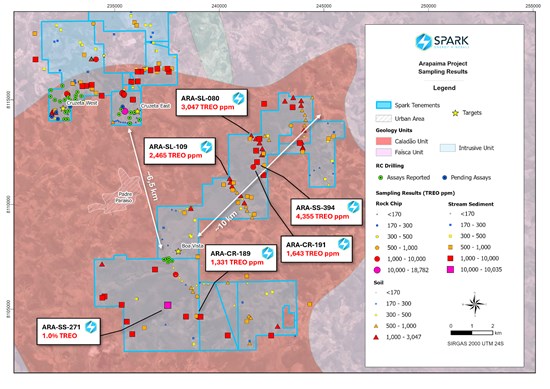
Figure 01: Map showing the soil (ARA-SL), stream sediment (ARA-SS) and chip rock (ARA-CR) samples on the Boa Vista Target highlighted, and your relationship with Cruzeta target.
To view an enhanced version of this graphic, please visit:
https://images.newsfilecorp.com/files/10093/315830_053c9fb804d62ab8_001full.jpg
Next Steps
Close-spaced grid soil sampling over the gallium-scandium horizon to define the lateral extent and boundaries of the anomaly;
Systematic rock prospecting upslope of ARA-CR-189 and in the vicinity of ARA-CR-028, ARA-CR-156, and ARA-CR-240 to locate and characterize the primary sources;
Deeper RC or diamond drilling to define the vertical extent of the rare-earth horizon, which remains open at depth;
Step-out drilling along the NNE-SSW strike and infill drilling to test lateral continuity between existing drill holes;
Request for an analytical method with a lower detection limit and re-analysis of retained pulps for scandium;
Mineralogical characterization of the gallium, scandium, and niobium host materials.
Technical Notes and Reporting Basis
"TREO" means total rare earth oxides and is calculated as the arithmetic sum of CeO2, La2O3, Pr6O11, Nd2O3, Sm2O3, Eu2O3, Gd2O3, Tb4O7, Dy2O3, Ho2O3, Er2O3, Tm2O3, Yb2O3, Lu2O3 and Y2O3. "MREO" means magnet rare earth oxides and is calculated as Nd2O3 + Pr6O11 + Dy2O3 + Tb4O7. Samarium is not included. "NdPr" means Nd2O3 + Pr6O11.
Gallium is reported as gallium oxide (Ga2O3) and scandium as scandium oxide (Sc2O3), each in grams per tonne. TREO, MREO, NdPr, Ga2O3 and Sc2O3 values are in-situ analytical assay results only. They should not be interpreted as recoverable oxides, metal-equivalent grades, mineral-equivalent grades or implied metallurgical recoveries.
Reported intervals are length-weighted composites over a minimum 4 m length, contiguous, with no internal dilution. Rare earth intervals are reported above a 500 ppm TREO basis. Gallium and scandium intervals are reported from surface above a 50 g/t Ga2O3 basis and a 15 g/t Sc2O3 basis respectively. Individual high-grade sample values are not necessarily representative of the mineralization sampled.
The analytical detection limit for scandium under the method used is 5 g/t elemental scandium, equivalent to approximately 7.7 g/t Sc2O3. Scandium is reported by the laboratory to whole units of elemental scandium, where one part per million of scandium is equivalent to approximately 1.5 g/t Sc2O3. In the supporting sample-level data, results below detection are carried at half the detection limit. Spark intends to request a lower-detection-limit method and to re-analyze retained sample pulps. No metallurgical recovery of scandium has been demonstrated.
Quality Assurance / Quality Control, Sampling and Analytical Procedures
The samples were collected at points of occurrence of fresh or altered rock (saprolite), in order to represent the exposure of the material. For soil samples, systematic sampling was carried out, following the access points every 200 m, in addition to sampling at representative points of the horizons of pedological change. The stream sediment samples followed drainages preferably of the 2nd order, at points of deposition of material with a predominantly clayey/silty composition, representing local drainage basins. The QA/QC program adopted aligned with the laboratory's QA/QC program, involving the insertion of blanks, duplicates, and CRMs (Certified Reference Materials) by the SGS Geosol laboratory.
Samples were submitted to the independent SGS Geosol Ltda laboratory in Vespasiano, Minas Gerais, Brazil. Sample preparation comprised crushing and pulverizing followed by Jones splitting (code PRP70J_A2-PA). Analysis was by ICP-MS/OES following sodium peroxide fusion for 56 elements, including rare earth elements, gallium and scandium (code ICM90A).
Data Verification
In accordance with NI 43-101, the Qualified Persons have verified the data underlying the scientific and technical information in this news release. Verification included review of laboratory certificates of analysis against the Company's assay database, review of quality-control results, including blanks, field duplicates and certified reference materials, and review of drill-hole collar and survey information.
The data reviewed were found to be consistent with the Company's assay database and adequate for the purpose of this disclosure. Verification was limited to data available as of the date of this news release; no independent verification sampling or re-assaying was undertaken, and the results have not been verified by, and do not constitute, a mineral resource estimate.
The Qualified Persons are not aware of any drilling, sampling or analytical factors that would materially affect the accuracy or reliability of the assay data disclosed, subject to the assumptions, limitations and cautionary statements described in this news release.
Exploration-Stage Property; No Mineral Resource or Economic Analysis
The Arapaima Project is an exploration-stage property. No mineral resource or mineral reserve has been estimated for the Project, and no preliminary economic assessment, pre-feasibility study, feasibility study or other economic analysis has been completed. There is no certainty that further exploration will result in the delineation of a mineral resource or that any mineralization identified will prove economically or technically viable to extract.
No recovery of scandium, gallium or rare earth elements has been demonstrated, and no economic assessment of those elements has been undertaken. Nothing in this release should be interpreted as a statement that they occur in economically recoverable concentrations at Arapaima.
Cautionary Statement Regarding Exploration Results
The exploration results disclosed in this release are preliminary. Reported drill intercepts are not necessarily indicative of mineralization elsewhere on the property or at depth. References to a "system," "horizon," "footprint," "continuity," "repeatability," "zonation" or deposit "style," including any ionic-adsorption-clay interpretation, reflect the Company's current geological interpretation only and have not been verified by a mineral resource estimate. Reverse circulation sampling may be subject to contamination, sample loss and down-hole dilution.
Qualified Person
The scientific and technical information in this release has been reviewed and approved by Jonathan Victor Hill, BSc (Hons), FAusIMM, VP Exploration, Country Manager & Director of the Company, and Dr. Fernando Tallarico, P.Geo., FSEG, Chief Executive Officer & Chairman of the Company, each a Qualified Person as defined by National Instrument 43-101 - Standards of Disclosure for Mineral Projects. Neither Qualified Person is independent of the Company.
About Spark Energy Minerals Inc.
Spark Energy Minerals Inc. is a Canadian critical minerals exploration company whose principal asset, the Arapaima Project, comprises approximately 91,900 hectares across several municipalities in the Lithium Valley region of Minas Gerais, Brazil. The Company has made gallium and rare earth element discoveries at Cruzeta and, more recently, at Boa Vista, where mineralization is hosted in ionic adsorption clays developed over the Caladão Granite. Lithium-bearing pegmatites are a secondary target on the property.
The Company also holds the Seridó Project, comprising twelve exploration permits totaling 21,492.74 hectares in the Seridó tungsten district of Rio Grande do Norte, where tungsten-focused reconnaissance exploration is underway.
For Additional Information, Please Contact
Spark Energy Minerals Inc. | Attn: Dr. Fernando Tallarico, P.Geo., FSEG, Chief Executive Officer & Chairman
Email: connect@sparkminerals.co | Tel: +1-877-272-9226 | Website: www.sparkminerals.co
Forward-Looking Statements
This news release contains "forward-looking statements" and "forward-looking information" (collectively, "forward-looking information") within the meaning of applicable Canadian securities laws, including National Instrument 51-102 Continuous Disclosure Obligations, and the United States Private Securities Litigation Reform Act of 1995. Forward-looking information includes, without limitation, statements regarding: the interpretation and significance of soil, stream sediment, rock and previously reported drilling results at Boa Vista; the size, continuity, extent, geometry, grade and surface character of gallium, scandium and rare earth mineralization at Boa Vista; the association of scandium with the surface gallium horizon, interpretations of vertical zonation and potential source rocks, and any ionic-adsorption-clay interpretation; proposed follow-up work at Boa Vista, including close-spaced soil sampling, rock prospecting, deeper drilling, step-out and infill drilling, and mineralogical characterization; the timing, scope and results of future exploration, drilling, re-analysis at a lower detection limit and metallurgical test work, including test work in progress at ANSTO; the potential to define a mineral resource; the advancement of the Arapaima Project; the availability of financing; and the Company's plans, objectives and strategies. Forward-looking information is identified by words such as "may," "could," "would," "will," "expect," "anticipate," "believe," "intend," "plan," "estimate," "project," "potential," "target," or similar expressions.
Forward-looking information is based on assumptions management considers reasonable as of the date of this news release, including assumptions regarding: geological interpretations and the continuity of mineralization; the accuracy and representativeness of sampling and assay data; the reliability of laboratory analyses and QA/QC; the timing and outcome of future metallurgical test work and lower-detection-limit analysis; commodity prices and market and trade conditions, including critical-mineral export-control policy; the availability of financing on acceptable terms; and the ability to obtain and maintain tenure, permits and regulatory approvals. Forward-looking information is subject to known and unknown risks and uncertainties that may cause actual results to differ materially, including, without limitation: the inherently preliminary and uncertain nature of exploration; the risk that no metallurgical recovery of gallium, scandium or rare earth elements is demonstrated and that reported oxide contents are not recoverable; the risk that scandium grades change on re-analysis at a lower detection limit; geological, metallurgical and sampling uncertainty, including reverse circulation sampling limitations; the selective nature of samples and the risk that individual high-grade values are not representative; the risk that true widths differ materially from down-hole widths; the absence of any mineral resource or mineral reserve estimate and the risk that no economically viable deposit is ever defined; volatility in gallium, scandium and rare earth prices and in critical-mineral trade and export-control policy; financing, dilution and liquidity risk; and title, permitting, regulatory, environmental, community and political risks associated with operating in Brazil.
Statements regarding exploration results, mineralization and geological interpretations are not, and must not be construed as, statements regarding the existence of any mineral resource, mineral reserve or commercially mineable deposit. There can be no assurance that any exploration program will result in a mineral discovery or that any mineralization identified will be developed into a commercially viable deposit. The forward-looking information in this news release is made as of the date hereof, and the Company does not undertake any obligation to update or revise it, whether as a result of new information, future events or otherwise, except as required by applicable securities laws.
Neither the Canadian Securities Exchange nor its Regulation Services Provider accepts responsibility for the adequacy or accuracy of this release.

To view the source version of this press release, please visit https://www.newsfilecorp.com/release/315830