Vancouver, British Columbia--(Newsfile Corp. - August 18, 2026) - Toogood Gold Corp. (TSXV: TGC) (OTCQB: TGGCF) (FSE: D3P) ("Toogood" or the "Company") reports findings from a technical review of its Table Mountain Gold-Silver Project ("Table Mountain" or the "Project") in Lincoln County, Nevada, completed by Dr. Stuart F. Simmons following a two-day field examination on July 25 and 26, 2026, conducted alongside Lee Hess, Vice President of Exploration, and Colin Smith, CEO and Director of the Company.
Dr. Simmons, an internationally recognized specialist in epithermal gold-silver deposits and hydrothermal systems, examined outcrops, vein exposures, epithermal textures, and alteration across the Table Mountain Project. His review focused on the depth level of exposure, mineral and textural indicators of the paleo-water table, evidence for boiling and fluid flow, structural and stratigraphic controls, and the implications of these observations for overall exploration potential.
Highlights of Dr. Simmons' Review
- Well-preserved epithermal system: Surface exposures represent the upper portions of the system, leaving the principal gold-silver target potentially preserved at shallow depths;
- Evidence of energetic boiling: Widespread lattice quartz textures are indicative of energetic boiling, a critical process that can cause gold and silver to be deposited from hydrothermal fluids;
- Surface geochemistry supports the model: Surface gold values are consistent with the interpreted shallow level of exposure and potential preservation of the more prospective zone at depth;
- Shallow, drill-testable target interval: Surface features interpreted to have formed near the paleo-water table support a prospective interval beginning approximately 50 metres below surface and extending through 200 metres, without constraining deeper potential;
- Substantial mineralized structures: Kilometre-scale structural corridors host multiple Au-Ag-bearing epithermal veins and strong As-Sb-Hg-Mo-Tl pathfinder anomalism;
- Potentially expanded mineralized interval: Changes in the paleo-water table level or later faulting may have increased the vertical range of mineralization; and
- Highly prospective and untested: Dr. Simmons concluded that "Table Mountain represents a highly favorable opportunity for new discovery in virgin ground."
Dr. Stuart Simmons Commentary
"Table Mountain represents a highly favorable opportunity for new discovery in virgin ground. It displays several of the key attributes I look for in a prospective low-sulphidation epithermal system, including excellent preservation and widespread quartz textures indicating energetic boiling within high-fluid-flux conduits capable of depositing significant gold and silver mineralization," stated Dr. Simmons. "With substantial veins exposed at surface and potential to encounter epithermal vein mineralization approximately 50 to 200 metres below surface in the areas examined, Table Mountain presents a compelling exploration opportunity."
Management Commentary
"Dr. Simmons' review provides valuable external technical support for our geological model and a practical vertical framework for targeting in the maiden drill program," stated Colin Smith, CEO and Director of Toogood Gold. "Our excitement continues to build as our understanding of the system advances, and Stuart's insights strengthen our confidence in Table Mountain's discovery potential."
Technical Review and Interpretation
Dr. Simmons' review supports the Company's interpretation that Table Mountain exposes the upper portions of a well-preserved, mineralized low-sulphidation epithermal system. Quartz textures, clay alteration and opaline silica interpreted to have formed at or near the paleo-water table indicate a shallow level of exposure, supporting the potential preservation of the principal gold-silver target at relatively shallow, drill-testable depths.
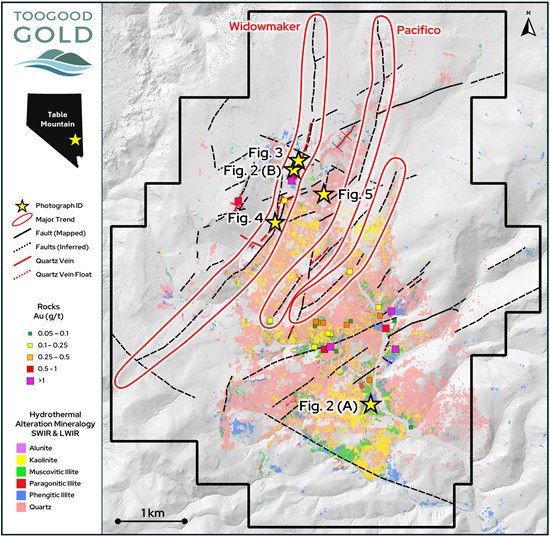
Figure 1: Map of Table Mountain showing major structural trends, alteration, rock samples and locations of photographs shown in the following figures.
To view an enhanced version of this graphic, please visit:
https://images.newsfilecorp.com/files/11439/310170_10abe41cc48c19c5_002full.jpg
Widespread lattice quartz and crustiform-colloform banding provide evidence of vigorous boiling and high hydrothermal fluid flow (Figure 2). These textures occur within major veins, hydrothermal breccias and permeable volcanic units, indicating that hydrothermal fluids moved through multiple structural and stratigraphic pathways. Boiling is an important ore-forming process capable of causing gold and silver to precipitate from hydrothermal fluids.
Table Mountain contains multiple structurally controlled epithermal quartz veins approximately 0.5 to 3 metres wide with anomalous precious metals and the pathfinder elements arsenic, antimony, mercury, molybdenum and thallium. These include the Widowmaker vein, which is exposed intermittently over approximately one kilometre. The Company interprets the mineralized structure to continue beyond the exposed segment based on an extensive train of epithermal vein float along strike.
Cuspate opaline silica and intense silicification observed across the areas examined further support shallow-level preservation and widespread hydrothermal fluid flow (Figure 3). Intense silicification of permeable volcanic units, including altered tuff with strong pathfinder anomalism, indicates widespread hydrothermal fluid flow beyond the principal veins (Figure 4). Multiphase silicification and lattice quartz within brecciated rhyolite provide further evidence of repeated fluid flow and boiling along the Widowmaker Trend (Figure 5).
Based on the interpreted level of exposure, Dr. Simmons identified potential to encounter epithermal vein mineralization approximately 50 to 200 metres below the respective present-day erosion surfaces in both sectors examined. This interval provides an initial vertical framework for drill targeting and does not constrain the system's deeper extent.
Next Steps
Toogood is advancing Table Mountain toward a maiden drill program. Current work is focused on integrating Dr. Simmons' interpretations with geological mapping, rock and soil geochemistry, LiDAR, magnetics and gravity to refine the structural and vertical controls on mineralization.
The Company also plans to complete approximately 15 line-kilometres of CSAMT surveying to improve its understanding of subsurface structures, vein corridors and alteration beneath cover. The combined datasets will be used to rank target areas and finalize drill-hole locations, orientations and planned depths.
In parallel, Toogood is refining potential drill-pad locations along approximately 1 to 1.5 kilometres of the Widowmaker Trend, advancing access planning and preparing the required permitting submissions for the maiden drill program.
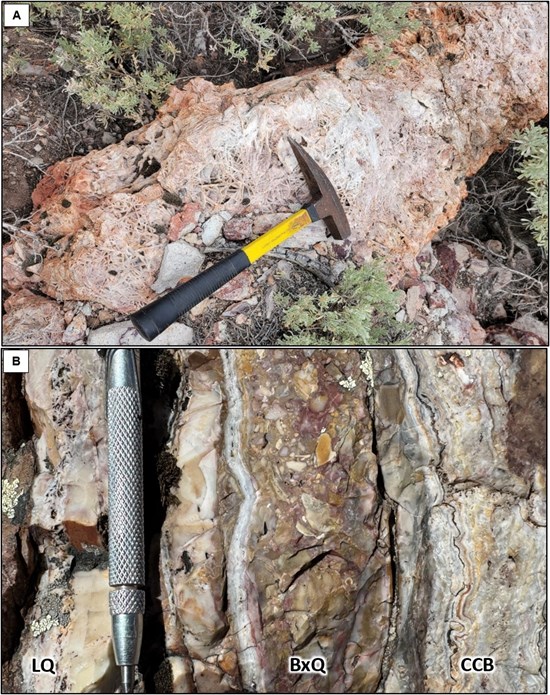
Figure 2: (A) Epithermal vein exhibiting lattice quartz (after calcite) texture, indicative of boiling; (B) Widowmaker vein textures, with lattice quartz (LQ), crustiform-colloform banding (CCB) and open-space filling composed of hematitic brecciated microcrystalline quartz (BxQ).
To view an enhanced version of this graphic, please visit:
https://images.newsfilecorp.com/files/11439/310170_toogoodfiguretwo.jpg
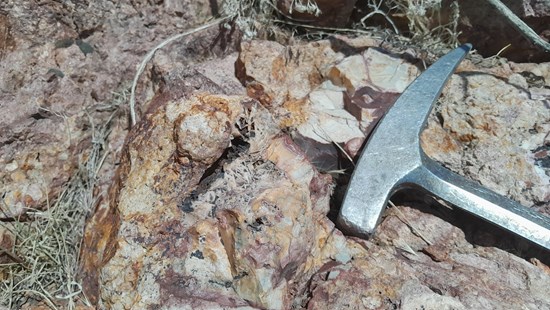
Figure 3: Cuspate opaline silica with local lattice quartz texture. These textures are interpreted to have formed at or near the paleo-water table.
To view an enhanced version of this graphic, please visit:
https://images.newsfilecorp.com/files/11439/310170_10abe41cc48c19c5_010full.jpg
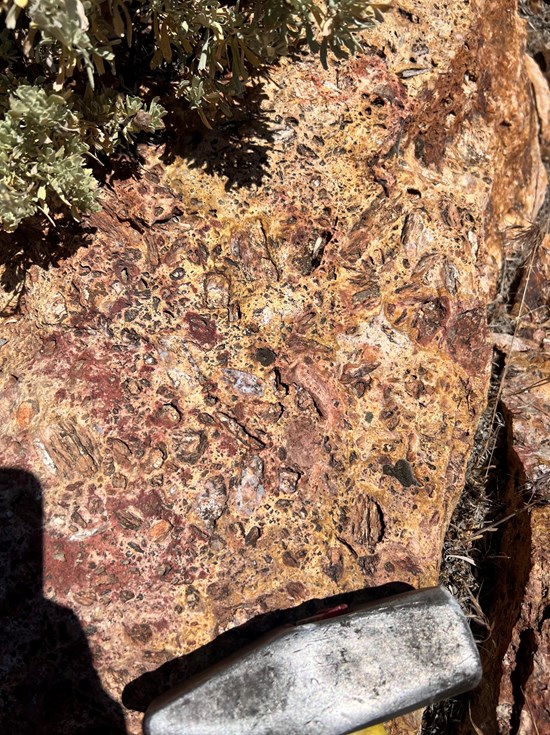
Figure 4: Intensely silicified and altered tuff with brecciated pumice fragments (Widowmaker Trend), with strong pathfinder anomalism (Hg-As-Sb-Tl-Mo).
To view an enhanced version of this graphic, please visit:
https://images.newsfilecorp.com/files/11439/310170_10abe41cc48c19c5_011full.jpg
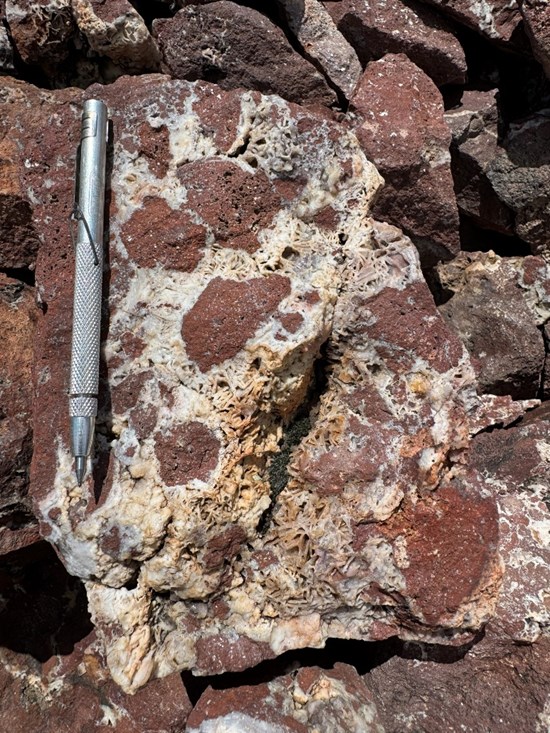
Figure 5: Crackle brecciated rhyolite, Widowmaker Trend, with multiple phases of silicification and interclast lattice quartz textures, consistent with boiling, and strong pathfinder signatures.
To view an enhanced version of this graphic, please visit:
https://images.newsfilecorp.com/files/11439/310170_10abe41cc48c19c5_012full.jpg
About Dr. Stuart F. Simmons
Dr. Stuart F. Simmons is a consulting geologist and Research Professor at the University of Utah's Energy & Geoscience Institute. He is internationally recognized for his work on epithermal gold-silver deposits, geothermal resources, and the geological, hydrological and geochemical controls on hydrothermal fluid flow and precious-metal mineralization in active and ancient systems.
Dr. Simmons earned his M.S. and Ph.D. in Geology from the University of Minnesota and held academic positions at the University of Auckland and Colorado School of Mines before joining the University of Utah. His field and research experience includes hydrothermal systems and mineral deposits across the Pacific Rim, including New Zealand, Mexico, Indonesia, Chile and the western United States.
He has authored or co-authored more than 70 technical papers in refereed journals and conference proceedings. Dr. Simmons is a former President of the Society of Economic Geologists ("SEG"), former Chair of the SEG Publications Board and former member of the Editorial Board of Economic Geology. He received the SEG Silver Medal in 2014 and the SEG Marsden Medal in 2018.
Qualified Person
Colin Smith, M.Sc., P.Geo., a Qualified Person under National Instrument 43-101, has reviewed and approved the technical information contained in this news release. Mr. Smith is not independent of the Company, as he serves as its CEO and Director and owns securities of the Company.
Dr. Stuart F. Simmons has reviewed and approved the statements attributed to him and the summaries of his observations and interpretations contained in this news release.
About Toogood Gold Corp.
Toogood Gold Corp. is a Canadian exploration company focused on the discovery and advancement of high-grade gold systems in tier-one mining jurisdictions. The Company has two core areas of focus: the Table Mountain Project in Nevada, where the Company has an option to earn a 100% interest in a large, undrilled low-sulphidation epithermal system with extensive surface alteration and multiple mineralized vein exposures; and the district-scale Toogood Gold Project in Newfoundland, where the Company has an option to earn a 100% interest in a 164 km² land package covering a highly underexplored gold district with multiple target areas and demonstrated gold prospectivity.
On Behalf of the Board of Directors
Colin Smith
Director & CEO
Toogood Gold Corp.
For further information contact:
Colin Smith, Director & CEO
+1 778 726-3356
info@toogoodgoldcorp.com
Additional information about Toogood Gold Corp. can be found at www.sedarplus.ca.
Forward-Looking Information
This press release contains "forward looking information" within the meaning of applicable Canadian securities legislation. Generally, forward looking information can be identified by the use of forward looking terminology such as "plans", "expects" or "does not expect", "is expected", "budget", "scheduled", "estimates", "forecasts", "intends", "anticipates" or "does not anticipate", or "believes", or variations of such words and phrases or state that certain acts, events or results "may", "could", "would", "might" or "will be taken", "occur" or "be achieved".
Forward-looking statements or information are subject to a variety of known and unknown risks, uncertainties and other factors that could cause actual events or results to differ from those reflected in the forward-looking statements or information, including, without limitation, the need for additional capital by the Company through financings, and the risk that such funds may not be raised; the speculative nature of exploration and the stages of the Company's properties; the effect of changes in commodity prices; regulatory risks that development of the Company's material properties will not be acceptable for social, environmental or other reasons; availability of equipment (including drills) and personnel to carry out work programs; and that each stage of work will be completed within expected time frames. This list is not exhaustive of the factors that may affect any of the Company's forward-looking statements or information. Although the Company has attempted to identify important factors that could cause actual results to differ materially, there may be other factors that cause results not to be as anticipated, estimated, described or intended. Accordingly, readers should not place undue reliance on forward-looking statements or information.
The Company's forward-looking statements and information are based on the assumptions, beliefs, expectations and opinions of management as of the date of this news release, and other than as required by applicable securities laws, the Company does not assume any obligation to update forward-looking statements and information if circumstances or management's assumptions, beliefs, expectations or opinions should change, or changes in any other events affecting such statements or information.
Neither TSX Venture Exchange nor its Regulation Services Provider (as that term is defined in the policies of TSX Venture Exchange) accepts responsibility for the adequacy or accuracy of this release.

To view the source version of this press release, please visit https://www.newsfilecorp.com/release/310170
Source: Toogood Gold Corp.