34% of holes hit mineralization averaging 0.28% eU3O₈ - matching the district's 0.30% historic production grade across 78 million pounds of U3O₈1
Vancouver, British Columbia--(Newsfile Corp. - September 10, 2026) - Manhattan Uranium Discovery Corp. (TSXV: MANU) (OTCQB: MAUUF) (FSE: J5B0) ("Manhattan" or the "Company") is pleased to provide an update on ongoing technical work at its Lisbon Valley uranium project ("Lisbon Valley") located in the San Rafael uranium district of Utah.
The North and Central Lisbon Valley Projects comprise 100 claims covering 2,066 acres along the 16-mile-long Lisbon Valley uranium trend, Utah's largest uranium-producing district, which produced 77.9 million pounds of U3O₈ at an average grade of 0.30% U3O₈ and 10.3 million pounds of V2O5 at an average grade of 0.30% V2O5 between 1948 and 19881. The properties are located near the historic Mi Vida Mine, one of the district's most prolific past producers, and lie within trucking distance of Energy Fuels' White Mesa Mill, the only operating conventional uranium mill in the United States.
Highlights
3.70% eU3O₈ over 5.2 ft in hole N-1: The highest-grade historical gamma intercept in the compiled database and more than ten times the district's reported 0.30% historical production grade.
499 historical drill holes compiled into a single modern database: Concentrated on the North Lisbon property and forming the foundation for the Company's 3D targeting model, with additional legacy records still being recovered and added.
More than half the compiled database returned mineralized intercepts: 266 holes (53%) graded above 0.15% eU3O₈, which may indicate the mineralized system extends beyond the historically mined areas and across the Company's North Lisbon block.
Mineralized intercepts average 0.28% eU3O₈: Comparable to the reported 0.30% U3O₈ the district mined between 1948 and 1988, meaning the historical drilling on the Company's ground returned the grades this district actually produced1.
36 high-priority historical intercepts ranked for follow-up: Filtered to exclude mined-out ground and intervals within 15 feet of known workings, providing the Company with a drill-ready target list.
"Lisbon Valley alone produced nearly 80 million pounds of U3O₈ before production ceased in the late 1980s, and much of that ground has not been evaluated with modern methods. This is not purely greenfield exploration; it is a mill-adjacent district with a substantial historical production history, and that distinction matters in the context of renewed interest in domestic uranium supply," stated William Sheriff, Chairman of Manhattan.
"This is the second major legacy dataset we've compiled and reviewed, and it reflects the broader work underway across our portfolio. We're developing a much deeper understanding of our U.S. assets, which include 15 past-producing mines. At Lisbon Valley specifically, a 53% historical gamma-intercept hit rate averaging 0.28% eU3O₈ is comparable to the reported 0.30% in the district. We now have a modern drill-ready foundation across the Lisbon Valley," stated Galen McNamara, CEO and Director of Manhattan.
Overview
The Company has completed a historical data compilation and digitization effort focused on building a modern digital drillhole and geological database for the Lisbon Valley.
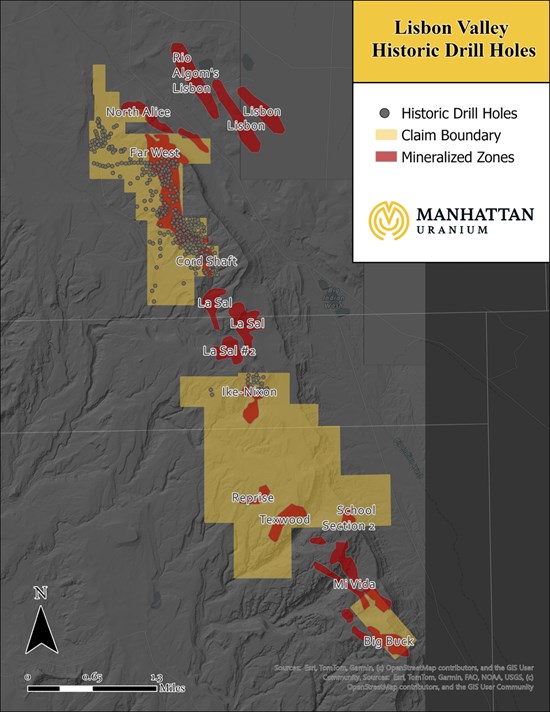
Figure 1: Lisbon Valley Historical Drill Hole Map
To view an enhanced version of this graphic, please visit:
https://images.newsfilecorp.com/files/8126/313738_761272d0b4af6a65_001full.jpg
Selected High-Priority Historical Intercepts
The table below presents 45 high-priority historical intercepts identified to date from the Company's ongoing review of the database. The table excludes holes flagged as mined out, holes flagged within 5 m of known underground workings, intervals beginning at 0 m, and exact 1 m or 2 m intervals to avoid including interpreted interval artifacts. These intercepts are historical in nature, transcribed from legacy project maps and records, and are being used for exploration targeting and 3D modelling purposes only. They have not yet been independently verified by the Company.
| DHID | From | To | Thickness | eU3O₈% |
| N-1 | 780.24 | 785.44 | 5.2 | 3.7 |
| FW3-3 | 815.9 | 815.9 | 5 | 0.94 |
| FW3-2 | 813.5 | 813.5 | 6 | 0.93 |
| P-3 | 755.4 | 755.4 | 7.5 | 0.65 |
| 81-124 | 703.65 | 713.65 | 10 | 0.640 |
| P-2 | 745.4 | 745.4 | 2.6 | 0.54 |
| C-5 | 798.1 | 798.1 | 2.9 | 0.52 |
| P-1 | 758.5 | 758.5 | 2.9 | 0.47 |
| FW3-4 | 810.7 | 810.7 | 6 | 0.44 |
| 79-53 | 765.02 | 768.52 | 3.5 | 0.420 |
| C-10 | 772 | 772.0 | 2.6 | 0.41 |
| T-5-71 | 579.70 | 582.20 | 1.5 | 0.410 |
| A-3 | 721.7 | 721.7 | 3.2 | 0.4 |
| P-4 | 665.00 | 665 | 0.8 | 0.4 |
| T-5-71 | 586.7 | 588.2 | 1.5 | 0.4 |
| _07-9 | 663.10 | 664.10 | 1 | 0.390 |
| _07-7 | 667.34 | 668.84 | 1.5 | 0.370 |
| 106 | 671.3 | 671.3 | 6.5 | 0.350 |
| 0-1 | 659.35 | 659.35 | 3 | 0.35 |
| FW3-9 | 809.5 | 809.5 | 3.5 | 0.34 |
| P-5 | 751.9 | 751.9 | 1.3 | 0.31 |
| C-6 | 698.2 | 698.2 | 3.1 | 0.3 |
| 79-22 | 722.14 | 723.14 | 1 | 0.280 |
| FW3-8A | 788.4 | 788.4 | 2.5 | 0.28 |
| C-2 | 656.4 | 656.4 | 2.8 | 0.27 |
| U-1 | 726.5 | 726.5 | 4.1 | 0.27 |
| _07-13 | 600.39 | 601.39 | 1 | 0.220 |
| T-3-11 | 730.8 | 730.8 | 0.5 | 0.22 |
| C-7 | 722.04 | 722.04 | 3.8 | 0.21 |
| T-7-71 | 749.6 | 749.6 | 2 | 0.21 |
| 81-113 | 710.63 | 720.13 | 9.5 | 0.200 |
| A-8 | 607.4 | 607.4 | 3.2 | 0.2 |
| N-4 | 778.6 | 778.6 | 4 | 0.2 |
| C-12 | 812.2 | 812.2 | 4 | 0.19 |
| 79-29 | 772.28 | 783.78 | 11.5 | 0.110 |
| 79-34 | 816.37 | 826.37 | 10 | 0.110 |
| 79-39 | 857.97 | 869.47 | 11.5 | 0.100 |
| 79-42 | 742.71 | 750.71 | 8 | 0.100 |
| 81-106 | 716.98 | 728.48 | 11.5 | 0.100 |
* eU3O₈ = equivalent U3O₈ from historical downhole gamma (radiometric) logging, not chemical assays. Values assume secular equilibrium; disequilibrium, if present, may cause them to overstate or understate true uranium grades. Historical and unverified; for exploration targeting purposes only.
Geology and Project Context
The Lisbon Valley Project is located in the Lisbon Valley uranium district of Utah, a historically significant uranium-producing area in the United States. Uranium mineralization at the project is hosted within the Moss Back member of the Chinle formation and the upper section of the Cutler formation, both of which are fluvial sandstone units that served as the primary hosts for uranium production throughout the Lisbon Valley mining district during the 1950s to 1980s mining cycle. The district has a well-documented history of uranium production and is underlain by documented infrastructure including roads, power, and historical mine workings.
The Company's lithology model is being used to constrain uranium-bearing horizons and to support 3D interpretation of gamma-defined mineralized trends. Using the updated drillhole database, digitized underground workings, and interpreted lithology model, Manhattan has begun generating preliminary 3D uranium target domains designed to identify areas where historical gamma intercepts, favorable stratigraphy, and underground development suggest potential for additional uranium mineralization.
Technical Work Completed to Date
- Consolidated historical drill hole collar, survey, and assay/gamma records into a modern digital database.
- Compiled approximately 499 drill collar locations and matching downhole survey records.
- Recovered additional historical gamma intercepts from legacy project maps not previously captured in the digital database.
- Added missing survey records where required using vertical-hole assumptions for legacy holes lacking survey data.
- Reviewed and corrected interval gaps, overlaps, duplicate records, and missing-value codes.
- Built an initial lithology model focused on the Chinle and Cutler formations.
- Generated preliminary 3D uranium target domains to guide follow-up drilling.
Next Steps
- Continued validation and reconciliation of historical gamma data with underground workings and modern exploration results.
- Refinement of the lithology model and 3D uranium target domains.
- Recovery of additional historical data and expansion of database as the review of legacy records continues.
Technical Disclosure
The historical drill hole and gamma data referenced in this news release were compiled from legacy maps and historical records believed to be reliable. The Company has not yet completed sufficient work to independently verify these data and results. In addition, historical gamma values may not be directly comparable to modern chemical assay results and are being used by the Company for exploration targeting and modelling purposes only. The Company encourages readers to exercise appropriate caution when evaluating these data and results.
No current mineral resource or mineral reserve estimate has been established at the Lisbon Valley Project.
The uranium grades in this news release are expressed as equivalent U3O₈ (eU3O₈) and are derived from historical downhole gamma-probe (radiometric) measurements, not chemical assays. Equivalent grades are calculated from gamma response and assume secular equilibrium between uranium and its radioactive decay products. Uranium in sandstone-hosted systems such as those in Lisbon Valley is mobile and may occur in radioactive disequilibrium, in which case eU3O₈ values may materially overstate or understate true uranium grades. The gamma-probe equipment, calibration standards, and conversion parameters used by the historical operators are not fully documented, and the Company has not independently verified the original measurements or conversions. Reported intervals represent downhole lengths, not true thicknesses. These historical values are used for exploration targeting and 3D modelling only. The Company encourages readers to exercise appropriate caution when evaluating these data and/or results.
Mineralization at nearby properties is not necessarily indicative of mineralization at Lisbon Valley, and there can be no assurance that any processing arrangement will be available.
Qualified Person
The scientific and technical information in this news release has been reviewed and approved by Galen McNamara, P.Geo., CEO and a director of Manhattan, who is a Qualified Person as defined by National Instrument 43-101 - Standards of Disclosure for Mineral Projects ("NI 43-101"). Mr. McNamara is not independent of Manhattan under NI 43-101.
About Manhattan Uranium Discovery Corp.
Manhattan Uranium Discovery Corp. (TSXV: MANU) (OTCQB: MAUUF) (FSE: J5B0) is a newly consolidated North American uranium company committed to the discovery, development, and advancement of high-quality uranium assets. Following the successful acquisitions of Urano Energy and Pegasus Resources, Manhattan now holds a premier portfolio of 15 past-producing uranium mines across 25 underexplored properties covering 25,099 acres in the United States, complemented by high-grade exploration potential in Canada's Athabasca Basin. Backed by an elite technical and management team with decades of uranium discovery, project advancement, and capital markets experience, Manhattan is strategically positioned to capitalize on the growing demand for domestic uranium and the American nuclear renaissance. For more information about Manhattan, please visit: www.manhattanuranium.com.
Neither the TSX Venture Exchange nor its Regulation Services Provider (as that term is defined in the policies of the TSX Venture Exchange) accepts responsibility for the adequacy or accuracy of this release.
Follow Manhattan on social media for the latest updates
- X: https://x.com/manhattanur
- LinkedIn: https://www.linkedin.com/company/manhattanuranium/
On behalf of Manhattan Uranium Discovery Corp
"Galen McNamara"
Chief Executive Officer and Director
604-288-8046
info@manhattanuranium.com
REFERENCES
1 Chenoweth, W.L. (1990). Lisbon Valley, Utah's premier uranium area: A summary of exploration and ore production. Utah Geological and Mineral Survey Open-File Report 188.
FORWARD-LOOKING STATEMENTS
This news release contains "forward-looking statements" and "forward-looking information" within the meaning of applicable Canadian and United States securities legislation (collectively, "forward-looking statements"). All statements in this release, other than statements of historical fact, are forward-looking statements. Forward-looking statements are frequently, but not always, identified by words such as "may", "will", "expect", "intend", "believe", "anticipate", "estimate", "target", "plan", "potential", "could" or similar terminology. Forward-looking statements in this release include, without limitation: the interpretation of historical drill hole, gamma and geological data; the anticipated advancement of the Company's mineral properties and project portfolios, including but not limited to the technical work referenced herein, including the timing, scope and execution thereof; exploration expenditures, costs and timing of future exploration; exploration prospects of mineral properties; requirements for additional capital; the future price of metals; government regulation of mining operations; current geopolitical developments, including but not limited to U.S. government policy, environmental risks; the timing and possible outcome of pending regulatory matters; the potential for additional mineralization; and future plans, projections, objectives, estimates and forecasts and the timing related thereto.
Forward-looking statements are based on management's current beliefs, expectations and assumptions, including, without limitation: that historical information is reliable; that future exploration activities will proceed as currently anticipated; that permits, equipment, personnel and contractors will be available on commercially reasonable terms; and that current commodity prices, labour availability, cost and regulatory frameworks will remain consistent with management's expectations. Although management considers these assumptions to be reasonable based on currently available information, they may prove to be incorrect.
Forward-looking statements are subject to known and unknown risks, uncertainties and other factors that may cause actual results, performance or achievements to differ materially from those expressed or implied by such forward-looking statements. Such risks and uncertainties include, without limitation: the risk that historical data may prove to be inaccurate or unverifiable and that historical radiometric gamma data may not correlate with chemical assay results; that exploration results may not support further work or drilling; that exploration activities may be delayed, restricted or not carried out as planned; that permits may be delayed or revoked; the presence of adverse conditions at mineral properties; the price of uranium and other metals not remaining at levels that support continued exploration; the Company's ability to continue raising necessary capital to finance operations; and the ability to establish any mineral resource estimate; the Company's ability to complete its planned exploration programs; environmental regulations or hazards and compliance with complex regulations associated with mining activities; climate change and climate change regulations; fluctuations in exchange rates; the business objectives of the Company; whether mineralization can be defined; the uncertainty that any mineralization encountered on adjacent properties continues on to any of the Company's properties; the uncertainty that geological and/or geophysical and/or any trends, interpretations, or conclusions related to adjacent properties have relevance to any of the Company's properties; the uncertainty that the exploration season can be extended; changes in project parameters as plans continue to be refined; the consequences and implications of the historical mining activities on the environment and whether such activities affect potential exploration of the Company's properties; the implications of claims from First Nations, Tribes, Tribal Councils or Tribal Governments and land claims settlements on the Company's projects; accidents, labour disputes and other risks of the mining industry; future prices of metals; possible variations of mineral grade or recovery rates; geological, mining and exploration technical problems; failure of plant, equipment or processes to operate as anticipated; accidents, labour disputes and other risks of the mining industry; title to properties; operational, technical and geological risks inherent in mineral exploration; changes in capital markets, economic conditions, regulatory developments and stakeholder relations; the other risks set out in the Company's public disclosure record under its profile on SEDAR+ (www.sedarplus.ca) and management's ability to anticipate and manage the foregoing risks and uncertainties.
The Company provides no assurance that forward-looking statements will prove to be accurate, as actual results and future events could differ materially from those anticipated in such statements. Accordingly, readers should not place undue reliance on forward-looking statements. The Company does not undertake to update any forward-looking statements, other than as required by law.
To view the source version of this press release, please visit https://www.newsfilecorp.com/release/313738