
- Mineralized skarn is denser and more chargeable than the host rocks: laboratory testing of 18 drill core samples from Cerro Grande returned an average density of 3.76 g/cm³ for mineralized skarn, compared with averages of 2.92 g/cm³ or less for the host rocks tested, and chargeabilities of 74 to 128 ms, compared with 3 to 8 ms for unmineralized skarn.
- Ground gravity survey to begin October 22, 2026: approximately 1,296 stations across Mezquital, Cerro Grande, Cerro Potrero and Las Trancas, with the results to be integrated with the Company's magnetic, IP/MT, petrophysical and drilling data.
- Gravity and IP to test existing targets and generate new ones: more than ten structural intersections along the 7-kilometre corridor show magnetic signatures comparable to the Cerro Grande skarn; the combined gravity and IP data are designed to test these targets and may identify new ones.
- Hole AG-CG-PH2-003: intersected fault-hosted skarn at a target separate from Cerro Grande, with visible copper sulfides logged from 624.45 to 634.50 m; assays pending.
VANCOUVER, BC / ACCESS Newswire / October 7, 2026 / Algo Grande Copper Corp. ("Algo Grande" or the "Company") (TSXV:ALGR)(OTCID:ALGRF)(FRA:KM00) announces the results of rock property testing on drill core from its 100%-owned Adelita Project in Sonora, Mexico. Laboratory measurements show that mineralized skarn at Cerro Grande is denser than the host rocks tested and markedly more chargeable than unmineralized skarn. On this basis, the Company has engaged GEOTEM Ingeniería S.A. de C.V. ("GEOTEM") to complete a ground gravity survey beginning October 22, 2026. Together with the Company's IP data, the gravity results will be used to test the targets already identified along the corridor and to generate new ones.
Enrico Gay, CEO of Algo Grande Copper Corp., commented: "Our petrophysical analysis shows that skarn stands out as the densest rock we tested, and the copper-bearing skarn is strongly chargeable. Magnetics finds the structure, gravity finds the weight, IP finds the charge. That gives us a way to de-risk the structural targets along the 7-kilometre corridor that share Cerro Grande's magnetic signature. Hole 3, which intersected new skarn along a separate fault, is early evidence that following structure and geophysical anomalies can lead us to new skarn."
Targets Along the Corridor and Hole AG-CG-PH2-003
More than ten structural intersections along the 7-kilometre limestone corridor, where N-S and NW-SE faults cross the limestone host, show magnetic signatures comparable to the Cerro Grande skarn (Figure 1). The gravity survey and follow-up IP are designed to test these targets and may identify new ones. Drill hole AG-CG-PH2-003 tested one of these targets, separate from Cerro Grande. The hole was collared at 738,994 E / 2,961,792 N (WGS84, UTM Zone 12N) at an elevation of 490 metres, with an azimuth of 251 degrees and a dip of 55 degrees (see news release dated September 11, 2026). The hole intersected fault-hosted skarn from 602.0 to 654.1 m downhole, including an interval from 624.45 to 634.50 m in which core logging identified visible chalcopyrite, covellite and bornite. Intervals are downhole lengths; true widths are not yet known. Assays are pending. Visual observations of sulfide minerals are preliminary, are not a substitute for laboratory assays, and should not be relied upon until assay results are received.
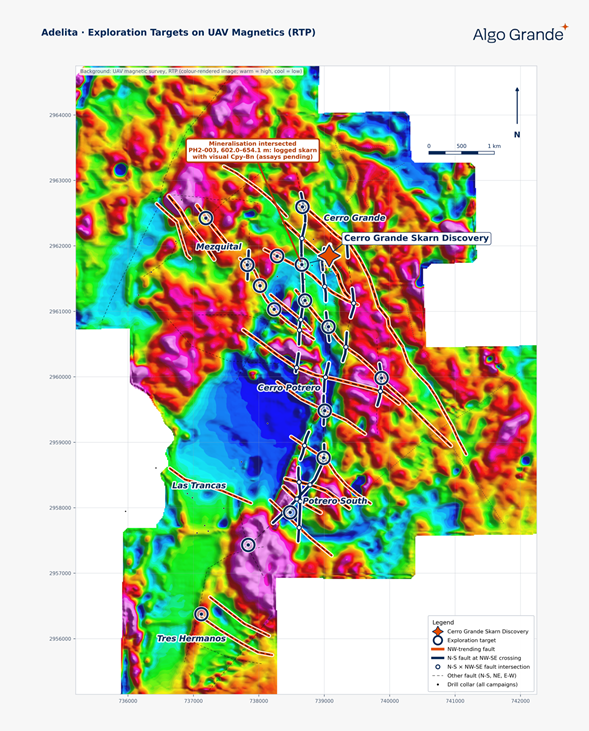
Figure 1. Exploration targets along the 7-kilometre limestone corridor, Adelita Project. Targets are located at intersections of N-S and NW-SE faults within the limestone host that show magnetic signatures comparable to the Cerro Grande skarn discovery. Background: UAV magnetic survey, reduced to pole. Drill hole AG-CG-PH2-003 intersected skarn with visually logged copper sulfides at a target separate from Cerro Grande; assays are pending. Targets are conceptual in nature and are not Mineral Resources.
Rock Property Testing
In December 2025, Zonge International's rock properties laboratory measured the physical properties of 18 drill core samples from Cerro Grande, three for each of six lithologies: mineralized skarn, unmineralized skarn, hornfels, recrystallized limestone, granodiorite and quartz monzonite (Figure 2). Key results:
• Skarn is denser on average than its host rocks: mineralized skarn returned dry densities of 3.51 to 3.99 g/cm³ (mean 3.76 g/cm³) and unmineralized skarn 2.74 to 3.53 g/cm³ (mean 3.25 g/cm³), compared with means of 2.92 g/cm³ for hornfels and 2.87 g/cm³ for recrystallized limestone, and a range of 2.60 to 2.67 g/cm³ for granodiorite and quartz monzonite.
• Chargeability distinguishes mineralized from unmineralized skarn in the samples tested: mineralized skarn returned laboratory time-domain chargeabilities of 74 to 128 ms, compared with 3 to 8 ms for unmineralized skarn and below 13 ms for all other lithologies tested.
These are laboratory measurements on a small, selected set of drill core samples, all from Cerro Grande, and may not be representative of the Project as a whole. The mineralized and unmineralized classifications reflect geological logging at the time of sample selection. Density overlaps between the two skarn classes: one unmineralized skarn sample (3.53 g/cm³) is denser than the least dense mineralized sample (3.51 g/cm³). A gravity high is therefore a vector to skarn, not to mineralization, and IP followed by drilling is required to distinguish between the two.
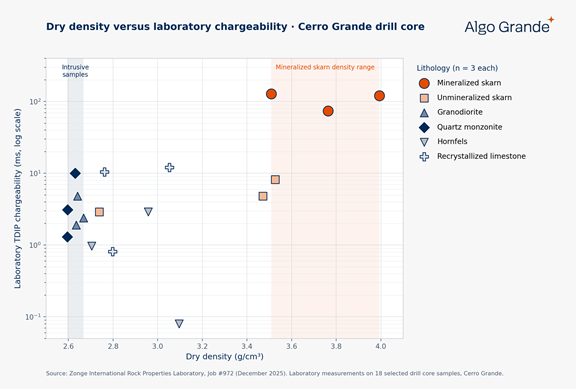
Figure 2. Dry density versus laboratory time-domain chargeability for the 18 drill core samples of Zonge Job #972, Cerro Grande. Mineralized skarn plots at high density and high chargeability; unmineralized skarn is weakly chargeable and, in two of three samples, dense; intrusive samples plot at the lowest densities. Lithological classifications reflect geological logging at the time of sample selection.
Magnetics: The Structural Framework
The Company's UAV and airborne magnetic data define the NW-SE structural framework and the intrusive contacts used to identify the current targets. Magnetics does not detect all skarn at Adelita, including garnet-rich skarn without magnetite, which is why gravity and IP are required.
Ground Gravity Survey
GEOTEM will complete approximately 1,296 gravity stations beginning October 22, 2026, using two crews, each operating a Scintrex CG-6 gravimeter with RTK GNSS positioning (Figure 3). Stations are on a 150 m grid across Mezquital, Cerro Grande, Cerro Potrero, Las Trancas and the footprint of the Company's existing IP and MT surveys, with closer-spaced infill at Cerro Potrero and around the petrophysical sample sites at Cerro Grande, and 500 m regional control stations. Fieldwork is expected to take approximately 28 to 35 active field days, subject to access and weather. The final report, including a 3D density inversion integrated with the Company's magnetic, IP/MT, petrophysical and drilling data, is expected approximately seven weeks after completion of fieldwork.
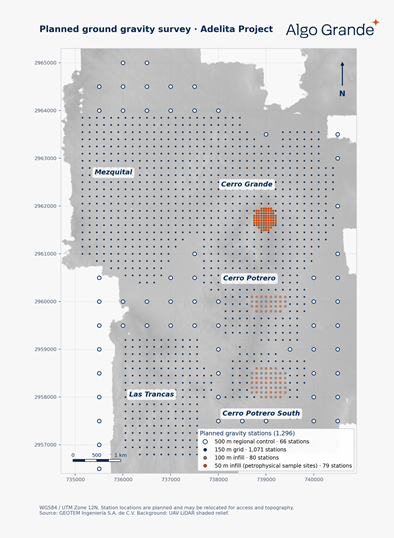
Figure 3. Planned ground gravity station distribution, Adelita Project (1,296 stations; WGS84 / UTM Zone 12N). Orange: 50 m infill around petrophysical sample sites; light orange: 100 m infill; navy: 150 m grid; open circles: 500 m regional control. Background: UAV LiDAR shaded relief. Sector labels are approximate. Station locations are planned and may be relocated for access and topography. Source: GEOTEM Ingeniería S.A. de C.V.
Follow-up IP Surveys
The Company's existing 3D DCIP data did not show a clear chargeability response over the copper mineralization intersected to date. Given the strong laboratory chargeability contrast, the Company is reviewing whether this reflects survey design rather than an absence of chargeable mineralization. Follow-up IP is expected to begin with a calibration test over known mineralized and unmineralized skarn at Cerro Grande, before surveys are extended over gravity targets.
Expected Outcome
The gravity and IP programs are designed to confirm and rank the skarn targets already identified along the corridor, and may identify new ones, ahead of the next phase of drilling. The program also includes detailed surface mapping and geochemical sampling on the higher-priority targets. Gravity is also expected to improve the mapping of intrusive-carbonate contacts, which are interpreted to control the distribution of skarn at Adelita.
Sampling and Laboratory Methods
The 18 samples were taken from drill core of holes AD-22-0017, AD-22-0018, AD-22-0019, AD-22-0020-A, AD-22-0021 and AD-22-0028 at Cerro Grande and were selected to represent six lithologies. Measurements were completed by Zonge International's rock properties laboratory in December 2025. Dry density was determined from saturated, submerged and dry masses; magnetic susceptibility was measured with a Bartington MS2 instrument on three orthogonal axes; and time-domain IP was measured with a GDP-32 receiver at 0.125 Hz, with chargeability reported as Newmont-standard integrated chargeability over a 450 to 1,100 ms window.
Qualified Person
The scientific and technical information disclosed in this news release has been reviewed and approved by João Rocha, EurGeol, Vice President of Exploration of Algo Grande Copper Corp., a Qualified Person as defined by National Instrument 43-101. Mr. Rocha is not independent of the Company. Mr. Rocha has reviewed the Zonge International laboratory results for Job #972. The petrophysical data are laboratory measurements on selected samples, are used for survey design and interpretation only, and do not represent grades, widths or a mineral resource.
About Algo Grande Copper Corp.
Algo Grande Copper Corp. is a mineral exploration company advancing the Adelita Project, a district-scale, multi-system copper-silver-gold opportunity positioned in the prolific Arizona-Sonora copper belt. The 5,895-hectare Adelita Project is anchored by the high-grade Cerro Grande Cu-Au-Ag skarn discovery, which exhibits strong geophysical continuity along a defined corridor extending over 7 kilometres. Reprocessing of legacy geophysical data and field mapping indicate that a potential porphyry system may occur at depth, suggesting a skarn-porphyry mineralization model comparable to deposits elsewhere in northwestern Mexico.
ON BEHALF OF ALGO GRANDE COPPER CORP.
Enrico Gay
Chief Executive Officer
For more information, please contact:
E-mail: info@algo-grande.com
Website: www.algo-grande.com
+1 (778) 907-2547
NEITHER THE TSX VENTURE EXCHANGE NOR ITS REGULATION SERVICES PROVIDER (AS THAT TERM IS DEFINED IN THE POLICIES OF THE TSX VENTURE EXCHANGE) ACCEPTS RESPONSIBILITY FOR THE ADEQUACY OR ACCURACY OF THIS RELEASE.
Cautionary Statement on Forward-Looking Information
This news release contains statements and information that, to the extent that they are not historical fact, constitute "forward-looking information" within the meaning of applicable securities legislation. Forward-looking information is based on the reasonable assumptions, estimates, analysis and opinions of management made in light of its experience and its perception of trends, current conditions and expected developments, as well as other factors that management believes to be relevant and reasonable in the circumstances at the date that such statements are made, but which may prove to be incorrect. Forward-looking information involves known and unknown risks, uncertainties and other factors that may cause the actual results, performance or achievements of Algo Grande to differ materially from any future results, performance or achievements expressed or implied by the forward-looking information, including, but not limited to, statements relating to the timing, scope and completion of the gravity survey, field productivity, access, permitting and weather, the review of existing IP data, the design, timing and completion of any follow-up IP surveys, the expected timing and content of the final gravity report, the interpretation of petrophysical, magnetic and other geophysical data, the identification and ranking of drill targets, the interpretation of visual observations in drill hole AG-CG-PH2-003 and the receipt and results of pending assays, planned surface mapping and geochemical sampling, future drill programs, the Company's geological model including the porphyry model, and those listed in filings made by Algo Grande with the Canadian securities regulatory authorities (which may be viewed at www.sedarplus.ca). Accordingly, readers should not place undue reliance on any such forward-looking information. Further, any forward-looking statement speaks only as of the date on which such statement is made. New factors emerge from time to time, and it is not possible for Algo Grande's management to predict all of such factors and to assess in advance the impact of each such factor on Algo Grande's business or the extent to which any factor, or combination of factors, may cause actual results to differ materially from those contained in any forward-looking statements. Algo Grande does not undertake any obligation to update any forward-looking information to reflect information, events, results, circumstances or otherwise after the date hereof or to reflect the occurrence of unanticipated events, except as required by law including securities laws.
SOURCE: Algo Grande Copper Corp.
View the original press release on ACCESS Newswire:
https://www.accessnewswire.com/newsroom/en/metals-and-mining/algo-grande-copper-core-testing-shows-mineralized-skarn-is-denser-and-more-charge-1234131
