
PEA Highlights:
US$638.8 Million NPV8 (post-tax), 89.0% IRR (post-tax), US$140M annual gross revenue; 12-Month Capex Payback
VICTORIA, BC / ACCESS Newswire / October 14, 2026 / Boron One Holdings Inc. ("Boron One" or the "Company") (TSXV:BONE), a company committed to advancing global decarbonization through the responsible utilization of its boron assets, is pleased to report positive results of an updated Independent Technical Report and Preliminary Economic Assessment ("PEA") for its wholly-owned Piskanja boron project (the "Project").
The primary reason for the PEA is to present an up-to-date Mineral Resource Estimate (MRE) and Preliminary Economic Analysis (PEA) for the Project that reflect the Company's most current technical studies which were completed subsequent to the Company's previous PEA in 2022. These new studies include: metallurgical and processing testing; a 3D block resource model by borate type; advanced mine designs; geotechnical testing; boron pricing and market dynamics studies; and an environmental study (EIA).
PEA ECONOMIC HIGHLIGHTS (in USD)
| Net Present Value (NPV8) post-tax | $638.8 million |
| Internal Rate of Return (IRR) post-tax | 89.0% |
| Initial capital cost (Capex) w/ contingency | $79.9 million |
| Capex payback from commercial production start | < 12 months |
| Life of Mine (LOM) | 13 years |
| Gross project revenue | $1.97 billion |
| Net project cash flow (post-tax) | $1.16 billion |
| Average annual gross revenue | $140.4 million |
| LOM average annual EBITDA | $87.7 million |
| Net operating margin | 73.0% |
| All in sustaining cost (AISC) per t of Product | $231.44 |
| Weighted average revenue per t of Product | $674.01 |
| LOM Sustaining Capital | $38.1 million |
| LOM average gross production (ROM) | 432.7 ktpa |
| Profitability Index (NPV/Capex) post-tax | 7.99 X |
| LOM Capital Intensity Index (Initial Capex/ROM tonnage) | $14.22 |
| LOM average C1 cost (ROM production) per ton | $89.48 |
| Average annual production (commercial grade) - colemanite | 157.6 ktpa |
| Average annual production (commercial grade) - ulexite | 83.8 ktpa |
| Average annual production of boric acid | 25 ktpa |
| LOM average C1 cost (colemanite) post-tax per ton | $188 |
| LOM average C1 cost (ulexite) post-tax per ton | $188 |
| LOM average C1 cost (boric acid) post-tax per ton | $328 |
| LOM mining gross production (t) | 5.62 million |
| Average grade B2O3 (measured and indicated) | 32.4% |
Note: Units expressed in metric tonnes
MINERAL RESOURCE ESTIMATE
The basis for the PEA is the Mineral Resource Estimate (MRE) prepared by Prof. Miodrag Banješevic PhD. P.Geo, EurGeol. Prof. Banješevic is a Qualified Person in accordance with the CIM Definition Standards on Mineral Resources and Reserves (CIM Standards). The MRE produced by Banješevic is an update to a previous estimate produced by Banješevic in 2022, and SRK Consulting in 2016 (amended in 2019) and reflects a reinterpretation that includes the delineation of geological blocks according to the dominant boron minerals (colemanite, ulexite, howlite) within the outlines of the borate bodies, both horizontally for all 12 borate bodies and vertically for main bodies. The MRE is estimated according to NI 43-101 and CIM Standards.
The updated Mineral Resource Statement generated for the Piskanja Project is as follows:
Mineral Resource Category | Tonnage (t) | B2O3 Grade (%) | Contained B2O3 (t) |
| Measured | 1,049,207 | 34.78 | 364,943 |
| Indicated | 6,090,601 | 31.99 | 1,948,626 |
| Measured + Indicated | 7,139,808 | 32.40 | 2,313,569 |
The updated Mineral Resource Statement by dominant boron minerals is as follows:
Geological Blocks by | CIM / NI 43-101 Mineral Resource | Mineral Resources in tonnes (t) | Weighted Grades (%) | Contained |
| Colemanite (COL) | Measured | 469,619 | 35.52 | 166,824 |
| Indicated | 3,360,829 | 34.14 | 1,147,478 | |
| Measured + Indicated | 3,830,448 | 34.31 | 1,314,302 | |
| Ulexite (ULE) | Measured | 256,795 | 40.47 | 103,923 |
| Indicated | 735,259 | 40.67 | 299,023 | |
| Measured + Indicated | 992,054 | 40.62 | 402,946 | |
| Polymineralic (Mix) | Measured | 322,793 | 29.18 | 94,196 |
| Indicated | 1,994,513 | 25.18 | 502,126 | |
| Measured + Indicated | 2,317,306 | 25.72 | 596,321 | |
| TOTAL | 7,139,808 | 32.40 | 2,313,569 |
The Mineral Resource Statement is reported at a minimum grade threshold of 12 percent B2O3, and considers reasonable underground mining, processing and sales technical parameters. All figures are rounded to reflect the relative accuracy of the estimates. Mineral Resources are not Mineral Reserves and do not have a demonstrated economic viability. The contained B2O3 represents estimated contained metal in the ground and has not been adjusted for metallurgical recovery, and may have discrepancies due to rounding.
PROJECT DESCRIPTION
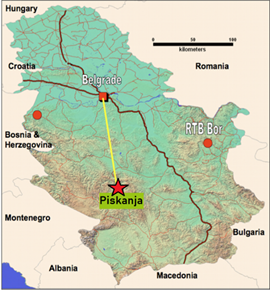
The Project occurs within a 306-hectare exploration licence located in southern Serbia (the Exploration Licence), some 160 km south of the Serbian capital Belgrade by paved road. Balkan Gold d.o.o, which holds the Exploration Licence, is a wholly owned subsidiary of Boron One.
Location of Serbia and the Piskanja boron project
PROJECT GEOLOGY
Geologically, the Project is located within the Jarandol basin, a Neogene continental sedimentary basin positioned in the Vardar Zone (VZ) tectonic belt. The host rocks comprise mudstones, sandstones, carbonates, tuffaceous sediments and conglomerates. It is interpreted that hydrothermal and tectonic activity led to borate mobilisation and deposition as a series of stratiform lenses within the basinal carbonate sediments. Mineralized horizons show a range of textures predominantly comprising different growths of the borate minerals colemanite, ulexite and howlite.
SUMMARY OF PRELIMINARY ECONOMIC ASSESSMENT (PEA)
The PEA was prepared independently, under the supervision of Prof. Miodrag Banješevic PhD. P.Geo, EurGeol, with contributions from Prof. Dejan Petrovic PhD (Mining Eng). Prof. Petrovic is employed at the Technical Faculty in Bor University of Belgrade as an associate professor in the Department of Underground Exploitation. The PEA was prepared in accordance with the requirements of National Instrument 43-101 and is based on the Mineral Resource Estimate for Piskanja with an effective date of October 12, 2026 (see "Mineral Resource Estimate" above).
PEA ECONOMICS
In summary, the Project has a post-tax Life of Mine (LOM) net project cashflow (pre-finance) of some US$1.16 billion which returns a post-tax NPV (8%) of US$638.8 million and an IRR of 89.0%. The following table presents the summary LOM cash flow resulting from the Technical Economic Model.
Project Cashflow | US$'000 |
Gross Revenue | 1,965,086 |
Deductions | 101,496 |
Net Revenue | 1,863,590 |
Operating Costs | 503,263 |
Project Capital | 79,903 |
Sustaining Capital | 38,059 |
Closure | 15,000 |
Project Cashflow | 1,227,366 |
Working Capital | 0 |
Corporation Tax | 70,020 |
Net Project Cashflow | 1,157,346 |
Project economics were estimated assuming a constant price of US$650/t for sales-grade Colemanite and Ulexite (40% B2O3 purity) and US$1,000/t for technical grade (99.9%) Boric Acid. Capital and operating cost estimates were prepared based on current pricing assumptions and to a PEA level +/- 35% level of accuracy. The PEA presents a complete list of assumptions.
SENSITIVITIES
Discount Rate
The following table shows the pre- and post-tax NPVs at varying discount rates. (USD'000). The base case discount rate of 8% returns a NPV of US$667.1M pre-tax and US$638.9M post-tax.
Discount Rate | Pre-Tax NPV (USD'000) | Post-Tax NPV (USD'000) |
| 5% | 828,431 | 789,104 |
| 8% (Base Case) | 667,135 | 638,893 |
| 10% | 581,579 | 558,798 |
| 12% | 509,633 | 491,176 |
The following table shows the effect on the post-tax NPV8 at varying revenue, opex, capex, and material price levels (from -50% to +50%):
Sensitivities: Post Tax NPV at 8% discount rate
(USD'000,000) | -50% | -40% | -30% | -20% | -10% | 0% | 10% | 20% | 30% | 40% | 50% |
| Revenue | 139 | 239 | 339 | 439 | 539 | 639 | 739 | 839 | 939 | 1,039 | 1,139 |
| OPEX | 768 | 742 | 716 | 690 | 665 | 639 | 613 | 587 | 562 | 536 | 510 |
| CAPEX | 677 | 670 | 662 | 654 | 647 | 639 | 631 | 623 | 616 | 608 | 600 |
| Concentrate price | 178 | 270 | 362 | 454 | 547 | 639 | 731 | 823 | 916 | 1,008 | 1,100 |
| Boric Acid price | 600 | 608 | 615 | 623 | 631 | 639 | 647 | 655 | 662 | 670 | 678 |
The following table illustrates the projected Post-tax Net Present Value ("NPV") sensitivity of the Piskanja project to Operating Cost and Capital Cost variations:
| NPV (USD'000) | OPEX | |||||||||||
| -50% | -40% | -30% | -20% | -10% | 0% | 10% | 20% | 30% | 40% | 50% | ||
CAPEX | -50% | 806,187 | 780,428 | 754,670 | 728,912 | 703,154 | 677,396 | 651,637 | 625,879 | 600,121 | 574,363 | 548,605 |
| -40% | 798,486 | 772,728 | 746,970 | 721,212 | 695,453 | 669,695 | 643,937 | 618,179 | 592,421 | 566,662 | 540,904 | |
| -30% | 790,786 | 765,028 | 739,269 | 713,511 | 687,753 | 661,995 | 636,237 | 610,478 | 584,720 | 558,962 | 533,204 | |
| -20% | 783,085 | 757,327 | 731,569 | 705,811 | 680,052 | 654,294 | 628,536 | 602,778 | 577,020 | 551,262 | 525,503 | |
| -10% | 775,385 | 749,627 | 723,868 | 698,110 | 672,352 | 646,594 | 620,836 | 595,077 | 569,319 | 543,561 | 517,803 | |
| 0% | 767,684 | 741,926 | 716,168 | 690,410 | 664,652 | 638,893 | 613,135 | 587,377 | 561,619 | 535,861 | 510,102 | |
| 10% | 759,984 | 734,226 | 708,468 | 682,709 | 656,951 | 631,193 | 605,435 | 579,677 | 553,918 | 528,160 | 502,402 | |
| 20% | 752,284 | 726,525 | 700,767 | 675,009 | 649,251 | 623,493 | 597,734 | 571,976 | 546,218 | 520,460 | 494,702 | |
| 30% | 744,583 | 718,825 | 693,067 | 667,309 | 641,550 | 615,792 | 590,034 | 564,276 | 538,518 | 512,759 | 487,001 | |
| 40% | 736,883 | 711,124 | 685,366 | 659,608 | 633,850 | 608,092 | 582,333 | 556,575 | 530,817 | 505,059 | 479,301 | |
| 50% | 729,182 | 703,424 | 677,666 | 651,908 | 626,149 | 600,391 | 574,633 | 548,875 | 523,117 | 497,358 | 471,600 | |
The table below illustrates the Post-tax NPV variability with changing Operating Cost and Revenue estimates:
| NPV (USD'000) | Revenue | |||||||||||
| -50% | -40% | -30% | -20% | -10% | 0% | 10% | 20% | 30% | 40% | 50% | ||
OPEX | -50% | 267,471 | 367,514 | 467,556 | 567,599 | 667,642 | 767,684 | 867,727 | 967,770 | 1,067,813 | 1,167,855 | 1,267,898 |
| -40% | 241,713 | 341,755 | 441,798 | 541,841 | 641,883 | 741,926 | 841,969 | 942,012 | 1,042,054 | 1,142,097 | 1,242,140 | |
| -30% | 215,954 | 315,997 | 416,040 | 516,083 | 616,125 | 716,168 | 816,211 | 916,253 | 1,016,296 | 1,116,339 | 1,216,382 | |
| -20% | 190,196 | 290,239 | 390,282 | 490,324 | 590,367 | 690,410 | 790,453 | 890,495 | 990,538 | 1,090,581 | 1,190,623 | |
| -10% | 164,438 | 264,481 | 364,523 | 464,566 | 564,609 | 664,652 | 764,694 | 864,737 | 964,780 | 1,064,823 | 1,164,865 | |
| 0% | 138,680 | 238,723 | 338,765 | 438,808 | 538,851 | 638,893 | 738,936 | 838,979 | 939,022 | 1,039,064 | 1,139,107 | |
| 10% | 112,922 | 212,964 | 313,007 | 413,050 | 513,093 | 613,135 | 713,178 | 813,221 | 913,263 | 1,013,306 | 1,113,349 | |
| 20% | 87,145 | 187,206 | 287,249 | 387,292 | 487,334 | 587,377 | 687,420 | 787,462 | 887,505 | 987,548 | 1,087,591 | |
| 30% | 61,362 | 161,448 | 261,491 | 361,533 | 461,576 | 561,619 | 661,662 | 761,704 | 861,747 | 961,790 | 1,061,832 | |
| 40% | 35,579 | 135,680 | 235,732 | 335,775 | 435,818 | 535,861 | 635,903 | 735,946 | 835,989 | 936,032 | 1,036,074 | |
| 50% | 9,848 | 109,898 | 209,974 | 310,017 | 410,060 | 510,102 | 610,145 | 710,188 | 810,231 | 910,273 | 1,010,316 | |
A more complete set of sensitivity tables are available within the PEA.
MINING
The geometry and depth of the mineralization identified at Piskanja best lends itself to an underground mining method. It is envisaged that mining will be by drift and fill method and that the key underground infrastructure will comprise:
- Twin access declines from surface to the deposit: i) main haulage decline - 1315 m in length (further addressed as MHD) from surface to the floor of Mineralized Zone 1, and ii) main ventilation decline - 1292 m in length (further addressed as MVD) from surface to the roof of Mineralized Zone 3;
- An underground spiral ramp connecting MHD and MVD and enabling access to all levels;
- A shaft connecting MHD and MVD to serve as the main ore pass (MOP) and temporary (if needed) ore stock;
- Footwall drives located below seam horizons of Mineralized Zones 1, 2 and 3; and
- Level drives and ventilation connections between three footwall drives.
The PEA envisages a Run of Mine (ROM) average annual tonnage of 432,654 tonnes to produce some 157,624.59 tonnes of sale grade colemanite, 83,818 tonnes of sales grade ulexite, and 25,000 tonnes of boric acid for a period of 13 years.
Excavation is proposed by mechanical cutting using Continuous Miners ("CM"). The rationale of the application of mechanical cutting, as opposed to drill and blast operations, is the need to minimize ground vibrations which may affect the residential structures in the nearby village. Similarly, the application of any caving mining methods, or any mining methods which could cause ground subsidence is, at present moment, excluded from further considerations.
Material mined by the CMs would be hauled by shuttles or battery haulers to the nearest pass/bin and fed to the panel conveyor at the main haulage horizon. The panel conveyor would then haul the mined material to the main ore pass/ore bunker. The main ore pass has two functions: i) to reduce the mined material tonnes to the Main Haulage Decline and feed it to the Main belt conveyor and ii) to serve as a temporary ore storage/ore stockpile. Once fed to the main belt conveyor, the material is conveyed to the surface and fed to the ore processing system.
In order to achieve an overall planned mining recovery of 75% and ensure the stability of excavated spaces, it will be necessary to apply solidifying material for backfill.
PROCESSING & RECOVERY
The development plan calls for the production of both Colemanite and Ulexite concentrates with a benchmark B2O3 content of ˜ 40% and Boric Acid (later in LOM) containing 56.3% B2O3, the latter at a rate of 25 ktpa, and the former at a rate of approximately 250 ktpa in combined total.
Bulk testing conducted by ALS during 2023 confirmed the ability to produce commercial grades of borate concentrates (Colemanite and Ulexite) and derivatives (in the form of Boric Acid) from each of the three borate mineral types found at Piskanja, while deploying conventional beneficiation processes and technologies used widely within the boron industry.
Colemanite Concentrate
The beneficiation process of Colemanite (Ca2B6O11·5H2O) demonstrates the upgrade of Piskanja run-of-mine (ROM) ore - containing 25% B2O3 - to a marketable concentrate (of up to 40% B2O3), suitable for downstream sales/chemical conversion and export. The process flow is predicated upon the metallurgical work conducted by ALS in 2023 and well-defined industry best practices. Of note is the fact that the process of beneficiation of Colemanite to be deployed at Piskanja relies on "off-the-shelf" technology that is widely used in the industry, and is a chemical-free process. The only inputs are energy and water (of which the latter is mostly recycled for future usage in a closed loop). Tailings generated from Colemanite processing are to be cemented into the mine as a part of the backfill process.
The industrial beneficiation of Piskanja Colemanite to commercial grade involves the following primary steps: Comminution (Crushing and Grinding); Attrition Scrubbing; Screening (slimes rejection); Classification (Hydrocyclones); Magnetic Separation (as needed for removal of magnetics); Dewatering and Tailings Handling; Water Recovery and Recycling.
Ulexite Concentrate
The process flow for the beneficiation of Ulexite is based upon the metallurgical work conducted by ALS in 2023 and well-defined industry best practices. Industrial beneficiation via calcination offers a robust, low-waste method to upgrade ore grade by removing water, thus concentrating B2O3 content without generating solid tailings.
The beneficiation process is structured as a continuous, closed-loop system comprising the following major unit operations: Crushing and Screening for optimal heat transfer and kiln feed uniformity; Feed Preparation and Conveying; Calcination (Rotary Kiln); Product Cooling; Packaging and Dispatch; and, Off-Gas Handling and Emissions Control.
Boric Acid Processing
Plans include the design, construction, and operation of an industrial-scale boric acid (H3BO3) production facility with a nominal output of 25,000 metric tons per annum (tpa), targeting a product grade of 56.3% B2O3. The process is based on the hydrometallurgical treatment of borate run of mine material averaging 24.1% B2O3. The production of Boric Acid will be comprised (primarily) of feed from the mix borate zones within the Piskanja deposit.
The process flow is based upon the metallurgical work conducted by ALS in 2023 and well-defined industry best practices. The selected process route is hydrometallurgical leaching of borate ore with sulfuric acid (H2SO4), followed by solid-liquid separation, crystallization, washing, drying, and packaging. This route is widely adopted in the industry due to its high efficiency, scalability, and compatibility with a range of borate ores.
The Boric Acid production process comprises the following main steps: Crushing and Grinding; Leaching Reaction with sulfuric acid; Solid-Liquid Separation; Crystallization; Filtration and Washing; Drying; Product Handling and Packaging; Tailings Handling; and, Water Recovery and Recycle.
ENVIRONMENTAL STUDY
Boron One commissioned the Mining Institute Belgrade d.o.o. (Zemun) to author a Study on Environmental Impact (the "EIA") in accordance with the Serbian Law on Environmental Impact Assessment, as a part of the mine licensing process and as good business practice. The EIA, its Annex and Amending Supplementary Documentation were completed in November of 2025.
Environmental Study Conclusions
The Study notes that plans include a detailed, legally grounded, and technically robust monitoring program designed to ensure that environmental impacts from the Piskanja underground borate mine are detected early, quantified accurately, and managed effectively. The plan integrates baseline conditions, regulatory requirements, scientific methodologies, and adaptive management principles. Through systematic monitoring of air, soil, water, noise, and waste, the program ensures continuous oversight of environmental quality and supports timely intervention whenever adverse impacts arise. The EIA concludes that Piskanja borate project exhibits a low to moderate accident risk profile, with no high-risk accident categories.
Key chapters of the EIA include:
Baseline Studies
Baseline characterization at Piskanja was carried out to establish a zero-state environmental profile prior to mining. The studies cover: morphology; population; ecology; land quality; hydrogeology; water quality; air quality; noise; and boron concentrations. These datasets form the foundation for impact prediction and regulatory compliance.
Identification of Possible Significant Environmental Impacts
Several areas of potential impact are recognized and include the following Impact Identification Framework, categorized into four domains (with several sub-categories in each):
- Physical Environment - land, geology, soil, surface water, groundwater, air quality, noise.
- Biological Environment - terrestrial and aquatic habitats, flora, fauna.
- Socio economic Environment - land use, resource access, economic activity.
- Cultural Environment - archaeological and historical sites.
Environmental Impact Assessment in the Event of an Accident
This chapter evaluates how accidental events could affect the environment during underground borate mining at Piskanja. The section emphasizes that the Piskanja project uses no explosives and no toxic or oxidizing chemicals, significantly reducing accident risk. Most machinery is electrically powered, meaning only small quantities of diesel fuel, oils, and lubricants are present. These substances pose limited environmental hazard, and accidental releases would be small and localized.
CAPITAL & OPERATING COSTS
A breakdown of the capital and operating costs used in the economic analysis is presented in the tables below.
Project Capital Costs [expended over a 24-month development period]
| Project Capital (USD'000) | Base Cost | Contingency | Total |
| Mining | 39,400 | 11,820 | 51,220 |
| Processing - Colemanite | 2,000 | 600 | 2,600 |
| Processing - Boric Acid | - | - | - |
| Infrastructure | 16,250 | 4,875 | 21,225 |
| Tailings | 3,814 | 1,144 | 4,957 |
| Total | 61,464 | 18,439 | 79,903 |
Unit Operating Costs (USD/t)
Colemanite/Ulexite | Boric Acid | |
Mining | 118.3 | - |
Processing - Colemanite | 5.3 | 1.3 |
Processing - BA Plant | 1.7 | 205.8 |
Tailings/Waste Disposal | 0.3 | 0.9 |
Infrastructure | 3.2 | 4.8 |
G&A | 36.4 | 54.8 |
Royalty | 32.5 | 50.0 |
Sales/Marketing | 1.1 | 1.5 |
Tax | 21.5 | 58.4 |
Unit Costs/ tonne of production | 220.2 | 377.6 |
KEY CONCLUSIONS
Exploration activities undertaken by Boron One to date, have outlined a significant boron mineral deposit which, in the opinion of the PEA Author, justifies further assessment. Boron One has progressed in several additional areas, having continued to advance its resource model, metallurgical work, geotechnical testing, and a more refined mine model. Additionally, the Company has furthered its business development, having secured a binding offtake contract with a buyer. Given these and other factors, future activities are justified to continue to advance project development.
This report includes a Mineral Resource Estimate for the Project that includes a Measured and Indicated Mineral Resource of 7.14Mt with a mean grade of 32.4% B2O3.
The report presents a Preliminary Economic Assessment for the Project, and shows the potential of the project by demonstrating a post-tax NPV for the Project at a 8% discount rate of US$639 million and an IRR of 89.0%. Of note is the fact that the values do not include any Inferred Mineral Resources.
It should be noted that there is a significant amount of future work to be undertaken in order to remove or minimize the risks before entering the mine construction phase. The Author of this PEA recommended appropriate actions and activities needed to properly assess and address associated risks.
A future work program will be discussed with the Company in order to define the necessary steps towards the FS stage, and eventual mine construction stage in accordance with Serbian regulatory requirements and international standards, as well as to define the decision-making milestones along the way to help decide how to advance through the next stages.
RECOMMENDATIONS
Recommendations for work to further advance and de-risk the Project are provided below. Much of this would fall under the parameters of a Preliminary Feasibility Study (PFS) or Feasibility Study:
- Expansion and improvement of the existing Piskanja Mineral Resource Estimate through further exploration and close-spaced drilling in the two unbounded directions;
- Improvement and refinement of metallurgical recoveries and processes through further metallurgical optimization work;
- Continued evaluation of different project operating scales ("right sizing") and optimization of mine plans;
- Evaluation and incorporation of existing technologies to improve sustainability and reduce environmental impact;
- Additional test work to further define geotechnical parameters of the rock mass;
- Additional model refining (structural, resource, economical) as an aid to appropriate mine design; and
- A demonstration of mitigation measures.
QUALIFIED PERSONS
Prof. Miodrag Banješevic PhD. P.Geo, EurGeol, is the qualified person as defined by NI 43-101 for the Preliminary Economic Assessment and for the Mineral Resource Estimate, and is independent of the Company. He has reviewed the technical information that forms the basis for this news release and has approved the disclosure herein.
Nenad Rakic, EurGeol, an employee of Boron One, is a qualified person as defined by NI 43-101, has reviewed the technical information that forms the basis for this news release and has approved the disclosure herein.
On behalf of the Board of Directors,
Tim Daniels
###
CAUTIONARY NOTE
The PEA summarized in this news release is considered preliminary in nature, contains numerous assumptions. There is no certainty that the results of the PEA will be realized. No Mineral Reserves have been estimated for Piskanja. Mineral Resources are not Mineral Reserves and do not have demonstrated economic viability. Mineral Resources are captured within an optimized mine plan (within the constraints of a PEA) and meet the test of reasonable prospects for economic extraction.
The effective date of the PEA is October 12, 2026, and a technical report prepared in accordance with National Instrument 43-101 Standards of Disclosure for Mineral Projects ("NI 43-101") in support of the PEA will be filed on SEDAR within 45 days of this news release.
The PEA will be available at Boron One's website (www.boronone.com) or the Company's filed documents at www.sedarplus.ca within 45 days of the date of this release.
About Boron One Holdings Inc.
Boron One Holdings Inc. is a leading company dedicated to advancing the decarbonization of the planet through the responsible utilization of its wholly owned boron assets. With a commitment to environmental stewardship and sustainability, Boron One aims to play a crucial role in reducing the world's carbon footprint and supporting a cleaner, greener future for us all.
Headquartered in Victoria, B.C., Canada, Boron One's shares are traded on the TSX Venture Exchange under the symbol "BONE". For detailed information please see Boron One's website at www.boronone.com or the Company's filed documents at https://www.sedarplus.ca/.
| For further information, please contact: Blake Fallis, General Manager Phone: 1-250- 384-1999 or 1-888-289-3746 info@boronone.com www.boronone.com | Boron's Public Quotations: TSX Venture: BONE Berlin: EKV US: SEC 12G3-2(B) #82-4432ERVFF OTCBB: ERVFF |
Neither the TSX Venture Exchange nor its Regulation Services Provider (as that term is defined in the policies of the TSX Venture Exchange) accepts responsibility for the adequacy or accuracy of this release.
For Boron One Holdings Inc. Investors
This news release contains "forward-looking statements" within the meaning of applicable Canadian securities legislation. Certain statements made in this press release that are not based on historical information are forward-looking statements that involve substantial known and unknown risks and uncertainties. This press release contains express or implied forward-looking statements relating to, among other things, Boron One's expectations concerning management's plans, objectives and strategies, including its plans for advancing the Company's Piskanja Project through to an exploitation license. These statements are neither promises nor guarantees but are subject to a variety of risks and uncertainties, many of which are beyond the Company's control, and which could cause actual results to differ materially from those contemplated in these forward-looking statements. Factors that could cause actual results to differ materially from any forward-looking statement include, but are not limited to, failure to convert estimated mineral resources to reserves, capital and operating costs varying significantly from estimates, the preliminary nature of metallurgical test results, delays in obtaining or failures to obtain required governmental, environmental or other project approvals, political risks, uncertainties relating to the availability and costs of financing needed in the future, changes in equity markets, inflation, changes in exchange rates, fluctuations in commodity prices, delays in the development of projects and the other risks involved in the mineral exploration and development industry.
Existing and prospective investors are cautioned not to place undue reliance on these forward-looking statements, which speak only as of the date hereof.
Boron One Holdings Inc. undertakes no obligation to update or revise the information contained in this press release, whether as a result of new information, future events or circumstances or otherwise except as expressly required by applicable securities law. Further information regarding the uncertainties and risks can be found in the disclosure documents filed by Boron One with the securities regulatory authorities, available at https://www.sedarplus.ca/. These and other factors made in public disclosures and filings by the Company should be considered carefully.
Cautionary Note to United States Investors
Boron One Holdings Inc. prepares its disclosure in accordance with the requirements of securities laws in effect in Canada, which differ from the requirements of U.S. securities laws. Terms relating to mineral resources in this news release are defined in accordance with NI 43-101 under the guidelines set out in CIM Definition Standards on Mineral Resources and Mineral Reserves, adopted by the Canadian Institute of Mining, Metallurgy and Petroleum Council on May 19, 2014, as amended ("CIM Standards"). The U.S. Securities and Exchange Commission (the "SEC") has adopted amendments effective February 25, 2019 (the "SEC Modernization Rules") to its disclosure rules to modernize the mineral property disclosure requirements for issuers whose securities are registered with the SEC under the U.S. Securities Exchange Act of 1934.
As a result of the adoption of the SEC Modernization Rules, the SEC will now recognize estimates of "measured mineral resources", "indicated mineral resources" and "inferred mineral resources", which are defined in substantially similar terms to the corresponding CIM Standards. In addition, the SEC has amended its definitions of "proven mineral reserves" and "probable mineral reserves" to be substantially similar to the corresponding CIM Standards.
U.S. investors are cautioned that while the foregoing terms are "substantially similar" to corresponding definitions under the CIM Standards, there are differences in the definitions under the SEC Modernization Rules and the CIM Standards. Accordingly, there is no assurance any mineral resources that Boron One may report as "measured mineral resources", "indicated mineral resources" and "inferred mineral resources" under NI 43-101 would be the same had Boron One prepared the resource estimates under the standards adopted under the SEC Modernization Rules.
In accordance with Canadian securities laws, estimates of "inferred mineral resources" cannot form the basis of feasibility or other economic studies, except in limited circumstances where permitted under NI 43-101.
SOURCE: Boron One Holdings Inc.
View the original press release on ACCESS Newswire:
https://www.accessnewswire.com/newsroom/en/metals-and-mining/boron-one-holdings-inc.-announces-positive-preliminary-economic-assessment-pea-fo-1236473
