Vancouver, British Columbia--(Newsfile Corp. - October 28, 2026) - Pacifica Silver Corp. (CSE: PSIL) (OTCQB: PAGFF) ("Pacifica Silver" or the "Company") is pleased to announce assay results for an additional 27 holes from its ongoing Phase II diamond drilling program at the 100%-owned Claudia Silver-Gold Project (the "Project"), located in the historic El Papantón Mining District in Durango State, Mexico.
The 27 holes reported are from the Central, Aguilareña and Justina veins and the Judy target, with the latest results outlining an emerging high-grade shoot extending approximately 750 m along strike on the Central Vein and extending the Aguilareña Vein an additional 700 m to the south. Initial drilling at the Judy anomaly returned modest grades, but the widespread silica- and sulfide-cemented breccias are interpreted to indicate an extensive hydrothermal system.
Drill Result Highlights (Estimated True Widths)
Central Vein
- 5.04 m @ 8.72 g/t Au and 49 g/t Ag (799 g/t AgEq*) from 104.63 m in hole 26CLAU150D
including 1.03 m @ 35.83 g/t Au and 159 g/t Ag (3,241 g/t AgEq)
- 1.58 m @ 7.79 g/t Au and 163 g/t Ag (833 g/t AgEq) from 74.90 m in hole 26CLAU135D
including 0.33 m @ 26.00 g/t Au and 166 g/t Ag (2,403 g/t AgEq)
- 1.57 m @ 2.37 g/t Au and 31 g/t Ag (235 g/t AgEq) from 69.33 m in hole 26CLAU157D
- including 0.62 m @ 5.18 g/t Au and 22 g/t Ag (468 g/t AgEq)
South Aguilareña Vein
- 6.34 m @ 0.63 g/t Au and 35 g/t Ag (89 g/t AgEq) from 60.35 m in hole 26CLAU132D
including 1.86 m @ 1.55 g/t Au and 73 g/t Ag (206 g/t AgEq)
- 1.93 m @ 1.52 g/t Au and 94 g/t Ag (225 g/t AgEq) from 104.40 m in hole 26CLAU134D
"The Central Vein just delivered one of the strongest intercepts of the program from a 500-m step-out where the structure was poorly exposed at surface," said Todd Anthony, President and CEO of Pacifica Silver. "Hole 26CLAU150D, together with hole 26CLAU135D, has outlined a new high-grade shoot that returned the highest gold grades and some of the widest intervals drilled to date on the Central Vein, and the structure remains open along strike and at depth. The program has now defined more than 3.9 km of mineralized strike length across the Aguilareña, Central and Justina veins, representing an increase of approximately 1.4 km (56%). Combined with evidence of an extensive hydrothermal system at the Judy anomaly, these results reinforce the district-scale potential of Claudia as we advance our fully funded 30,000-m program toward a planned maiden resource estimate in 2027."
Drilling Update
The Company's fully funded Phase II drill program, which commenced in mid-January 2026 and was expanded to 30,000 m, remains on track for completion in the fourth quarter of 2026. The program is designed to support resource definition and expansion ahead of a planned maiden resource estimate on the Project in 2027.
As of October 26, 27,941 m have been drilled in 118 holes. Four drill rigs are currently operating at the Project. Priority is focused on the high-grade mineralization at the Central Vein, continuing to drill-test the Aguilareña Vein, and developing and drill-testing new targets across the district.
The locations of the 27 holes reported in this release are shown in Figure 1, with full assay results summarized in Table 1. A detailed technical discussion of the results appears below.
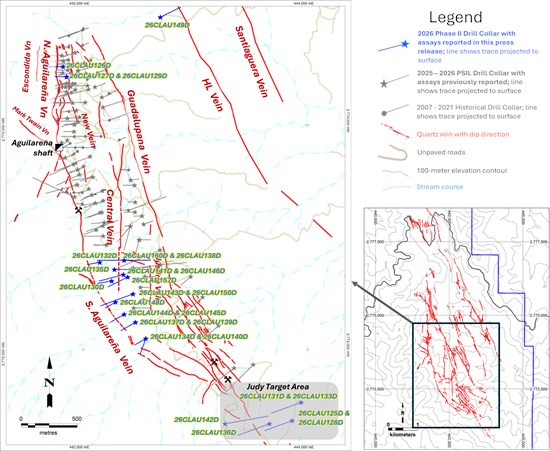
Figure 1 - Plan View Map Showing Locations of Drill Holes Reported in This Release
To view an enhanced version of this graphic, please visit:
https://images.newsfilecorp.com/files/10814/321382_551e277d8419c946_001full.jpg
Technical Discussion of Drill Results
Significant extension of high-grade mineralization at the Central Vein
The latest drilling has outlined an emerging high-grade shoot on the Central Vein. All widths reported in the following intercepts are estimated true widths unless otherwise noted. Hole 26CLAU150D, a step-out located approximately 500 m south of hole 25CLAU060D (see news from February 9, 2026), returned the highest gold grade and widest intercept on the vein to date, with 8.72 g/t Au and 49 g/t Ag (799 g/t AgEq) over 5.04 m, including 35.83 g/t Au and 159 g/t Ag (3,241 g/t AgEq) over 1.03 m, the highest gold grade over a width of 1 m or more drilled on the Project to date. Nearby holes 26CLAU135D and 26CLAU143D also intersected significant gold-silver mineralization. Hole 26CLAU135D was drilled from the footwall, and its intercept assayed 7.79 g/t Au and 163 g/t Ag (833 g/t AgEq) over 1.58 m, including 26.00 g/t Au and 166 g/t Ag (2,403 g/t AgEq) over 0.33 m. Hole 26CLAU143D intersected 1.46 g/t Au and 124 g/t Ag (250 g/t AgEq) over 1.66 m from 86.10 m. Full results are summarized in Table 1 and illustrated in Figure 2.
These results extend mineralization on the Central Vein to approximately 750 m of strike length and 100 m down-dip. Mineralization remains open in multiple directions, and follow-up drilling is underway.
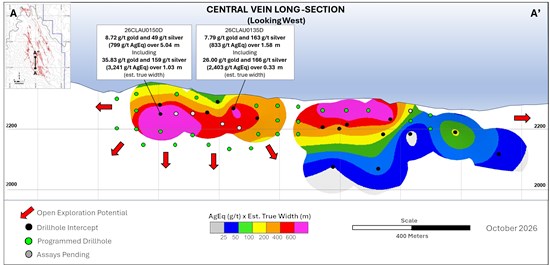
Figure 2 - Longitudinal Section Showing Recent Central Vein Drilling Results
To view an enhanced version of this graphic, please visit:
https://images.newsfilecorp.com/files/10814/321382_551e277d8419c946_002full.jpg
Before these results, drilling had intersected the Central Vein only at wide spacing, generally at modest grades. The best previous result was from hole 26CLAU079D, which intersected 1.71 g/t Au and 124 g/t Ag (271 g/t AgEq) over 2.70 m (drilled width) from 78.70 m, including 4.44 g/t Au and 324 g/t Ag (706 g/t AgEq) over 0.60 m (see news from April 14, 2026). That intercept confirmed the Central Vein as a prospective target warranting dedicated follow-up drilling. The emerging high-grade shoot outlined in the current release represents a substantial step-up in both grade and width from those earlier, more limited intersections.
The Central Vein strikes north-south and dips 48 to 70 degrees to the west. It lies between the Aguilareña and Guadalupana veins and is interpreted to have formed within a favourable transtensional dilational zone linking these structures.
The structure has been mapped and sampled over approximately 900 m on surface; however, the recent high-grade drilling results are from a portion of the vein that is partially covered by colluvium and poorly exposed. Combining surface mapping and recent drilling, the structure has now been traced for approximately 1.5 km.
Like other veins in the district, the Central Vein is an epithermal quartz breccia hosted in andesitic flows and breccias. Nearly all intercepts to date are relatively shallow and contain a mix of sulfide and oxide minerals. Estimated true widths of the 15 drill hole intercepts to date range from 0.56 to 5.04 m and average 2.13 m.
Extension of the Aguilareña Vein System to the South
Phase II drilling continues to extend the Aguilareña Vein to the south, where 14 recent drill holes have intersected the vein over approximately 700 m of strike length. This has increased the vein's mineralized footprint to approximately 2.7 km along strike and 225 m down-dip, up from nearly 2 km of strike length and approximately 200 m down-dip previously reported (see news from July 28, 2026). Assays are still pending for four completed drill holes from this area.
The best result received to date from the southern extension came from hole 26CLAU132D, which intersected 0.63 g/t Au and 35 g/t Ag (89 g/t AgEq) over 6.34 m (est. true width), including 1.55 g/t Au and 73 g/t Ag (206 g/t AgEq) over 1.86 m (est. true width) within a faulted quartz breccia.
While grades encountered in the southern extension are lower than those in the high-grade mineralized shoot north of the historical Aguilareña shaft, such as hole 26CLAU115D, which returned 8.00 g/t Au and 65 g/t Ag (754 g/t AgEq) over an estimated true width of 4.44 m (see news from July 28, 2026), the vein remains continuous and locally wide as it extends south. Assay results are summarized in Table 1 and illustrated in Figure 3.
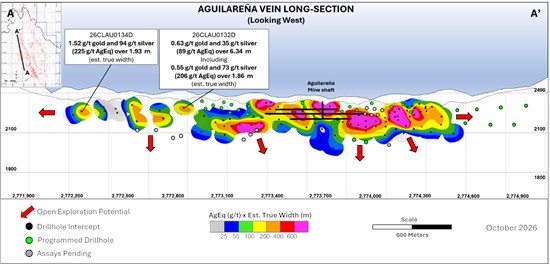
Figure 3 - Longitudinal Section Showing Recent Aguilareña Vein Drilling Results
To view an enhanced version of this graphic, please visit:
https://images.newsfilecorp.com/files/10814/321382_551e277d8419c946_003full.jpg
Judy Anomaly Target Area
The Judy target was generated by a 10-line, 31.65 line-km IP-resistivity geophysical survey completed late in the second quarter of 2026, the first geophysical survey conducted at Claudia (see news from July 6, 2026). The survey identified a large, near-surface, volcanic-rock-hosted chargeability anomaly in the southern portion of the property, referred to as the "Judy" anomaly. The anomaly extends approximately 600 m in a northeast-southwest direction, with its strongest response modelled at depths of approximately 75 to 150 m below surface.
Seven holes have been drilled at the target since drilling began in late June 2026. Most intersected multiple zones of silica- and sulfide-cemented breccia with visible fine-grained pyrite, along with narrower structures containing galena, sphalerite and chalcopyrite. As previously reported, the style of alteration and mineralization indicates a deeper position in the system relative to drilling to the north and west (see news from July 28, 2026).
Assay results have been received for six of the seven holes. The best result came from hole 26CLAU128D, which intersected 0.11 g/t Au and 52 g/t Ag (61 g/t AgEq) over 0.68 m (est. true width). Full assay results are summarized in Table 1.
While the initial drill results at the Judy anomaly returned modest grades, the widespread silica- and sulfide-cemented breccias are interpreted to indicate an extensive hydrothermal system. Several additional IP-resistivity anomalies in the Judy target area remain untested, and the Company is evaluating whether further drilling is warranted to better understand the system.
Additional Structures & Exploration Potential
Drilling to date at the Central Vein has tested only a limited portion of the structure, which remains open along strike and at depth. Based on the results of a recent district-scale structural geology study, north-south oriented structures are interpreted to be favourable for mineralization. Other north-south oriented vein targets occur on the Project, most notably the Justina Vein, which has been traced by drilling over 600 m of strike length and remains open along strike and at depth (see news from June 11, 2026). The Justina Vein will continue to be a focus of exploration.
At the Aguilareña Vein, exploration potential remains along strike, particularly to the north, where recent detailed mapping and sampling have extended the vein system, as well as at shallow levels between the top of known mineralization and the surface, and at depth. As previously reported (see news from July 28, 2026), vein textures and metal content indicate that the mineralization identified to date sits relatively high in the epithermal system. Drilling along the southern extension has so far tested the vein only at relatively shallow depths, and the Company considers this area a priority for follow-up drilling to test for potential higher-grade mineralization and feeder zones at depth. Drilling is currently underway to test the shallow, up-dip portions of the vein.
Several surface-mapped structures outside the main Aguilareña Vein also remain untested, and detailed surface mapping and sampling continue to prioritize these targets.
Quality Assurance/Quality Control
The 2026 drill samples reported here were collected from HQ-diameter core and were logged and sampled at the Pacifica Silver gated and enclosed facility in Santiago Papasquiaro, Durango. Sample lengths varied from 0.25 to 3.4 m, with an average length of 0.79 m. Pacifica Silver geologists marked the core lengthwise to best divide the core into halves, perpendicular to veins, mineralized fractures and vein-breccia. Sample intervals were cut in half lengthwise and one-half of each sample was placed into pre-numbered plastic sample bags with numbered sample tickets and closed with ties. The closed sample bags were placed into numbered shipping sacks along with numbered bags of coarse preparation blanks and certified reference material (CRMs or "standards") inserted with each hole for quality assurance/quality control purposes.
Until September 4th, samples were transported by commercial package delivery to the ALS preparation laboratory in Hermosillo Sonora. Afterwards samples were transported by commercial package delivery to the ALS preparation laboratory in Zacatecas City, Mexico. At the ALS preparation laboratories, the samples were crushed in their entirety to 70% passing 2 mm, and riffle split to 1-kg subsamples which were pulverized to 85% passing 75 µm. ALS then shipped 200 g splits of the pulverized material by air freight to the ALS assay laboratory in North Vancouver, Canada, for analysis. Gold was analyzed by 30 g fire-assay fusion with an Atomic Absorption (AA) finish (method code Au-AA23); samples with >10 g/t Au were re-assayed by fire-assay fusion and gravimetric finish. Silver plus 34 major, minor and trace elements were analyzed by ICP-AES following 4-acid digestion of 0.5 g aliquots (method code ME-ICP61). Samples that assayed greater than 100 g/t Ag were re-analyzed by ICP-AES following a 4-acid digestion (method code Ag-OG62). ALS holds accreditation under ISO/IEC 17025:2017 for specific analytical procedures and is independent of Pacifica Silver.
Qualified Person
Stephen Redak, CPG, Vice-President of Exploration for Pacifica Silver, is a Qualified Person for the purposes of National Instrument 43-101 and has reviewed and approved the technical content in this news release.
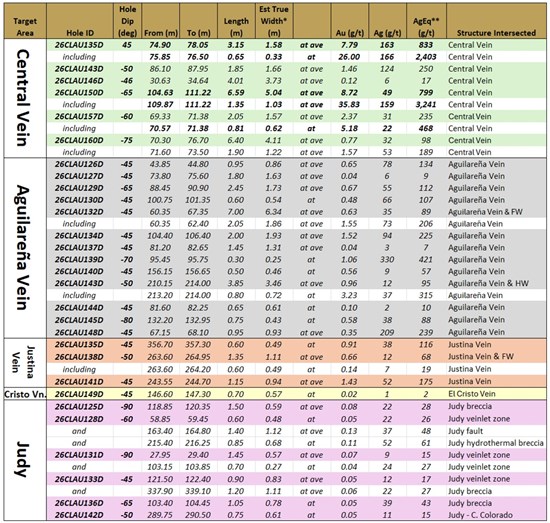
Table 1 - Significant Assay Results from the 27 Holes Reported in This Release
To view an enhanced version of this graphic, please visit:
https://images.newsfilecorp.com/files/10814/321382_pacificatable110282026.jpg
Assay results are listed by target area; drill holes that intersected more than one vein structure may appear under each relevant target area.
Composites calculated with Au minimum of 0.150 g/t (0.100 g/t Au if Ag > 30 g/t) and no more than 1.0 m of internal dilution.
*Estimated true widths of the reported drilled intervals vary from 39% to 98% with an average of 78%.
**Silver equivalent grade (AgEq) is calculated based on the following formula: AgEq (g/t) = Ag (g/t) + [Au (g/t) x (Au price / Ag price) x (Au recovery / Ag recovery)]. Metal prices for silver and gold are assumed to be US$30/oz and US$2,500/oz, respectively. At this stage, insufficient metallurgical test work has been completed to determine recoveries for silver and gold at the Claudia property. Accordingly, recoveries of 93% for silver and 96% for gold were applied, based on the five-year historical average production data reported from First Majestic Silver Corp.'s San Dimas mine. These values are considered reasonable proxies for anticipated recoveries at Claudia due to similarities in deposit style and the relative proximity of the two properties.
About Pacifica Silver Corp.
Pacifica Silver Corp. is a Canadian resource company led by a proven management team with decades of mining and exploration experience in Mexico. The Company is focused on its 100%-owned Claudia Silver-Gold Project located in Durango, Mexico. Spanning 11,876 hectares, the Project encompasses most of the historic El Papantón Mining District where at least nine small mines operated intermittently during the 20th century. Since 1990, sampling and drilling within the district have returned high-grade silver and gold intercepts across multiple vein systems, with only 10% of over 30 km of known veins having been drilled. Today, the Project is a prime target for modern exploration and holds exceptional potential for new high-grade discoveries.
Signed,
Todd Anthony
Chief Executive Officer
FOR FURTHER INFORMATION, PLEASE CONTACT:
Todd Anthony
Phone: 778-999-2627
E-mail: info@pacificasilver.com
Neither the CSE nor its Market Regulator (as that term is defined in the policies of the CSE) accepts responsibility for the adequacy or accuracy of this release.
Forward-Looking Information
This news release contains certain "forward-looking information" and "forward-looking statements" within the meaning of Canadian securities legislation as may be amended from time to time, including, without limitation, statements regarding the perceived merit of the Project, the timing of completion of the Phase II drill program, the planned maiden resource estimate in 2027, the receipt of pending assay results, planned follow-up drilling at the Central and Aguilareña Veins and the Judy target, potential quantity and/or grade of minerals and the potential size of the mineralized zones. Forward-looking statements are statements that are not historical facts which address events, results, outcomes or developments that the Company expects to occur. Forward-looking statements are based on the beliefs, estimates and opinions of the Company's management on the date the statements are made, and they involve a number of risks and uncertainties. Certain material assumptions regarding such forward-looking statements were made, including without limitation, assumptions regarding the price of gold and silver; the accuracy of mineral resource estimations; that there will be no material adverse change affecting the Company or its properties; that all required approvals will be obtained, including concession renewals and permitting; that political and legal developments will be consistent with current expectations; that currency and exchange rates will be consistent with current levels; and that there will be no significant disruptions affecting the Company or its properties. Consequently, there can be no assurances that such statements will prove to be accurate and actual results and future events could differ materially from those anticipated in such statements. Forward-looking statements involve significant known and unknown risks and uncertainties, which could cause actual results to differ materially from those anticipated. These risks include, but are not limited to: risks related to uncertainties inherent in the preparation of mineral resource estimates, including but not limited to changes to the cost assumptions, variations in quantity of mineralized material, grade or recovery rates, changes to geotechnical or hydrogeological considerations, failure of plant, equipment or processes, changes to availability of power or the power rates, ability to maintain social license, changes to interest or tax rates, changes in project parameters, delays and costs inherent to consulting and accommodating rights of local communities, environmental risks, title risks, including concession renewal, commodity price and exchange rate fluctuations, the ongoing war in Ukraine, delays in or failure to receive access agreements or amended permits, risks inherent in the estimation of mineral resources; and risks associated with executing the Company's objectives and strategies, including costs and expenses, as well as those risk factors discussed in the Company's most recently filed management's discussion and analysis, available on www.sedarplus.ca. Except as required by the securities disclosure laws and regulations applicable to the Company, the Company undertakes no obligation to update these forward-looking statements if management's beliefs, estimates or opinions, or other factors, should change.
*All silver equivalent grades (AgEq) expressed in this Press Release are calculated based on the following formula: AgEq (g/t) = Ag (g/t) + [Au (g/t) x (Au price / Ag price) x (Au recovery /Ag recovery)]. Metal prices for silver and gold are assumed to be US $30/oz and US $2,500/oz, respectively. At this stage, insufficient metallurgical test work has been completed to determine recoveries for silver and gold at the Claudia property. Accordingly, recoveries of 93% for silver and 96% for gold were applied, based on the five-year historical average production data reported from First Majestic Silver Corp.'s San Dimas mine. These values are considered reasonable proxies for anticipated recoveries at Claudia due to similarities in deposit style and the relative proximity of the two properties.

To view the source version of this press release, please visit https://www.newsfilecorp.com/release/321382