
The first quarter of Harju Elekter proved significantly more challenging than anticipated, and the results did not meet expectations. While the strong order book at the beginning of the year provided a basis for steady growth, several factors hindered the planned course of activities and affected the ability to fulfil orders within the agreed timeframes. The primary reason for the weak financial performance included disruptions in the supply chain - deliveries of various materials and components were delayed or postponed by manufacturers, which in turn caused the fulfilment of orders to shift into future periods. Although the order book remains substantial, rapid cost reduction is not possible without risking the ability to respond quickly enough to a subsequent increase in demand. Retaining competence, ensuring team readiness, and maintaining the capacity to react upon the arrival of the peak season are strategically critical for us.
As an additional external factor, the weakening of the Swedish krona (SEK) also affected the quarter - since a large portion of sales in the Swedish market takes place in local currency, the decline in the exchange rate had a strong negative impact on both operating and net profit. Currency fluctuations are not under our control, but their impact on the quarter was clearly felt.
We approach the year as a whole with moderate optimism but also with caution, as there are several signs of a potential new crisis in the air. The order books of both the Estonian and Swedish units are higher than average, and the volume of orders currently under tender provides a basis to assume that a significant portion of them will materialize as revenue during the current financial year. The majority of the results of these units, as well as those of the Finnish units, will manifest in the second and third quarters, when the delivery of substations to customers under framework agreements commences. At the same time, delays and the accumulation of semi-finished products on production floors create additional challenges for the use of production resources and storage. Inconsistent material flow disrupts planned work organisation, creates temporary downtime, and strains production space, which in turn makes resource management and production planning more complex than usual. Concurrently, the low sales of the Lithuanian unit and the resulting high level of idle production capacity remain a problem, pointing to market challenges and, unfortunately, the need for a more efficient organisation of sales activities.
Although there have been no cancellations of orders so far, caution can be sensed in the behavior of customers. What is certain, however, is that the now-customary long delivery times will soon be joined by price increases for materials and components. We have received initial signals and new price lists from suppliers regarding this. The pass-through of price increases to customers takes place predominantly through the indexing provided for in framework agreements, but due to the long ordering and production cycle, the positive effect on results will only reach the financial statements with a lead time of one to two quarters.
Geopolitical tensions in the Middle East affect the activities of Harju Elekter mainly indirectly through the global supply chain, logistics, and input prices. Instability in international transport channels extends delivery times and increases freight costs, which in turn causes delays in components and the postponement of projects. Consequently, the impact may manifest in the timing of revenue and in greater volatility of quarterly results. Additionally, the rise in the price of energy, metals, and other inputs may increase production costs. While we have the possibility to take changes in input prices into account in projects to a certain extent, the impact on profitability may not be direct or uniform.
Revenue and financial results
In the first quarter, Harju Elekter Group's consolidated revenue amounted to 35.1 (Q1 2025: 37.4) million euros, remaining 6.2% below the level of the same period last year. The change in revenue was primarily influenced by differences in the timing of project-based deliveries, a high comparison base from the previous year, and delivery postponements caused by supply chain disruptions, which were more extensive than usual during the period. The manufacturing segment continued to account for the dominant share of quarterly revenue, amounting to 32.4 (Q1 2025: 34.5) million euros, representing 92.3% of the Group's total revenue.
| Key indicators | | 3M | 3M | +/- | ||
| (EUR'000) | 2026 | 2025 | ||||
| Revenue | 35,113 | 37,427 | -6.2% | |||
| Gross profit | 5,533 | 5,667 | -2.4% | |||
| EBITDA | 1,641 | 3,866 | -57.6% | |||
| Operating profit (EBIT) | 477 | 2,795 | -82.9% | |||
| Profit for the period | 19 | 2,636 | -99.3% | |||
| Earnings per share (EPS) (euros) | 0.00 | 0.14 | -100.0% |
The Group's operating expenses amounted to 34.5 (Q1 2025: 35.6) million euros in the first quarter of 2026, decreasing by 3.3% year on year. The decline in expenses was primarily driven by lower costs of goods and services sold, while expenditures incurred to support operating volumes and market activity were reflected in higher distribution and administrative expenses. Overall, the cost structure remained broadly unchanged, with production-related costs continuing to account for the largest share of operating expenses.
Distribution costs amounted to 1.9 (Q1 2025: 1.3) million euros, increasing by 45.2%, mainly due to higher volumes of marketing and sales services to support sales and market activity. This included participation in international trade fairs to strengthen the Group's visibility in its target markets and to present developments related to the low-voltage switchgear product group HECON EVO and the electric vehicle charger Elektra Sense. Consequently, the distribution costs ratio increased to 5.3% (Q1 2025: 3.4%) of revenue. Administrative expenses totalled 3.0 (Q1 2025: 2.6) million euros, increasing by 16.6%, and the administrative expense ratio rose to 8.6% of revenue (Q1 2025: 6.9%).
Depreciation and amortisation of non-current assets amounted to 1.2 (Q1 2025: 1.1) million euros within operating expenses. Total labour costs amounted to 10.5 (Q1 2025: 9.5) million euros, and the labour cost ratio increased to 30.0% of revenue (Q1 2025: 25.5%), reflecting the impact of salary adjustments and performance-based bonuses.
Despite lower sales volumes, the cost base remained stable, and gross profit decreased moderately by 2.4% to 5.5 (Q1 2025: 5.7) million euros. Operating profit (EBIT) amounted to 0.5 (Q1 2025: 2.8) million euros and business profitability 1.4% (Q1 2025: 7,5%). Net profit for the period amounted to 19 (Q1 2025: 2.6 million) thousand euros, and earnings per share were 0.00 (Q1 2025: 0.14) euros.
Core business and markets
The Group's revenue by markets in the first quarter of 2026 was primarily supported by sales growth in the Nordic target markets, while sales declined year on year in certain project-based Central European markets. Sweden and Estonia contributing the largest increases in revenue. In Sweden, revenue increased to 6.3 (Q1 2025: 4.9) million euros, up by 28.4%, supported by the execution of several larger projects and increasing demand for substations as investments in electricity networks have begun to recover. In the Estonian market, revenue grew to 5.6 (Q1 2025: 4.8) million euros, an increase of 16.2%, driven mainly by orders related to distribution networks and stable demand across the Group's core product groups.
In the Group's largest target market, Finland, revenue amounted to 13.1 (Q1 2025: 12.9) million euros. Finland accounted for 37.4% of the Group's quarterly revenue, and the moderate year on year increase in sales was supported by stable deliveries, primarily of compact substations and low voltage switchgears.
Sales declined year on year in the Norwegian and German markets. In Norway, revenue amounted to 4.2 (Q1 2025: 6.9) million euros, while in Germany revenue decreased to 1.1 (Q1 2025: 6.5) million euros. In both markets, the decline was mainly related to a high comparison base from the previous year, shifts in the timing of large projects, and the project-based nature of sales.
In other markets, revenue developments in the first quarter of 2026 were primarily influenced by the addition of new markets and higher sales volumes compared to the same period last year. Notable sales were recorded in Denmark, where revenue amounted to 2.2 (Q1 2025: 0.0) million euros, and in Belgium, where revenue increased to 0.6 (Q1 2025: 0.0) million euros. In both cases, sales were related to one-off project-based deliveries. Revenue also increased in the Netherlands, rising to 1.2 (Q1 2025: 0.8) million euros.
Investments
During the reporting period, the Group invested a total of 1.7 (Q1 2025: 0.8) million euros in non-current assets, including 0.02 (Q1 2025: 0.1) million euros in investment properties, 1.3 (Q1 2025: 0.3) million euros in property, plant, and equipment, and 0.4 (Q1 2025: 0.4) million euros in intangible assets.
The majority of investments in property, plant, and equipment were related to the expansion of the Estonian subsidiary's production facilities, where construction of the new production building at the Keila continued. The modern production facility with a total area of 4,000 m², scheduled for completion in October this year, will increase the Group's total production space to 28,000 m² and create additional high value-added engineering and manufacturing jobs. In addition, investments included the acquisition of production technology equipment to support growth in production volumes and operational efficiency.
Investments in intangible assets were mainly related to development activities, including the development of the new-generation electric vehicle charger Elektra, as well as the enhancement of the Group's digital solutions, including website development.
As of the reporting date, the carrying amount of long-term financial investments totalled 27.2 (31.12.2025: 27.2) million euros.
Share
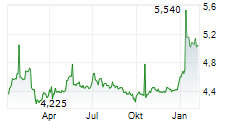
The company's share price on the last trading day of the reporting quarter on the Nasdaq Tallinn Stock Exchange closed at 5.60 euros.
CONSOLIDATED STATEMENT OF FINANCIAL POSITION
| (EUR'000) | 31.03.2026 | 31.12.2025 | |
| ASSETS | |||
| Current assets | |||
| Cash and cash equivalents | 1,834 | 1,545 | |
| Trade and other receivables | 34,111 | 46,654 | |
| Prepayments | 2,115 | 1,209 | |
| Inventories | 22,447 | 19,896 | |
| Total current assets | 60,507 | 69,304 | |
| Non-current assets | |||
| Deferred income tax assets | 137 | 142 | |
| Non-current financial investments | 27,227 | 27,225 | |
| Non-curren receivables | 2 | 9 | |
| Investment properties | 27,856 | 28,228 | |
| Property, plant, and equipment | 33,799 | 33,273 | |
| Intangible assets | 10,139 | 9,880 | |
| Total non-current assets | 99,160 | 98,757 | |
| TOTAL ASSETS | 159,667 | 168,061 | |
| LIABILITIES AND EQUITY | |||
| Liabilities | |||
| Borrowings | 13,477 | 15,452 | |
| Prepayments from customers | 5,815 | 15,326 | |
| Trade and other payables | 22,332 | 19,670 | |
| Tax liabilities | 3,330 | 3,324 | |
| Current provisions | 290 | 336 | |
| Total current liabilities | 45,244 | 54,108 | |
| Borrowings | 15,072 | 15,072 | |
| Other non-current liabilities | 20 | 20 | |
| Total non-current liabilities | 15,092 | 15,092 | |
| Total liabilities | 60,336 | 69,200 | |
| Equity | |||
| Share capital | 11,706 | 11,672 | |
| Share premium | 3,619 | 3,410 | |
| Reserves | 22,532 | 22,397 | |
| Retained earnings | 61,474 | 61,382 | |
| Total equity attributable to the owners of the parent company | 99,331 | 98,861 | |
| TOTAL LIABILITIES AND EQUITY | 159,667 | 168,061 |
CONSOLIDATED STATEMENT OF PROFIT AND LOSS
| (EUR'000) | |||||
| 3M 2026 | 3M 2025 | ||||
| Revenue | 35,113 | 37,427 | |||
| Cost of sales | -29,580 | -31,760 | |||
| Gross profit | 5,533 | 5,667 | |||
| Distribution costs | -1,866 | -1,285 | |||
| Administrative expenses | -3,008 | -2,580 | |||
| Other income | 85 | 1,024 | |||
| Other expenses | -267 | -31 | |||
| Operating profit | 477 | 2,795 | |||
| Finance income | 65 | 633 | |||
| Finance costs | -531 | -284 | |||
| Profit before tax | 11 | 3,144 | |||
| Income tax | 8 | -508 | |||
| Profit for the period | 19 | 2,636 | |||
| Earnings per share | |||||
| Basic earnings per share (euros) | 0.00 | 0.14 | |||
| Diluted earnings per share (euros) | 0.00 | 0.14 | |||
CONSOLIDATED STATEMENT OF COMPREHENSIVE INCOME
| (EUR'000) | 3M 2026 | 3M 2025 | |
| Profit for the period | 19 | 2,636 | |
| Other comprehensive income | |||
| Items that may be reclassified to profit or loss | |||
| Impact of exchange rate changes of a foreign subsidiaries | 205 | -588 | |
| Items that will not be reclassified to profit or loss | |||
| Revaluation of financial assets | 3 | -5 | |
| Total comprehensive income (-loss) for the period | 208 | -593 | |
| Other comprehensive income | 227 | 2,043 |
Priit Treial
Member of the Management Board/CFO
+372 674 7400
priit.treial@harjuelekter.com

