

New research finds nearly two-thirds of organizations remain in the early stages of resilience maturity as gaps between intelligence, response, and continuous improvement limit progress
Everbridge, the global leader in High Velocity Critical Event Management (CEM) and national public warning solutions, today announced the findings of its 2026 Best in Resilience Study, revealing a significant gap between organizations' ability to respond to disruption and their overall resilience maturity.
This press release features multimedia. View the full release here: https://www.businesswire.com/news/home/20260908740849/en/
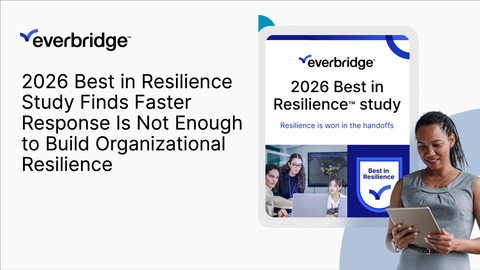
Based on 203 Best in Resilience assessment responses, the study found an average overall resilience maturity score of 56 out of 100. Nearly two-thirds (61.6%) of responses remain at the Ad Hoc or Reactive stages of maturity, while just 8.9% reach Proactive or Dynamically Adaptive maturity.
The findings point to a growing integration gap. While organizations continue to invest in risk intelligence, response plans, communications and reporting, many struggle to connect those capabilities into a unified operating model that turns information into decisions, decisions into coordinated action, and each event into measurable learning.
"Organizations have made real progress in their ability to respond quickly, but speed alone does not create resilience," said Pamela Larson, Chief Security Officer, Everbridge. "The next leap forward will come from connecting intelligence, people, plans, workflows and learning so they operate as one system. Organizations that can shorten those 'handoffs' will be better positioned to understand impact earlier, coordinate action faster, and continuously strengthen how they respond to the next disruption."
The study compares assessment results across three stages of the resilience cycle: Know Earlier, Respond Faster, and Improve Continuously. While response execution increased 1.5 percentage points in the 2026 results, earlier awareness declined 2.9 points and continuous improvement fell 1.9 points. Overall maturity declined 1.3 points.
The research also identifies where some of the greatest operational friction remains. Initiating a standard operating procedure (SOP) when a critical event occurs received an average score of just 38 out of 100, the lowest-scoring operational question. Other challenges include activating the closest and most capable response team, using metrics to improve future responses, locating responders, and identifying impacted stakeholders.
Together, the findings suggest that the next resilience advantage will come not simply from adding more capabilities, but from better orchestrating the capabilities organizations already have.
Connecting Intelligence to Action
The 2026 study highlights how Best in Resilience certified organizations are addressing these challenges by connecting risk intelligence, organizational data, workflows, communications, and response.
Santander US, for example, uses Everbridge to help manage risk across more than 14,000 employees and 600 assets. By filtering incoming risk information against organizational exposure, Santander reduced approximately 2,000 incoming notifications over a 24-hour period to roughly 100 alerts requiring acknowledgement and triage, a 95% reduction.
"With the Response Management module, we're able to quickly assess the situation, activate the appropriate plan, and ensure the right actions are being taken," said Jay Sartori, VP Associate Director, Corporate Security, Santander.
Johnson Controls has similarly created a more unified operating picture across approximately 1,600 offices in 150 countries and more than 100,000 employees, combining organized asset data, automated threat alerts, and structured communications.
"Everbridge filled a giant gap that we had. It allowed our GSOC to focus on more than the most severe critical events," said Brad Abelt, GSOC and Security Operations Manager, Johnson Controls International.
Building Dynamically Adaptive Resilience
The study concludes that organizations can strengthen resilience by better connecting what happens before, during, and after a critical event. It identifies five priorities for leaders and provides industry and organization-size benchmarks for comparing resilience maturity.
Beyond benchmarking resilience maturity, the 2026 Best in Resilience Study provides practical guidance for organizations at each stage of maturity, including a 90-day framework for identifying high-friction handoffs, redesigning critical workflows, and measuring improvement.
Download the Everbridge 2026 Best in Resilience Study to explore the findings and assess your organization's resilience maturity.
About Everbridge
Everbridge helps more than 6,500 enterprises and government organizations manage critical events by enabling them to know earlier, respond faster, and improve continuously. Through an all-in-one AI-powered platform, Everbridge High Velocity CEM is autonomous when you want it to be and human-guided when you need it to be, so every incident response is optimized. For more information, visit everbridge.com and follow us on LinkedIn.
View source version on businesswire.com: https://www.businesswire.com/news/home/20260908740849/en/
Contacts:
Everbridge Contact:
Jim Gatta
Media Relations
jim.gatta@everbridge.com
215-290-3799
