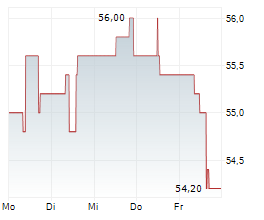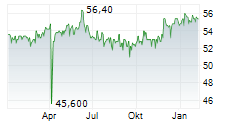
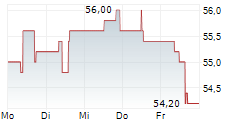
A mixed set of developments shapes the near-term picture for Flughafen Wien. The Iran conflict adds uncertainty around passenger growth in 2026, although the direct impact appears manageable at this stage. Preliminary Q4 figures came in broadly in line with expectations (see p.2) and do not indicate a change in underlying trends. Finally, the dividend proposal and outlook are more conservative than we had expected, reflecting a cautious capital allocation stance.
The current Middle East airspace disruptions are a near-term headwind. For Vienna, the region is expected to account for roughly 6% of passenger movements in FY'26e (Malta: c. 1%). To frame the downside, we run a conservative sensitivity assuming a full four-week disruption: this would reduce FY group EBITDA by around 1%, i.e. c. € 4m (exclusively eNuW). We therefore keep estimates unchanged for now. The impact should be cushioned by partial and phased normalisation at key hubs, capacity redeployment to other routes, and a limited seasonality impact as it coincides with Ramadan (ending March 19).
Overall, these near-term uncertainties do not change the company's long-term ambition of 40m passengers annually at Vienna by 2035 (CAGR: 2.1% 2025-35 or 3.2% 2026-35). Following the expected dip in 2026e, passenger growth is expected to resume from 2027e, supported by the ongoing expansion programme, including the Terminal 3 Southern Expansion (opening 2027) and follow-on infrastructure additions. Group capex is guided at € 330m for 2026e, keeping investment levels structurally elevated. Funding looks manageable given solid operating cash flow (€ 333m in 2025) and a strong balance sheet (net cash: € 414m).
The proposed dividend is € 1.65 p.shr., implying c. 3% yield, and setting a more conservative payout baseline than we had assumed (eNuW: € 3.00). While a higher payout would be financially feasible following the cancellation of the third runway project, a step-up look difficult to justify alongside an ongoing restructuring programme and political sensitivity around aviation ticket taxes. Looking ahead, current investment plans are expected to absorb the net cash position by 2029e (assuming a stable 60-75% dividend payout ratio), effectively defining the capital return level the company is willing to commit to.
In sum, Flughafen Wien remains a high-quality infrastructure case on a secular growth trajectory. Nonetheless, operating momentum is seen to weaken in 2026, as guided and expected by consensus, with low-cost carriers set to partially reschedule their limited fleet capacity to lower-tax countries. Uncertainty from the Middle East conflict might further weigh on sentiment. Hence, we remain at HOLD, unchanged PT of € 57, based on DCF.
ISIN: AT00000VIE62