Off the Texas coast, artificial RGV Reef is 'capturing or trapping CO2 . . . in some significant proportions,' says UTRGV research lead with Enbridge-funded study
NORTHAMPTON, MA / ACCESSWIRE / January 10, 2024 / Enbridge
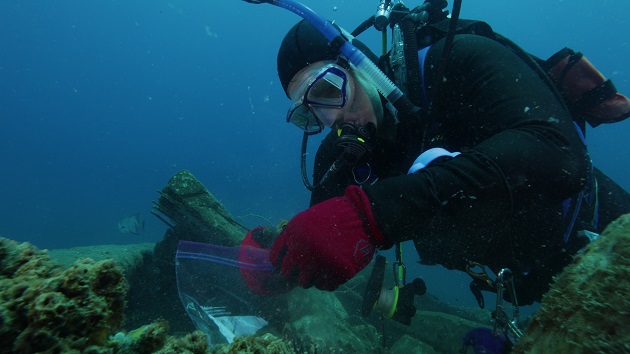
A researcher bags samples from the RGV Reef to be studied in the UTRGV lab.
There's the proverbial knowledge sponge. On the flipside, there's the dreaded fun sponge.
In this case, off the Texas coast, researchers believe they may be dealing with an environmental game-changer-the invaluable carbon sponge.
In October 2022, work began on a groundbreaking carbon sequestration study on the RGV Reef, a 1,650-acre artificial reef off South Padre Island in the Gulf of Mexico. The project is being managed by the Friends of RGV Reef, a non-profit group that created the reef in 2017, and University of Texas Rio Grande Valley (UTRGV) researchers, and funded through a $250,000 Fueling Futures grant from Enbridge.
At the outset, it was hoped that the study could provide a seminal moment in the battle against climate change. And at the project's midway point, the UTRGV researchers are seeing promising results.
"The early data that we are seeing is delivering some encouraging results. The sponges and soft corals that cover the reef do contain high amounts of carbon," says Dr. Richard Kline, Ph.D., Professor, School of Earth, Environmental, and Marine Sciences at UTRGV, whose team is leading the research.
"We suspected that reefs, man-made or natural, could sequester or capture carbon. Now, initial data shows that the reef's structure, the bottom or sediment, and the biomass, fish and other marine life in the water column, is indeed capturing or trapping CO2, a known greenhouse gas, in some significant proportions."
Since its creation, the RGV Reef has already brought back substantial populations of fish and attracted growing numbers of other sea life. The majority of the artificial reef consists of cleansed, intentionally sunken vessels, concrete rail ties, and cinder blocks.
"UTRGV's research is the most comprehensive study in the world to determine the ability of artificial reefs to capture or trap carbon-and maybe provide a solution in dealing with our real-life climate challenges," says Gary Glick, President of the Friends of RGV Reef.
"If reefs prove to be a major force or a way to capture carbon, then this research could benefit every country in the world that has a coastline," he adds. "As human beings, we need to look at all the ways we can reduce emissions and capture greenhouse gases. Reefs may be an important tool in our bigger toolbox that we can use to help us achieve a cleaner and brighter future."
After refining the data collection process, with supporting lab analysis, the study now enters its final 12-month phase.
"The study is driven by the data we're collecting. At the end of the study, we will publish our findings for the world to see," says Dr. Kline. "We'll be able to know definitively if reefs have the ability to capture carbon in enough concentrations to have a significant impact."
View additional multimedia and more ESG storytelling from Enbridge on 3blmedia.com.
Contact Info:
Spokesperson: Enbridge
Website: https://www.3blmedia.com/profiles/enbridge
Email: info@3blmedia.com
SOURCE: Enbridge
View the original press release on accesswire.com