Legacy coronavirus biochemistry was overlooked that governs spike protein toxicity, key morbidities, risk factors and therapeutic responses
SALT LAKE CITY, April 22, 2024 /PRNewswire/ -- TrialSite News features a paper published today in Viruses (Basel), authored by an international team of researchers, including two fellows of their nations' academies of sciences (Colleen Aldous, senior author Wendy Hoy) and others who participated in Nobel prize-honored research (Thomas Borody, Morimasa Yagisawa). The publication reveals how coronavirus biochemistry well-established over past decades governs the morbidities of COVID-19, risk factors and therapeutic approaches.
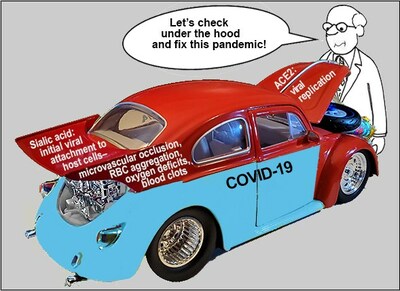
The glycan monomer sialic acid, ubiquitous on eukaryotic cell surfaces, serves as the initial attachment point to host cells for the COVID-19 virus-SARS-CoV-2-as well as for other coronaviruses. The virus can then slide over to ACE2 for cell entry. SARS-CoV-2 spike protein attaches particularly tightly to the dense sialic acid coatings on the trillions of red blood cells (RBCs), platelets and endothelial cells in the human adult. These interlaced attachments trigger the RBC aggregation, microvascular occlusion and vascular damage underlying the oxygen deficits, blood clotting and related morbidities of severe COVID-19.
In the genetics-centric research environment of recent decades, however, most COVID-19 research ignored this older, well-established biochemistry, focusing instead on SARS-CoV-2 replication and its replication receptor, ACE2. Yet the typical human cell is coated with at most a few hundred ACE2 molecules vs. millions of virally-binding sialic acid molecules. This misdirected focus led to oversights of significant consequence, as detailed in the Viruses paper.
More broadly, disregard for the active physiological role of RBCs yields unreliable or erroneous reporting of pharmacokinetic parameters as routinely obtained for most drugs and other bioactive agents using detection in plasma, with whole blood levels being up to 30-fold higher.
Substantiation of the importance of this glycan biochemistry for COVID-19:
- RBC aggregation as experimentally induced in several animal species using an injected polysaccharide caused most of the same morbidities of severe COVID-19.
- Three major risk factors for COVID-19 mortality-older age, diabetes and obesity-are each associated with significantly increased RBC aggregation and microvascular occlusion.
- Three generic drugs that gleaned most interest as COVID-19 therapeutics each reduce blood cell aggregation-one disaggregated virally induced RBC clumps in vitro within 30 minutes.
- For mammalian species, clinical susceptibility to COVID-19 correlates to RBC aggregability (p=0.03).
- The two human betacoronaviruses that express a sialic acid-cleaving enzyme, hemagglutinin esterase, are benign, while the other three-SARS, SARS-CoV-2, and MERS-are virulent.
As detailed in the newly published paper, this glycan biochemistry is also key to disentangling controversies that have arisen over the efficacy of certain generic COVID-19 treatment agents, one of which competitively binds to several sites on SARS-CoV-2 spike protein, and the safety of spike protein-based COVID-19 vaccines.
The paper further considers how an appreciation of the related active physiological role of RBCs, the most abundant cells in the human body, can elucidate the microvascular underpinnings of other health conditions, including cardiovascular disease, and therapeutic opportunities to address them.
Contact: David Scheim, corresponding author - dscheim@alum.mit.edu
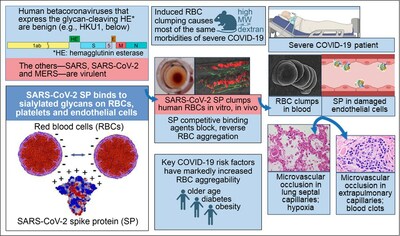

Photo - https://mma.prnewswire.com/media/2392947/TrialSite_News_1.jpg
Photo - https://mma.prnewswire.com/media/2392946/TrialSite_News_2.jpg
Logo - https://mma.prnewswire.com/media/2392207/TSN_Logo.jpg
 View original content:https://www.prnewswire.co.uk/news-releases/landmark-new-publication-the-forgotten-biochemistry-101-of-covid19-302123251.html