WASHINGTON, D.C. / ACCESS Newswire / August 8, 2025 / A press release issued yesterday by the Chesapeake Bay Foundation (CBF) continues a multi-year pattern of gross dishonesty, as it presented an incomplete and misleading narrative regarding menhaden management in the Chesapeake Bay. CBF's misleading release includes a statement from Virginia Executive Director Chris Moore that ignores and disparages the established science, and the regulatory framework that ensures the fishery remains sustainable and responsibly managed.
In response, Ocean Harvesters has issued the following:
The CBF release refers to "growing warning signs around the Chesapeake Bay":
"There are clear signs of peril in the Chesapeake, and menhaden are one of the connecting threads."
This claim is not supported by any independent, peer-reviewed science, but rather represents the biased opinion of a special interest group. The assertion that "there are clear signs of peril in the Chesapeake, and menhaden are one of the connecting threads" overstates both the available scientific evidence and the known ecological dynamics of the Bay. While ecosystem concerns merit monitoring, attributing broad Chesapeake Bay challenges to already conservative menhaden harvest regulations is not supported by the best available science.
In 2024, the U.S. Geological Survey (USGS) presented data to the ASMFC on osprey populations which showed osprey reproduction challenges and nest failures occurring on both the Atlantic and Pacific Coast, including many areas with no menhaden fishery at all. In a letter to Congress earlier this year, USGS said it found no direct link between regulated menhaden harvests and declining osprey populations. The federal agency emphasized that multiple, complex factors, including weather, predation and prey access, contribute to ecological trends in the Bay.
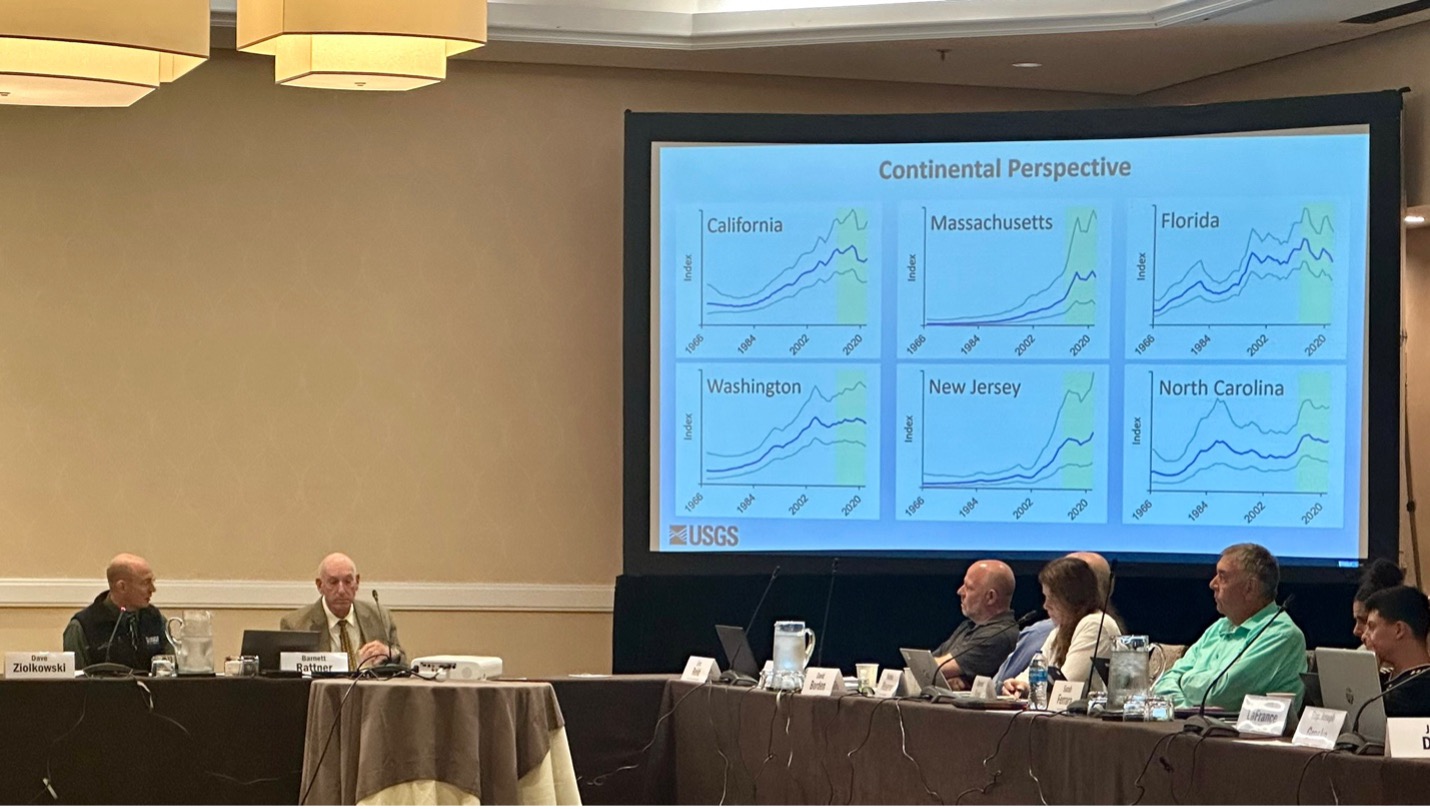
Scientists from the U.S. Geological Survey present a slide to the ASMFC showing that the recent leveling-off in Maryland and Virginia osprey populations, after years of explosive growth, is a phenomenon also being seen in states across the nation, on both the East and West Coast.
The statement includes: "This new timing of intense fishing pressure may be contributing to the problems facing the Chesapeake Bay."
Any adjustment in the timing of Bay fishing is minor and reflects natural shifts in the seasonal population dynamics of menhaden, not a quantifiable increase in harvest pressure or ecological harm. No scientific evidence has established any link between this timing shift and the broad ecological challenges described in the release.
While the press release references anecdotal concerns from Maryland fishers, it omits mention of well-documented water quality issues in Maryland that may also explain the localized fishery observations cited.
Another claim in the statement reads: "One foreign-owned company consistently prevents progress in Virginia, and now coastwide at the ASMFC."
This statement is inaccurate. Omega Protein is a Virginia-based processing company, and the menhaden are harvested by Ocean Harvesters, a separate American-owned and operated company whose crews are overwhelmingly local, unionized, and multi-generational, represented by UFCW Local 400, AFL-CIO. This domestic fleet works in full compliance with harvest controls, vessel reporting, and ecosystem-based management thresholds set by the ASMFC. CBF is clearly attempting to mislead the audience with distorted information and is crossing a very serious ethical line of misinformation that merits further scrutiny.
CBF's repeated implication that the industry has obstructed scientific research misrepresents the actual facts. Ocean Harvesters supported a comprehensive ecosystem study of the menhaden fishery developed by the Atlantic States Marine Fisheries Commission (ASMFC) in 2021. However, the proposal that later emerged in the Virginia General Assembly used a lower cost, novel methodology that had not undergone scientific peer review. The industry raised legitimate concerns-not about research itself, but about relying on an untested approach for such a politically charged issue. CBF has repeatedly and inaccurately characterized this as blanket opposition to science. In fact, the industry continues to support the original, science-based study design developed by ASMFC, and no menhaden research could be conducted without longstanding industry cooperation.
The statement concludes: "The Chesapeake's fisheries and predators can't wait. Menhaden are key to a thriving Chesapeake Bay, and a healthy, productive Chesapeake is vital to the entire Atlantic coast."
There is simply no Chesapeake Bay crisis that would threaten fisheries or predators. The menhaden fishery is already one of the most scientifically scrutinized in the United States.
The menhaden fishery is currently:
Not overfished, and overfishing is not occurring, as confirmed by repeated stock assessments.
Certified sustainable by the Marine Stewardship Council (MSC)
Governed by ecosystem reference points that account for predator-prey relationships
Subject to real-time reporting, seasonal harvest caps, and rigorous monitoring under ASMFC's management plan
Here is the true threat: CBF's statements add up to nothing more than scare tactics that threatens the livelihood of hundreds of blue collar, multi-generational employees, many of whom are minority and UFCW Local 400 union workers, in Virginia's Northern Neck.
About Ocean Harvesters
Ocean Harvesters owns and operates a fleet of more than 30 fishing vessels in the Atlantic Ocean and Gulf of Mexico. The company's purse-seine fishing operation is exclusively engaged in the harvest of menhaden, a small, nutrient-dense fish used to produce fish meal, fish oil, and fish solubles. Both its Atlantic and Gulf Menhaden fisheries are certified sustainable by the Marine Stewardship Council. Committed to responsible fishing operations, Ocean Harvesters is proud to be heir to a fishing legacy that extends nearly 150 years.
Press Contact
Stove Boat Communications
(202) 595-1212
contact@stoveboat.com
SOURCE: Ocean Harvesters
View the original press release on ACCESS Newswire:
https://www.accessnewswire.com/newsroom/en/industrial-and-manufacturing/ocean-harvesters-responds-to-chesapeake-bay-foundation%e2%80%99s-august-7-pres-1058601