
NEW YORK, NY / ACCESS Newswire / October 10, 2025 / Farming in Syria's Crumbled Food System
Ibrahim, a 45-year-old farmer and livestock keeper, is a father of four living in a village in Aleppo Governorate. Like many others in his community, he has faced huge challenges due to the prolonged conflict in Syria.
Syria once had a strong agricultural sector and was a net agricultural exporter, but over the course of 14 years of conflict, its food systems have crumbled. The cost of war-related damages was already estimated to be $16 billion by the Food and Agriculture Organization after just 6 years of conflict. Now, farmers are struggling to meet their own families' nutritional needs, let alone provide enough food for the country or beyond.
"After several years of conflict in Syria, we have lost many of the assets we once relied on for our livelihood," says Ibrahim. "We are also struggling to afford the agricultural inputs needed to resume our activities as before, such as fertilizers, seeds, and fodder [animal feed]. This has forced us to sell some of our sheep and leave a large portion of our farmland uncultivated."
Those challenges have led to thousands of farmers leaving their lands, either to escape the conflict itself or because maintenance costs have become too much to bear. With less farmers, food availability has shrunk and the price of what is available has skyrocketed, leaving families struggling to access basic food items. The Food Security Cluster projects that 9.1 million people in Syria will face food insecurity this year, the sixth most food-insecure country globally.
Altogether, the agricultural sector has suffered immensely in the last 14 years. Left without the tools, resources, or networks that they once relied on, farmers - and everyone who is part of Syria's food system - face a daunting future.
The Silent Spread of Giant Reed
While farmers have been forced away from their fields or too resource-constrained to adequately respond, an invasive species called Giant reed has been able to spread like wildfire. Scientists say that invasive species are one of the greatest threats to biodiversity, and Giant reed could have long-term impacts on harvests in the region. It grows extremely quickly, and native plant species have difficulty competing. The subsequent damage to pollinator populations and the local ecosystem has badly impacted growing conditions.
"Additionally, the spread of invasive plants has blocked agricultural drainage and increased soil salinity, rendering the land unusable," Ibrahim shared. Giant reed grows best near water and has damaged essential irrigation infrastructure on many Syrian farmers' lands. Unable to control the flow of water in their lands, farmers have suffered severe impacts on soil health, leading to weaker crop yields and worsening food insecurity.
The spread of invasive Giant reed in Syria shows how one shock, like conflict, creates a ripple effect of problems that fuel hunger. Food systems are fragile. They rely on a complex set of factors that enable food to get from farm to fork. Once that system is damaged, it is difficult to rebuild.
A Pathway Toward Renewal
Action Against Hunger launched a program to support farmers in Ibrahim's village. Three main goals were identified for the intervention:
Fix the broken irrigation system
Decrease agricultural input costs
Build a sustainable, community-owned approach to addressing long-term challenges
The first goal was straightforward. Action Against Hunger staff worked alongside community members to clear agricultural drainage channels that had been clogged by an overgrowth of Giant reed. That way, water could start flowing again, and salinized soil could be replenished.
Decreasing agricultural input costs required a creative solution. Surprisingly, that solution was found in the Giant reed plant. Instead of throwing away uprooted Giant reed, Action Against Hunger realized it could be repurposed into essential inputs like silage, compost, and fodder cubes. Since Giant reed grows freely and abundantly, it offers a consistent, low-cost supply of resources. The solution controls the growth of Giant reed and transforms it into a valuable asset for farmers.
Action Against Hunger established Farm Field Schools (FFS) with funding from the Syria Humanitarian Fund to teach local farmers about innovative, sustainable approaches to their agricultural challenges. "My home became a learning hub where our FFS sessions were conducted," Ibrahim recounted.
Farmers were provided with specialized equipment like grinders and presses to help process the Giant reed plants efficiently. "These tools will enable us to reduce fodder and fertilizer costs while ensuring access to organic, clean products," explains Ibrahim. "With the grinder, we shredded about 12 tons of Giant reed, producing more than 4 tons of silage and over 6 cubic meters of compost."
Ibrahim was invigorated to keep learning after the success of his first FFS course. He participated in four additional schools held near his village, gaining additional skills in agroecology.
By equipping farmers with tools and knowledge, Action Against Hunger ensured that solutions were not just immediate, but sustainable. The community-led nature of FFS means farmers like Ibrahim are taking the lead on their recovery. They have reduced dependency on external aid and can continue income-generation independently. In this way, our third goal was realized, and the foundation for a long-term, community-owned approach was firmly established.
Farmers are now sharing skills, implementing agroecological methods, and envisioning new opportunities. For example, Ibrahim and several other local farmers are considering launching a large-scale project to produce and sell silage.
Ripple Effects of Recovery in Syria's Food System
Building sustainable food systems after conflict is laborious, slow work. According to the United Nations Development Programme's impact report, Syria's economy will take 55 years to restore pre-conflict GDP levels at current growth rates - but with support, it can go much faster. Because in the same way that conflict can create a ripple effect of damage, a supportive intervention like a Farm Field School can launch a chain reaction of improvement. Ambitious farmers like Ibrahim are up for the challenge.
"We are deeply grateful for the knowledge and equipment provided to us. This project has given us a renewed sense of hope and stability, and we are excited to turn these challenges into opportunities," Ibrahim said.
***
Action Against Hunger leads the global movement to end hunger. We innovate solutions, advocate for change, and reach 26.5 million people every year with proven hunger prevention and treatment programs. As a nonprofit that works across over 55 countries, our 8,500+ dedicated staff members partner with communities to address the root causes of hunger, including climate change, conflict, inequity, and emergencies. We strive to create a world free from hunger, for everyone, for good.
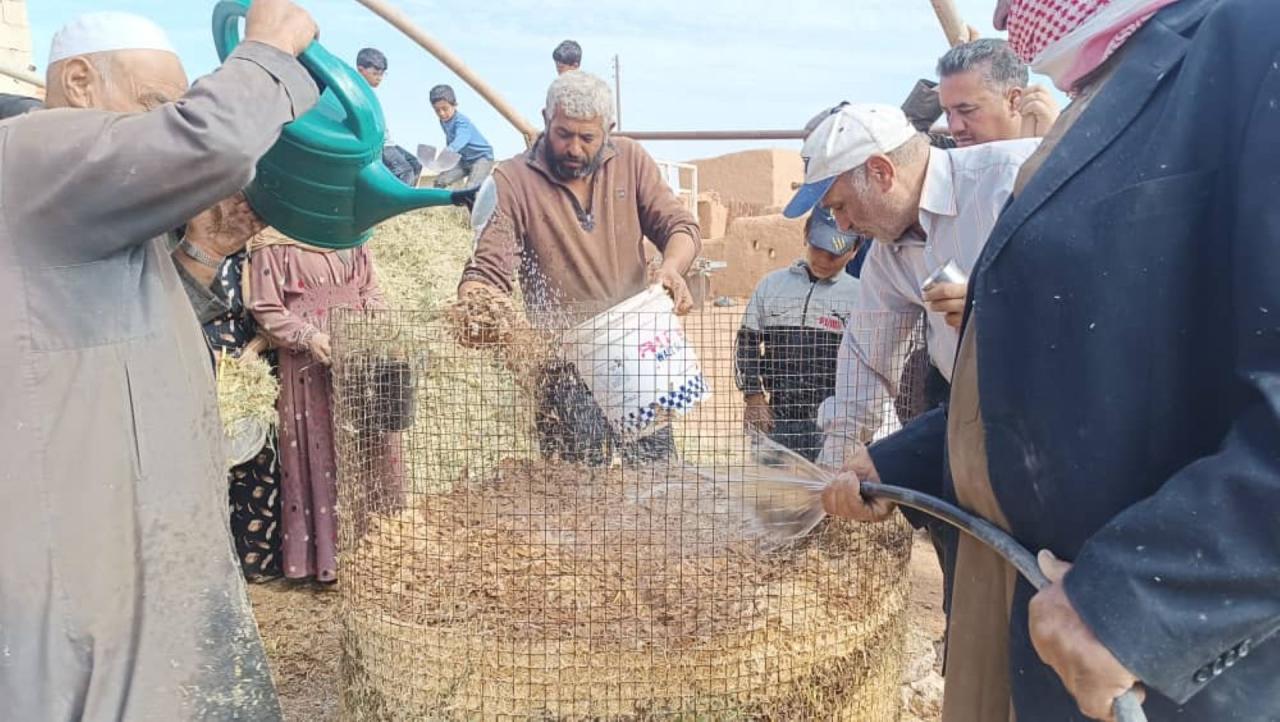
Ibrahim (center) and other farmers learn to make compost.
View additional multimedia and more ESG storytelling from Action Against Hunger on 3blmedia.com.
Contact Info:
Spokesperson: Action Against Hunger
Website: https://www.3blmedia.com/profiles/action-against-hunger
Email: info@3blmedia.com
SOURCE: Action Against Hunger
View the original press release on ACCESS Newswire:
https://www.accessnewswire.com/newsroom/en/business-and-professional-services/rebuilding-sustainable-food-systems-in-syria-1085466
