
Black Book Research's Europe Cybersecurity in Healthcare 2026 finds only 13% of providers have tested kill-switches for critical vendors and AI platforms as NIS2, GDPR and the EU AI Act raise the stakes.
LONDON, UK / ACCESS Newswire / December 8, 2025 / Against a backdrop of fresh ransomware and outage concerns across Europe, Black Book Research today announced the release of Europe Cybersecurity in Healthcare 2026: Upstream Vendor, AI, and National Platform Risk under NIS2, GDPR, and the EU AI Act, an industry report designed as a practical "how-to" guide for European boards, ministries, CISOs, and hospital clinical leaders.
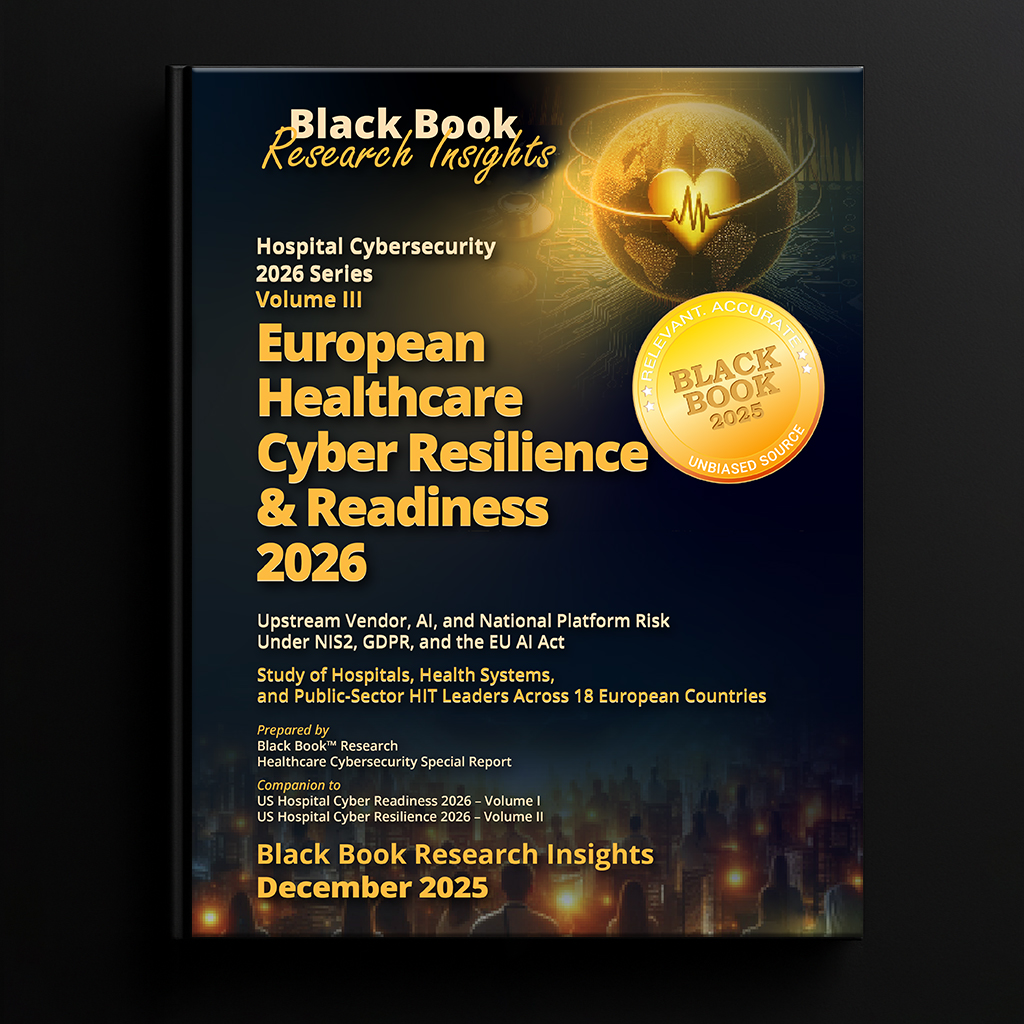
Based on comprehensive polls of 561 executives, CISOs, and health-IT leaders across 18 European countries, the report finds that upstream cyber risk has become the defining resilience challenge for European healthcare - particularly where hospitals depend on national EHRs, ePrescription hubs, imaging exchanges, data spaces, and AI platforms that serve whole regions at once. When a shared vendor, cloud, or AI service is compromised, multiple organisations now feel the impact within the same hour.
Europe's upstream challenge
The study confirms that European healthcare operates in a uniquely high-risk environment: public and highly integrated health systems, a dense regulatory "triangle" of NIS2, GDPR and the EU AI Act, and care that routinely crosses national borders. For European providers, this turns vendors, clouds, and AI platforms into Tier-1 critical infrastructure, not optional add-ons.
Key polling highlights include:
Kill-switches remain rare. Only 13% of organisations report a tested, cross-domain kill-switch for their highest-impact vendors and AI platforms, despite growing dependence on national and cloud platforms. A further 51% have written policies or diagrams but have never rehearsed them end-to-end; 36% have no formal kill-switch at all.
Revoking access still takes too long. Asked how long it would realistically take to cut off a compromised vendor across identity, network, and integrations, respondents report a median time-to-revoke of around 10 hours, with a long tail stretching beyond 30 hours. Fewer than one-third believe they can fully isolate a Tier-1 vendor or AI platform within 90 minutes - well beyond the "sub-hour" targets many cyber leaders now view as necessary for patient safety and NIS2 resilience.
Regulation is ahead of operations. While 74% say NIS2 has raised board-level attention to cyber and supply-chain risk, only 26% have tested isolation runbooks for their top 10 suppliers, and just 19% regularly present time-to-revoke or kill-switch coverage as metrics to their boards or ministries. Control planes and playbooks have not yet caught up with regulatory expectations.
AI is inside clinical workflows but not governed as Tier-1 risk. Seventy-one percent of organisations already use AI in documentation, imaging, decision support or other care workflows, and 49% use AI in revenue and coding - yet only 23% automatically classify production AI vendors and their underlying model/API hosts as Tier-1 critical suppliers. Fewer than one in five have run an AI-specific incident tabletop, leaving AI attack paths and model/API dependencies under-tested.
Identity remains the structural gap. Human identities are generally well covered by MFA and SSO, but non-human accounts, connectors, tokens and keys for vendors, national platforms, and AI tools are poorly inventoried. Many leaders admit they could not quickly produce a complete list of all accounts and tokens a given vendor uses inside their environment - a visibility gap that directly extends time-to-revoke and enlarges the blast radius of upstream incidents.
A distinctly European risk profile and where it is worst
The report's executive summary and European context chapters highlight how national platforms and cross-border data flows reshape the blast radius of cyber incidents in Europe. A compromise at a shared EHR, ePrescription hub, imaging exchange or AI platform can impact hundreds of hospitals simultaneously, including smaller and rural facilities, and draw immediate scrutiny from regulators, parliaments and the public.
The research also surfaces marked regional differences:
Northern markets such as Denmark and the Netherlands tend to lead on identity-first architectures, central SOCs and shared services yet still report significant gaps in tested kill-switches and end-to-end revocation drills.
Southern and Central/Eastern Europe emerge as particularly vulnerable, with tighter budgets, staffing constraints and a heavy reliance on a small number of vendors and national platforms. In these regions, weak visibility of non-human identities and longer, manual revocation processes mean a single upstream compromise can propagate quickly and is harder to contain.
For CISOs, CIOs and DPOs across these markets, the report frames upstream readiness in operational terms: time-to-revoke, vendor and AI kill-switch coverage, and the frequency and quality of joint exercises with suppliers and national platforms, rather than generic maturity scores.
"European healthcare has some of the world's most advanced digital platforms and strongest privacy laws, but most hospitals still cannot shut off a compromised vendor or AI service in under an hour," said Doug Brown of Black Book Research. "NIS2, GDPR and the EU AI Act have made upstream risk a board-level obligation. This report is about turning that obligation into concrete targets: sub-hour time-to-revoke, AI and national platforms treated as Tier-1 by default, and contracts that actually support kill-switches instead of slowing them down."
What Europe Cybersecurity in Healthcare 2026 delivers
Beyond polling data, Europe Cybersecurity in Healthcare 2026 is designed as an operational playbook for European cyber and resilience leaders. It provides:
Upstream risk in plain European terms - how ransomware and credential abuse now move through trusted vendor tunnels, national platforms, and AI connectors, and what that means under NIS2, GDPR and EU AI Act scrutiny for operators of essential services and critical entities.
Kill-switch designs hospitals can actually build - a practical pattern that sequences Identity - Endpoints - Network - Integrations/APIs, with annexes for national platforms and AI/model/API tokens and keys, and "good looks like" benchmarks expressed in minutes, not hours.
Country-level vulnerability profiles for 18 European markets - from Denmark and the Netherlands, which lead on identity-first architectures and shared SOCs, to Southern and Central/Eastern Europe, where staffing gaps and dependence on a small number of vendors accentuate upstream risk, especially for resource-constrained hospitals.
Scorecards, dashboards and evidence packs - templates that translate upstream readiness into board- and ministry-level KPIs: time-to-revoke, kill-switch coverage, tabletop coverage, PAM/JIT adoption, and use of ZTNA and API gateways. These artefacts are designed to support NIS2 audits, supervisory reviews and cyber-insurance renewals.
A 12-month European readiness roadmap - stepwise improvements that help organisations move from manual tickets and improvised calls to orchestrated, repeatable isolation of vendors, cloud services and AI platforms, aligned with NIS2 implementation, sectoral guidance and emerging AI governance programmes.
"The message from Europe's 561 respondents is remarkably consistent," Brown added. "Readiness is now upstream readiness. If you cannot name your Tier-1 vendors and AI platforms, list their identities and keys, and cut them off in minutes with evidence, your hospital or health system is not yet resilient - no matter how many tools you own."
Availability
Europe Cybersecurity in Healthcare 2026 - Upstream Vendor, AI, and National Platform Risk under NIS2, GDPR, and the EU AI Act is available free of charge to the healthcare industry. The report, part of Black Book's Hospital Cybersecurity 2026 series, can be downloaded now from Black Book Research at https://blackbookmarketresearch.com/european-healthcare-cyber-resilience-and-readiness-2026
No vendors funded this research, provided client lists, or were given the opportunity to review or edit findings prior to publication.
For more information or to request an interview, contact research@blackbookmarketresearch.com.
About Black Book Market Research
Black Book Research is an independent global research and consulting organisation recognised for in-depth, crowdsourced client-experience studies across healthcare technology, services, and cybersecurity. Since 2013, Black Book has been the only healthcare market research firm to benchmark more than 50 categories of cybersecurity functionality on a global basis, not just in the United States. Agnostic and data-driven, Black Book does not sell consulting, accept vendor sponsorship for rankings, or allow suppliers to influence findings. This 100+ page report is produced to help protect patient data and healthcare organisations' operations and finances in 2026, not to promote any vendor or consulting firm.
Contact Information
Press Office
research@blackbookmarketresearch.com
8008637590
SOURCE: Black Book Research
View the original press release on ACCESS Newswire:
https://www.accessnewswire.com/newsroom/en/healthcare-and-pharmaceutical/europes-hospitals-cant-cut-off-hacked-vendors-fast-enough-new-cyber-r-1114998
