
The 2025 Imperial Springs International Forum
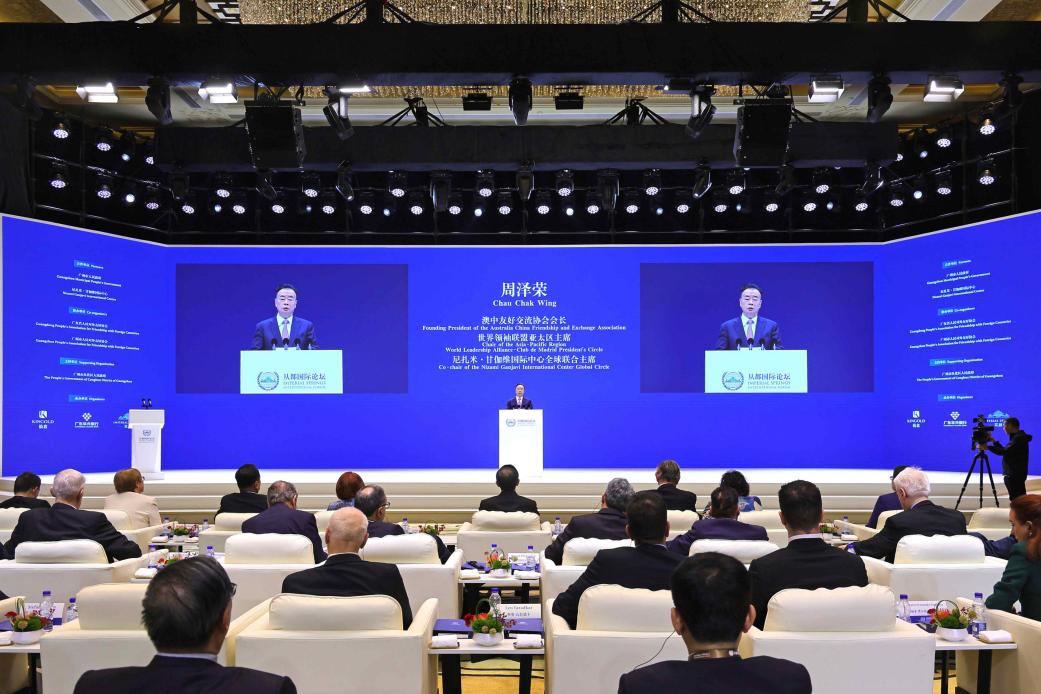
GUANGZHOU, China, Dec. 08, 2025 (GLOBE NEWSWIRE) -- The 2025 Imperial Springs International Forum concluded on December 3 at the Imperial Springs International Convention Center in Guangzhou. During the forum, Chinese and international participants focused on topics such as "Global Economic Trends Amid Trade and Tariff Conflicts", engaging in substantive exchanges, sharing informed perspectives, and building broad consensus. Many called for responding to change through reform and pursuing development through transformation.
A Media Snippet accompanying this announcement is available by clicking on this link.
Managing the risks posed by the 'technology divide' and integrating proactively into the digital age are as important as addressing traditional economic risks. We should advance reforms of existing economic governance institutions, promote a fairer distribution of resources, and give developing countries greater opportunities to be heard. Through repeated exchanges and mutual inspiration, consensus was continuously deepened and consolidated, conveying a strong message of openness, cooperation, mutual learning, and win-win outcomes.
Amid growing uncertainties, how to accurately identify risks, enhance socio-economic resilience, and establish effective early-warning and response mechanisms became a shared focus among participants.
Romano Prodi, former Prime Minister of Italy, observed that many current trade policies are driven not by economic logic but by domestic political considerations and geopolitical competition, significantly increasing the unpredictability of global supply chains and the trade environment. He noted that the politicization of economic instruments has become a major source of global economic turbulence and called for institutionalized dialogue to jointly address such risks.
Kim Campbell, former Prime Minister of Canada, highlighted the impact of tariff policies on global supply chains and the free trade order. "Today's supply chains are highly globalized and complex, and countries are becoming increasingly interdependent. Some political leaders believe tariffs weaken other countries, but what they actually do is cause job losses at home and increase prices for their own people," she said. Campbell stressed the need for better information-sharing to help all sides understand how global supply chains are interconnected and interdependent, and to strengthen their resilience and sustainability through collaborative efforts.
Many participants emphasized that the ability to manage risks is essential to ensuring stable and sustainable development.
Xue Lan, a distinguished professor of arts, humanities and social sciences and the Dean of Schwarzman College at Tsinghua University, noted that China attaches great importance to and strongly advocates the open-source model. He argued that this approach can effectively address a key challenge faced by many small and medium-sized countries: limited capacity to independently develop advanced large models due to technological and resource constraints. By enabling enterprises in those countries to use China's open-source models at relatively low cost, they can genuinely share in the benefits of AI development. From this perspective, China is in fact leading future global development trends.
Xue added that the open-source path embraced by Chinese technology companies is likely to deliver significant technology spillover effects for developing countries, helping ensure that AI-driven transformation benefits all. "The empowerment coming from China enables a wide range of developing countries to actively build their own future economies," he said. China is committed to investing in long-term development, technology transfer and capacity building, advancing its own modernization while helping developing countries enhance their autonomous development capabilities.
Against the backdrop of profound changes in the global economic landscape, traditional development models face major challenges. At the forum, participants from various countries discussed and reflected on the old paradigm that emphasized growth speed and scale, and instead explored new sustainable development paths that prioritize endogenous driving force, structural optimization and shared well-being.
María Fernanda Espinosa, former President of the 73rd Session of the UN General Assembly and former Minister of Foreign Affairs of Ecuador, said that economic and financial governance mechanisms represented by the International Monetary Fund, the World Trade Organization and the World Bank remain integral to the global governance system and continue to play a vital role in maintaining global economic stability and development. However, she stressed that as the world has undergone profound changes, existing economic governance institutions need to be reformed; resources must be distributed more fairly; and developing countries should be supported to have greater opportunities to voice their concerns.
Michelle Bachelet Jeria, former President of Chile and Vice President of the World Leadership Alliance - Club de Madrid, underscored the necessity of a paradigm shift. She noted that many global risks today, such as climate change, financial crises and technological disruptions, are systemic in nature and cannot be addressed by any country alone. "Fragmented or unilateral responses will make us even less secure," she said. Bachelet argued that nations must move beyond isolated and short-sighted approaches, and adopt cooperation rather than confrontation, and systemic governance rather than zero-sum competition, as the foundation for a new development paradigm.
Many participants agreed that the new development paradigm must be "sought inward".
"Under external pressure, Europe is attempting to preserve what it considers its autonomy and identity." Using Europe as an example, Romano Prodi explained how identity reconstruction forms part of a shifting development paradigm. He noted that the pursuit of strategic autonomy and internal cohesion is itself an adjustment aimed at achieving stable development in turbulent times, reflecting a shift from overreliance on external forces toward strengthening internal identity and capacity.
Zhu Feng, Dean of the School of International Studies at Nanjing University and Executive Director of the Collaborative Innovation Center of South China Sea Studies at Nanjing University, said that China's 15th Five-Year Plan represents a major strategic shift. A key element, he observed, is transitioning from past heavy reliance on exports and global trade to placing greater emphasis on endogenous driving force and inclusive development. He noted that this transformation aims to address domestic economic imbalances and make prosperity more inclusive, representing a shift from "quantity" to "quality," and from "external dependence" to "a balance of internal and external drivers."
Guest Views
Dr. Chau Chak Wing, Initiator of the Imperial Springs International Forum (ISIF), Founding President of the Australia China Friendship and Exchange Association, Chair of the Asia-Pacific Region, World Leadership Alliance - Club de Madrid President's Circle, Co-chair of the Nizami Ganjavi International Center Global Circle: Since its establishment, the ISIF has brought together many good friends and true friends of great wisdom, influence and vision. The more complex the international landscape becomes, the more important it is to strengthen exchanges, to view issues from different perspectives, and to foster cooperation and inclusiveness. People-to-people exchanges are flexible and diverse, with broad reach, vitality and promise.
Romano Prodi, Former Prime Minister of Italy:
China-EU Cooperation Injects Greater Stability into the World Economy
Romano Prodi noted that frictions arising from political differences have become a key driver of volatility in global landscape. He said that the decisions of some political leaders are not grounded in economic logic but are shaped by domestic political considerations. "Such political-level conflicts challenge the process of globalization and even hinder the development of free trade," he said.
He argued that if countries narrowly pursue their own interests without shifting away from a confrontational mindset, global tensions will be difficult to ease. Prodi emphasized that the European Union and China are both among the world's three largest economies, and that as the United States moves toward separation and isolation, closer China-EU ties become even more essential.
"There are many areas where China and Europe can cooperate, and they should also work together on third-party cooperation. This is important and constructive." He stressed that the world today needs more harmony and cooperation, and that China and the EU should take joint action, based on respecting differences and managing disagreements effectively, to advance their relationship.
"Over the past 20 years, China's foreign trade has demonstrated remarkable resilience. Today, more countries trade with China than with the United States. Therefore, concluding an investment and trade agreement between China and Europe is a necessary means to safeguard globalization and free trade." Prodi said that China and the EU, as major actors on the world stage, must deepen cooperation not only for their own interests but also to prevent historical backsliding and to sustain the future of globalization, which would inject greater stability and certainty into the global economy.
"As a major country, China can play an even greater role in advancing international cooperation," Prodi said.
María Fernanda Espinosa, President of the 73rd Session of the UN General Assembly and Former Minister of Foreign Affairs of Ecuador:
Globalization Has Not Ended. It Has Entered a "Recalibration" Phase
"Tariffs, export controls and subsidies, these were once very rare measures, yet today they have become routine tools for some of the world's major economies. This has brought uncertainty to the global economy, with particularly significant impacts on developing countries." Espinosa stressed that enhancing the predictability of the global economy is itself a form of international public good, and that all countries should work together to promote fair and transparent trade governance.
She noted that today's global economy is highly interconnected, but also more fragile and uncertain. Countries must reassess how economic interdependence is governed, and find a balance between national sovereignty and international responsibility. Despite current setbacks and challenges to globalization, she said, the open markets, multilateral trade rules and international supply chains it established remain the shared foundation of economic development for all countries.
In her view, globalization has not come to an end; instead, it has entered a phase of "recalibration". She observed that the restructuring of global supply chains is increasingly driven by security and technological considerations rather than actual human needs, posing profound challenges for developing countries. Meanwhile, regional economic diversification is gaining momentum, with Southeast Asia, Latin America, Africa and the Middle East seeking more diversified cooperation policies to enhance resilience. However, she emphasized that such efforts must remain aligned with the direction of global multilateral trade reform.
Source: The 2025 Imperial Springs International Forum

Contact: Ms. Luo, Tel: 86-10-63074558
