
Key findings:
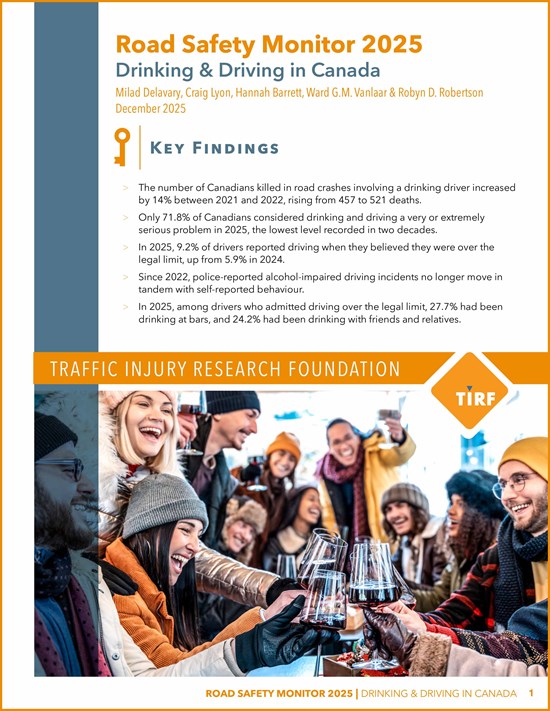
The number of Canadians killed in road crashes involving a drinking driver increased by 14% from 2021 to 2022, rising from 457 to 521 fatalities.
Self-reported drinking and driving behaviours increased sharply in 2025, with approximately one in ten (9.2%) of drivers admitting to driving when they believed they were over the legal limit, up from 5.9% in 2024.
In 2025, less than three in four (71.8%) of Canadians considered drinking and driving a very or extremely serious problem, the lowest level in two decades.
Since 2022, police-reported alcohol-impaired driving incidents no longer closely tracks with self-reported behaviour.
Among approximately one in ten drivers who admitted driving over the legal limit in 2025, approximately one quarter (27.7%) had been drinking at bars, and (24.2%) had been drinking with friends and relatives.
Alcohol-related crashes, however, remain far below the levels recorded in the 1990s, with fatalities involving a drinking driver declining by 51.7% between 1996 and 2022.
Ottawa, Ontario--(Newsfile Corp. - December 15, 2025) - The Traffic Injury Research Foundation (TIRF), with, sponsorship from Beer Canada and Desjardins Insurance, has released the 2025 Road Safety Monitor (RSM) on drinking and driving in Canada. The RSM combines insights from a nationally representative sample of Canadian drivers with data from TIRF's National Fatality Database to examine trends in alcohol-impaired driving, attitudes toward risk, and enforcement efforts. These findings can inform road safety policies, enforcement strategies, and education campaigns tailored to emerging patterns in driver behaviour.
"While Canada has made substantial progress in reducing alcohol-impaired driving over the past three decades, 2025 marks a concerning reversal in some key indicators," said Milad Delavary, TIRF Research Scientist. "Rising self-reported alcohol-impaired driving behaviour, coupled with declining public concern, may suggest there are important contextual changes and practical barriers that communities are facing in delivering prevention strategies."
Post-pandemic, the landscape of impaired driving has changed as policing protocols have evolved, particularly with the adoption of new tools combined with competing priorities. In addition, capacity for public health and prevention work at a local level continues to be challenged as resources have declined or been reallocated. This may have contributed to shifts in public attitudes and a higher level of complacency when it comes to risk-taking.
Drinking patterns have shifted significantly in the post-pandemic period, with notable changes in where and with whom people choose to drink. The 2025 data show a clear return to public drinking, with more drivers reporting alcohol consumption at bars and social gatherings with close friends and relatives.
Craig Lyon, TIRF Director, Road Safety Engineering, noted, "This shift is really illustrative of how a one-size-fits-all approach over time can lead to overlooking important cohorts and their relative size. The important takeaway here is two-fold; first, a once-size-fits-all approach when it comes to prevention means one or more segments of the problem will be left unaddressed and second, the currency of data is paramount in order to effectively change behaviour."
Recent data from TIRF's National Fatality Database show a 14% rise in deaths involving a drinking driver with fatalities increasing from 457 in 2021 to 521 in 2022. Self-reported behaviours also reflect a sharp uptick with 9.2% of Canadian drivers admitting to driving when they believed they were over the legal limit, which is a 56% increase over 2024.
Another notable change is that fluctuations in self-reported and police-reported alcohol-impaired driving moved in tandem until 2021, suggesting that enforcement data roughly reflected prevalence during that period. However, this relationship has weakened since 2022; between 2022 and 2024, enforcement figures appear to reflect policing activity rather than actual prevalence. While enforcement trends still provide valuable context about detection efforts, they should not be interpreted as a direct measure of impaired driving behaviour. Ongoing monitoring and comparison of both self-reported and police-reported data are essential to track emerging patterns and guide evidence-based strategies to prevent and reduce alcohol-impaired driving across Canada.
"The combined rise in impaired driving fatalities and self-reported drinking and driving is concerning and suggests more targeted prevention, enforcement and public awareness strategies remain essential despite the progress achieved," said Steve Sullivan, CEO of MADD Canada. "The more than 500 impaired driving deaths impact communities across the country. These crimes may not make national headlines, but they pose a serious public safety risk which warrants action from political officials."
Download the fact sheet:
- Road Safety Monitor 2025: Drinking & Driving in Canada
Register for TIRF's Dec. 16th webinar:
- Canada's Impaired Driving Landscape: New Data, Community Insights & Emerging Solutions
Access TIRF's Sober Smart Driving website:
The Traffic Injury Research Foundation (TIRF)'s Sober Smart Driving website (formerly Change the Conversation), with funding provided by Beer Canada, shares knowledge and research to answer common questions about alcohol and impaired driving. It contains facts to help Canadians speak up about the risks associated with drinking and driving and why they choose not to drink and drive. Visit: https://sobersmartdriving.tirf.ca/
Use link in press release to download
To view an enhanced version of this graphic, please visit:
https://images.newsfilecorp.com/files/10180/277948_6785c836a4367b0c_001full.jpg
About the poll
These results are based on the RSM, an annual public opinion poll developed and conducted by TIRF. A total of 1,501 Canadians completed the poll in September-October of 2025. Results can be considered accurate within plus or minus 2.5%, 19 times out of 20. The majority of the questions were answered using a scale from one to six where six indicated high agreement, concern, or support and one indicated low agreement, concern or support.
About TIRF Canada:
The vision of the Traffic Injury Research Foundation (TIRF) is to ensure people using roads make it home safely every day by eliminating road deaths, serious injuries and their social costs. TIRF's mission is to be the knowledge source for safe road users and a world leader in research, program and policy development, evaluation, and knowledge transfer. TIRF is a registered charity and depends on grants, awards, and donations to provide services for the public. Visit www.tirf.ca or find all TIRF websites and social media at https://linktr.ee/tirfcanada.
- 30 -
For more information, contact:
Karen Bowman
Director, Communications & Programs
Traffic Injury Research Foundation
613 238-5235 (office) | 1 877 238-5235 (toll-free) | karenb@tirf.ca

To view the source version of this press release, please visit https://www.newsfilecorp.com/release/277948
Source: Traffic Injury Research Foundation
