- Leading enterprises including BlueCloud and Sigma Computing will rely on Snowflake Postgres to reduce data silos and complex data pipelines for AI and analytics use cases
- Snowflake Horizon Catalog helps customers like Merck and Motorq access and govern data across different systems and formats with enhanced interoperability, reducing data silos, eliminating lock-in, and helping ensure AI systems run on trusted data
- Snowflake is advancing data sharing and data backup capabilities, enabling enterprises to build AI systems that can be securely shared and protected wherever it lives
Snowflake (NYSE: SNOW), the AI Data Cloud company, today announced advancements that make data AI-ready by design, allowing enterprises to rely on data that is continuously available, usable, and governed as AI transitions from experimentation into real-world production systems. With new enhancements to Snowflake Postgres (generally available soon), the world's most popular database1 now runs natively in the AI Data Cloud so enterprises can consolidate their transactional, analytical, and AI use cases onto a single, secure platform. To help ensure AI systems are trusted at enterprise scale, Snowflake is further embedding enhanced interoperability, governance, and resilience features into its platform, enabling more customers to bring Snowflake directly to their data, wherever it lives.
This press release features multimedia. View the full release here: https://www.businesswire.com/news/home/20260203524672/en/
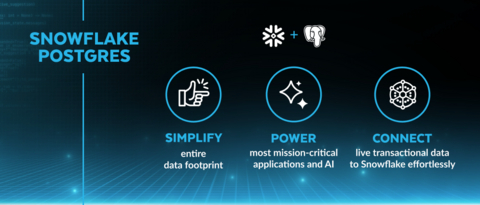
Snowflake Postgres unifies the world's most popular database with analytics and AI on a single, secure platform
"As businesses move from AI experimentation to production, the real challenge is ensuring AI systems can consistently access data that is connected, governed, and discoverable across the enterprise," said Christian Kleinerman, EVP of Product, Snowflake. "That means eliminating data silos, fragile pipelines, and closed systems that slow down AI deployment and increase risk. By bringing unified operational and analytical data, as well as open interoperability together in one platform, we're empowering customers to develop enterprise-ready AI systems that work with real business data, securely and at scale."
"At Sigma, our customers expect live, interactive analytics on the most current business data," said Jake Hannan, Head of Data, Sigma Computing. "With Snowflake Postgres, we can work directly on fresh transactional data inside Snowflake without relying on complex pipelines or external systems. That gives our teams and customers a simpler, more reliable foundation to build governed analytics and AI-powered experiences that respond in real time."
Connecting Enterprise Data and AI to Power Mission-Critical Apps and AI Agents
Most organizations still keep their transactional and analytical databases siloed on separate systems, a legacy approach that forces teams to rely on complex pipelines to connect these systems. This fragmentation adds steep costs, slows development, introduces risk, and delays insights. Snowflake Postgres eliminates these pipelines by bringing transactional, analytical, and AI capabilities together on a single, enterprise-ready platform. In turn, full compatibility with open source Postgres allows companies to move their existing apps onto Snowflake, without code changes. Now with Snowflake Postgres, teams can power critical apps and AI agents, analyze business performance and trends using the most up-to-date data from their operations, and build AI-driven features like recommendations or forecasting all without costly, complex data pipelines or the infrastructure overhead of managing multiple vendors.
Powered by pg_lake, a set of PostgreSQL extensions that allow Postgres to easily work within an organization's open and interoperable lakehouse grounded in Apache IcebergTM2, enterprises can leverage Snowflake Postgres to directly query, manage, and write to Apache Iceberg tables using standard SQL. This capability is delivered within a familiar Postgres environment, so enterprises can eliminate costly data movement between transactional and analytical systems. Enterprises such as BlueCloud and Sigma Computing are using Snowflake Postgres to simplify their data architectures and run enterprise-ready AI and apps on connected data.
"For BlueCloud, Snowflake Postgres represents a major opportunity to help our customers eliminate data pipelines, without compromising performance," said Rob Sandberg, SVP and Head of Advisory Consulting, BlueCloud. "Its enterprise-grade Postgres foundation brings real credibility, particularly for the financial services organizations we support. With Snowflake Postgres, we can deliver low-latency transactional workloads alongside analytics and AI on a single platform, reducing overhead and helping our customers be more agile in meeting their business goals."
Making Data Governed and Open for Trusted AI
As AI moves into production, enterprises need data that remains open, governed, and resilient as it flows across engines, formats, and environments. To address this need, Snowflake is expanding how customers access, share, and govern their data, so AI systems can scale with real-world demands:
- Freedom to work across engines without impacting governance controls: To reduce silos and avoid vendor lock-in, Snowflake enables enforcement of the same governance policies when Snowflake data is queried from other engines. Snowflake Horizon Catalog, which provides context and governance for AI across all data, is enabling customers like science and technology company, Merck, and Motorq, a leading connected vehicle intelligence company, to leverage external engines to securely access data in Apache Iceberg tables (now generally available), as well as create, update, or manage data stored in Iceberg tables (public preview soon).
- Seamless data collaboration across open formats: As organizations increasingly rely on open table formats, Snowflake is simplifying how those formats are shared without duplicating data or managing fragile pipelines. Open Format Data Sharing extends Snowflake's zero-ETL sharing model to include formats such as Apache Iceberg and Delta Lake, enabling secure data sharing across teams, clouds, and regions. Customers can now share data in open formats, while maintaining control over access and costs. A new integration with Microsoft OneLake (now generally available) enables mutual customers with secured bidirectional read access for Iceberg data managed by Snowflake or Microsoft Fabric. This means customers can seamlessly access all their data across both platforms without complexity or data duplication.
- Built-in resilience to protect business-critical data: To help enterprises address regulatory requirements and withstand disruptions, Snowflake is strengthening how data is protected by default. Snowflake Backups (now generally available) further strengthens data resilience by protecting business-critical data. Organizations can recover quicker from ransomware or disruptions, while ensuring data isn't altered or deleted once created. These protections give enterprises greater confidence that essential data is preserved, even in the face of unexpected events or security incidents.
Learn More:
- Dive deeper into how Snowflake is ensuring customers have AI-ready data to power production AI and intelligent apps in this blog post.
- Learn how to get started with Snowflake Postgres with this quickstart.
- Learn how to get started with Snowflake Horizon Catalog with this Developer Guide.
- Check out all the innovations and announcements coming out of BUILD London 2026 on Snowflake's Newsroom.
- Stay on top of the latest news and announcements from Snowflake on LinkedIn and X, and follow along at SnowflakeBUILD.
1Stack Overflow (July 31, 2025): "Stack Overflow Annual Developer Survey." Available at the following link. Stack Overflow.
2Apache Iceberg is a high-performance format for huge analytic tables. "Apache" is a registered trademark or trademark of the Apache Software Foundation in the United States and/or other countries.
Forward Looking Statements
This press release contains express and implied forward-looking statements within the meaning of Section 27A of the Securities Act of 1933, as amended, and Section 21E of the Securities Exchange Act of 1934, as amended, including statements regarding (i) Snowflake's business strategy, plans, opportunities, or priorities (ii) the release, adoption, and use of Snowflake's new or enhanced products, services, and technology offerings, including those that are under development or not generally available, (iii) market growth, trends, and competitive considerations, (iv) Snowflake's vision, strategy, and expected benefits relating to artificial intelligence and other emerging product areas, including the expected benefits and network effects of the AI Data Cloud, and (v) the integration, interoperability, and availability of Snowflake's products, services, and technology offerings with and on third-party platforms. Other than statements of historical fact, all statements contained in this press release are forward-looking statements. These forward-looking statements are subject to a number of risks, uncertainties and assumptions, including those described under the heading "Risk Factors" and elsewhere in the Quarterly Reports on Form 10-Q and the Annual Reports on Form 10-K that Snowflake files with the Securities and Exchange Commission. In light of these risks, uncertainties, and assumptions, actual results could differ materially and adversely from those anticipated or implied in the forward-looking statements. As a result, you should not rely on any forward-looking statements as predictions of future events. Forward-looking statements speak only as of the date the statements are made and are based on information available to Snowflake at the time those statements are made and/or Snowflake management's good faith belief as of that time with respect to future events. Except as required by law, Snowflake undertakes no obligation, and does not intend, to update these forward-looking statements to reflect events that occur or circumstances that exist after the date on which they were made.
2026 Snowflake Inc. All rights reserved. Snowflake, the Snowflake logo, and all other Snowflake product, feature and service names mentioned herein are registered trademarks or trademarks of Snowflake Inc. in the United States and other countries. All other brand names or logos mentioned or used herein are for identification purposes only and may be the trademarks of their respective holder(s). Snowflake may not be associated with, or be sponsored or endorsed by, any such holder(s).
About Snowflake
Snowflake is the platform for the AI era, making it easy for enterprises to innovate faster and get more value from data. More than 12,000 customers around the globe, including hundreds of the world's largest companies, use Snowflake's AI Data Cloud to build, use and share data, applications and AI. With Snowflake, data and AI are transformative for everyone. Learn more at snowflake.com (NYSE: SNOW).
View source version on businesswire.com: https://www.businesswire.com/news/home/20260203524672/en/
Contacts:
Media Contacts:
Daria Bianchini
Product PR Specialist, Snowflake
press@snowflake.com
Source: Snowflake Inc.