
OCEAN SPRINGS, MS / ACCESS Newswire / March 4, 2026 / The Science Center for Marine Fisheries (SCEMFIS) is pleased to announce that researchers from NASA's Earth Science Division have joined SCEMFIS as the latest members of its Industry Advisory Board (IAB). The partnership will create new opportunities to integrate NASA's Earth observations into future SCEMFIS research, allow for closer collaboration with NASA scientists, and further SCEMFIS' mission to support groundbreaking marine science research.
For decades NASA's satellites have measured the biological and physical characteristics of the global ocean, information that has been integral to Earth science research broadly, and fisheries research in particular. The temperature of the surface ocean, for example, can influence the distribution and potential health of commercially important species such as menhaden and illex squid.
Another measurement, termed ocean color, is a key indicator of ocean health and food availability to various fish species. Because different particles and organisms in the water absorb and reflect different frequencies of light, the color of the ocean can tell us the locations and prevalence of microscopic phytoplankton. As the tiny "plants" of the sea, phytoplankton directly or indirectly feed nearly all ocean life and provide up to half the oxygen we breathe.
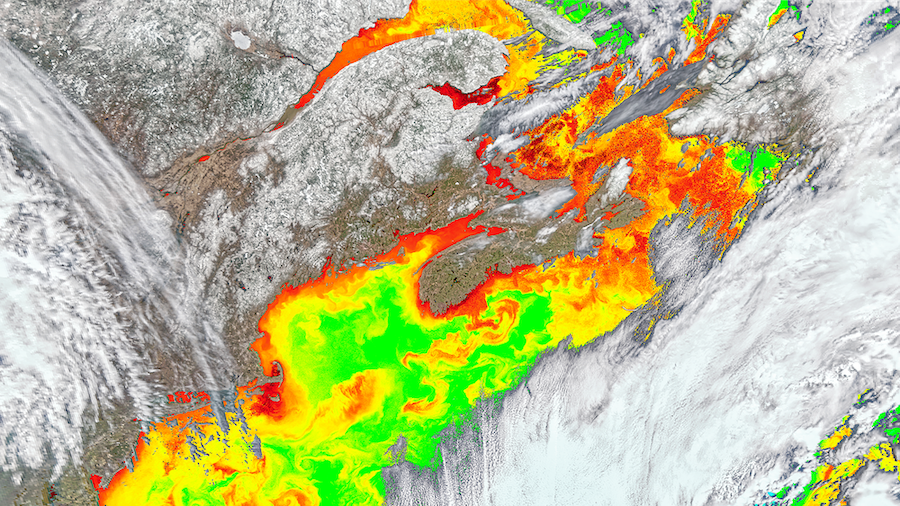
NASA's decades of phytoplankton and other ocean measurements have advanced our understanding of the biological activity and overall health of the ocean, information critical to supporting coastal economies and our seafood supply chain.
NASA recently expanded ocean observation capabilities in 2024, with the launch of its PACE (Plankton, Aerosol, Cloud, ocean Ecosystem) mission. PACE can observe the ocean in a finer range of ultraviolet, infrared, and visible light wavelengths compared to previous missions. Seeing the ocean with hundreds of colors instead of 20 or 30 enables PACE to identify different types of phytoplankton across the globe each day, a capability unavailable on previous missions. Advanced phytoplankton measurements can help fisheries better respond to ever-changing ocean conditions and improve detection of phytoplankton that may be harmful to fish populations or seafood consumers.
By partnering with SCEMFIS, researchers at NASA will collaborate to apply this information to a new range of fisheries research projects. The partnership will allow for expanded commercial applications for existing NASA data and create a more formal collaborative relationship.
"Collaborating with NASA researchers to integrate these data into our future research will give us new insights into our oceans and the marine species that are important to us, and will benefit the finfish and shellfish fisheries and our industry partners," said Joe Myers, Senior Director of Innovation & Sustainability at Sea Watch International, and the current chair of the SCEMFIS IAB.
"NASA Earth Science is a perfect fit for SCEMFIS' mission, which is identifying and supporting the latest breakthroughs in marine science," said Dr. Eric Powell of the Gulf Coast Research Laboratory at the University of Southern Mississippi, and the Director of SCEMFIS. "The broad portfolio of ocean observations from NASA, and the advanced data from PACE in particular, will be an integral part of future SCEMFIS research."
About SCEMFIS
The Science Center for Marine Fisheries (SCEMFIS) brings together academic and industry expertise to address urgent scientific challenges facing sustainable fisheries. Through advanced methods, analytical tools, and collaborative research, SCEMFIS works to reduce uncertainty in stock assessments and improve the long-term sustainability of key marine resources.
SCEMFIS is an Industry-University Cooperative Research Center supported by the National Science Foundation. Industry organizations join SCEMFIS through an Industry Membership Agreement with one of the center's site universities and contribute both financial support and valuable expertise to help shape research priorities.
Its university partners include the University of Southern Mississippi (lead institution) and the Virginia Institute of Marine Science at the College of William and Mary. The center also collaborates with scientists from a broad network of institutions, including Old Dominion University, Rutgers University, the University of Massachusetts-Dartmouth, the University of Maryland, and the University of Rhode Island. These researchers bring deep expertise in finfish, shellfish, and marine mammal science.
Demand for SCEMFIS' services continues to grow, driven by the fishing industry's need for responsive, science-based support. The center provides timely access to expert input on stock assessment issues, participates in working groups, and conducts targeted studies that lead to better data collection, improved survey design, and more accurate modeling-all in service of sustainable, science-driven fishery management.
PRESS CONTACT:
Stove Boat Communications
john@stoveboat.com
SOURCE: Science Center for Marine Fisheries
View the original press release on ACCESS Newswire:
https://www.accessnewswire.com/newsroom/en/business-and-professional-services/nasa-earth-science-researchers-join-science-center-for-marine-fi-1143564
