
Depending on how long the Iran war continues, between 0.3 and 2% of global GDP are at risk
ZURICH, CH AND SEOUL, KR / ACCESS Newswire / March 13, 2026 / Modelling the impact of the Strait of Hormuz closure to global GDP through economic analysis calculates global economic losses from $330 billion to $2.2 trillion, depending on the length of the conflict. The risks to the global economy increases with each day the war continues.
Approximately 20 million barrels per day - roughly one-fifth of globally traded petroleum - normally transit through the 33-kilometre wise Strait of Hormuz. The ongoing conflict has effectively closed the waterway, stranding an estimated 14.8 million barrels of oil production per day with no viable export route. Saudi Arabia and the UAE hold limited pipeline bypass capacity; Kuwait, Qatar, and Bahrain have none. Qatar's 81-million-tonne annual LNG export facility - supplying approximately 22% of world liquefied natural gas - has declared force majeure.
Applying the IMF's established oil gap transmission coefficient - every sustained 10% rise in oil prices reduces global GDP by up to 0.2 percentage points, the analysis models three potential outcomes:
Short conflict (<2 weeks): ~$330 billion global GDP loss, Brent crude ~$80/bbl, global inflation rises by up 0.4pp, Gulf GDP is 4% down
Medium conflict (4-6 weeks): ~$770 billion global GDP loss, Brent price at $100-120, global inflation increases up 1.0pp, Gulf GDP is down 11%
Prolonged conflict (3-6 months): ~$2.2 trillion global GDP loss, Brent $130+, global inflation rises up 2.5pp, Gulf GDP is down by 22%, leading to global stagflation conditions comparable to the 1973-74 Arab oil embargo
The analysis shows the hidden economic cost of fossil fuel dependency - dependency that is hardest felt in countries that have not yet diversified their energy base. Nations that have invested in domestic renewable capacity are measurably less exposed to the current shock. Countries that invested les in renewable (domestic) electricity remain dependent on a supply chains that can be disrupted by a single choke-point (the Strait of Hormuz).
The countries best placed to weather this disruption are those that have already begun reducing their fossil fuel dependency, it is the structural argument for sustainable competitiveness as a national strategy.
The full interactive report, including scenario modelling by region and country-level export data, is
available at the research website of SolAbility here.
The analysis also connects to the Global Sustainable Competitiveness Index, which measures long-term national economic resilience across 192 countries. Economies scoring higher on resource intensity/efficiency, intellectual capital, and governance quality demonstrate greater structural resilience to external geopolitical shocks and lower dependency to fossil fuel price volatility.
Key data points for editors:
14.8M bpd of oil production stranded with no export route
$745M/day oil & gas revenue loss in the Gulf countries
Gulf equity markets are down 15-35% from pre-war levels
European LNG prices (TTF) are up 180% from pre-war levels
War-risk insurance premiums up 300-500% for Gulf vessels
62M+ GCC residents depend on desalination for drinking water from 400+ desalination plants along the Gulf Coast, all of which are in range of Iranian drones
---
About SolAbility
SolAbility is an independent research and advisory boutique specialising in sustainable competitiveness. We are the proud publisher of the Global Sustainable Competitiveness Index (GSCI), a composite measure of long-term national economic resilience covering 192 countries. http://www.solability.com
Media contact: contact@solability.com
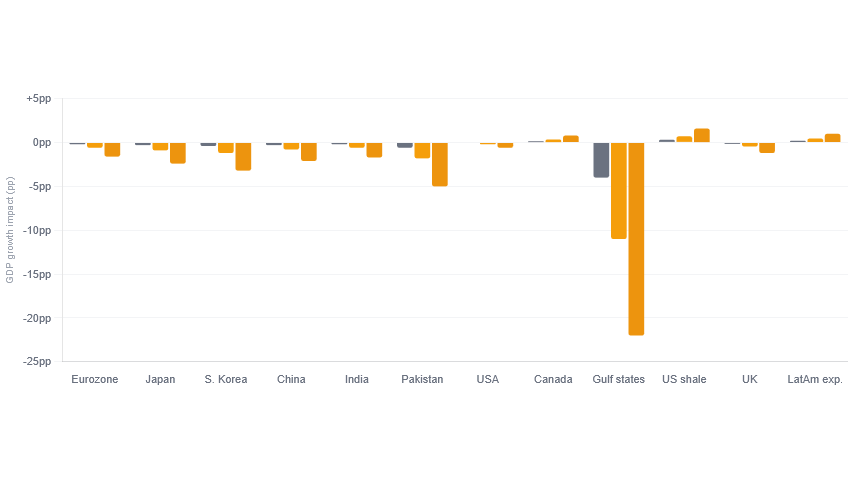
GDP losses by country depending on the length of the Iran war
Find more stories and multimedia from SolAbility at 3blmedia.com.
Contact Info:
Spokesperson: SolAbility
Website: https://www.3blmedia.com/profiles/solability-sustainable-intelligence
Email: info@3blmedia.com
SOURCE: SolAbility
View the original press release on ACCESS Newswire:
https://www.accessnewswire.com/newsroom/en/business-and-professional-services/iran-war-hormuz-closure-puts-up-to-2.2-trillion-of-global-gdp-at-1147393
